WoodCentral Forums

Est. 1998 — 27 years of woodworking knowledge

Search query: «"dovetail jig"»

Posts

General Woodworking » Re: Whats your favorite Dovetail jig? »

#101

Re: Whats your favorite Dovetail jig?

Hank Knight

I had a Leigh D4 and had the same problem Dick has: I used it so seldom, I had to re-learn it every time I dragged it out to use. It was complicated, but it cut great joints. A also had an older smaller model Leigh (12" (I think). I finally bit the bullet and learned to cut dovetails by hand and discovered it's not all that hard. I can cut a bunch of dovetails in the time it used to take me to assemble the Leigh jig and review the manual. I kept the little Leigh in case I ever had a big project with lots of dovetails and gave the D4 to my son-in-law. I haven't missed it and I've cut a lot of dovetails since I gave it away. I haven't had a project yet that I thought was big enough to use the little Leigh.

General Woodworking » Re: Whats your favorite Dovetail jig? »

#102

Re: Whats your favorite Dovetail jig?

John McGaw

I have the big original Leigh jig of roughly the same vintage as yours as well as a couple of their accessory guides. I've not found any problem with the flexing-induced imprecision you describe but the re-learning is a real problem if I go for a while without using it.

I'd have to leave the Leigh at the top of my list.

General Woodworking » Re: Whats your favorite Dovetail jig? »

#103

Re: Whats your favorite Dovetail jig?

William Duffield

My dovetail kit consists of:

- Veritas dual marking gauge, which replaces a home made cutting gauge that still works good enough for dovetail baselines.

- Stanley #25 Type 2 8" sliding T-bevel. Newer models with a wing nut don't work nearly as well. Chris Vesper and others make them that are much better, but don't give any better results. You should also consider making your own from some aluminum angle. For dovetails, you might like a 6" bevel better.


- Chester Toolworks spear point marking knife. The Blue Spruce is a better tool, but the Chester Toolworks is good enough, unless you are cutting single-entry tails. There are other, much less expensive knives available that work just as well, but I won't use one with bevels on both faces); Another viable option is to make one yourself, using a Hock blade.

- Lie-Nielsen Independence Dovetail Saw (but a Veritas would work just as well);

- Knew Concepts 5" fret saw; Some prefer their 3" fretsaw or their coping saw. I also have a home made coping saw that works well.

- Lie-Nielsen Toolworks bevel edged socket chisels (sizes needed depend on the scale of the work you are doing). I also have a pair of their 1/4" skew chisels, but a single 1/8" works as well for cleaning out the corners of half blind pins.

- home made Hophornbeam carving mallet; I've also turned them from bloodwood, purpleheart, cocobolo, dogwood, hard maple and trifoliate orange.

- home made Moxon vise, using my own design bench-on-bench for the rear jaw. So far, the only Moxon hardware I've found that works better than mine is Benchcrafted's.

If this seems too complicated, you might want to read Chris Schwarz' The Anarchist's Toolchest

If I were forced to use a router and jig (due to time constraints on a huge job, for example, which I don't do anymore) by far my favorite would be the Porter-Cable 24" Omnijig. It will do anything the Leigh jig will do, is more precise, and all the documentation you need to set it up (after reading the relatively short and well written manual) is on the machine itself, in color coded icons.
General Woodworking » Whats your favorite Dovetail jig? »

#104

Whats your favorite Dovetail jig?

Bart Goldberg

Howdy all,

I purchased the Leigh dovetail jig over 15 years ago, and while it is versatile, I found it lacking in a few ways. 1) Its complicated to use. I don't use if very often, but when I do, I have to relearn how to use it. 2) The template is not stable enough. I found that the template flexes a bit, which causes a slight misalignment of my pieces when I go to assemble my parts.

I believe that the newer versions of the Leigh may have addressed the flexing issue, but still wonder if its somewhat complex to use. I have seen the Keller jig at the last WW show I attended and it seemed rock solid and simple to use. Help me out and let me know what your preferred system is.

Thanks

Bart (who has been away far too long)

General Woodworking » Re: Tip for new woodworkers »

#105

Re: Tip for new woodworkers

John McGaw

I would add, if you have a dovetail jig then save samples of all the tail and pin stock and write down the number of the dovetail bit used to cut them. It will save you countless hours of setup time since it can easily reproduce the proper depth setting for each sort.

General Woodworking » Re: Anyone use the Freud box cutter set? »

#106

Re: Anyone use the Freud box cutter set?

ChuckinND

I use to use the table saw and a dado blade for box joints, but since I started doing box joints with a router and dovetail jig with a box joint template I haven't went back to the table saw for that task. With a router the bottoms are pretty much guaranteed to be flat, and the spacing equal with the dovetail jig.

General Woodworking » Re: Pattern Routing Edge Joint »

#107

Re: To answer your actual question

TomD

It is a good question, there are some sneaky things that can happen...

1) So when doing cuts that cut both sides same time, you have balanced forces in line with the cut, the right side is pushing back and the left side is pushing in, and they net out. Unless you pushed two edges together that were uneven, where you could at some point be cutting heavier on one side than the other.

The lateral force is all to the right.

2) If you are using a template where you do a pass on one side, then the other, you need to feed each in the right way, or you could end up climb cutting.

3) not all climb cutting is bad, joinery wise you can make the final cuts with very slight cuts, these might be controllable in a climb direction, and it might yield a cleaner cut. This approach is used in some dovetail jigs where one scores the surfaces, then powers the waste. It is also the strategy things like table saw with secondary blades use. And many metal working machines.

There are also certain router cuts where climb cutting blows away material but never quite snugs up, leaving one to waste material quickly while always leaving a hair to be taken out in the self setting direction. An example of that is freehanding router pins, at least as far as the waste is concerned, in that case the precision is hand sawn.

General Woodworking » French cleat questions »

#108

French cleat questions

mdclor

I have a couple cheap cabinets that came with the house that I want to hang in the shop on French cleats. I will store various tools, but nothing with motors-ratchet set, drill bits, biscuits, doweling jig, Leigh dovetail jig, stud finder, etc, etc. you get the idea. I think I will mount a cleat at the top and bottom of the cabinets. Here are my questions:

1. Is plywood acceptable or should it be hardwood?

2. How wide should the halves of the cleats be?

3. What angle are the cleats normally cut at? 45*?

4. Are #8 x 2.5" screws sufficient?

5. Any other considerations?

Thanks!

General Woodworking » Leigh dovetail jig changes »

#113

Leigh dovetail jig changes

Randy Johnson

Several years ago my Leigh dovetail jig took a trip to the floor. It had been clamped to the bench, but I had just removed the clamps to put the jig in its normal storage spot. One of the end supports got bent. I did a quick eyeball straightening job and put the jig up. The next time I tried to use it, the dovetails were loose at one end and too snug at the other.

I acquired a PM3520, and flatwork of all kinds fell to the wayside.

Then, I started playing the primitive muzzleloader game again and even the turning was falling by the wayside.

Flat work started again this past summer when I made a dovetailed corner walnut chest that was actually a cooler. I fiddled with the jig until I finally got it making good joints again. In the course of making the cooler I discovered that one of the guide fingers would not lock in place due to the nut being stripped out. It really isn’t that big a deal, I have never used all of the guide fingers anyway. Still, I would like to be able to if I ever need to.

Fast forward to yesterday. A trip to Cincy where Woodcraft and Rockler are walking distance from each other was in order. I had not been in either store for a few years, and was surprised at what I thought was a poor selection of Leigh jig parts at Woodcraft. I have been away for too long. When I bought my dovetail jig there was one model available. Now there are at least three, and I couldn’t be sure without mine handy for a side by side comparison, but it seemed like what I saw was not nearly as beefy as my old one. While at one time Woodcraft carried a wide selection of Leigh jig parts it looks like that is no longer the case, even online. In their defense, it looks like no one else does either. I sure hope that this is not a case of “new and improved” (i.e. made cheaper and not as well) making an excellent product obsolete for lack of parts.

General Woodworking » Changes in Leigh dovetail jigs »

#114

Changes in Leigh dovetail jigs

Randy Johnson

Several years ago my Leigh dovetail jig took a trip to the floor. It had been clamped to the bench, but I had just removed the clamps to put the jig in its normal storage spot. One of the end supports got bent. I did a quick eyeball straightening job and put the jig up. The next time I tried to use it, the dovetails were loose at one end and too snug at the other.

I acquired a PM3520, and flatwork of all kinds fell to the wayside.

Then, I started playing the primitive muzzleloader game again and even the turning was falling by the wayside.

Flat work started again this past summer when I made a dovetailed corner walnut chest that was actually a cooler. I fiddled with the jig until I finally got it making good joints again. In the course of making the cooler I discovered that one of the guide fingers would not lock in place due to the nut being stripped out. It really isn’t that big a deal, I have never used all of the guide fingers anyway. Still, I would like to be able to if I ever need to.

Fast forward to yesterday. A trip to Cincy where Woodcraft and Rockler are walking distance from each other was in order. I had not been in either store for a few years, and was surprised at what I thought was a poor selection of Leigh jig parts at Woodcraft. I have been away for too long. When I bought my dovetail jig there was one model available. Now there are at least three, and I couldn’t be sure without mine handy for a side by side comparison, but it seemed like what I saw was not nearly as beefy as my old one. While at one time Woodcraft carried a wide selection of Leigh jig parts it looks like that is no longer the case, even online. In their defense, it looks like no one else does either. I sure hope that this is not a case of “new and improved” (i.e. made cheaper and not as well) making an excellent product obsolete for lack of parts.

General Woodworking » Re: miters »

#115

Re: miters

Larry Clinton At Frankfort, (Central) Indiana

I have had an issue with the board slipping on my CMS & other saws during cuts. Your issue may be that the board edge are out of parallel or your blade may be pulling the material into the blade as you are cutting (I think soft woods do tend to pull more than hard woods unless you have a razor sharp blade). You might try clamping the board before cutting or, as I have done, installing some self adhesive fine sandpaper to the area where the board is held in the fixture. I have some fine sandpaper disks I cut pieces from as well as the small rolls of adhesive backed sandpaper. Makes it a lot easier to insure the boards are not moving during a cut. I also installed some in my Leigh dovetail jig, later found Leigh had "improved" their jig by adding a rough finish to the clamping area.

General Woodworking » Planning Dovetails »

#116

Planning Dovetails

Don Emmerling

I have been playing with two different dovetail jigs, the Incra Jig and the Porter Cable 4212. Both of these jigs have fixed spacing for the dovetails and the pins. I have been noticing that the outcome of the dovetail pattern is very dependent on the width of the wood being used. If one uses these jigs should they be looking at how the dovetails will come out with a particular width of board and let that width dictate the depth of a draw or other item or should I ignore the location of the dovetails and let the design of the drawer or other item dictate the width. If I ignore the width, I find that I might get a partial dovetail that is weak because it is so thin and not much wood supporting it. I know when I cut the dovetails by hand I can space the dovetails for the best fit and have ample wood on each end. I am planning to make a number of drawers for two work benches in my shop but I am not sure what should dictate what in the design or build. Any thoughts out there?

General Woodworking » Router Plate »

#117

Router Plate

Jeff from Las Vegas

I just recently bought a Ryobi routerI need to know where I can purchase a plate that goes on the bottom for me to do dove tales and finger joints on a jig its 3 inches in diameter and the plate supports the router bushings on the dovetail jig any systems for help thanks Jeff

General Woodworking » Re: Cherry Night Stands »

#118

Re: Cherry Night Stands

David Yoho

I'm glad you left the cherry natural. That figure on the drawer fronts is beautiful. Given some time and exposure to sunlight, that color will get so much richer and more beautiful.

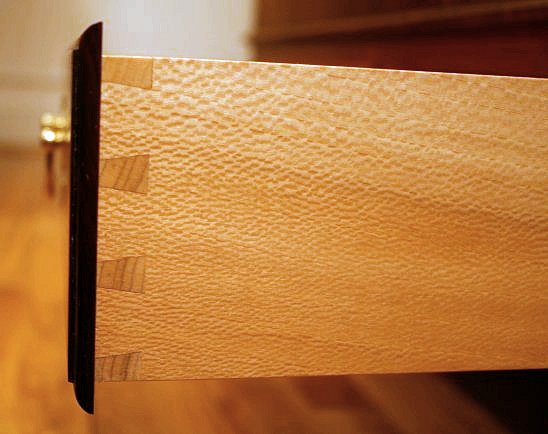
Looks like you used a dovetail jig for the dovetails. Some like the Leigh allow you to set the spacing. I think the spacing on the case is okay but I like to see them a little further apart in that application.

Given the depth of the drawers, I would probably have a few more there. One thing to pay attention to when setting up the jig is that you start and end with a half dovetail. Looks like you tried but the ones in the drawer picture look a little off.

Nevertheless, nice job. It's not easy starting something like this and keeping up with what you're doing when you pick it back up each time. Each project we do teaches something we can take forward to the next one. I really like the base and can fully appreciate the fitting it took.

What did you use to make the scooped places where the pulls are?

General Woodworking » Re: What would you do to Repair a dovetail »

#119

Re: What would you do to Repair a dovetail

David Yoho

Even if you get it knocked apart, the wood pores would still be filled with dried glue. Not good for a re glue.

Well, unless you used hide glue. Then it doesn't matter because the joints would come apart easier and re-gluing would be a snap, since old and new hide glue sticks to itself so well. Hide glue also makes joinery slide together like it's been greased.

I, too, use an acid brush for spreading glue. A tip I learned from another professional for clamping through-dovetail joints to make sure the joint comes together works real nice. Weather gluing and clamping a large case like a blanket chest or a smaller one like drawers I use my K-bodies and some wooden strips cut to look like dental molding with blue painter's tape applied to the "teeth". I keep on hand a few different sizes I've made and used before but can make new ones to fit the spacing of any dovetail layout that's different. Just place the strips so the "teeth" are between the dovetails and clamp. The blue tape keeps the glue from sticking.

As for drawers, another method I got from this same fellow is only use through dovetails, illuminating the need to cut half-blinds. One can make a convincing look with this method and if you use a dovetail jig, you only have to set it up for one type of dovetail. The trick, if you're using a secondary wood for the box, is to use it for the two sides and back. Then use the same wood as the drawer front for the front of the drawer box. Assuming a 3/4" drawer front is desired and 1/2" drawer parts, cut the through-dovetails and assemble the box. Then attach a 1/4" drawer front to the box and no one is the wiser. It sure makes drawer construction quicker and easier.

General Woodworking » Re: ***SURVEY: THE IDES OF SEPTEMBER*** »

#120

Re: That makes little sense to me...

craigd

My bad - I was upset with the "it's a program, anyone can push a button and recreate something" comment, which I feel can only be made by people who don't actually push buttons (I do agree that this is usually the case in a production environment). I was trying to draw an analogy between "a program is a tool just as a tablesaw is a tool" (in my view) to "it is the tool that makes the object" fallacy. So I agree with you on one level but think your definition of craftsmanship is much too narrow as I think someone who can assemble a Testor model into something that looks really sharp is a craftsman/person.

A CNC controlled machine used in a production environment (which may be where we disagree) is just being used as a cookie cutter. Nice if you need a zillion of something but probably not if that is your job.

Human beings do not work this way. Part of craftsmanship is the discipline to execute repeat operations as consistently as possible - in some cases over years and years of work.

I agree mostly. I just hates making the same thing over and over and over. Thus, I lack the discipline to dedicate the time to make nice hand cut dovetails when I can use my dovetail jig to get dovetails "exactly the same, every time, to the same tolerances". I'd rather get it done so I can implement my design/program to make something new [to me]. On the other hand, I've spent decades to understanding the foundations of computer science because I need that knowledge/skills to make the widgets I'm interested in. I'd like to think I'm a craftsman but maybe I'm delusional.

So, thinking about it, I suspect our differences are the scope of what craftsmanship is and how we express that definition.

General Woodworking » Re: I actually invented/discovered something »

#122

Re: To summarize.....

roger lance

The use of a dovetail bit and/or dovetail jig will generally limit the size, shape, and placement of dovetails.....but you are certainly free to do that.....I have a PC Omnijig (older version) and use it for certain applications like making shop drawers in 1/2" bb ply (try that freehand !).....the idea behind this post was to show some agreement with the OP....Joe....that there are many, many ways of cutting dovetails and using power tools in some part of the process....here, I'm using a small router to evacuate waste on the pin board of half-blinds.....Joe found a way to use an oscillating saw on cutting pins as well....Bill and I are blended woodworkers who like to use hand tools and power tools together....but I like to use jigs and Bill not so much....it gives us something to argue about....there are many ways to do things, not just one way.

General Woodworking » Re: I actually invented/discovered something »

#123

Re: To summarize.....

Robert Fuller

Correct me if I am wrong here, but if I were going to use a router to cut dovetails, I would use a dovetail bit and cut on the end grain, using a few scraps of wood on either side to form a platform for the router.

And if I did not want to freehand this I could just use a dovetail jig.

General Woodworking » Re: porter cable dovetail jig »

#125

Re: porter cable dovetail jig

larry in nw ohio

Lester If it`s what I think it is, Rockler has it on page 25 of the June 2012 catalog for $44. If you decide to get one, I hope you go through WC. I say this because you seem to be a new person here, and if you are you may not know that WC gets something out of people ordering by clicking on the advertizing logo here at WC. I seem to remember that there is rockler logo on the message board. Good luck with your project. Larry

👍 This page answered my questions

Your vote helps other woodworkers quickly find the answers and techniques that actually work in the shop.