WoodCentral Forums

Est. 1998 — 27 years of woodworking knowledge

Search query: «"dovetail jig"»

Posts

Hand Tools » Re: Are chisels obsolete? »

#1

In my experience the mechanized tooling never quite measures up to expectations for precision.  Jig cut joints are another matter (Leigh dovetail jig) will do an admirable job for large repeatable runs and are very precise when set up properly. 
By hand dovetails require practice and more practice. 
Dovetails certainly do not require a $300.00 chisel, other than a woodworker wanting them. 
You can buy used serviceable chisels for less than 35$. 
Craftsman from previous centuries certainly did not pay that much. The process does require”sharp” however, whether a 300$ or 10$ chisel 
You can suit yourself, but for me I’d rather learn the hand skill first. Now at 77, I appreciate the time spent working by hand and eye in the beginning, then graduating to machine work to increase production in the boat yard. But machines only carry you so far in woodworking as opposed to metal machining. Build your skill set is of paramount importance whether your pursuit is professional or casual.

Ed

General Woodworking » Hot woodworking topics »

Edited #2

One of the best ways to help WC become popular again is to answer questions people are currently asking the search engines. Here's a current list of the Top 100:

🔧 Tool & Equipment Questions

  1. What woodworking tools should a beginner buy?

  2. How to choose a good table saw for home shop?

  3. How to align a band saw blade?

  4. How to remove blade drift on a band saw?

  5. How to tune and flatten a hand plane?

  6. What’s the difference between a jointer and a planer?

  7. How to sharpen a chisel correctly?

  8. What grit sandpaper should I use for final finish?

  9. How to maintain and clean a router?

  10. How to square a table saw fence?

  11. What is a “throat plate” and which one should I use?

  12. Is it worth buying a CNC router for a small shop?

  13. How to safely change blades on table saw / miter saw?

  14. How to reduce vibration on power tools?

  15. What is a dovetail jig and how do I use one?

  16. How to make jigs (crosscut sled, taper jig, box joint jig)?

  17. How to build a dust collection / fume extraction system?

  18. What kind of clamps are best for glue-ups?

  19. How to choose the correct router bit for edge profiling?

  20. How to safely use a router table?

  21. How to square up long boards in small shop with limited space?

  22. What safety gear do I absolutely need (respirator, hearing, eye)?

  23. How to mount / stabilize a workbench?

  24. How to set up shop lighting for precision work?

  25. How to sharpen and set plane blades properly?


🧰 Joinery & Woodworking Techniques

  1. How to cut dovetail joints by hand?

  2. How to make mortise & tenon joints?

  3. How to do box joints / finger joints?

  4. How to cut dados and rabbets accurately?

  5. Best method for tongue and groove joints?

  6. How to cut a through tenon vs a blind tenon?

  7. How to cut half-lap joints properly?

  8. How to do floating tenons / domino joints?

  9. How to avoid tear-out when planing / routing across grain?

  10. How to scribe curves or arcs into wood?

  11. How to make circle or ellipse jigs for routing?

  12. How to bend wood (steam bending, laminating) safely?

  13. How to do segmented turning or segmented wood bowls?

  14. How to resaw thick boards into thinner boards?

  15. How to flatten wide boards by hand?

  16. How to taper legs or plinths?

  17. How to inlay wood / do decorative inlays?

  18. How to cut curved / freeform shapes with scroll saw / band saw?

  19. How to align mortises on multiple pieces precisely?

  20. How to mitigate wood movement (expansion/contraction) in joinery?

  21. How to deal with twist, cup, and warp in boards?

  22. How to counteract wood twist when designing a project?

  23. How to veneer wood or apply veneer over curves?


🪵 Wood & Material Questions

  1. How to identify wood species (appearance, grain, hardness)?

  2. How to choose hardwood vs softwood for furniture?

  3. Which woods are good for outdoor use?

  4. What woods are food-safe for cutting boards?

  5. How to read lumber grades (FAS, Select, #2 common)?

  6. What moisture content should wood be before gluing?

  7. How to properly acclimate wood to shop humidity?

  8. What is kiln drying vs air drying?

  9. How to reduce checking / cracking in slabs?

  10. How to fill knots or voids (epoxy, resin, filler)?

  11. How to glue up wide panels without warping?

  12. How to choose stable wood for guitar / instrument making?

  13. How to veneer or plywood vs solid wood decisions?

  14. How to stabilize soft or punky wood?

  15. How to deal with spalting, burl, or figure wood?

  16. How to select wood for turning (bowls, spindles)?

  17. How to cut lumber from logs (milling, chainsaw, bandsaw mill)?


🎨 Finishing, Staining & Sealing

  1. How to apply stain evenly without blotching?

  2. What is the best finish for walnut / cherry / maple?

  3. Oil vs polyurethane — which is better and when?

  4. How to do a wipe-on finish?

  5. How many coats of polyurethane should I apply?

  6. How to sand between finish coats?

  7. How to buff and polish a clear finish?

  8. How to use shellac, lacquer, or varnish?

  9. What is tung oil / Danish oil / linseed oil, pros & cons?

  10. How to repair finish scratches or dents?

  11. How to achieve a “matte” vs “semi-gloss” finish?

  12. How to finish a cutting board (food-safe)?

  13. How to apply finish to end grain?

  14. How to apply finish to live edge slabs?

  15. How to avoid dust nibs in finish coats?

  16. How to thin varnish / reduce bubbles?

  17. How to strip old finishes safely?

  18. How to color wood with dyes vs pigment stains?

  19. How to “raise the grain” (water pop) before final finish?


🏠 Projects & Design / Planning

  1. How to design a small side table?

  2. How to build a Shaker style desk?

  3. How to build a dining table with breadboard ends?

  4. How to build a bed frame with mortise/tenon rails?

  5. How to make cabinets / casework?

  6. How to build a wooden toolbox or chest?

  7. How to build a rocking chair or ladder-back chair?

  8. How to build picture frames with mitered corners?

  9. How to build a wall-mounted shelf / floating shelf?

  10. How to build a router table or tool cabinet?

  11. How to plan for wood movement in tabletop design?

  12. How to design hidden fasteners or hardware-free cabinetry?

  13. How to dimension and layout boards for minimal waste?

  14. How to incorporate curves or organic shapes in furniture?

  15. How to laminate thin strips into curved shapes?

  16. How to build jigs / fixtures for repetitive tasks?


🔐 Safety, Shop Practices, & Troubleshooting

  1. How to set up proper dust collection / air filtration?

  2. How to choose a respirator for wood dust?

  3. How to prevent kickback on table saw?

  4. How to manage shop humidity / seasonal changes?

  5. How to identify and fix squeaks or creaks in furniture?

  6. How to diagnose wood movement problems (cupping, twist)?

  7. How to fix glue joint failures?

  8. How to avoid splitting when driving screws?

  9. How to safely store lumber in shop?

  10. Why is my finish white / cloudy (moisture issues)?

  11. How to fix tear-out on edge routing?

  12. How to safely use a plunge router?

  13. How to prevent glue line visibility?

  14. How to manage MDF / plywood vs solid wood movement?


✅ Tips for Using These in Forum / SEO Strategy

  • Turn each question into a forum thread — make the thread title exactly the question (or something very close).

  • Encourage responses with photos, process steps, and additions (those replies help “bulk up” content).

  • Interlink relevant threads (e.g. joinery → finishing → wood choice).

  • Over time, use your analytics / Search Console to filter which topics attract impressions — expand on those.

  • Use long-tail, low competition ones first (e.g. “how to apply finish to live edge slabs”) — easier to rank.

  • Avoid mentioning Taylor Swift or other subjects that have absolutely nothing to do with woodworking. ;)

Hand Tools » Storytime »

Edited #3

The Great Woodshop Showdown: Hand Tools vs. Power Tools

In the quiet town of Timberville, where the scent of fresh sawdust filled the air and the rhythmic sound of chisels and saws echoed down Main Street, a feud was brewing. Not just any feud—this was a war between two factions of woodworkers: the Hand Tool Purists and the Power Tool Enthusiasts.
On one side stood Old Man Perkins, the self-proclaimed guardian of traditional woodworking. He could carve a dovetail joint so fine it could make a grown man weep. His workshop was a sanctuary of peace, patience, and the occasional muttered curse when a chisel found its way into his thumb.
On the other side, there was Bob “The Router” Jenkins, a man who believed that if a machine could do it, why waste energy on hand tools? His shop was a symphony of whirring blades, spinning routers, and enough sawdust in the air to suffocate a moose.
The two had been at odds for years, exchanging passive-aggressive remarks at the Timberville Woodworking Guild meetings.
“Nothing beats the connection between a craftsman and his hand tools,” Perkins would say, stroking the handle of his beloved No. 4 smoothing plane.
“Yeah, if you have all day to build one drawer,” Bob would retort, adjusting his laser-guided, WiFi-connected, fully automated dovetail jig.
Things escalated one fateful Saturday when the town hosted the Annual Great Timberville Wood-Off, a friendly competition where local woodworkers showed off their skills. This year’s challenge? Build the finest rocking chair in a day.
Perkins showed up with nothing but his toolbox and a serene smile, while Bob arrived towing a trailer filled with every power tool known to man, plus a generator in case of emergencies.
The competition began, and the crowd watched in fascination. Perkins worked like an artist, shaving down each piece of wood with care, his hand tools whispering against the grain. Meanwhile, Bob’s workshop sounded like a fighter jet was being built, as he used his entire arsenal to cut, sand, and assemble his chair at breakneck speed.
At lunchtime, Bob had already assembled his chair, complete with polished edges and a built-in cup holder (because why not?). Perkins, however, was still fine-tuning the rockers, carving delicate details into the armrests.
As the sun began to set, both men placed their finished chairs in front of the judges. Bob’s chair looked flawless—sleek, modern, and sturdy enough to hold a linebacker. Perkins’ chair, while taking much longer, had a warmth and charm that seemed to whisper, “Sit here and contemplate life.”
The judges deliberated, scratching their heads. The competition was about craftsmanship, speed, and artistry, but how could they choose?
Then came the ultimate test.
055582e9-5a63-466a-b58c-6b0a5c352fb6_675.jpg
The mayor, a stout man with a fondness for pie, decided to test the chairs himself. He sat in Bob’s chair first. It held steady… for about three seconds before a hidden joint popped, sending the mayor tumbling backward into the dust.
Perkins’ chair, however, rocked gently, as if it had been made for him. The mayor sighed in bliss.
“Well,” he said, brushing himself off, “I think we have a winner.”
Perkins grinned and tipped his cap. Bob shrugged, admitting defeat but also secretly impressed. From that day forward, the feud softened—just a little. Bob started sneaking in a few hand tools for finer details, and Perkins, though he’d never admit it, found himself eyeing a cordless drill now and then.
And so, Timberville remained a town of skilled woodworkers, where hand planes and power sanders could exist—if not in perfect harmony, then at least with mutual respect and a bit less sawdust-fueled rivalry.

General Woodworking » Bidding up craftsman cred with gimmick tools. »

#4

Come and check out my tools dude.
So I walk in the guys massive garage and he has this cabinet full of Bridge city, Lie Nielsen and God knows what else. He must have spent a small fortune on all that gear. Dovetail jig of course, gizmo's router table, sawstop table saw. The machinery was mostly Felder, " only the best" he said.
So I asked him if he had made anything yet because it all looked pristine.
Oh no, I will get around to it one day maybe but it's mostly to impress client's  !
Turns out he was claiming it all as a business expense to write off/ avoid capital gains.
He said he made so much money he has to spend it on something that made him feel good. Then he said I could try his sh!t out if  I made him a table for free !
I knew there had to be a catch. 
Of course, he said, you'll have to set it all up first because I don't know how !
RUFing kidding me ? 
"I can put a lot of work your way."
Then he stroked my elbow..
Time to leave. 
Lawyer's. 
Must be a stumpy nubs fan boy or something. Who knows.
This culture is entirely a mystery to me.
Disney land for wannabee Woody's or some such. Weird. Mason ?
Yup.

General Woodworking » Half blind dovetail for drawers question »

Edited #5

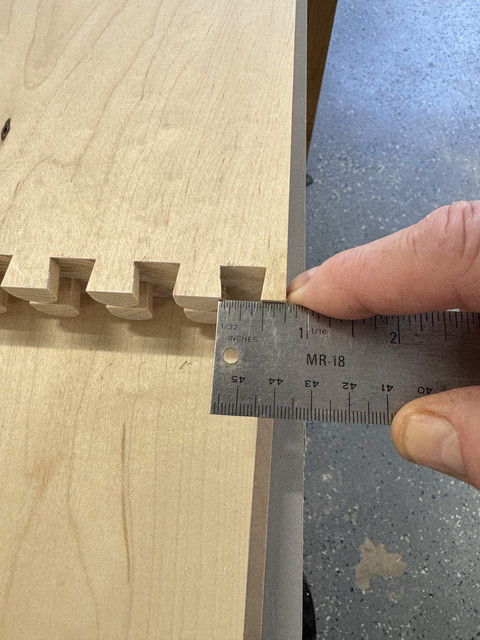
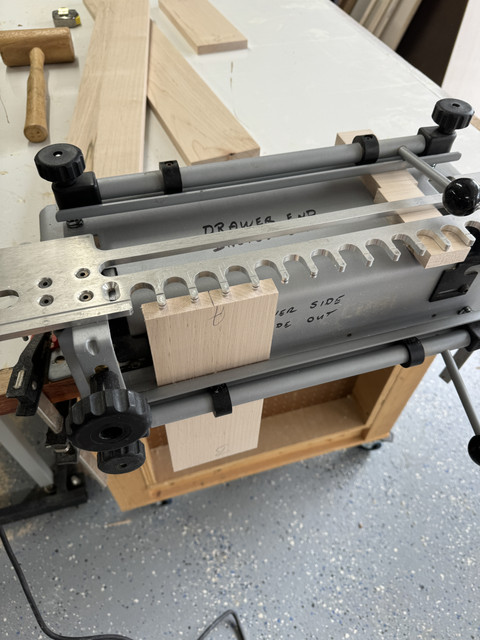
Morning all.  I have my dovetail jig dialed in so everything fits great.  I dry fit the drawer pieces and they all fit fine.  So next I want to cut a 1/4 inch grove for the bottom.  No problem until I measure the sides and see I will have to go about an inch up to make them hide in the Pins (I think is the correct term).  The drawer is 7 inches wide the other drawer is 4 inches wide.  Do I need to make them 7 and a half inches wide and 4 and a half inches wide to get the bottom to work correct?  


IMG-6422.jpg


General Woodworking » Setup gauge for the Porta Cable half Blind dovetail jig »

Edited #6

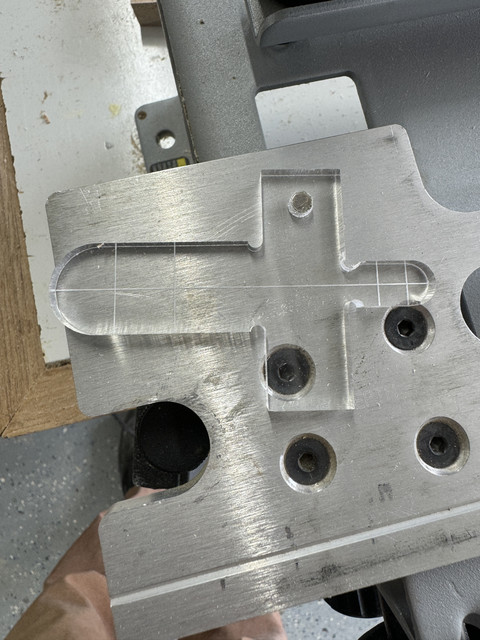
I was watching a lot of videos on how to us the Porter Cable Dovetail jig.  I bought it in 2008, and used it once a long time ago.  I was watching the setup videos and found one of a jig to center the side piece, so you can set the edge guide.  I had been using a ruler to adjust for center.  Sometimes I did really good others time not so good.

I took the chance and bought the centering jig.  Now I can set it up and have the boards centered in just a few minutes.  

I bought it off Esty.
IMG-6247.jpg
IMG-6248.jpg
IMG-6249.jpg
Centering Jig

General Woodworking » Garage Sale Finds »

#7

Last weekend I was on my way to a park and didn't have a dime on me. Maybe I said this before. I stopped at a garage sale and just about pooped my pants. The guy had inherited his father-in-laws wood shop and was getting rid of all the tools. I saw the Porter Cable dovetail jig there and it was marked $10. Everything was marked $10. I had to sell my dovetail jig a while back. The guy asked me what I was interested in and I replied about the dovetail jig and said I don't have any money and he told me to take it home with me. So a free dovetail jig.

I saw this Bosch 1581 jig saw at a local flea market type shop and had the money to buy it this week. It is the best jig saw ever made, although I have never touched a Festool, I don't know about that. The oscillation on mine quit working years ago and it just doesn't cut well, I think I ended up getting rid of it. I paid $25 plus tax for this one, I count that as a bargain.

Dovetail-Jig.jpg
Bosch-1581-Jig-Saw.jpg

Brain Teasers & Puzzles » Re: Two fer Monday »

#8

Answer

1. The so called cistern dovetail was used to make the outer case of the cistern, some were lined with a waterproof material such as lead some were plaster lined. The timber outer 'case' used dovetails which were equal in size to the pins rendering the maximum strength possible to withstand the pressure of the water. As stated by Dan most dovetail jigs do this by default, but the British "cistern dovetails" were much larger than the examples produced by jigs of today.

2. So he can use less force when striking with it. The force of the swing is focused on a smaller area (the tangent point of a circle) instead of over a larger flat area. This would lead to lighter taps, but the same equivalent force. Owing to this also is the tendency to "choke up" on the mallet for additional control and the roundness allows for comfort and feel.

Turning » Re: QotD:How much will you spend w/o trying it 1st? »

#10

Re: QotD:How much will you spend w/o trying it 1st

charlie belden

Normally there's a tool I need for something I'm working on or plan on doing.

If the former, and the tool is available locally, I'll go buy one I think will do the job.

If it's the latter, I probably will ask around for recomendations, and reasons for the recomendation. I'll take that advice and get what's recomended.

Sometimes it's a used tool that wasn't overused or abused - at half the new price - and already assembled. I may not have an immediate use for it - but often this type of purchase opens up possibilities for future projects. If I've got the cash I'll usually seize the opportunity.

Then there's the Revolutionary Tool - one that does something already being done - but does it quicker, easier and more accurately. The AKEDA Dovetail Jig and the Festool DOMINO were two such purchases. Saw what they did and why they are head and shoulders above other ways of doing what they do and handed over The Card - a Debit Card, NOT a Credit Card. I NEVER rent money. If the money ain't in the bank "it" don't get bought.

Then there's the One Of Many tools. They all do basically the same thing, but in different ways - captured hollowing systems for example. That purchase involved researching what was available, considering each one's strengths and weakness - without actually getting to play with any of them on a piece I have in mind - and picking the one that fits my immediate and foreseeable needs. Once the selection is made, if I have the money available it's purchased. If I don't have the money - I'll wait and save up for it rather than get The Next Best.

Buy Once, Cry Once is advice I've found to be true. I got the MiniMonster because it's the best for what I want to do. The price, coincidently, was also very good for what you get with that system. I'll be getting a replacement for the one I gave to a turner with more talent and imagination than money.

Turning » Re: Playin' With A Laser - Session 2 »

#11

Re: I Know! I KNOW!!!

charlie belden

George:

I know you CAN center the laser to the center of the design. I just haven't learned HOW. I have learned that HOW I THOUGHT it SHOULD work - is different from how it DOES work. Just need to read, understand and follow the instructions in the manual.

Like any Indirect method - this one has a bit of Cognitive Friction - the relationship between effect and cause. Router based dovetail jigs are similar. You can see if a resulting dovetail joint is too tight or too loose - but figuring out what to do to correct the erroneous results takes some mental gymnastics (heighten to tighten, lower to loosen in the case of the amount of router bit cutting the dovetail pins and tails).

If you pursue the use of a laser engraver PLEASE takes notes - and share what you discover.

Turning » Re: Are Wood Turners Proned To OCD? »

#12

Re: Are Wood Turners Proned To OCD?

charlie belden

>Normally, thinking you can buy a tool that will make you an expert is usually a mistake - and a common mistake. Tool demonstrators sure give you the impression that you CAN buy abilities you're not worth working to get. But unlike the "fool proof, perfect results every time" dovetail jigs and mortise and tenon jigs - there are turning things you CAN buy that do enable you to do things that would take a lot of time and effort to do otherwise. And turners keep coming up with more.

Turning » Re: Laser Engraving/Cutting and Turnings *LINK* »

#13

Re: Interesting, but ...

charlie belden

>Apologies if my heads up on a potentially useful tool came acrossed as an infommercial, I certainly ain't selling anything. I have no affiliation with anyone making or selling laser engravers. When I find a tool I find interesting and get a feel for it from a user's perspective, rather than from reading brochures or watching a demonstration at a show, I share what I've found in the hope that i the info might be useful to another woodworker.

Regarding hand work and power assisted work, I learned to handcut half blind and through dovetails and do them either for a special One Off or just for the pleasure of cutting them. But when I have four or five drawers to make I'm going to set up the router, bit and dovetail jig - a variable spaced dovetail jig. If I only need to stock prep a couple of boards for a box I'll more often than not get out a handplane or two. But If I've got 20 bf to prep I'm off to the joiner, planer and table saw.

Maybe it's because I've been playing with computers and computer graphics and CAD for years, I often do the creative sketching and some plans on my computer. With a tablet and pen I can free hand sketches and drawings and use the computer to variations without having to redraw anything. In part because even my hand printing only borders on legible, I "write" using my computer rather than using a typewriter. The "basket weave" pattern and the variation on the linked page took about an hour to do - most of that time figuring out how to do the shading for the basket weave. I chose that subject to investigate what it takes to do a gray scale image that could be used for "low relief carving" using a laser. Most of that time was spent on the original image - the variations took only minutes to create.

I'm seeing laser engravers as possible tools to enable me to make things I can see in my mind but can't yet make in the real world - and not for any mass production or limited editions. But I like the idea of being able to do variations fairly quickly, again not for commercial purposes but just to see them in the real world.

If I came acrossed as hyper-enthusiastic - apologies. But this laser idea has my creative joices flowing and I guess my cup ranneth over, or in this case - my keyboard.

Turning » Re: Nothing New Under The Sun? NOT! *LINK* »

#14

Re: Nothing New Under The Sun? NOT!

charlie belden

>>If you can write a program to run umpteen thousand of an

> identical design then why not just buy "manufactured" stuff.

There's no program writing - computer applications for doing

your own artwork are readily available - some free or shareware.

There's even a paint program "Painter" that has "natural medium"

brushes that work like sable, or horsehair etc. - water color

brushes, oil brushes etc. and you can "paint" with simulations

of water colors, chalk pastels, oil pastels, oil paint, acrylic paint,

tempra - OR - combinations that won't work in the real world

like water color oil paint. Add a pressure sensitive "pen" and

a digitizing tablet and it's very much like painting or drawing,

without getting paint on your hands and filling the space with

the smell of paint thinner.

And CAD just does what you'd do with a T-square, some triangles,

compass and maybe french curves - and a pencil or inking pen

- common drafting equiptment and materials. Unlike a hand

drafted drawing, the CAD version can easily be modified - change

dimensions, scale the whole thing up or down, rotate it, ... Rather

than a pencil or pen you use a mouse or a digiting tablet and

"pen" - no need for the Tsquare, triangles,french curves or even

one of those three sides scales.

And just because, once you have the computer drawing, it doesn't

mean you will mass produce the piece it's used for. These programs

and tools just make it easier to get an idea into a 3D wood object

or maybe on one. AND, once you've got the idea "digital" it's

pretty easy to try variations. A prototype of a piece done in say

poplar, or out here, redwood let's you work out unforseen problems

- before committing to mahogany or maple - or rosewood.

> I equate it to flat work.

> How many times have you heard people complain about cheap

> furniture and the lack of craftsmanship.No one does fine joinery

> anymore.

I'm sure there are Chinese craftsman who use triple mitered

joints with integral mortise and tenons and intricate mitered

saddle joints that think Stickley, Greene and Greene stuff or even

Sam Maloof's rocking chair blended joinery are "primitive" - in

part because they're so simple and in part because you can see

them so easily. High end Chinese pieces NEVER have grain

simply meeting at 90 degrees IF a mitered joint can avoid it.

And if it's at all possible to conceal the joinery - you won't

have any idea of how things were put together - even if you

remove drawers and stick your head inside a piece. And that

unseen joinery will hold things together without opening up

or failing - for centuries

Are variable spaced half blind dovetails considered fine joinery?

If you make them with a router, bit and dovetail jig - are they

still fine joinery?

Does it matter if a hidden mortise and tenon joint is cut by hand

or with a machine? Is "loose/floating tenon" mortise and tenon

joinery any less strong/effective than "true" mortise and tenon

joinery?

How about paneled doors? Is a cope and stick framed raised panel

door doenne with a router and set of bits less fine than one that has

the same joinery done by hand - with wooden profile hand planes?

Is a coopered door or box lid - with staves cut on a table saw and

held together with TiteBond II really any different that one made

from split wood that was hand worked to form the staves and held

together with hide glue?

Is a shelf that's joined to the uprights with a stopped dovetail joint

which happens to have been made with a router, bit and edge guide

any less fine than one done with hand tools?

How about an inlayed band in a groove cut with a router and

a precision fence like the Micro-Fence?

> They take up wood working and buy a Kregg jig and duplicate the

> same crap they complained about.

Some do, many don't. I'd venture to guess that some of the finest joinery and the highest quality furniture created in the US are done by amateur woodworkers who will spend the time, effort and money - to make their ideas for a piece of furniture, or a turning - as good as they can imagine - and sometimes even better.

But you don't start out in woodworking, be it furniture making out of solid wood, ply and solid wood, or turning - with all the knowledge, skills and abilities of a traditionally trained wood worker. So if you start with a bathroom vainity cabinet - face framed ply for example - and use pocket screws to hold things together in a way that a) does the job and b) doesn't show - and c) spend the saved time selecting nice wood and ply,pick the best grain for each part and on finishing it - what's the problem?

New woodworking tools come along that reduce the grunt work and lower the learning curve required to do something to within reach of more people. The laser engraver may or may not be such a tool. But it does open up some creative possibilities - if you want to think creatively.

Turning » Re: Nothing New Under The Sun? NOT! *LINK* »

#15

Re: Nothing New Under The Sun? NOT!

charlie belden

>As is often the case, some focus on a tree or trees and don't see the forest. Perhaps I should have used a Frontiersman metaphor. The folks that head out into new areas aren't the people who build elegant homes or create monumental works of art or beautiful exquisiteky refinded japanese gardens. When they find a place to settle down - THEN they may do those things. But civilizations grow because people go outside the established norms and open up possibilities.

The idea of using string and yarn as inlays in a turning - which is a very defined surface - and blurring, with the nature of spun yarn, the outline/surface of the piece, adding some subtle or very obvious and bright color to a piece . . .

Turners have been incorporating soapstone, marble, epoxy etc. into pieces. PolyClay lends itself to turning, and is more forgiving than stone or some of the other materials that have been used.

The laser engraver is a tool to remove wood - and so is a turning tool, or a carving tool, or a bur in a flex shaft . . . The laser worked pieces are examples of early exploration of the use of lasers with turnings. And as is the case with learning to use a new tool you start simple and explore how it works. THEN you can start adding the "artistic" element(s), the creative stuff.

I assure you that Michelangelo's early experimentings with marble carving were not like The Pieta or The David.

Imagine if Binh Pho had found and worked out how to use the laser to do his piercing rather than the bur and flex shaft he now uses? He does a drawing on the piece to know where he'll remove wood and where he won't - then he cuts. But if he could've done the design - and have the cutting done without the grunt work, or could do a drawing, have it cut out quickly and relatively effortlessly - and then see if it "works" in the real world. Think of the laser as a 2 1/2 D word processor or as Computer Aided Drawing - the ability to quickly try alternatives - with an UNDO option if the idea doesn't please you - or keep your "original" and vary it in all sorts of ways, keeping what you like and playing with that/those some more.

The stuff I put up on the laser engraving/cutting is just some of what I learned about this tool - in just a little over two hours - some of the basics of what this tool can do. Imagine just playing with the positive and negative of an image - a picture or a drawing - you can have the laser "burn" the "dark lines/areas" and leave the "white" - or "burn" the ight and leave the dark. You can get it to cut deeper in black areas, less deep in gray areas and not at all in white areas - or visa versa. How about adding a pierced "woven reeds" area to a piece, with "carving" where one reed goes over or under another - or an interesting Celtic Knot. How about a flowing art nouveau design in an an area of a piece that is otherwise an uninteresting area - say on a piece with SOME intereting spalting but most of the outside surface that's really bland?

While some see the laser engraved and cut examples as just clip art I see just some of the capabilities and possibilities this tool may provide other turners who may have access to this tool. And who knows, maybe in a few years your local Ginkos or some other "Copying Center" may have a laser engraver. You hand them your piece and the computer file, with the "printer" settings and in a few minutes they hand you back your laser engraved/cut piece - along with the bill.

I'm kind of frustrated by my inability to adequately convey what some of the new tools and refined tools I've gotten to play with are capable of letting you do, or do more easily, or more accurately - the Festool DOMINO and the AKEDA Dovetail Jig for example.

Will try to do better as I get to play with the laser engraver.

In the mean time - hopefully - some here will think about ways of using this tool - and share their ideas.

charlie belden

Hand Tools » Re: Magical dovetail markers »

#17

Re: Magical dovetail markers

William Duffield

The CAis very strong. It's problem is that it gets more and more brittle with time. I don't know the rate of change, or the other conditions that might affect how quickly it degrades, but eventually, just dropping it on the bench might cause the joint to separate. But I agree with you, they are so easy to make, just expect that some day you may have to make some new ones. There are lots of other ways in the shop to break them. :D

Here is a well presented video of expert techniques for assembling custom items from acrylic or Lexan.

https://www.youtube.com/watch?v=w09t-ROvDcY

Both plastics use the same techniques and the same glues. Like CA, the glue is made in different viscosities. His techniques use the #3, which I think is the thinnest. He uses MDF blocks for insuring the plastic pieces are in the right place and square, just like in your tutorial. But, importantly, he uses a two step process, first spot welding the joints so the glue doesn't touch the jig blocks, and then removing the blocks and continuous welding the whole length of each joint. This is probably a lot more care than is needed for some DIY dovetail jigs, but he has some very high end customers.

Hand Tools » Re: Flat panel doors with beads... »

#18

agree

Bill Tindall, E.Tn.

"The bead could be applied, but making the bead separately with hand tools will take longer.

Applying any sort of edge molding on a panel door will take longer, hand or power tools. If there is one thing I have learned over and over (I'm a slow and stubborn learner) it is that I am unlikely to improve on the way furniture was put together in 1820. How the parts and joints are made varies but not the engineering. If the technique survived in professional shops for 200 years one can be sure the technique is both reliable and efficient. These two attributes were essential for success. Exceptions are when a modern design has little to do with what was made in 1820, Danish Modern for example. Then new engineering must be invented.

All the things a beginning woodworker needs to learn to build like stuff was built in 1820 is daunting. If you need a place to store socks, my advice would be to build it with what ever skills and tools you have. On each project learn a new skill or buy a new tool that moves the capability toward the ideal.

When my wife and I moved into our first unfurnished apartment I built a couch and two end tables from plywood, screw on legs and stock molding, with a hand saw (both are still in use). The best way to put a drawer together is with dovetails. My first drawers were sides nailed in rebates, followed by a Sears dovetail jig, then a Keller jig and eventually hand making them. (the only drawers that did not hold up were made with the Sears dovetail jig. ) My early furniture survived surprisingly well, but it is not heirloom in quality and/or design

Hand Tools » Re: Is anyone building anything? »

#19

Re: Is anyone building anything?

Paul M

I'm building some walnut cabinets to hold CDs and DVDs. I didn't think it post worthy since it is using plywood and power tools for the most part.

I used a half-blind dovetail jig to make the 6 drawers out of 1/2" plywood, and disassembled the entire router setup before assembly. I removed the bottom plywood retaining channel on 5 of the drawer backs, and then accidentally removed it from one of the sides on one drawer. I didn't want to get the screaming router out and set it all up again so I remade the damaged side using saws and chisels. So I've successfully created a hand-made dovetail drawer that looks just like a machined dovetail drawer. Sigh.

Hand Tools » Re: "personalizing" your furniture »

#20

Lots of opinions here

Ron Harper

I really do not intend to start a big hoohaaa here, but I think Bill may be suggesting that it is OK to leave some slight imperfections that show that a piece was made on a bench by an individual woodworker. David has expressed distaste at dishonesty. I agree strongly with both. I know some hand tool woodworkers who leave the slight ripples left by a jack plane on the under side of table tops. I like it. I also know some power tool only guys that use a dovetail jig to make joints and then go back with a marking gauge to scribe a line so folks might think it was cut by hand. I do not like that. I do know some guys who make all of the small side of the dovetail pins smaller than a quarter inch, so the observant woodworker will know that they are hand done. That is too subtle for the general audience, but I like it. I do not think there is ever an excuse for sloppy work. But hand made pieces will always show imperfection. As we grow in the craft, those imperfections become harder to detect as we make fewer errors and improve at disguizing the errors that we make. I also think we have to be realistic about what we expect from ourselves. Particularly as hand tool craftspersons. I can study and watch Curtis Buchanan make a chair. I can do my very best to do it the way he does. I am not likely to succeed. I may get close but a skilled viewer can see the differences. I will bet he would tell you that the chairs he makes today are better chairs than the ones he made 20 years ago.

Hand Tools » Re: What are you working on.... »

#21

Re: Writing a Report, Cursing a Kitchen Job

William Duffield

Deprivations are not on the schedule. I'll post here as well as on the SAPFM forum, and maybe a reference to the post on "Hand Tools" over on "Messages". I'm sure we'll get more views and more discussion here than anywhere else.

Steve mentioned more than once on Saturday, that he was a firm believer in hand tool woodworking, just not in unnecessary hand tool woodworking. If you can find a way to get equivalent results with power tools and get it done more quickly (and safely) use the power tools.

A very funny piece of advise he offered: Whatever method you use (e.g, back saw or table saw) to cut your tails, make sure you leave the neck of the socket between the tails no more than 3/16" wide (towards delicate) since you can't do that with a router bit, and you don't want them to look like they were cut with a router dovetail jig.

Hand Tools » Re: Electric Tool Must Haves? »

#22

That is an easy question to answer

Bill Tindall

You need the tools you need determined by your skills and interests and only you can decide what you need. When I could not hand cut dovetails I "needed" a dovetail jig and router. Now I don't. Nobody else made, or could make, that decision for me. I could not make what I want to make without a jointer. But that in no way suggests that you need one to make what you want to make. It will become obvious if you do, or don't.

I have been growing my skills in recent projects and my need for some tools has increased and my need for others has waned.

Hand Tools » Re: Age of machine made dovetails »

#23

Definitely by 1960

Ian Neuhaus (in Sydney, Australia)

Jack

I live in Australia, I'm 55 this year.

When I was about 4, my dad bought a Miller Falls tailed router and around the same time a Stanley dovetail jig -- which cuts the standard no layout, evenly spaced, half blind DTs.

Given the distance between Australia and the US and our different voltage (240, not 110) my guess is the same tools were almost certainly available to US home WW in the early 1950s.

"40 years ago" is 1970, much older is say 1960

If she was in Australia, and if my dad had built and sold stuff out of his home shop, he could have built it any time after about 1959.

Hand Tools » Re: dovetail jig setup »

#24

Re: dovetail jig setup

Thomd

>With that type of jig you have to do some trial cuts to set the proper bit projection, the depth of cut, and as you have found out, the offset. Once all three are dialed is it smooth sailing. The offset is normally just a small fence on the upper right that one adjust to align the parts when assembled. You also have to fold the sides over in the correct sequence to get them properly aligned, though that would be pretty obvious since the pins would be backwards.

👍 This page answered my questions

Your vote helps other woodworkers quickly find the answers and techniques that actually work in the shop.