WoodCentral Forums

Est. 1998 — 27 years of woodworking knowledge

Half blind dovetail for drawers question

Posts

Half blind dovetail for drawers question

Edited #1

Morning all.  I have my dovetail jig dialed in so everything fits great.  I dry fit the drawer pieces and they all fit fine.  So next I want to cut a 1/4 inch grove for the bottom.  No problem until I measure the sides and see I will have to go about an inch up to make them hide in the Pins (I think is the correct term).  The drawer is 7 inches wide the other drawer is 4 inches wide.  Do I need to make them 7 and a half inches wide and 4 and a half inches wide to get the bottom to work correct?  


IMG-6422.jpg


Re: Half blind dovetail for drawers question

#2

Don't worry......someone from Facebook will be along shortly to answer that for you.......and if not, I (or another boomer) will answer your question before the day ends......

Re: Half blind dovetail for drawers question

#3

admin

No worries. Did you know the average demographic of Facebook is probably people our age? Young people think Facebook is for "old people" and are all over on Instagram and Reddit. And OnlyFans. I think I saw WOOD GIRL over there. She's gone missing from YouTube.

Are you familiar with the OK Boomer meme? I find it humorous, as I do most of the nonsense on social networks. I only use it to annoy and warn friends and enemies.

Re: Half blind dovetail for drawers question

#4

OK.......I won't worry about it then........why would you ever think I would care about/or know the demographics of Facebook??.......

Re: Half blind dovetail for drawers question

#5

To keep from losing so much height how about using a strip of wood around the inside of the drawer 3/4 x 1/2 with the groove for the bottom cut into this strip? This method would give you a wider bearing surface for the drawer slides. google "finewoodworking boxes, carcase and drawers" and the method is on the cover of this book.

Re: Half blind dovetail for drawers question

Edited #6

Mike .......to review......
IMG-0938.jpg

The front of the drawer is called the pin board
The side of the drawer is called the tail board
On the pin board you can see the ends of the pins
But, on the tail board all you see is the outside surface of the tails in a half-blind
So, to run a grove......you want to run it between the bottom pin......known as a half-pin.......and the next full pin above that bottom half-pin........as that grove will not be seen in the finished joint
Likewise, if you run a corresponding grove on the tail board, it will run through the tail.......but, will not be seen in the finished joint
Understand??

Do some experiments on scrap with this......you'll get the idea.......and you will see how to make adjustments.......like, in your case, you might want to make a larger half-pin which will give you a little more space between the underside of your drawer bottom and the bottom edge of the drawer side and front......

Re: Half blind dovetail for drawers question

#7

@Roger Lance

Thanks I will play with it.  I was really happy I got everything to fit it right.

Re: Half blind dovetail for drawers question

Edited #8

That is one of the advantages of hand cut dovetails, you can easily plan them out.  With a fixed spacing jig you can't as easily do it.  One option, if for whatever reason you end up with pins with a slot in them, short of a patch, is to stop the cut in the front piece so it won't show.  Plunge cut on the router table, or you can chisel the groove.  Of course this gives up one of the great benefits of the joint, how it hides the though cut.  But if everything else is working great, it might be worth it.

If the same problem occurs at the back of a drawer, well then you have the moral issue of "it won't show" to deal with.

Added later 22 min 54 s:

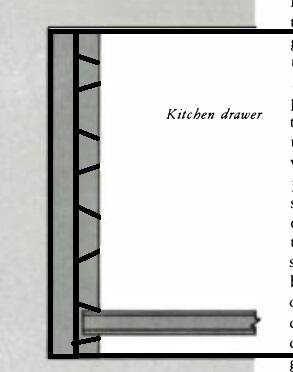
One might imagine that Virgil has trashed up the neighbourhood with his kludges.  But far from it.  In his seminal article in FWW 09 Alan Marks discusses the Kitchen Drawer Bottom, as used by hacks like Krenov, about which he says "The Kitchen Drawer Bottom carries the cheapening of construction to the extreme".  It is the kind of thing that would not even last 100 years.
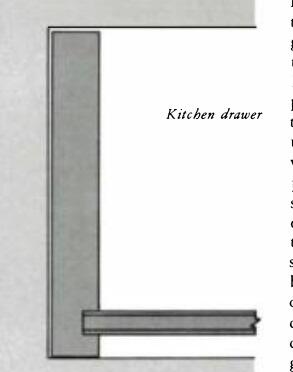
kitchen-drawer-bottom_393.jpg

He prefers the False French Bottom that uses a panel captured inside a flame.  This has several advantages, in particular, reducing wear on the enclosure.
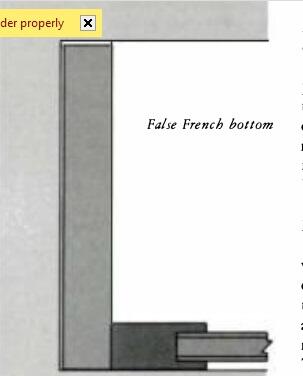
french-dawer-bottoms_394.jpg

There are solid wood versions that offer further advantages.  But for today, the fact these panels are not let into the drawer sides is a solution
Re: Half blind dovetail for drawers question

#9

@Virgil @Tom D

I am using a Porta Cable Jig to cut them.  I reread both your post a few times now, I am working at another set of drawers.  I will give the false bottom a try.   Stay tuned.  

Thanks
Mike

Re: Half blind dovetail for drawers question

#10

I have owned a cheaper version of that jig.  It is just a mater of planing out the joint design from the fixed dimensions the jig allows.

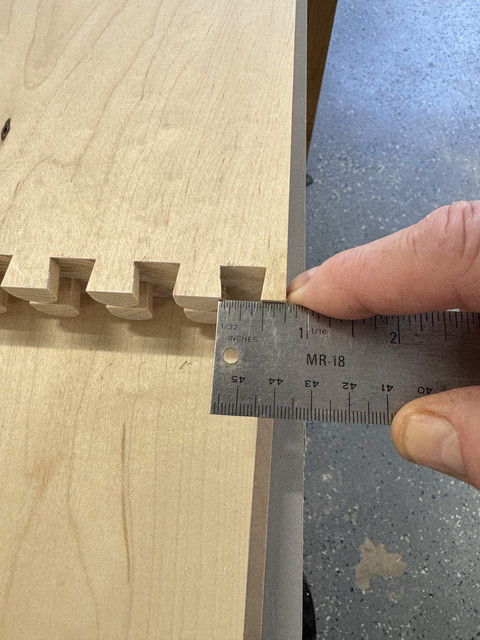
It might not be obvious, but you can see in Roger's photo that the lowest pin, the black stuff, is a half pin.  It can be placed rather low, to keep the bottom low enough that the groove is still strong enough, yet covered with the dovetail.  Then the issue is do you get a nice joint up at the top edge. This will depend on the size of the parts.  And the trick is that in sizing the drawers, for a fixed spacing jig, you have to take the jig spacing into consideration when laying out.  Lots of furniture is laid out for those jigs, and they are not using fancy drawer bottoms. I suggested the French bottom if you had parts you hadn't yet used that would show a gap.

If one wanted a set of drawers of variable size then you decide what the fixed space is from the lower edge of the drawer, to the tail that covers the groove.  Then you could create drawers based on increments that are based on each increase of one dovetail,  You have three factors.  The design up through the the first tail, and the design for the top pin, and the incremental increase of each additional tail. Oh, the joints normally start and finish with a half pin.

A simple way at times, is to have applied fronts, particularly if you are using drawer glides or slides.  Then you can simplify your design as to some extend the drawer case can be independently sized relative to the opening.

You can see in the picture how the drawer bottom is covered by the first dovetail.
kitchen-drawer-bottom-2_395.jpg

Re: Half blind dovetail for drawers question

#11

Put the slot where you want it.  If it shows you can either ignore it or plug it with a piece of matching wood.  Remember, a drawer spends at least 90% of it's life closed where no one will see it.

Re: Half blind dovetail for drawers question

#12

Mike, the basic problem is that you have cut the side/tail board incorrectly - essentially leaving the drawer back-to-front - leaving half-pins at each end. These half pins are for the front/pin board. Others (above) have diagramised this well. 

Regards from Perth

Derek

👍 This page answered my questions

Your vote helps other woodworkers quickly find the answers and techniques that actually work in the shop.