WoodCentral Forums

Est. 1998 — 27 years of woodworking knowledge

Flat panel doors with beads...

Posts

Flat panel doors with beads...

#1

Flat panel doors with beads...

David Weaver

I'm going to start making doors this weekend. Thanks to what I'll refer to as covid unproductiveness, I won't be able to do it all weekend and knock all four out, but the door design will be flat panel (solid wood) and mortise and tenon with an interior bead (the bead will be mitered).

As is generally the case, entirely by hand, so haunched m&t because it's easiest.

if you've come across a beaded door design that you are particularly fond of that has just a little bit more gingerbread than what I'm mentioning, I'm all ears.

Also, I've seen people mention before that they apply the bead at the end of the process instead of making it integral to the door. What's the advantage of this - making it easier to get the miters dead on?

I've got a nice beading plane that will work well for this, and won't have to scratch them. In continuing to unwind why I find things in certain conditions, I've found that buffing the face of the beading iron certainly rounds the front over a little bit, but it eliminates or nearly eliminates tearout in cherry that's not really that straight.

I've been puzzled by this in the past - some irons have been very deliberately rounded on the face (non-bevel side) I think I know why.
Re: Flat panel doors with beads...

#2

Re: Flat panel doors with beads...

Warren in Lancaster, PA

I can't imagine someone making a door by hand that would use an applied bead. An integral bead does not appeal to someone without hand skills.

Decades ago many guys deliberately sharpened moulding plane irons on the flat side. Their explanation was that it was "impossible" to sharpen a moulding plane iron without messing up the profile,

Re: Flat panel doors with beads...

#3

Re: Flat panel doors with beads...

David Weaver

I recall that from woodnet, and I'm sure it was well practiced as one of the professionals on that board (janus) had mentioned he did the same thing most of his career with complex moulding planes.

It seems like something you can get away with for a while, but a plane that's used a lot, not forever.

I think it's eaiser to keep the bevel side of the plane in shape if one knows what the geometry is supposed to look like vs. the sole of the plane and it's done a little at a time. None of the irons are poorly behaved (that I've come across, at least - most like an india slip and arkansas slip just fine).

One thing that I don't want to do is deal with tearout in beads, though, so the buffing on the non-bevel side of the iron is an attempt to do that only with something very fine and that will not leave the face of the iron completely mutilated.

As far as the applied details (rather than integrally cut in the rail), I've always been a little surprised as that seems like it would be more work. But I build little enough furniture to really have no idea what the standard is or why people do certain things. Using an applied bead to make the door looser and have the outward appearance of the bead miter look tight anyway is the only guess I can come up with. I have a construction tablesaw, but nothing really usable, and could also only guess at the ways people would rout a bead and then cut it off. Thankfully, those things are in my past - fairly sure I can have all of the beads cut in the sticking for four doors in less than 15 minutes and they won't be pinned or have a giant quirk or need to be sanded.

Re: Flat panel doors with beads...

#4

false cope

Bill Tindall, E.Tn.

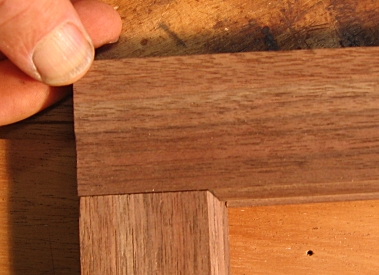
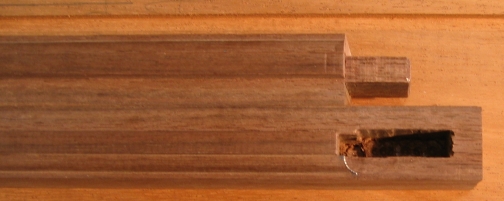
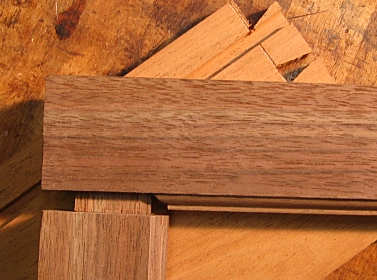
I learned how to do this joint in the Headley shop. It is easy to do and ideally suited for hand tool execution. The result is a handsome joint that won't open with age. I'll try to walk you through it if you want to use it.


Re: Flat panel doors with beads...

#5

Re: false cope

David Weaver

is this a joint typically used with glass?

I'm probably going to stick with a bead, but if I decide to do a joint like you're showing, I think I can figure it out from the pictures.

Re: Flat panel doors with beads...

#6

Re: false cope

Bill Tindall, E.Tn.

is this a joint typically used with glass?

glass or panel, flat or raised.

I'm probably going to stick with a bead,

I don't understand what you mean by "bead"

Re: Flat panel doors with beads...

#7

Re: false cope

Warren in Lancaster, PA

We sometimes use the term bead somewhat sloppily, but David means a moulding with more than 90 degrees of arc; it has a little quirk where it meets the rest of the frame. This makes it so the joint cannot be coped.

Your moulding, Bill, is more properly an ovolo or a quarter round, although we sometimes do refer to it as a bead when the other person knows what we are talking about.

Re: Flat panel doors with beads...

#8

thanks....got it.

Bill Tindall, E.Tn.

A "quarter round" with a flat panel is so common I didn't think beyond this possibility. And I am not sure "false cope" is the right name either.

Re: Flat panel doors with beads...

#9

Re: Flat panel doors with beads...

Derek Cohen (in Perth, Australia)

David, no doubt you do not need advice here, so I add this to contribute to the discussion.

I’ve done quite a few of these types of doors. This was the first time I posted a build (not flat panel, however) ....

http://www.inthewoodshop.com/Furniture/Buildtheframe.html


Sean Hughto also wrote a nice pictorial making similar doors: http://www.inthewoodshop.com/Furniture/Making%20a%20frame%20and%20panel%20door.html

Since then I have coped the corners as Bill describes, rather than just mitering them as above. Having said that, the mitres have remained tight over the years.

Regards from Perth

Derek

Re: Flat panel doors with beads...

#10

Re: Flat panel doors with beads...

David Weaver

That's exactly how I intend to make the doors. My only concern is whether or not the bead will sit too high above a flat panel aesthetically. The raised panel brings some depth up to the level of the bead.

Re: Flat panel doors with beads...

#11

Re: false cope

David Weaver

warren clarified it. I didn't actually know what you meant by "I don't understand the bead" comment.

But, I see now. I'm naming the effect based on the plane that cuts it (a side bead).

Every style of flat and glass door that I ever saw working in a cabinet factory was coped. That's not true across the board, I'm sure, but the doors that were made at our factory were cope style unless they had a raised panel - some of those were mitered frame. Of course they were just fast mass-produced stuff (but solid wood), but they didn't stray much on the traditional arch and flat styles back then.

In 3 summers that I worked in a cabinet factory, I have to admit that I never thought I'd do any woodworking, so I didn't look at anything that closely. I was just there because they paid almost twice as much as working in a restaurant.

Re: Flat panel doors with beads...

#12

Example of joint with panel

Bill Tindall, E.Tn.


Re: Flat panel doors with beads...

#13

same experience

Bill Tindall, E.Tn.

"Since then I have coped the corners as Bill describes, rather than just mitering them as above. Having said that, the mitres have remained tight over the years."

I mitered the 1/4 round on M&T doors until recently. Like you, I have a dozen or more doors and side panels for chests done this way and none of the miters have opened in decades.

The miters are more fiddly to get perfect. The cope is more fun to make.

Re: Flat panel doors with beads...

#14

Re: Flat panel doors with beads...

Bill Tindall, E.Tn.

Personally I am not picturing an attractive result from the bead. Beads were easy to make in 1720. Yet I can't recall ever seeing a door made with a bead as you intend to use it. The scarcity of this decoration would give me pause. When in doubt, mock it up.

Re: Flat panel doors with beads...

#15

A fundamental question...

Jim Matthews

If the bead isn't structural (if the panel rises in a recessed groove) is making the bead integral required? Moldings are applied, why not beads?

It seems an expensive way to display skill, with lots of downsides.

Re: Flat panel doors with beads...

#16

Re: A fundamental question...

David Weaver

The bead could be applied, but making the bead separately with hand tools will take longer.

I don't know how common scratching straight beads is, but now that I've got my small beader set up so that it's working well (and safely), I'll do a better job with it than I could scratching.

The aesthetics may not be that great, but ..I can always take the doors apart and remake them if it doesn't work out.

Re: Flat panel doors with beads...

#17

small bead

David Weaver

I'll try a couple of mock ups - my planes are slipped. I'll have to look closer at them, but I believe the slips will allow me to sink the bead further if desired (Than just at the surface).


This isn't a door, just testing the plane coming and going on the same board edge. This board is about 1 1/4" thick for scale of the bead. If it looks bad, I can go bigger and sink it closer to the door.

I'm looking for something kind of plain looking but a little bit different - but my senses about it could be off the mark. I've got roundover bits for guitars and could just use one for the coped look - but I like the mitered corners. They will probably open up at some point in the future, but hopefully i'll be too old by then to notice. If they do, this is a putty grade cabinet. I'll fill them.


I have a couple of small things to do other than the doors. It's clear that the bottom of the top case should have a thin moulding of some sort applied around, but I'm going to wait until the doors are on so that I can just just what it should be and how far out it should come.

Lobbying the mrs now to not stain this thing dark but rather french polish it with button lac.

Re: Flat panel doors with beads...

#18

agree

Bill Tindall, E.Tn.

"The bead could be applied, but making the bead separately with hand tools will take longer.

Applying any sort of edge molding on a panel door will take longer, hand or power tools. If there is one thing I have learned over and over (I'm a slow and stubborn learner) it is that I am unlikely to improve on the way furniture was put together in 1820. How the parts and joints are made varies but not the engineering. If the technique survived in professional shops for 200 years one can be sure the technique is both reliable and efficient. These two attributes were essential for success. Exceptions are when a modern design has little to do with what was made in 1820, Danish Modern for example. Then new engineering must be invented.

All the things a beginning woodworker needs to learn to build like stuff was built in 1820 is daunting. If you need a place to store socks, my advice would be to build it with what ever skills and tools you have. On each project learn a new skill or buy a new tool that moves the capability toward the ideal.

When my wife and I moved into our first unfurnished apartment I built a couch and two end tables from plywood, screw on legs and stock molding, with a hand saw (both are still in use). The best way to put a drawer together is with dovetails. My first drawers were sides nailed in rebates, followed by a Sears dovetail jig, then a Keller jig and eventually hand making them. (the only drawers that did not hold up were made with the Sears dovetail jig. ) My early furniture survived surprisingly well, but it is not heirloom in quality and/or design

Re: Flat panel doors with beads...

#19

I think it will work

Bill Tindall, E.Tn.

With the picture in mind I could vision a panel inset and a mitered corner and it looks attractively modern, which is in keeping with the unconventional cove at the base, that also worked. I would find it a challenge to keep the bead registered in the miter, but you will pull it off. Splining the miters?

Lobbying the mrs now to not stain this thing dark but rather french polish it with button lac. I hope you succeed. You could lac it and put in service with the claim you will get to staining it when you get time....... ;)

Re: Flat panel doors with beads...

#20

Re: I think it will work

David Weaver

Good point about the cove at the base, and probably as well with the interrupted cyma recta. There's nothing conventional about any of it - the chance that it turns out ugly is there, but it won't be a situation where the rest of the thing looks historically correct and one element doesn't.

I simply don't know enough about furniture and haven't been thrilled to look at furniture (aside from the spectacular mellon family duds they have on display here at the carnegie museum of history - it's hard not to be inspired by that stuff, but they don't let you try to work the bits and bobs on the roentgen desk or fiddle with some of the philadelphia and boston furniture - the quality of the carvings on even well known styles there is otherworldly - I've never seen anything like it in person. The shells, etc, are absolutely perfect, crisp and sharp, as if they'd been made 10 minutes ago by an alien).

Anyway. I could write a book - like some other people seem to do - make a piece of furniture, write a book about it. It would be called "everything I know about furniture, I learned on the assembly line at Aristokraft".

Separate and aside, the outside of the doors will be plain, so I'm hoping the small plain interior bead will be OK.

Re: Flat panel doors with beads...

#21

Efficiency or affectation?

Jim Matthews

"If the technique survived in professional shops for 200 years one can be sure the technique is both reliable and efficient."

Where archeology studies the state of the art in antiquity, Architecture embraces what is most viable, today. Why should working with our hands be limited to what we can divine from millenia old engravings?

https://youtu.be/k69YgtS1CD0

"If you want a place to store socks."

Bless your heart.

Re: Flat panel doors with beads...

#22

Re: Efficiency or affectation?

Wiley Horne

Hi Jim and all,

If you quote Bill’s whole thought, he covers it all, including modern exceptions:

“ How the parts and joints are made varies but not the engineering. If the technique survived in professional shops for 200 years one can be sure the technique is both reliable and efficient. These two attributes were essential for success. Exceptions are when a modern design has little to do with what was made in 1820, Danish Modern for example. Then new engineering must be invented.”

What is modern?... 1800 ogee, Gen. Grant’s war memoirs, 1780’s Constitutional debates—these bring the olde tymes current.

Wiley

Re: Flat panel doors with beads...

#23

?

Bill Tindall, E.Tn.

I had to look up "affectation". Not a word we use much in East TN. "artificiality of manner". Well, still have no idea what you were trying to say.

I have been reading the Federalist Papers. Now there is a challenge in reading comprehension. There are sentences that go on for a paragraph. Some essays have more commas than periods. But the struggle is worth the effort to see reasons for why the constitution was written the way it was written. Without the Internet it is amazing the depth and breath of knowledge the authors had back them.

Re: Flat panel doors with beads...

#24

Your sentiment in furniture..

David Weaver

..is my sentiment for tools, and when I do make furniture once in a while, I want to find the people who think about furniture like I think about tools.

I'm sure that some of the current guys can make ends meet by using screws and they maybe can't market "fine furniture" without doing that, but I don't think anyone will be swooning over it in 200 years.

Is it necessary? Of course not, but it's desirable. My dad made a whole bunch of functional furniture for us with pine board and nails and brown stain. I did it carefully, but I don't remember anything other than a jigsaw, sandpaper, glue, nails, sanding and a circular saw. It's all still together and nothing is sagging. But I live in a small house and don't want to fill it with that stuff.

It's interesting, since I knew nothing about doors at Aristokraft when I worked there, that so many of their solid wood doors have changed very little in profile over many 200 years old. There are more cope and stick joints (I have no idea what they make these days, that was more than 20 years ago) than M&T, but the style looks a lot the same. It's enduring.

Re: Flat panel doors with beads...

#25

The aesthetic at this point...

David Weaver

this isn't glued, just clamped together for look. I moved the groove forward of center, which may be suspicious, but it works better with the smaller bead. Otherwise, George's tip to me of not mixing straight lines and curves in a single element is broken at the transition of the bead into the frame (e.g., a round bead and a straight tall area down to the panel looks worse).


https://i.imgur.com/K3t8P34.jpg

I could get faster at these (I think it'll take me 2 hours to profile the sticking, plow grooves, mark everything up and get a fit of this quality - 2 hours per door, and could maybe get it down to 1 by the fourth door), but the penalty for hurrying is shortening the height of the door to close these little miters and the result would be problematic.

👍 This page answered my questions

Your vote helps other woodworkers quickly find the answers and techniques that actually work in the shop.