miter making aid
Bill Tindall, E.Tn.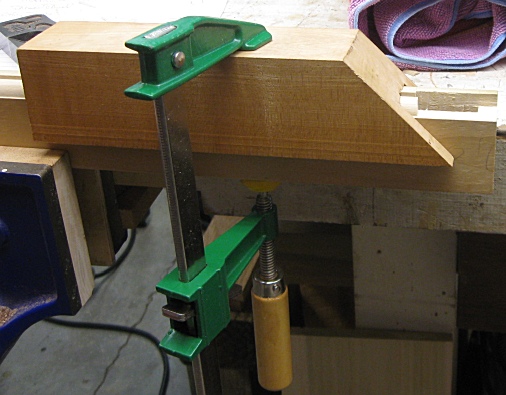
With this angle block it is a simple matter of paring to perfect fit. Yet another Headley shop aid.
Est. 1998 — 27 years of woodworking knowledge
miter making aid
Bill Tindall, E.Tn.
With this angle block it is a simple matter of paring to perfect fit. Yet another Headley shop aid.
Re: miter making aid
David Weaver
Indeed, I made one similar to that (a little smaller, but same idea) when I made my kitchen cabinets.
The uber lazy (like me) can be enticed into trying to cut both corners exactly to size on the first go, but in my experience, that can result in loss of door height if the first guess is a bit of an overcut.
There's probably a whole world of competence and speed and sense that I could get with this joint if I did 25 doors, but (hopefully) I won't have that chance. Just hoping to do it only once each door this go around.
Sharpening method with the shallow angle and the buffed edge is the bees knees for this work. Cherry works like mahogany - for the first time, I've pared the shoulders of these rails to the mark (quickly) rather than laying them on the bench and chopping.
I saw a video online of an instructor (someone legitimate, can't remember his name) showing a very shallow chisel used only for shoulder cleaning, but I never liked the edge damage those take in anything less than ideal wood like pine and mahogany, and the corner always erodes on a tool like that.
I did all of the work so far with a sorby chisel, of all things.
Re: miter making aid
Bill Tindall, E.Tn.
I did all of the work so far with a sorby chisel, of all things.
I liked the chisels but the edge was so useless I sold them. What is the primary bevel on the sorby and how much covex are you adding....about 10 degrees?
Re: miter making aid
David Weaver
It's the same chisel that you, wiley and I talked about. It's primary ground just under 20, with a 25 degree and then the edge is buffed, so it's rounded over.
I suspect that the tiny rounding is better than a 35 degree flat facet, but have no proof.
The sharpness is otherworldly - from the buff pictures that are in the short thread, I can't match it by hand in any reasonable period of time.
Refreshing the edge is about 15 seconds on a diamond hone and 15 seconds on the buff (5 seconds of actual buff time and then some back and forth on the soft corners of the buff to remove any scuzz that hangs on at the edge).

The diamond hone removes the buff's work each cycle so there is no compounding error. The one thing I always hated about power sharpening stuff is that it's either not that great or for a polish at an edge, you traded a bunch of geometric problems (or it was gadgety). This has none of those issues and it's cheap.
question
Bill Tindall, E.Tn.
Refreshing the edge is about 15 seconds on a diamond hone
Is this refresh at 25 degrees?
Do I have this right..........?
primary bevel 20 degrees established by hollow grinding,
secondary bevel about 25 degrees established by diamond hone
tiny convex edge established by buffing.
Philosophically, 20 degree primary makes for easy establishment of 25 degree and renew at 25 with fine diamond. ? .
Tiny convex bevel provides strength but easy to renew at 25 degrees because the 25 degree bevel is short. ? .
exactly correct...
David Weaver
that's exactly what I'm doing. Surprised when measuring the primary that it was that shallow, but it facilitates it and I guess you just do it automatically.
I'm sure the very terminal edge of the rounding is steeper than 35, but it's tiny (and I'm sure most of it is less than that and closer to the 25). I'm sure it could be duplicated on linde B and leather, but I have no idea what the equivalent is and leather can get contaminants easier.
I don't really understand how the buff never seems to get dirty. Mine literally sits below the grinder (which understandably has less mess than in the past as the wheel is cbn - it's just metal filings flying around), and I've never done anything to clean anything out of the buffing wheel. I guess everything just flies out of it.
Wiley may have triggered this as I couldn't get a good edge on the SGPS knife he suggested with anything but deburring wheel (not used here...too harsh) and the buff. And then I realized that I could use the buff and deburr to do most of the sharpening on an incannel gouge (Which goes through stuff like snot when sharpened like this and is handy for all kinds of fitting stuff and trimming where a chisel can spelch or require too much force)
Re: exactly correct...
Wiley Horne
David,
Regarding the SGPS knife, the Fallknivn factory description says they put a small convex finished edge on the knives. They don’t explain why; the obvious reason would be the added durability you are describing.
I’m glad Bill recapitulated the exact edge geometry, thru the full cycle. This is a very significant idea.
Incidentally, I recall that Tools for Working Wood’s oval-bolstered mortise chisels (made by Iles in England of D2) have a 20-degree hollow primary, with a steeper cutting tip (no buffed finish). I thought that an odd geometry for a mortise chisel, like it is begging to get wedged and stuck—but they don’t. Great minds....
Wiley
short version...
David Weaver
..of what I found sharpening a bunch of knives. The SGPS knife is the only one I have left made of wondersteel of any type, but I like it now.
reading around, it seems like there is a preference among some for a knife that doesn't really get that sharp. I saw under the scope that voids were created in sharpening with stones, diamonds on steel, pretty much everything but the buff.
There are levels of sharpness - what's nice in a gouge or a paring chisel is far sharper than "it removes some hair". You could only just get SGPS to remove a little bit of hair, but see the voids under the microscope.
But surprisingly, when diamonds and other such things seemed to just move the steel around and leave voids, the crystolon stone instead wastes it away quickly, and the deburr wheel and the buff unexpectedly make it as sharp as anything else - after temporarily giving up on it and being completely puzzled why anyone would want a knife that gives up little bits of the edge even to a very fine stone.
Somewhere, this fits in the theory of spontaneous something. Set it aside, and at some point, a solution will spontaneously appear.
I have that knife in my pocket now. No clue if any of this kind of stuff is useful to anyone else (I can't imagine, for sure, telling a beginner to use a deburring wheel and a buff to sharpen a knife - like woody hayes would say, three things can happen and two are bad). It gives me something to do not just on really tough knives, but knives that aren't tough (cheap knives are now easily refreshed for scraping work on inside curves).
About a decade ago (or more), i remember George Wilson talking about various things with knives, and when someone asked him what his favorite tool was (expecting who knows what...an HLVH lathe or some exotic infill plane that he made) he said the most useful tool is a good shop knife.
This gives me an idea to experiment with something else on the buffer - related to card scrapers.
Re: short version...
Wiley Horne
David,
Real interested in card scraper experimenting...
What buffing wheel are you using? Can it be bought or approximated on the market? Charged with what?
Thanks,
Wiley
Re: short version...
David Weaver
spiral sewn cotton buff, 6 inches (size doesn't matter, just mentioning to go with the number of stitches) with 8 stitches. Looks sort of like this.
https://www.mscdirect.com/product/details/00533448
I'm sure I got mine for about 6 bucks or something at home depot. Important part is stitching, more than just a little bit, but some fuzzy soft part left outside of the last stitch (there needs to be some give so that the honing compound doesn't build up at the edge of the wheel and so that the wheel doesn't just hone things quickly).
The compound is jackson lea yellow 5 micron al-ox. It's not something special, it's cheap, and I was waiting for a way that it would become useful as it wasn't good on MDF. It's $10 a *kilo*.
The deburring wheel (used here to remove file marks, but way too aggressive for chisels, etc) is a gray scotch brite brand wheel.
The buffer is the cheap 6" harbor freight buffer. Sometimes it's nice to have something you can beat on to experiment without worrying. high speed (about 3600 rpm). It's really a punchless little buffer for anything bigger than small items, but I've never been able to bust it.
I've used lots of different buffs before - hard leather, felt, etc, and they're too aggresive -they hone and create geometry problems. Running into all of this is by chance and all of the bits and bobs aren't being used for what bought them for (as in, freebie experiment and not putting good money toward something potentially worthless). I use the deburring wheel for toolmaking and cleaning old tools, as well as basket case razors, and the buff for cleaning up razors (or used to when I was doing that) and general buffing of anything with light scratches. It's nice for that.
leather?
Bill Tindall, E.Tn.
It seems to me leather charged with abrasive will produce the desired edge profile. yet to try it. Need to get a desk made before doing experiments. For chopping on ash with a Narex just rolled the chisel on the 1 micron plate. Worked till I chipped an edge off. I was not being tender with it. Optimum...unlikley.
it will, but it hones fast..
David Weaver
my very first experiment with this stuff was a layered wheel in a lathe with the green stuff. It hones fast, but touch could be developed quickly with it. I've noticed in the past when someone uses those wheels, they get lazy and chase a fat part of the front edge up. If the self-enforced rule is to hone all evidence off at 25 degrees each time, it would stop that behavior and keep the edge behind the front roll thinner.
There are some reasons that I didn't like the leather that I can't remember - perhaps it raised the wire edge, heat, dirty and contaminated easily or glazed? I remember throwing away the accessory kit that went in the lathe chuck and included a leather wheel.
On the buff, you can just push the tool into it and not much happens, and then if there's any wire edge, the corner is soft and it just removes it (plus you can buff other things with it).
clarification of leather
Bill Tindall, E.Tn.
I was thinking of using a abrasive charged leather strip and doing the convex bevel by hand. Pull blade across the leather while rolling it up about 10 degrees. Seems it should work.
Re: clarification of leather
David Weaver
ahh...yes, should work. some pressure into any leather (paddle strop, whatever) would work well, too and maybe be a little bit more precise.