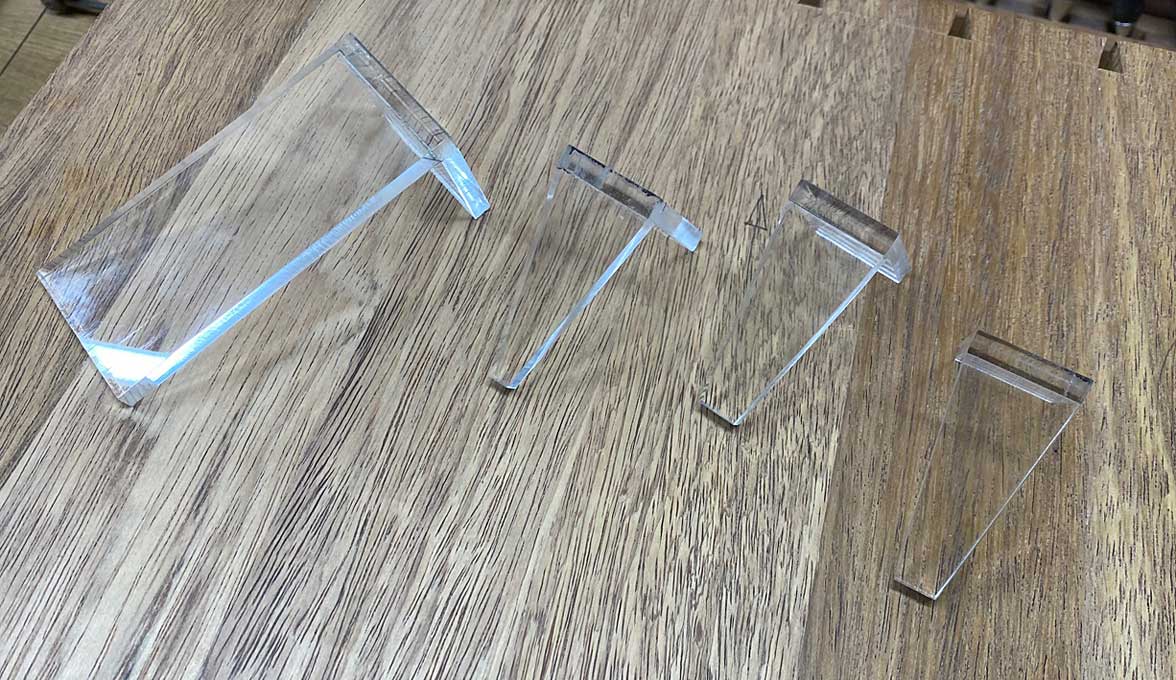
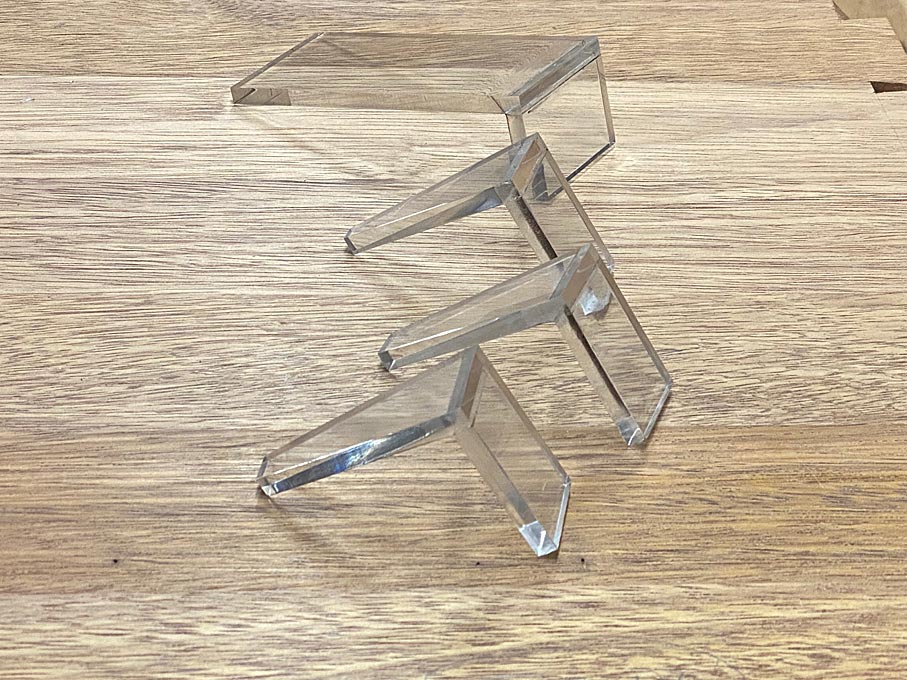
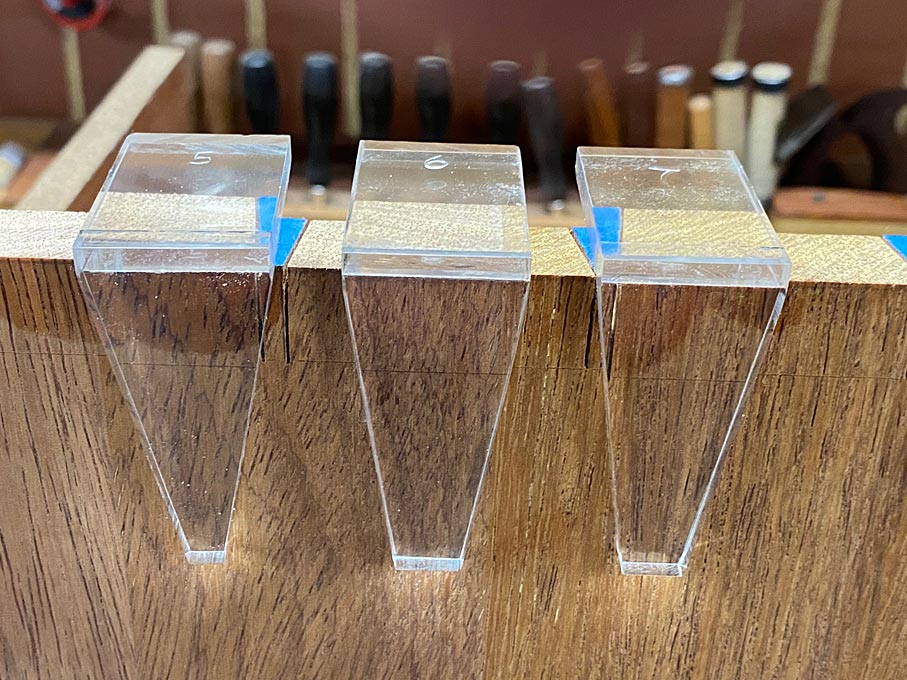
Make a set of the Magical Dovetail Markers for yourself, or as Christmas presents
These dovetail markers are rather fun. Also very practical. For some time I’ve been wanting to make a few see-through markers as they obscure less, and make it a little easier to see where your lines are going.
These are made of 1/4”-thick Lexan, which is a polycarbonate resin sheet.
Details of building the markers on my website (too many photos to post here) ...
Great tutorial, and its transparency makes an important improvement to dt markers. I'm going to have to attempt it.
I have some questions:
Why use CA, since it is not permanent and gets brittle after a couple of years? There are glues which are specifically formulated for Lexan. They are mostly methylene chloride, even thinner than CA, and wick between two Lexan parts.
Note that I have used this glue. In the name of cheap, I decided to buy a rather large can of it, thinking I would use the leftover on the next projects. That didn't work. I couldn't effectively reseal the can and lost most of it to evaporation. Next time I have a small project (like your gauges), I'll get the smallest size tube available.
I also have a procedural question: Since you are making multiple gauges, why not start by gluing up two long pieces of plastic into an L-channel shape and then cut off the individual gauges on your tablesaw or chopsaw or even miterbox?
It seems that you could use a couple of 1-2-3 blocks for alignment if using the dedicated glue, since it won't stick anything together except the two pieces of plastic, and then not need to worry about the squareness of your UHMW setup blocks. I understand that we are using what we have on hand, and you have these pieces of UHMW, while I have a couple pairs of setup blocks. The incompatibility between UHMW and CA is useful to know, so I will file it away for my next project using the slippery stuff. If I were using CA, however, I wouldn't want to try to separate the Lexan from the steel blocks.
I used what was in the workshop. I was about to start on a dovetailed case, and the thought to make the markers had to be followed up there-and-then!
Someone mentioned to me that CA glue is not strong enough. So I went to a couple I had made and tried to pry them apart, bend them, to see what would happen. Nada. They remained strong and stiff. Short of wacking them with a hammer, I see them lasting. How many years? To me that is irrelevant since I view these tools as throw away ... if they give you 5-10 years, what more can one ask? In any event, the markers do not get stressed, so hopefully they will last.
If I was making them for production, for sale, I would do exactly as you suggest. And I would recommend that others here follow your lead, not mine.
..for some reason, I always found dovetail markers irritating because you can't see what's under them and have to move them to see it and then guess where it is.
The CAis very strong. It's problem is that it gets more and more brittle with time. I don't know the rate of change, or the other conditions that might affect how quickly it degrades, but eventually, just dropping it on the bench might cause the joint to separate. But I agree with you, they are so easy to make, just expect that some day you may have to make some new ones. There are lots of other ways in the shop to break them.
Here is a well presented video of expert techniques for assembling custom items from acrylic or Lexan.
Both plastics use the same techniques and the same glues. Like CA, the glue is made in different viscosities. His techniques use the #3, which I think is the thinnest. He uses MDF blocks for insuring the plastic pieces are in the right place and square, just like in your tutorial. But, importantly, he uses a two step process, first spot welding the joints so the glue doesn't touch the jig blocks, and then removing the blocks and continuous welding the whole length of each joint. This is probably a lot more care than is needed for some DIY dovetail jigs, but he has some very high end customers.