WoodCentral Forums

Est. 1998 — 27 years of woodworking knowledge

Search query: «richard raffan»

Posts

Turning » Re: Suggestions for lathe and turning tools »

#1

Casey,

Big topic with lots of info.  Here is the Reader's Digest version.

  1. Find and join a "local" turning club.  Best source for information and mentoring you can get.

  2. Avoid YouTube for education.  There is lots of excellent content on YouTube, but there is lots of dangerous content too.  Just because a person has a camera at their lathe does not automatically make them qualified to mentor turning.  Go back to Item #1.  Having said that, here is an abbreviated list:

    1. Richard Raffan

    2. Mike Peace

    3. Sam Angelo

    4. Tomislav Tomasic

    5. John Lucas

  3. Read some books:

    1. Woodturning: A Foundation Course; Keith Rowley

    2. Getting Started in Woodturning; American Association of Woodturners

    3. Turning Wood; Richard Raffan

  4. Basic Tools.  Don't buy junk.  NOTE:  I am not a fan of carbide scraping tools.  I prefer cutting tools.  Make sure you get tool handles if they are sold separately.

    1. 1/8" parting tool

    2. 3/4" skew

    3. 3/8" spindle gouge

    4. 3/4" spindle roughing gouge

    5. 1/2" bowl gouge with elliptical flute (Bar diameter is 1/2".  English bowl gouges are typically measured across the flute so a 3/8" Robert Sorby bowl gouge is really a 1/2" tool)

    6. 3/4" radius scraper

  5. Tool brands I recommend for basic tools:

    1. Thompson

    2. Robust

    3. D-Way

    4. Sorby

    5. Hamlet

    6. Henry Taylor

    7. Carter and Son

  6. Where to shop for tools, accessories and lathes (I am assuming you are in the United States)

    1. Directly from these makers

    2. Craft Supplies USA (woodturnerscatalog.com)

    3. Packard Woodworks (packardwoodworks.com)

    4. The Woodturning Tool Store (woodturningtoolstore.com)

    5. Rockler Woodworking

    6. Woodcraft

  7. Needed accessories:

    1. Safety

      1. Face shield

      2. safety glasses

      3. dust collection

      4. dust mask (N95)

    2. Shop accessories

      1. grinder with type I, J or K wheels (white wheels; not gray wheels)  Rikon has a half-speed grinder set up for woodturners

      2. sharpening jig; Oneway's Wolverine is the industry benchmark

      3. assorted sanding discs and paper

        1. I use 2" sanding disks; 3" sanding disks and 3" fabric-backed rolls; grits from 80 to 600

      4. broom

      5. task lighting

      6. outside calipers like Veritas

      7. There are dozens of other items that turners use.  Learn those as you go)

  8. Wood

    1. You can buy ready-to-go turning blanks (easy way to get started, but can be expensive)

    2. You can harvest/gather your own wood (most woodturners gravitate here, but this requires some tools to process the wood:  bandsaw and chainsaw are typical)

    3. Stick with domestic species as you get going

  9. Lathe:  lots of choices and price points.  Tomislav did a video recently with a lot of good tips and recommendations

    1. Youtube:  "All You Need To Know When Buying A Wood Lathe"  https://www.youtube.com/watch?v=ga2K7eR58LI

  10. Lathe accessories

    1. 4" Chuck (Vicmarc, Oneway, Sorby, Record Power, Axminster)

    2. 3" faceplate (probably comes with the lathe)

    3. drive center

    4. live center

    5. lots more that you will accumulate over time

  11. Finishing supplies (a topic for another day.)  

    1. Maybe some wiping oil to start.  I recommend Mahoney Oil.  It is food safe, drying Walnut oil.


I'm out of gas..

Joe

Turning » Re: Turning boxes lately »

#4
eliot feldman wrote:

I find these boxes to be very fine indeed. I also have been turning boxes, a bunch of them recently; and they really look a lot like yours( if I may be so bold to say so.)So here's a technical question: a couple of my box turning heroes are Richard Raffan and Ray Key. Raffan sands with dry sandpaper, but Key always uses wax with his sandpaper. What do you do? And why?

Richard sands with whatever works best.  I saw him turning some architectural boxes from some very dry ash.  He was sanding that dusty mess with sandpaper and spritzing with water to hold down the dust.  He also doesn't spend much time sanding and usually does not go much finer than 220.

I have used water, oil, paste wax and beeswax mixed with mineral oil over the years to sand various timbers.  I like the mineral oil and wax mixture for exotics to reduce the friction and prevent heat checking.  On the thin end grain of some of my boxes heat will cause the lid to crack and that makes one say bad words.

Turning » Re: Turning boxes lately »

#5

I find these boxes to be very fine indeed. I also have been turning boxes, a bunch of them recently; and they really look a lot like yours( if I may be so bold to say so.)So here's a technical question: a couple of my box turning heroes are Richard Raffan and Ray Key. Raffan sands with dry sandpaper, but Key always uses wax with his sandpaper. What do you do? And why?

Turning » Spillikins (aka Pick-up-sticks) »

#6

I've been working on a set of spillikins. The project is a nice skill builder. Richard Raffan's advice is to use a chuck for holding. Alas, I have no chuck jaws, so I'm turning between centers. I complete the trickier shaping off the lathe using a drill, files, and sandpaper. The one in the second pic I changed the center a bit. Thinnest cross sections are 1/8  or so.spillikins.jpg
picker_136.jpg

Turning » Re: suggestion for a food safe finish that will/may not darken the wood as much as Walnut oil »

#7

Re: suggestion for a food safe finish that will/may not darken the wood as much as Walnut oil

You could always go with no finish. Richard Raffan has commented that no finish is a very good option for many items. If the item looks darker when wiped with distilled water (safer than tap as no minerals present that may discolor), then it will likely look darker with pretty much any finish. Even an unfinished item will develop some sort of patina after years of service, especially one that will see the repeated contact with food like what you are describing.

I'm thinking no finish may well be the way to go.

My best guess.


Turning » Re: Question how to? »

#8

Re: Thank you

Practice on some poplar or similar softer wood first.  You can make the concave hollow with push or pull cuts. 

For push cuts you can use a spindle roughing gouge, spindle gouge, or bowl gouge.  Begin at the center and work out taking light cuts.  A bit much to explain a push cut in a few sentences. 

For pull cuts you can use the left wing of a spindle gouge or bowl gouge.  Again a bit much to explain in a few sentences.

Richard Raffan once or twice a week is posting usually shorter videos on Youtube.  He is excellent at explaining as he demonstrates.  I don't think he has a video just on push and pull cuts though.


Turning » Re: How 'Bout This »

#10

Re: How 'Bout This

Took a 1-day class with Mike Kehs many years ago. He was teaching a technique he was using to create thin walled vessels to pierce like Bin Pho. So basically, for this class, straight walled vases with about 3-4" openings.

I didn't quite have the skill (and probably still don't) for it. He used the same gouge presentation to go down the inside wall. Biggest problem I had was failing to turn the gouge at precisely the right instance when reaching the bottom. Worked pretty good for the walls, but that bottom turn was tricky.

On another note, Richard Raffan uses a 5/8" spindle or detail gouge to shape the outside. Even though the steel is substantially thicker, they are cheaper (or were, haven't priced of late) than the equivalent bowl gouge and subject to less vibration. I have one and like it. Think it is a Thompson. Also is pretty good when making those Sfirri multi-axis candlesticks. And with a spindle/detail grind, you get a long edge to use for shear scraping should you choose to do so. (Is Thompson still selling gouges? Don't see any ads in the AAW Journal anymore.)


Turning » Re: How Thick Is Thick Enough? »

#12

my opinion

John K Jordan

I have no guidelines. I use my fingers to feel the thickness but I never measure. I rarely use calipers except on pieces with openings too small for my fingers. The size of the piece does make a difference.

Besides the appearance, I think part of the aesthetics is the weight and balance. I don't like bowls and forms that are too light in weight unless they set on a shelf and are not meant to be used. When I do demos on my small dished platters I always get more complements on the heavier pieces than the lighter ones. A thin wall is sometimes a badge of honor to a turner but the bragging rights don't mean much to a non-turner. A light weight piece can feel cheaper. And certainly more fragile - I heard the story of a piece so fragile from super thin walls that a breeze blew it off the table and smashed it.

I like the balance towards the bottom, especially if the piece is going to be used. Almost everything I turn is to be used. Heavier on the bottom makes it more stable. When turning the piece in the hands you can sense the balance and center of gravity; a "bottom heavy" piece feels better to me that a one that's top heavy. If the wall thickness is the same all the way from the base to rim the larger diameter at the rim puts more wood near the top and to me it can feel top heavy.

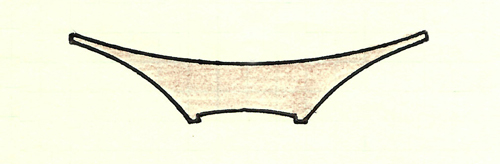
So how to get the piece heavier and the balance "right" without making it look too crude and clunky? Make the base thicker and the rim thinner. This obviously won't work so well when turning wet wood to finish because the thicker base may crack. But almost always turn dry wood, or rough turn green and finish turn after good and dry. I don't hold with those who insist on an even wall thickness all the way down the piece. That's fine for them. One guy I know turned that way because someone told him that's the way it's "supposed" to be done.

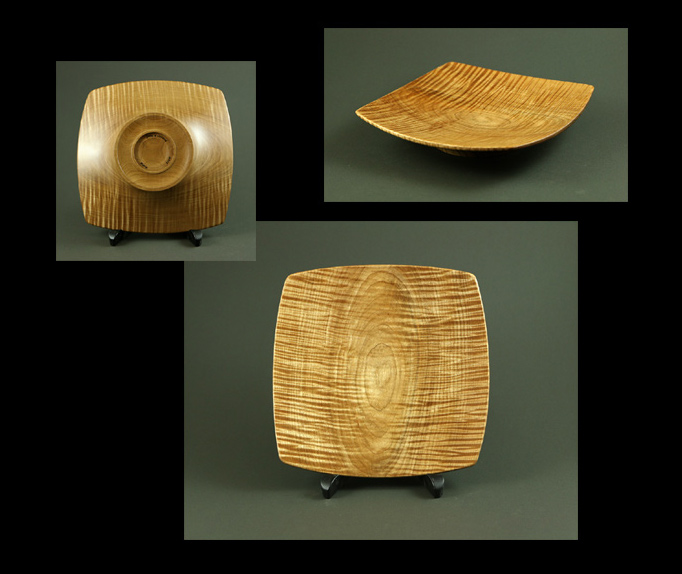
The base on these small dished platters is thick, the rim fairly thin. The thickness is evenly tapered from near the rim. I think they feel great in the hand and are very stable on the table.


Crude sketch of a typical cross section:


When I make Beads of Courage lidded boxes I purposely make the base extra thick for extra stability so a child who may have coordination problems won't knock it over easily. Do the tip test - push the side of the top with the finger and see if it feels stable. I think yarn bowls should be heavy and stable enough so they stay in one place while the knitter pulls yarn out.

Richard Raffan give this advice about wall thickness and balance: when you turn a piece and like the balance and feel, put it on the bandsaw and cut it in half to see the cross section. If you turn a piece and don't like the balance an feel, put it on the bandsaw and cut it in half to see the cross section.

This might seem like an extreme thing to do for the beloved results of hard work but it can be enlightening. One thing is to quickly turn a number of "test" pieces from cheap, boring wood without spending time on finish cuts and sanding. Turn them with different thickness profiles and see what looks and feels best to you then cut those in half.

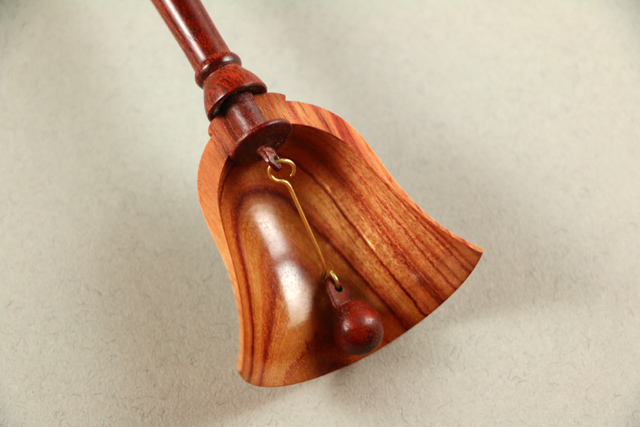
I've cut a number of things in half like this and it's helped me develop what I'm happy with today. This is a small handbell Christmas ornament, cut in half mostly to show others how I make the cross-section. In this case the balance is not important but the strength is. Since the rim is thin, the whole thing may appear and feel thinner than it is.


BTW, the side taper does add a lot of strength. I have made a couple of bells very thin (.020 or so) most of the way up the side and I can tell you this - they are fragile! I broke through the side of one just applying Renaissance Wax. But I can make the rim .020 from good wood and it's plenty strong enough for handling if the wall immediately tapers away from the rim.

JKJ

Turning » Re: Suggestions on a classroom finish sought »

#13

Re: Mineral Oil and Beeswax

Mike Stafford

Yes....

Actually I bought 5 pounds of beeswax some years ago which is light yellow to creamy in color. I just shave some off the block and melt it into the hot oil.

This is not a finish for your art pieces. There are a number of disadvantages to using a mineral oil/beeswax finish. First of all it will show fingerprints and it will become grimy over time if the wax isn't thoroughly friction melted into the wood. If the surface is tacky when you are done then you are not done as the finish hasn't properly melted into the wood. It should feel silky smooth but not tacky.

It is best used on kitchenware that people are going to use for food not for your art display items. Richard Raffan used it on his boxes.

Turning » Re: New Turner advice »

#14

Re: New Turner advice

Don Stephan

The "Woodturner's Resource" forum has a videos section and, unlike Youtube, they have all been screened before being posted so the viewer won't be seeing poor mechanics, unsafe practice, and other undesirables.

In my opinion the best videos are by Richard Raffan, but they would have to be purchased. I would suggest buying the books as well. I've had them for many years and always pick up a new detail when I watch them again.

Turning » Re: Excellent video on cutting with the grain *LINK* »

#17

Re: Excellent video on cutting with the grain

Leo Van Der Loo

What is said at 4.20 is wrong, where he starts the circle going down it is going against the grain, the rest is OK.

All this info is/was already in Richard Raffan’s “Turning Wood” book, I would recommend his books any day.

Here is one picture that is that book that shows red arrows for the wrong direction of cutting and black arrows for the right or better direction.


Turning » Re: Turning blanks for boxes »

#18

Re: Turning blanks for boxes

Brad Vietje

I do what Richard Raffan does, but if I had 5 chucks, I'd probably do what Mike Stafford does -- he's produced a lot of beautiful boxes, so he's surely figured out how to do it right.

I have 50 - 60 taped-up pairs in boxes, anywhere from 6 months to 15 years old, so when I need to finish one on a tight deadline, I can get to the finish line pretty quickly. That comes in handy near graduation season, or whenever someone needs an affordable, hand-made gift item.

In my climate, I never seal them, but I rarely use exotic woods, which not only often come waxed (and cracked), but some are oily and don't dry anywhere near as fast as local hardwoods. On a high-priced or high-value piece of wood, I've been known to put the taped, rough-turned pair into a lunch-sized paper bag, but that's as far as I go.

Safe spinning,

Brad Vietje

Newbury, VT

Turning » Re: Turning blanks for boxes »

#19

Re: Turning blanks for boxes

Mike Stafford

I turn quite a few boxes. I used to rough turn the blanks and soak them in denatured alcohol. Then I started rough turning the blanks as proscribed by Richard Raffan, taping the ends together and letting them air dry until I remembered where they were.

Now I decide what kind of box I am going to turn from the piece of wood at hand. I cut it to appropriate length and rough hollow leaving at least 1/2" of thickness. I tape the ends together and label the blank with a date and a name to remind me of what style I intended for the blank although I can usually tell by the general dimensions. I then put the blanks in buckets or boxes and promptly forget that they are there.

When I want to turn a specific style of box I dig through the buckets or boxes of blanks until I find something I wish to turn. Most of the time the masking tape label has come off but I can more or less tell by how the wood feels if it is dry enough to turn. Where I live wood seldom air dries below 14% anyway.

I chuck up the lid blank, true it up and turn the inside of the lid and rough shape the outside. I let that sit in the chuck at least over night. I usually turn at least 5 boxes at a time so I will have 5 lids sitting in chucks. i do all the steps described to all 5 box blanks. The next day I check to see how much the lids have changed, i.e. gone oval due to changes in moisture. Most of the time the change is imperceptible. So I finish turn the lid, make sure the sides of the lid are parallel, sand and finish the inside.

Next I do the same thing with the body blanks. I rough turn them cutting a tenon approximately the right size to fit the lid but not small enough to fit inside. I let the body sit overnight to equilibrate. The next day I taper the tenon on the body to just begin to allow the lid to fit on the taper. Once the lid will sit on the end of the taper I do more hollowing on the inside of the body and shape the exterior to close to finished dimensions. I continue to do this until I get the inside of the body to finished thickness. I then let the body sit overnight to equilibrate.

The next day I turn the tenon so I can jam fit the lid for finish turning. Once I can squeeze the lid on I support it with the live center and turn most of the finished shape. Turning generates heat and sometimes can cause the lid to expand and loosen. So I try to cut it only with sharp tools to minimize heat. Once the lid is turned I can sand and finish its exterior.

Back to the body where I can sand and finish the inside and outside except for the bottom which is attached to a tenon being held by the chuck. Once those areas are finished I can carefully go about fitting the lid. I prefer a suction fit that does not require a strong man to remove the lid. I would like for anyone to lift off the lid without much effort. The problem with box lids is that one day they fit snugly and the next day they are loose depending on humidity. So you pays your money and takes your chances as they say and do the best fitting job for the area where you expect the box to end up. Boxes going to areas of high humidity will expand and tighten up and boxes going to areas of low humidity will shrink and get loose. Cut the tenon to fit. Do not sand it to fit. Sanding results in an oval tenon and you can end up with the dreaded twist fit.

Once you are satisfied with the lid, you can part off the box and reverse turn the body and finish the bottom. The bottom should be finished to the same degree of finish as the rest of the box.

Rinse and repeat 5 times. By doing multiples and repeat the same steps time after time on different boxes it become much easier to get good results. Turning one off boxes gets one off results unless you turn a lot of boxes.

Turning » Re: Turning blanks for boxes »

#20

Re: Turning blanks for boxes

Don Stephan

I follow the process shown and described by Richard Raffan in his companion book and video on turning boxes. It would take several paragraphs to summarize and Shirley I would leave out some key points. I lose a very small percentage to drying cracks. You could weigh and record the weight on a few every week until weight loss stops, but I think they dry amazingly fast - just a few months.

Turning » Re: Why do they still make spindle gouges? »

#21

Re: Why do they still make spindle gouges?

Don Stephan

From Richard Raffan's bowl making book and DVD combo, I learned to use often a spindle gouge for roughing out the exterior of bowls. It is less likely to become clogged with shavings and I believe is less expensive than a corresponding bowl gouge.

Turning » Re: Richard Raffan Finish »

#24

Re: Contact Richard Raffan

John K Jordan

>>... unless you can spin it again, putting on a beeswax finish will be difficult.

You've got that right, Mr Jake!

I have applied beeswax after the fact by warming the wood with gentle heat from a heat gun then rubbing the wax on the wood (like a big crayon) melting with the heat gun. Spread and rub into the wood, reheating as needed.

I suspect the oil and beeswax "paste" finish some people use could be applied off the lathe ok. I have also just rubbed Renaissance wax into bare wood - I'd probably prefer that to bare wood.

JKJ

👍 This page answered my questions

Your vote helps other woodworkers quickly find the answers and techniques that actually work in the shop.