I have been turning for some time now and am always displeased at how clunky my bowls are. I think I need to overcome my anxiety about making bowls too thin. Mine tend to be in the 3/8th inch thick area for a six to eight inch diameter bowl.
So, I am looking for some general guidelines on bowl thickness for general utility bowls. I assume bowl diameter makes a difference, the bigger the bowl, the thicker the sidewalls. I recently cored some that go up to 18 inches in diameter for a set of four.
I have looked in some reference books but find no actual numbers.
Please tell me what you think is the most aesthetically pleasing thickness.
If you turn a recess in the bottom of the bowl you can always remount the bowl on the lathe and turn it thinner or add texturing or other types of embellishments later on. Everyone usually turns heavy wall vessels when they first start turning and over time bring the wall thickness down as they gain turning experience and add tools that allow measuring wall thickness with accuracy. Some people like heavier walled vessels which tend to be more of a utility type item instead of an artistic piece.
I have some 16" bowls here with 3/8" wall. Sold 2 dozen of these over the years with the same wall thickness. My Grandmother's working wood bowl is 12" in diameter and also has a 3/8" wall. It's about 85 years old, but she died in 1961. So it hasn't seen any use since then. Both are fine in my eyes.
I have no guidelines. I use my fingers to feel the thickness but I never measure. I rarely use calipers except on pieces with openings too small for my fingers. The size of the piece does make a difference.
Besides the appearance, I think part of the aesthetics is the weight and balance. I don't like bowls and forms that are too light in weight unless they set on a shelf and are not meant to be used. When I do demos on my small dished platters I always get more complements on the heavier pieces than the lighter ones. A thin wall is sometimes a badge of honor to a turner but the bragging rights don't mean much to a non-turner. A light weight piece can feel cheaper. And certainly more fragile - I heard the story of a piece so fragile from super thin walls that a breeze blew it off the table and smashed it.
I like the balance towards the bottom, especially if the piece is going to be used. Almost everything I turn is to be used. Heavier on the bottom makes it more stable. When turning the piece in the hands you can sense the balance and center of gravity; a "bottom heavy" piece feels better to me that a one that's top heavy. If the wall thickness is the same all the way from the base to rim the larger diameter at the rim puts more wood near the top and to me it can feel top heavy.
So how to get the piece heavier and the balance "right" without making it look too crude and clunky? Make the base thicker and the rim thinner. This obviously won't work so well when turning wet wood to finish because the thicker base may crack. But almost always turn dry wood, or rough turn green and finish turn after good and dry. I don't hold with those who insist on an even wall thickness all the way down the piece. That's fine for them. One guy I know turned that way because someone told him that's the way it's "supposed" to be done.
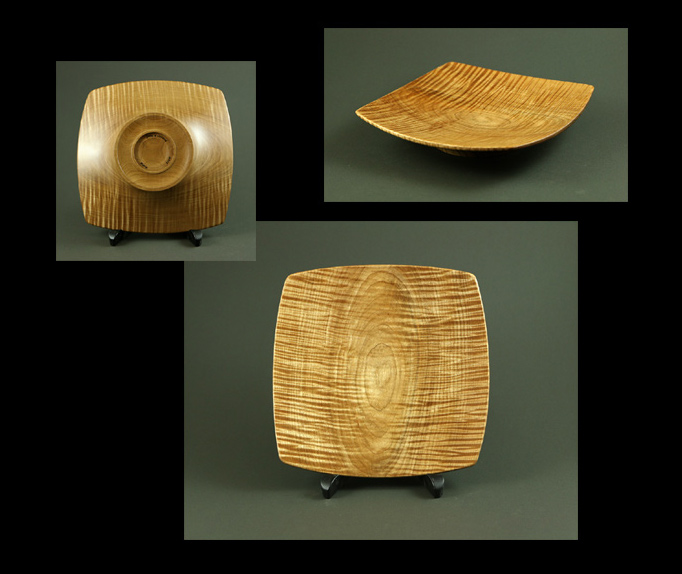
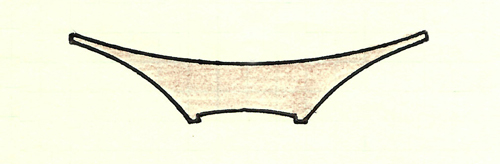
The base on these small dished platters is thick, the rim fairly thin. The thickness is evenly tapered from near the rim. I think they feel great in the hand and are very stable on the table.
Crude sketch of a typical cross section:
When I make Beads of Courage lidded boxes I purposely make the base extra thick for extra stability so a child who may have coordination problems won't knock it over easily. Do the tip test - push the side of the top with the finger and see if it feels stable. I think yarn bowls should be heavy and stable enough so they stay in one place while the knitter pulls yarn out.
Richard Raffan give this advice about wall thickness and balance: when you turn a piece and like the balance and feel, put it on the bandsaw and cut it in half to see the cross section. If you turn a piece and don't like the balance an feel, put it on the bandsaw and cut it in half to see the cross section.
This might seem like an extreme thing to do for the beloved results of hard work but it can be enlightening. One thing is to quickly turn a number of "test" pieces from cheap, boring wood without spending time on finish cuts and sanding. Turn them with different thickness profiles and see what looks and feels best to you then cut those in half.
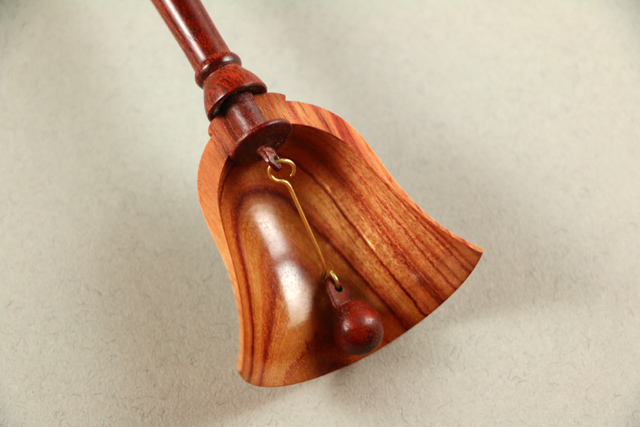
I've cut a number of things in half like this and it's helped me develop what I'm happy with today. This is a small handbell Christmas ornament, cut in half mostly to show others how I make the cross-section. In this case the balance is not important but the strength is. Since the rim is thin, the whole thing may appear and feel thinner than it is.
BTW, the side taper does add a lot of strength. I have made a couple of bells very thin (.020 or so) most of the way up the side and I can tell you this - they are fragile! I broke through the side of one just applying Renaissance Wax. But I can make the rim .020 from good wood and it's plenty strong enough for handling if the wall immediately tapers away from the rim.
Most of my bowls are in the 1/4 to 3/8 inch range, even for bowls up to 15 inches. I do tend to go a little thicker with the lighter woods like BLM, and a bit thinner with more dense woods like the Myrtle/bay laurel. Never below 1/4 inch though. Turned some catalpa once, and at 1/2 inch thick, it just felt too light.
As is often the case, I agree with JKJ. I like for the bowl to feel good in my hands. I find a little extra weight in the bottom feels good. Also, if you turn the walls thin, say 1/4" try leaving the rim slightly thicker, say 5/16". Richard Raffin suggested this, making a "thumb" recess just below the rim. On a working bowl this makes it easier to lift the bowl by the rim. It seems to add just a little strength to the rim as well. I also like to tip the edge of the rim to the inside to make it look like anything that landed on the rim would fall to the inside. This is very slight as well.
The shape of the bowl can lead to the clunky look. Make a nice bulbous curve from the rim to the bottom with no straight lines, just a nice sweeping curve. Make the bottom relatively small and it will give the bowl lift off the table and a sense of lightness no matter what the wall thickness. I would agree with you the walls for a 6-8 inch bowl could be half that thick for a more pleasing balance. It is not any harder to turn a bowl 1/8, than it is to do 3/8.