WoodCentral Forums

Est. 1998 — 27 years of woodworking knowledge

Search query: «#605»

Posts

General Woodworking » Dining Table - re-visited »

Edited #1

Time to re-visit the dining table, and move in a new direction. I have design, this time, a trestle table. The design is aimed at complimenting the (DC 09) chairs. To do this, in part the table legs must reduce clutter, which is the advantage of a trestle table ... the legs are tucked out of the way.The base is to be Jarrah, which is a particularly hard and stiff wood. I have used in in many builds, as many are aware. One of the advantages this has given me is the option of building with thinner stock. All the trestle tables I have seen come with rather chunky legs and stretchers, and this is not the aesthetic I prefer.

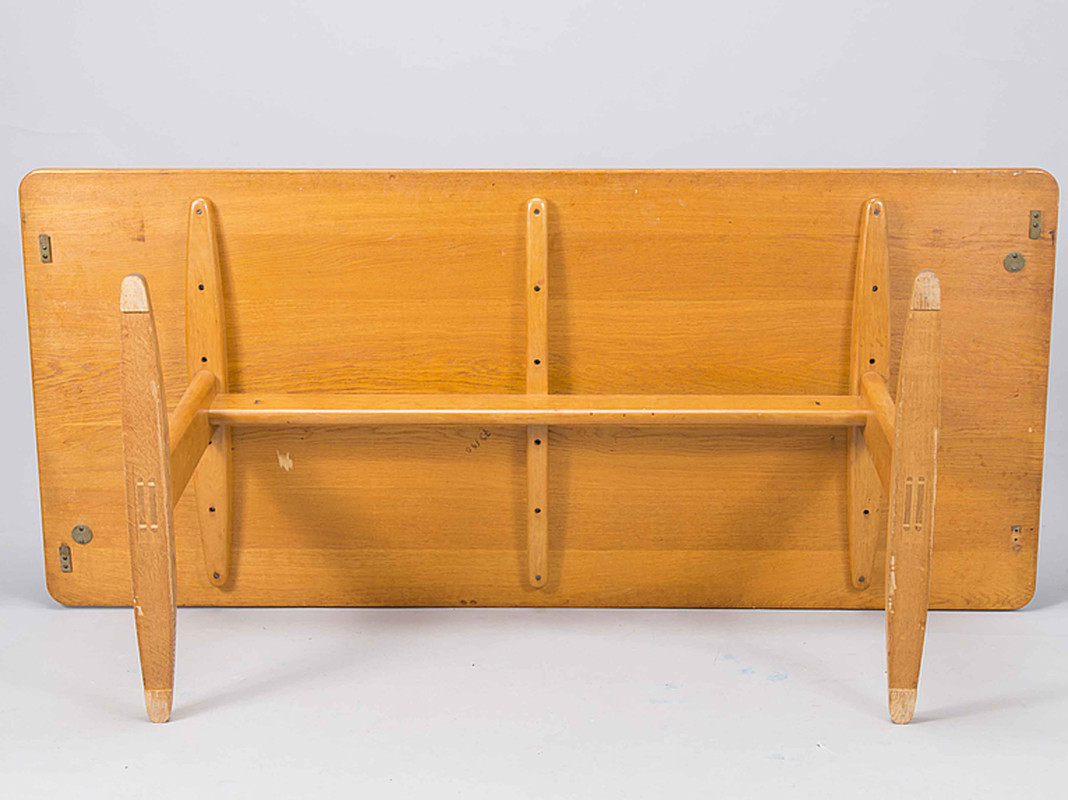
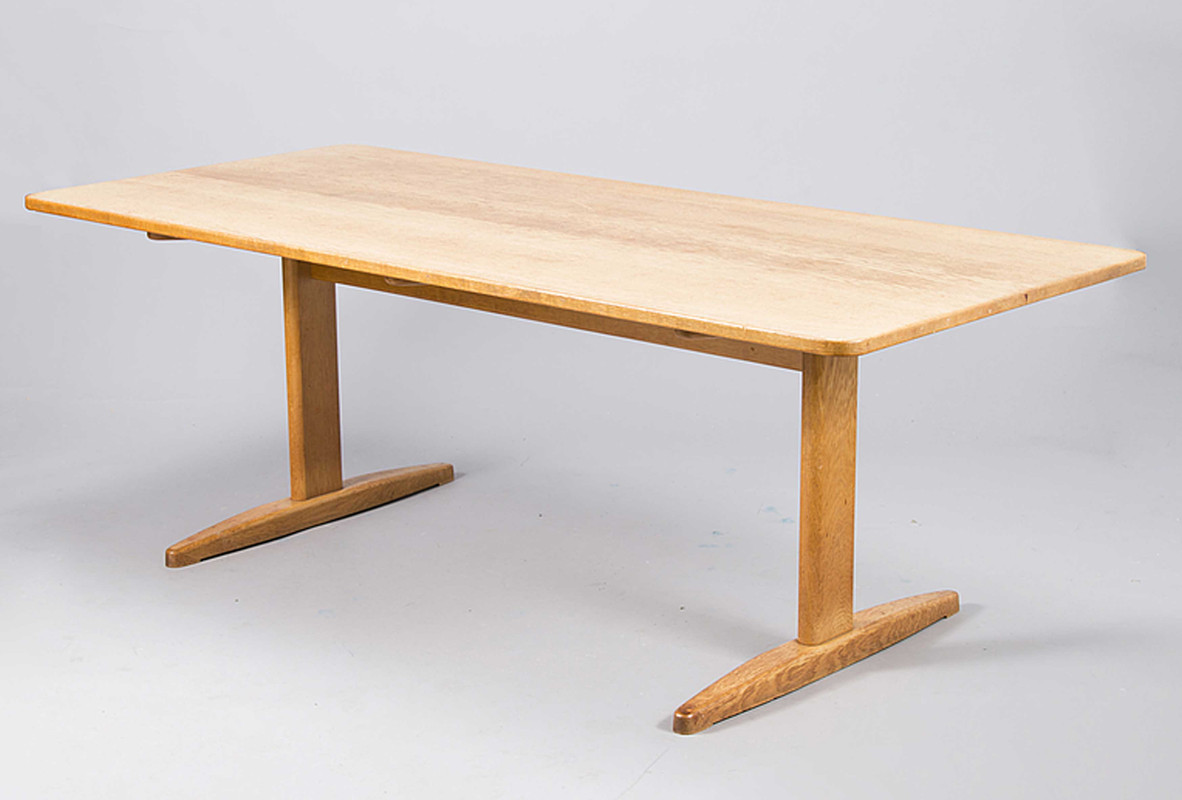
I have made up some basic drawings and plans, but nothing I want to show here. Instead, I am posting photos of tables I found which have similarities - this is just to offer up some concepts to aid in visualising what I am planning. My design is different in important areas, but there are indeed similarities ...Here is a table made by Borge-Morgensen, which has similar dimensions for the parts. The construction is very similar.

Borge-Mogensen1.jpg

Borge-Mogensen3.jpg

Borge-Mogensen4.jpg

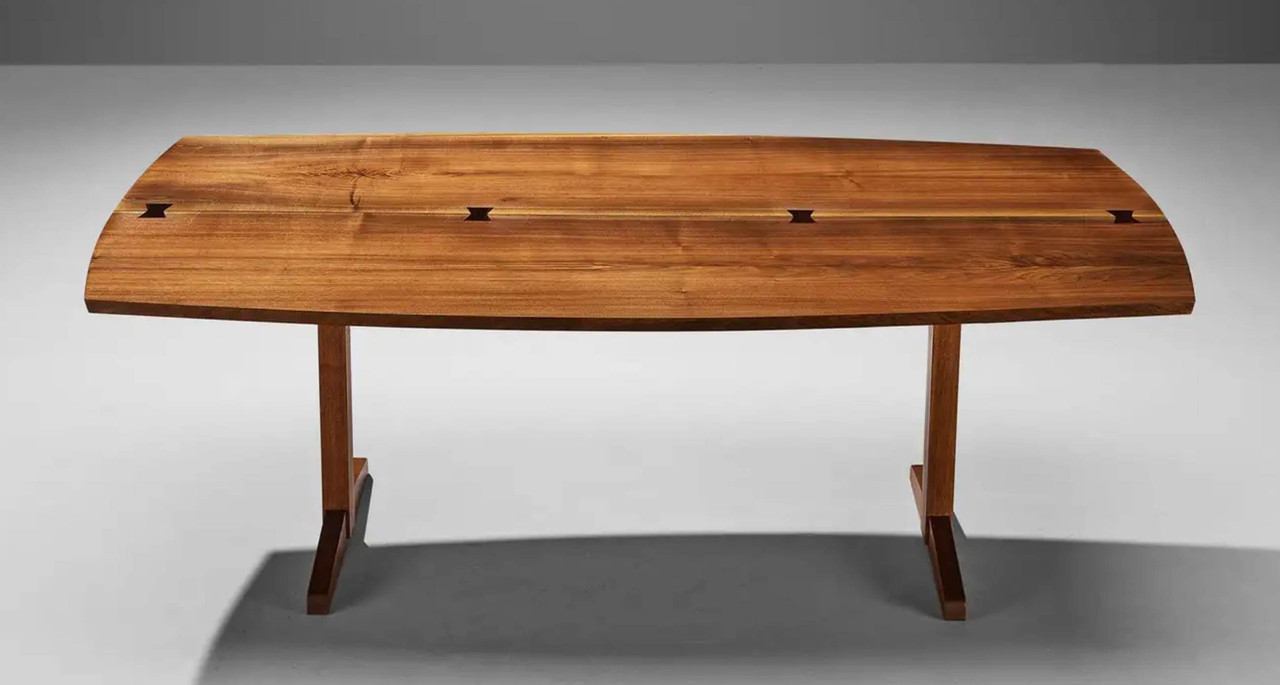
The top will be made from Rock Maple, and 1825mm long (72") x 900mm (35") wide, and 30mm thick. At present my first choice is to use a shallow elliptical router bit, creating a pillowed (very slightly rounded) face to soften the edge. This is in keeping with the chairs, which are all curvy. The second choice - if this leaves the top looking too thick - is to use a shallow undercut chamfer. Note that the top will be curved along all sides.Something like this Nakashima table ...

Nakashima4.jpg

Nakashima3.jpg


The legs link to the chairs through an oval shape I plan to give them (the legs of the chairs are oval) ... both in the horizontal and vertical parts. Joinery is pinned loose mortise-and-tenon and not the bridle joint in the Nakashima photo.The light Rock Maple top will appear to float on the dark Jarrah base. That is the intention.

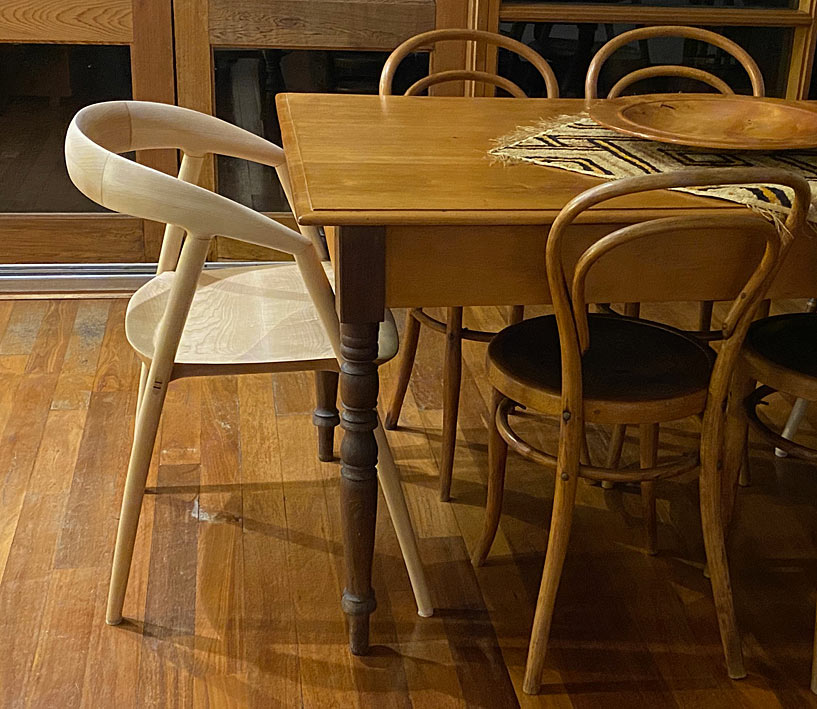
A comment about the DC 09 Chairs I built:   When we were planning to build a larger table, it was necessary to add two more chairs. My initial thought was to find bentwood carvers to join the existing bent wood chairs, but we did not like their looks, and went searching for something else. Much of our furniture is contemporary, Mid Century-styled (as you may have noticed from my builds), and so I decided to add two modern carvers (we do not mind a mix-and-match), and use the table to blend all the pieces together.

Prep15.jpg

I managed to do a little work on the trestle table this weekend, in between watching the Olympic Games.

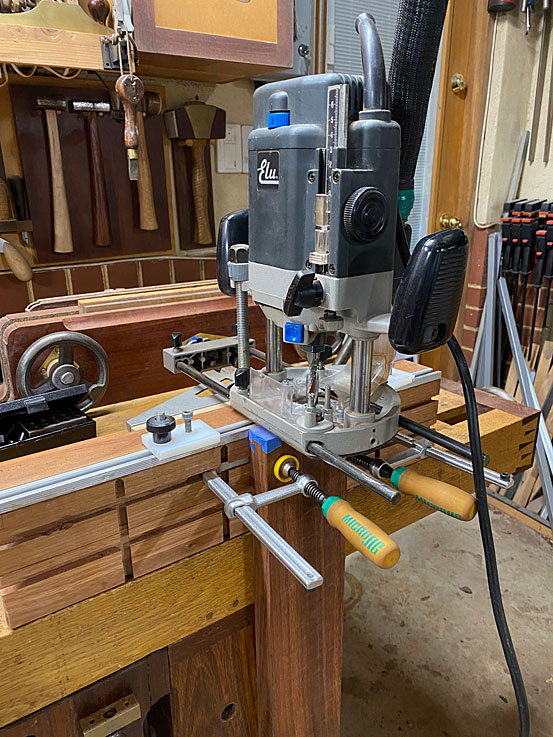
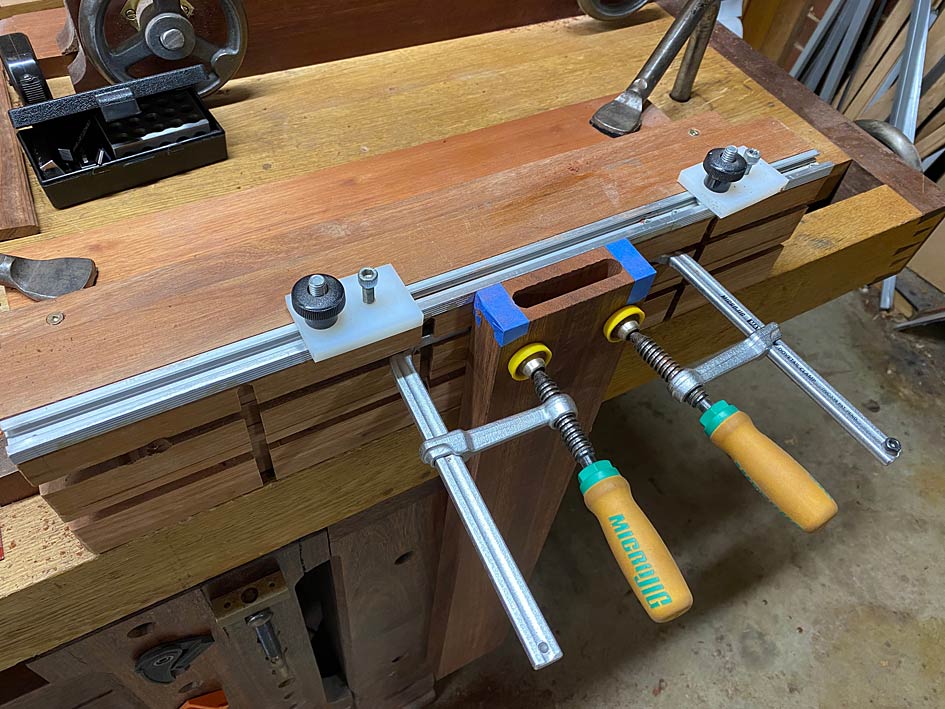
The mortise and tenon joinery is all loose tenons, which is easier to do accurately since all are through mortises. Plus I can orient the grain in the tenons for maximum strength (i.e. no run out).

TT1.jpg

With the exception of the cross support, all mortises are 1/2" x 70mm wide x 40mm deep. The cross support mortises are 1/2" x 40mm wide x 40mm deep.

TT2.jpg

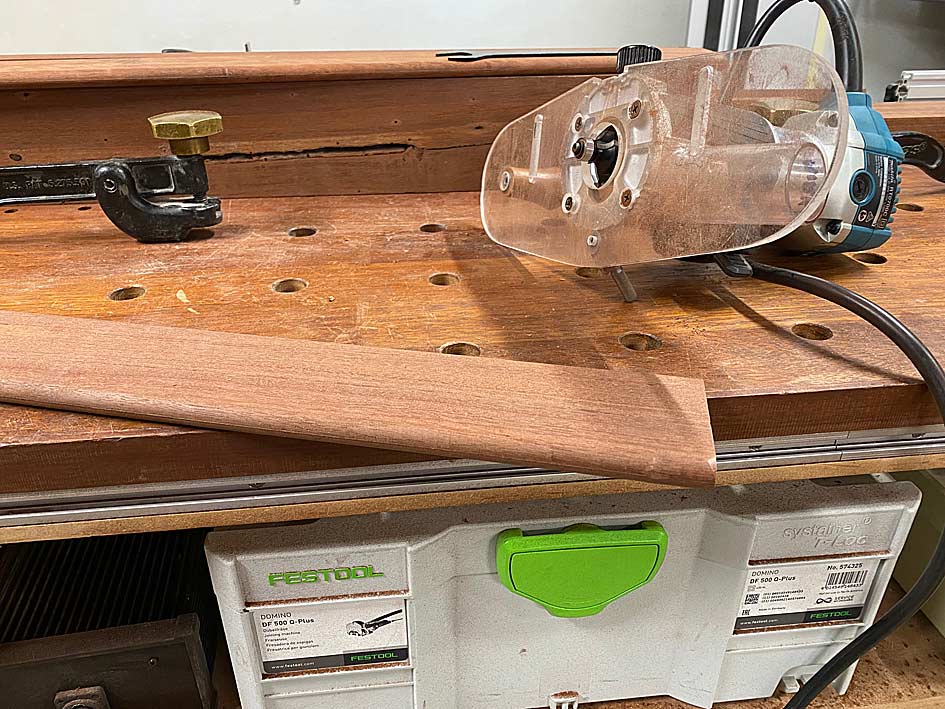
The loose tenon stock is made simply and quickly: thickness quarter sawn Jarrah, saw to width, and round over with a 1/4 round bit in a trim router.

TT3.jpg

One correction for the loose tenons: the loose tenon is actually 80mm (3 1/8") long. The root is 40mm. And will be pinned at each end. That is pretty substantial. The rail will be wedged.

Regarding the choice of loose tenon joinery in this build: I have a preference for traditional mortise-and-tenon joinery. When I started making the chairs, this is what I did - integrated tenons from the seats. Then it became evident that they were vulnerable to breaking owing to run out. That is not a risk to take with chair legs. I started again, and this time used loose tenons, which allowed me to choose quarter-sawn stock.

The wedged M&T legs ...

12Completion_html_m68895486.jpg

... need to be echoed in the table. Hence the round ends (made with a router) in the table legs. Also the oval table legs linking to the oval chair legs.

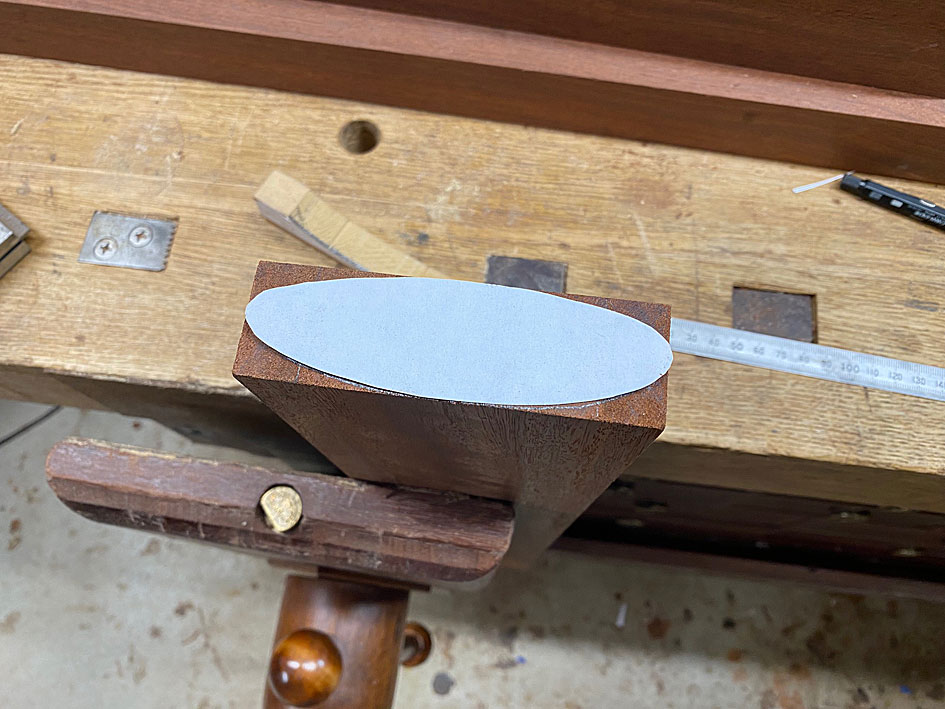
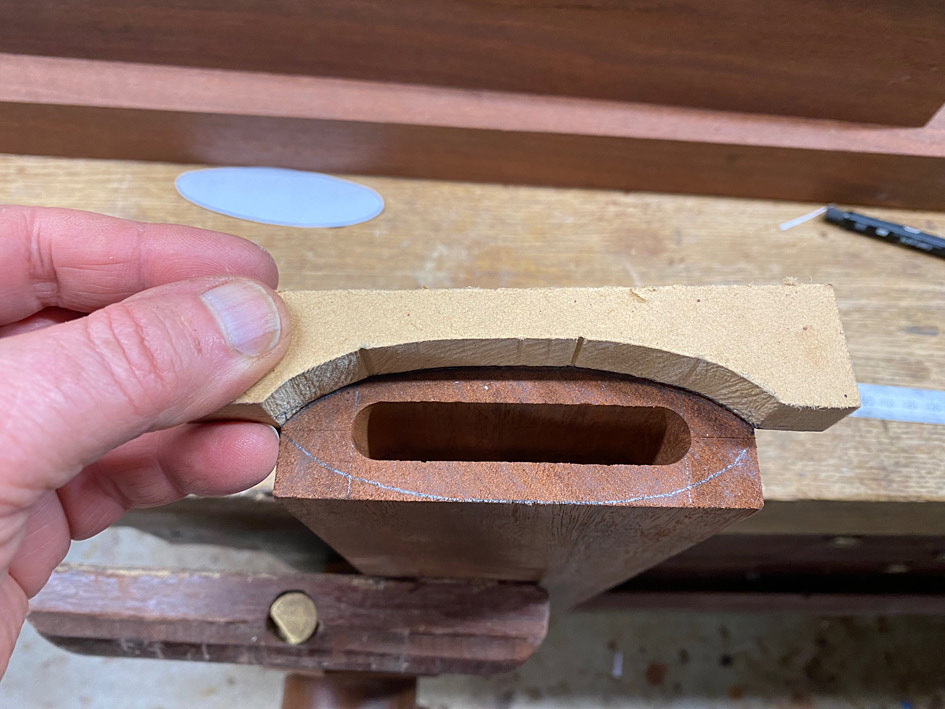
Now we get to the interesting part. What I start with will be quite different from what ends up finished. There is very little that will not be carved away. Remember, the table is intended to blend with the two chairs I built. For this reason, the two vertical sections and the horizontal cross support will be oval in cross section. I have not seen this before ...

TT4.jpg

A template for later use ...

TT5.jpg

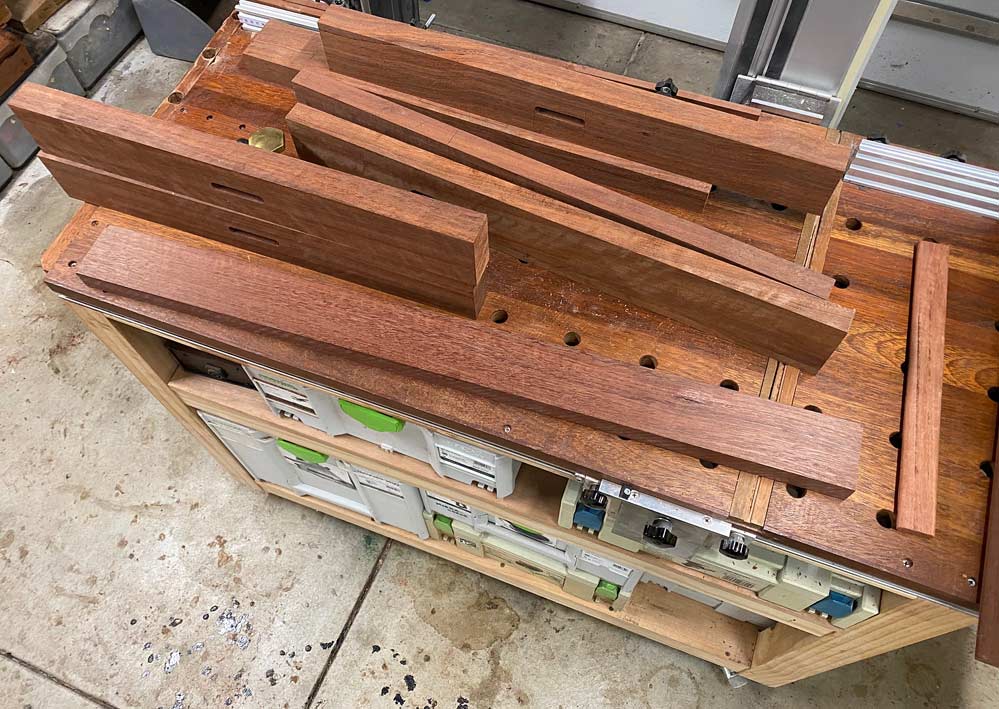
All the base parts cut to length and width, and mortised ...

TT6.jpg

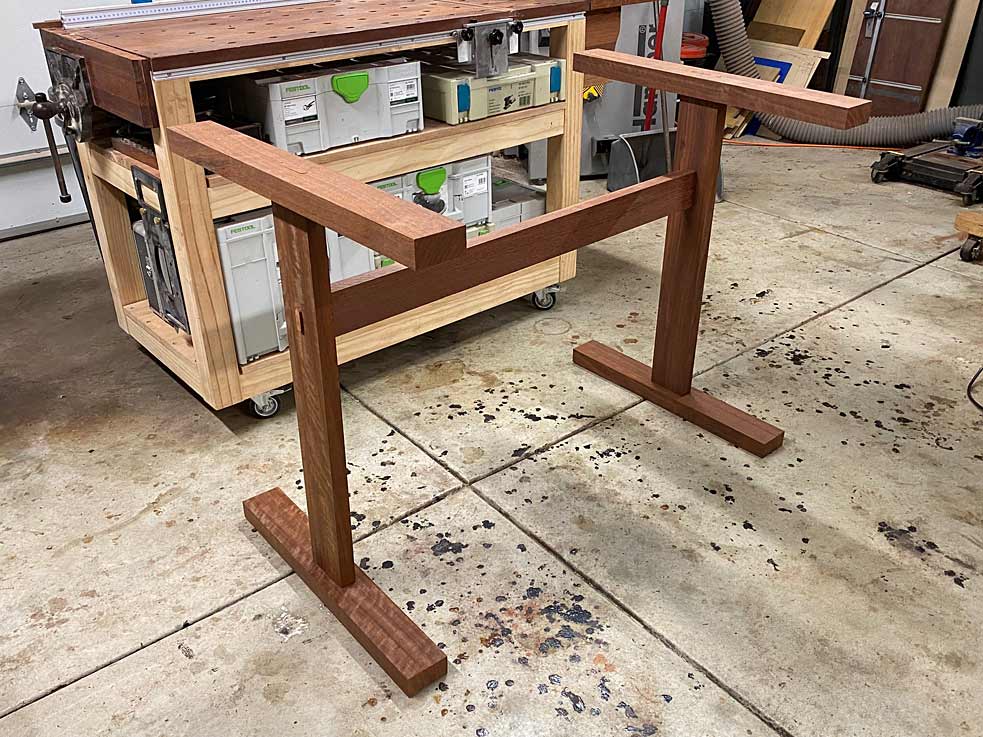
A loose fit. There is just over 1m (40") between the trestle ends, with a 16" overhang planned. 72" long in total.  Note that the top support is wider than the base. Both will be carved away for an "organic" blend with the upright sections. It looks a little stick-like at present ...

TT7.jpg

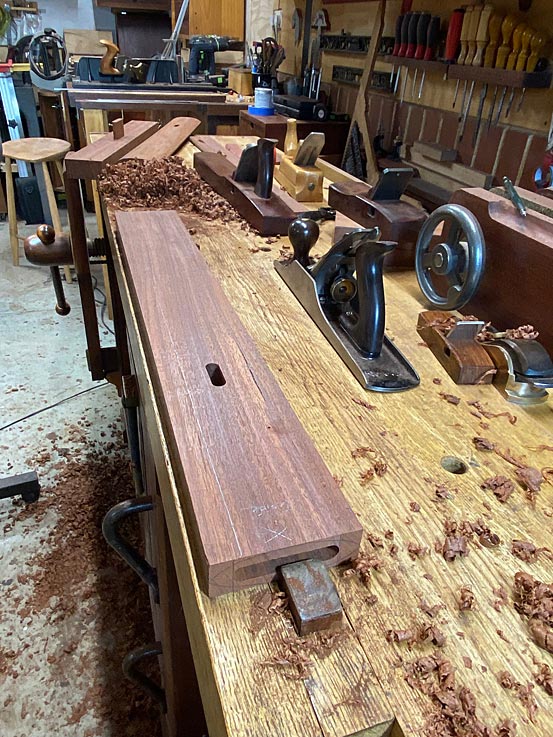
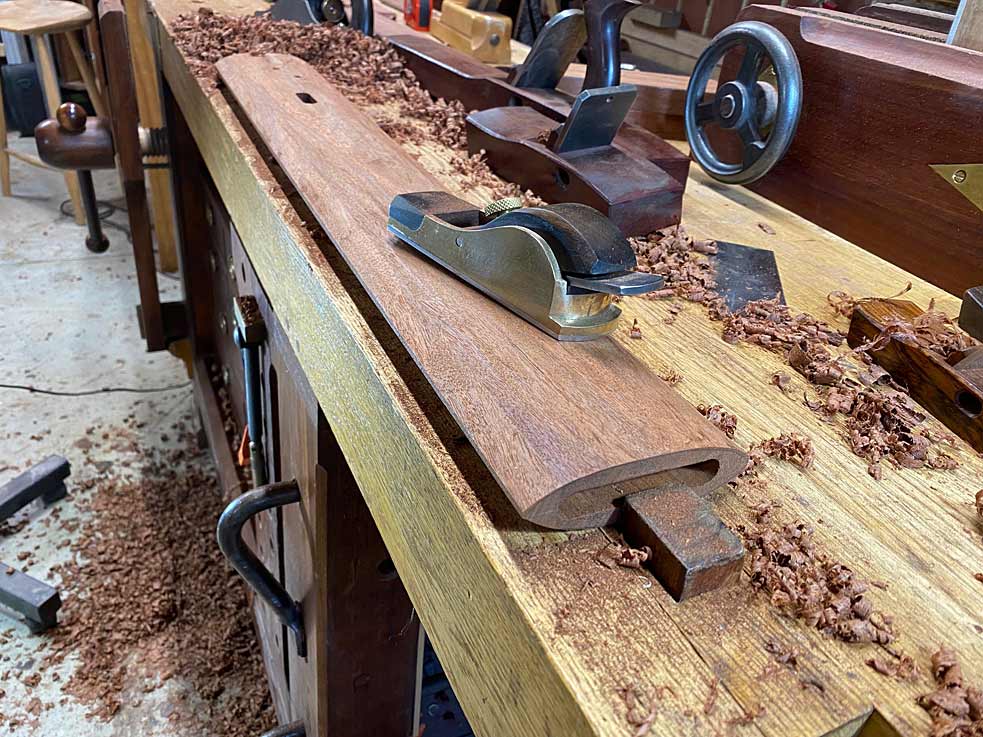
Here is one leg or, rather, one upright. Everyone likes looking at shavings and planes. Start with a jack ... in this case a Stanley #605 with a radiused blade ... follow with a HNT Gordon Trying Plane to remove any tearout, and more shaping with smaller planes ...

TT8.jpg

Planing down to the marked curved lines ...

TT9.jpg

The tiny high angle BU smoother I made worked its magic ...

TT10.jpg

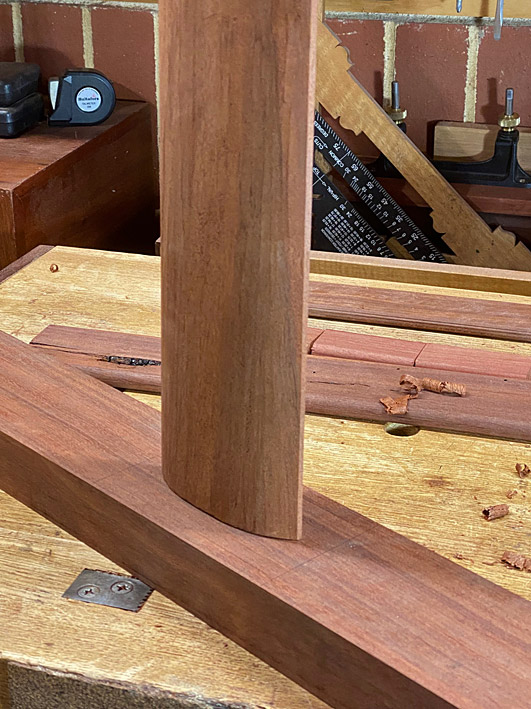
Here the vertical rests on an un-shaped base. That's where the challenge lies with shaping.

TT11.jpg

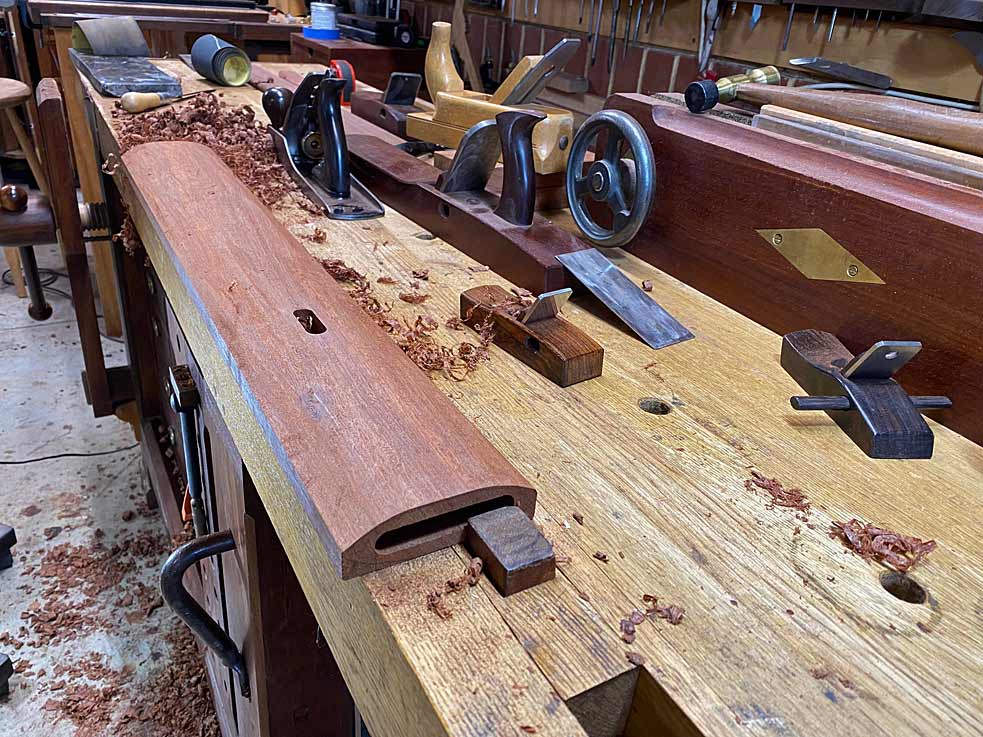
Still to be sanded and edges rounded ...

TT12.jpg

Regards from Perth
Derek

Turning » NEW SHOP SHOTS *LINK* »

#2

NEW SHOP SHOTS *LINK*

David Yoho

>I've just uploaded our five newest Shop Shots this morning. There are still more here waiting to be processed so stay tuned.

Thanks to these talented folks for the latest submissions:

Mark Serfas - Shot #605 - wanted a permanent way to set up his son's new train where it wouldn't get destroyed. He borrowed an idea seen elsewhere and went to work designing the layout and began construction of an overhead railway.

C.A. Rush - Shot #606 - worked hard to help create a woodworking club in his area. With a need to hold meetings in various member's shops, he came up with a smart solution for a breakdown speaker's podium and carrying case.

Dave Griessmann - Shot #607 - fills several needs in his shop with the simple-to-build outfeed table.

Doug and Mary Ridley - Shot #608 - are back with another wonderful carving. This is their third Uncle Sam caricature and it's sure to be a hit!

Gary Kunz - Shot #609 - describes his project as having clean, simple geometric lines, in a contemporary style with a hint of art deco. Have a look at the beautiful work of this amateur craftsman.

David Yoho

Editor - Shop Shots


New Shop Shots

Hand Tools » Re: Using a 5 1/2 for roughing? »

#3

Re: Using a 5 1/2 for roughing?

Derek Cohen (in Perth, Australia)

“Roughing” means to me the removal of high spots on a board to achieve a roughly coplanar surface. Traditionally, if the amount of waste is large, this has been the role of the scrub plane. The typical scrub plane has a 1 3/4” wide blade with a 3” radius. It is probably closer to a decade since I required more than the occasional use of a scrub plane as a jack plane has been all that is needed.

The general recommendation for a jack plane is an 8” radius on a 2” wide blade. Currently, my jack has a 12” radius. This is because most of my boards are jointed and thicknessed by machines, but occasionally I still need to work them with a hand plane. Since there is less thickness to remove - less need for the jack to substitute for a scrub plane - I would rather take a wider and shallower cut. Set the radius according to your needs.

With regard to using a #5 1/2, irrespective of it being a Veritas Custom, LN or Stanley (which I had), there was a time (about 20 years ago) when I experimented with one as a scrub-type plane. It certainly ploughed well through hard wood, but it was too heavy to use for long. I do not recommend its use. I have two jacks, one is a woodie I made (my go-to), and the other a Stanley #605 (which I keep for it versatile ability to also act as a small jointer with a straight blade). The woodie has a single iron. No chipbreaker. This is a rough plane, not intended for anything but.

Regards from Perth

Derek

Hand Tools » Re: Scary sharp: replacing sandpaper »

#4

The original "Scary Sharp" post (1995)

Derek Cohen (in Perth, Australia)

"Scary Sharp" has been around a long time - long before it was first described by Steve LaMantia in 1995.

Here is a copy of the original Scary Sharp post. This was back in the days of rec.woodworking, which was the first woodworking forum many of us shared on.

Regards from Perth

Derek

The D&S Scary Sharp(TM) System

[No, you can't sharpen sandpaper. And please don't ask me how I know that.]

[Required warnings:]

[If you don't like sharpening tales, or sandpaper, or handplanes, or any deviation from simple declarative sentences, please don't read this post. Also, it's a process gloat, and it's windbaggy, so be forewarned.]

[And if you prefer one-clause synopses, here: "I sharpened a plane blade with sandpaper." Now move along now.]

For anyone else:

I recently emailed a few folks about some attempts I made at sharpening a plane iron with sandpaper. Some suggested I post my story to the group.

So here it is.

(Rich and David, I've pretty much rehashed my email to you guys here, so you can move on out now, too.)

Let's see. Who's left? Oh.

Dear Mom,

I've recently been experimenting with using sandpaper for honing. I had been getting tired out with the oilstones getting unflat and glazed and needing to be lapped all the time, tired of oil all over the place and on my hands so I couldn't even scratch, tired of having to clean the stones after each use, tired of having to keep a conscious effort going to distribute wear on the stones evenly. So tired of all of this.

So I started thinking about abrasives and abrasive action in general, and read up a bit, and asked around, and found out that there's nothing different, in principle, between sandpaper and an oilstone. Silicon carbide sandpaper (i.e., wet-or-dry) goes up to 600 grit in the hardware and woodworking stores, but up to 2000 grit in the automotive finishing stores, as I learned from David Opincarne, a local rec.woodworker and admitted metalhead who works right here at the school and who sent me some 1200-and 2000-grit samples and who's recently been helping me greatly to understand the secrets of metal. For example, did you know that to produce high-carbon steel, crushed bone from the skull of an infidel is an excellent carburizing agent? Me, neither. Or that hardening the steel in cutting blades is achieved by the sudden and even cooling of the blade, and that the best known way to achieve these dual goals is to quench the blade in the still-living body of an enemy warrior? Same here; I had no idea. David's been teaching me a lot.

Me and him and some other wreck.the.woodwork folks had been talking lately about this abrasive business, and it got onto sandpaper somehow, and so I decided to test something out. For the sharpening-with-sandpaper experiment, I used a slightly-pitted 2" wide jack plane blade that came with an old beat-up Stanley Bedrock #605 I bought last year at a tool swap. The bevel on the plane iron had been somehow ground *concave* by the previous owner (or else it just wore that way), so I first straightened the edge out on the grinding wheel, grinding in straight at first so as not to create a thin edge that would burn, and then grinding in a bevel but stopping a bit short of a real edge, again to prevent burning. Because of this care not to burn the steel, this grinding goes slow and light, but it's time well spent. Time now to lap the back behind the cutting bevel. I took a page out of the plane-sole lapping book -- figuratively speaking of course, you should never tear pages out of a book -- and used very light coatings of 3M "77" spray adhesive to temporarily glue small 1-1/2" x 3-1/2" rectangular pieces of sandpaper along the edge of a sheet of 1/4" plate-glass. The paper I used was Aluminum Oxide in grits 50, 80, and 100, and Silicon Carbide (wet-or-dry to you lay people) in grits of 150, 180, 220, 320, 400, 600, 1200, and 2000. The plate glass was placed with its edge flush to the edge of the workbench.

I lapped the end one inch of the back of the iron on each grit in turn. I didn't use any water; I just went at it dry. So as I lapped -- can you call it lapping if it's dry? -- anyway, about every ten seconds or so I'd stop and brush off the sandpaper with a whisk broom and wipe the blade off on my shirt. (On the coarser grits, I found that a dustbuster vacuum actually cleaned up the paper quite thoroughly, much better than sweeping it off, but this sucking advantage disappeared at around 220 grit.) Since I progressed through the grits so gradually, I found I had to spend only about a minute or so on each grit, including the suck-down and sweep-off and shirt-wipe time.

One trick to efficiency is knowing when you've lapped the back sufficiently on each progressive grit. I had previously had trouble gauging this, and didn't know how to tell when enough is enough. Thanks to a clever suggestion from Jeff Gorman, I tried a trick that seemed to work wonderfully. I have a cheapie Radio Shack 30-power hand microscope -- "microscope" sounds impressive, but it's only $10, although I forget where I got it from -- and used that to tell when the striations from the new grit had replaced all the striations from the previous grit, and when they had, I stopped there and moved on to the next grit.

About ten minutes after starting, I had gone from 50 grit on up to 2000, and there was a mirror finish on the back of that iron the likes of which must be seen. The back of the iron became so shiny I could count my nose hairs in it; 98 on the left, 79 on the right, but 109 and 85 if you count the white ones.

I then jigged the blade in a Veritas honing jig -- which, by the way, Mr. Lee, should be called a honing fixture, not a jig, since a jig's for holding a tool and a fixture's for holding a workpiece and in the sharpening operation the plane iron, while usually thought of as a tool, or as a part of one, is actually in this instance the workpiece -- man, near-terminal digression there, almost lost it for good; Boy, snap out of it! -- I clamped the blade down in the Veritas blade-holder device, taking care to have the hollow-ground bevel resting on the glass perfectly along both edges of the hollow grind. I then adjusted the microbevel cam on the jig up to its full two-degree microbevel setting -- Robin, tell your uncle that Steve said "way to go, old dude" -- and honed away on the 2000-grit. Even though I had not ground a sharp edge on the primary bevel with the bench grinder, even on that little slip of fine 2000 grit it still took only about another couple of minutes before I had a nice sharp little 1/64" microbevel gleaming back at me.

I flipped the blade over on the sandpaper several times, hone and lap, hone and lap, each time gentler and gentler, to remove the little bit of wire edge. (Which, by the way, as a result of using such a fine grit must have been so tiny that it was very hard to see or feel, so pretty much just from my awareness of the process I assumed it was there.) The resulting little thin secondary bevel was shiny. I mean *clean* shiny, like nothing I'd ever seen before. Unlike the secondary bevels I'd previously coaxed out of my hard white Arkansas stone, this one was unbelievably Shiny with a capital S. I mean *clean* shiny, like nothing I'd ever seen before. Oh, I said that already. Okay, it's hard to describe; about the best I can do is to say that it looked almost *liquid* when you catch the light on it just right. I mean, it was so darn clean and shiny that it takes ten lines just to say it was so shiny it's hard to describe.

Of course, shine is not the ultimate goal. But sharpness *is*. Still, they equate. The more shiny, the more uniform the surface is microscopically, and the closer to the geometric ideal of a *line* is the edge, and hence the sharper it is. Cool. I mean *COOL*!!! I was trembling in my Mickey Mouse boots in anticipation. Hell, this cutting edge looked downright *dangerous*! I didn't dare touch it. But yet, there was still something I just *had* to try.

I removed the blade from the jig, and anxiously tried the old cliché "cut a finger off before you can notice and bleed all over your screaming wife in the car on the way to the hospital" test. Oops; no, wait. Sorry, that's the wrong test, for those other kinds of tools. Sorry. For the Neanderthals, it's the "shave some arm hairs off" test. Now I've done this test before, on other blades sharpened up on white Arkansas, and while these other blades would pop *some* hairs off the back of my wrist, many other hairs would just bend on over down under the blade's edge (probably from the sheer weight of four prepositions in a row), and those hairs that *did* pop off would do so quite painfully, as though the blade was more grabbing the hairs and *ripping* them out, and I could feel every one of them offering their stubborn and vengeful resistance. Not much fun, and nothing to be doing voluntarily in front of others.

But the edge on this blade was something else! Not only did it cut off every little hair in its path with total ease, but it didn't hurt at all. In fact, I couldn't feel a thing; for all I could tell, there were no hairs there in its path to begin with. But of course there were many, since I'm Italian and also since I could see the fallen hairs all over the back of the blade. And my arm where I had shaved it was a smooth as a non-Italian baby's butt.

Again, man, this had gotten downright *frightening*.

But of course, the ultimate test of a plane iron's sharpness is what it does on wood. So I put the blade back into the plane, that old early-model Bedrock jack, which I've not yet tuned in any way. I tried it on the edge of a piece of pine, and as I adjusted the blade for the finest cut possible, it glided through the wood with no effort. None whatsoever. In fact, it almost seemed like the plane was pulling itself along, or that the wood was *wanting* to be planed and was throwing itself into the blade -- no, I've not read Krenov -- it took that little effort.

I ended up getting a shaving that was so darn thin I could read newsprint through it easily. Unbelievably easily. So easily, in fact, that I thought for a moment about taking the iron back on out of the plane and putting the shaving over the shiny part of its back and counting my nose hairs again, but by this time I had grown weary of counting nose hairs, and of my concerned wife repeatedly asking me why I was doing that.

I thought, no way, this can't be! So skeptic that I am -- I'm so skeptical, that I can't be fully sure that I'm really that much of a skeptic -- I put a micrometer to the shaving, and get this: it measured .0004 thick! Four ten-thousandths of an inch! (Or, as my eternally-pestered but forever-patient metalmentor David Opincarne showed me, "four-tenths" in machinist talk.) No, I read the mike right. Less than one half way to the very first line after zero.

Man! That's a cubic hair less than one-half of a thousandth of an inch! Incredible! Amazing!

And it just gets better. For a while there, I actually thought I had taken off another shaving that was even thinner, one so thin in fact that it was invisible and of no measurable mass. I'm pretty sure I did, actually, but I'm having a hard time trying to think of a way to check this out, or even to find the spot on the ceiling that it floated up to.

And what about the planed wood itself? Well, the surface the plane iron left on the wood in indescribable! It's like glass! No, it's like glass wet down with water and a tad of liquid soap added and then some Slick-50 and then frozen and polished. And this is on pine, a softwood! Not only that, but I then gave it the torture test: end grain. I put the same piece of wood in my shooting board, and had a go at the endgrain. Man oh man, I've never seen such a smooth surface on *endgrain* in my life. And again, this is on *pine*! The endgrain was almost as smooth as the edgegrain!

This has gotten good! Still, having exclaimed all this, I'm making no claims to the throne of King of the Neanderthals. I'm the first to admit that this was kind of like when I was a kid and one year I batted a thousand in the Kiwanis Grasshoppers when I was really four years too young to actually play in the league but it was the last game of the year and Dad the team manager put me up in a losing game as the last batter just for the novelty of it and to stop my pestering -- he figured I'd get beaned and would shut up for a while -- and the opposing pitcher Terry Crowley the hotshot star started laughing at me because I was so scrawny and tiny and he taunted me who's this, Mickey Mantle or something, and he threw a pitch at my crutch and I just shut my eyes and said a curse and swung and slammed a hard grounder right down the line and under the legs of the first baseman 20 some odd years before Bill Buckner got his chance and I got a hit. I know it was kind of like that, because this shaving wasn't the minimum three feet long as per the Rules for the Contest to Become the King of the Neanderthals, so it shouldn't qualify. But it still feels just as nice. One more good thing is that in the process of taking this plane iron from misshapen funkiness to terrifying sharpness I used up all of about 25 cents worth of sandpaper, and probably about 3 cents worth of spray glue, and about fifteen or so minutes of my time, twenty if you stop for a nosehair count.

When it was all done, I peeled the sandpaper from the glass and threw it away -- well, actually I could have but in truth I stick them together back-to- back and save them in a "used-sandpaper" box for odd tasks that never come up. I then scraped the little bit of residual adhesive from the glass with a razor blade, a quick wipedown with acetone on a piece of paper towel, and the cleanup was done in a minute. No oil, no water, no mess, no glaze or flatness problems to worry about, and a cutting edge that is Scary-Sharp (TM).

I think I'll still keep my stones, though; they can sit atop the packets of sandpaper to help keep them flat.

-- Steve LaMantia [I'm talking about my oilstones.]

Seattle, WA
Hand Tools » Re: I need a new plane »

#6

Re: I need a new plane

Moses Yoder in White Pigeon, MI

>Not sure what the others have written but for the money I would buy a new Lee Valley jointer plane. I have a shop full of Stanley jointer planes (okay, maybe just 3 or 4), none of which are straight enough and tuned up enough to joint a nice true edge. This is why I use a tailed jointer and a #605 to glue a panel together. Some day I will have that LV jointer, and it will be a #7 or #8 size. A longer plane will always work on short boards but a short plane will not work very well on long boards.

Hand Tools » Re: The edge planing experiment »

#7

Re: The edge planing experiment

mikew


>Hi DC,

Just for fun I paid attention to a glue up I am doing. Boards are ~1" Makore and the panels once glued up are about 24" x 36". Boards were about 4"-6" in width

Two panels worth of boards were prepared, though I don't own a jointer and so I paid no attention to how they came off the bandsaw--other than were were mostly straight.

If I positioned a board with one end in the vice and the free end resting on the board jack, I created a convex board of varying amounts dependent on how many passes. If I planed the boards on the benchtop against a stop the boards were dead flat.

I tried this using a #605 and a #8. Same results with either plane using either method. While I do own a Starrett straight edge [and used it], I also used a back light. I didn't measure the gap, though I could get a piece of notebook paper started under one end or the other.

To double check the attempts I believed were straight, I do what I always do. Take two boards which are to be glued together, aly them together on the edges to be glued and use an F-clamp at one end, lightly clamping them together. If it doesn't raise the top one off, and I cannot see light passing in the middle, good enough for me.

As well, most often my last pass on a typical board is using a #3 or a #4. My typical method is a very light cut, and I begin about 1/3 of the way into a board's length and lift off before the board's end. Next pass is half the distance from where I started to about the same place at the end. Then one full shaving. This I did following the attempts which produced convex boards. These passed my quick glue up test at that point. This is in part the method I use for creating sprung joints, though there are other steps. But it keeps me consistent.

Looking most closely with the Starrett, the boards which I am calling convex, really were flat for a significant portion of the centers and dove off at both the leading and traling edges. I think that my "technique" may unconsciously be compensating for the effect which you started this thread for. Or I have been lucky in that the way I was taught to create sprung joints crept into my "normal" technique and simply produced the desired result.

Sorry I didn't attempt a strict test as per the request, but these boards did need to get glued up :^}

Take care, Mike

Hand Tools » Re: Okay .... It says ... BEDROCK »

#8

Re: Okay .... It says ... BEDROCK

William Duffield, on the Cohansey

>The only plane marked BEDROCK that was not made by Stanley is this one:

601 That one, of course, is not a #605.

Since yours has two patent dates on the casting, it was made by Stanley between 1911 and 1922. We could narrow it down, based on the trademark stamped in the blade, and the diameter of the depth adjustment knob. The correct lever cap should be marked either

STANLEY

BEDROCK

if it is a Type 5 (1911), or just

BEDROCK

(like Patrick's curiosity) if it a Type 6 (1912-1921) or Type 6a (1922).

Hand Tools » Flattened my first panel with a plane »

#9

Flattened my first panel with a plane

Jay St. Peter

>I did it yesterday. I took a large glued up panel and used my #605 to take out the ridges instead of my ROS. It worked great and I wound up with a flatter panel than the one I had just done with the ROS. There were less hills and valleys.

I had spent a lot of time with this 605 a few years ago. But, I had sharpened the Hock blade straight. So, every time I used it I gouged up the work. After recently beveling the edges of my LV LA block blade and seeing how much it helped, I knew what I had to do to this one (I kind of knew that anyway but had been to lazy).

I also re-learned the lesson of mixing sander and plane. As I was sanding the panel later I found a ridge that I had missed. I picked up the 605 and started to smooth it down. Soon, small ridges were appearing on the board. Looks like time to rehone.

I'm now convinced this is the way to smooth out a glued up panel. I'll try out my LV LA smoother next.

Jay St. Peter

Hand Tools » Re: Bedrock question »

#10

Re: Bedrock question

Bob Hackett

>You mentioned Keen Kutter.What`s your feeling about these planes as compared to Stanley?

Seems most folks are after Stanley planes and that drives the price up to beyond what some of us feel is reasonable,same with the Winchester crowd.What I`m looking for is an alternative that I can steer folks to.

I know that I can`t afford Bedrocks and was surprised to be able to get a user grade #605 at a reasonable price(less than $50).I was equally surprised to find that the performance wasn`t noticeably better than my tuned up #5 which cost $10.

This got me to thinking that maybe the Stanley,especially bedrock, thing is just alittle more hype than fact.I know that Sargent planes go for alot less up here and seem to perform at least as well if not better.

Just wondering what the options are for the user grade bottom feeders out there now that anything with Stanley on it is getting scarce and relatively expensive.

Mainely,Bob

Hand Tools » New (well, old) Planes »

#11

New (well, old) Planes

Mark B Smith

>I visited my local "reseller" on Friday. Came home with 4 new purchases.

Stanley #4, type 15.

Stanley #5C, type 12

Stanley #605 1/2 C (not sure how old)

Stanley #80

$56 for all 4. All have little or no rust on the soles, but some tote and knob damage. Can't wait to start cleaning them up.

Had to pass up a nice 608 for lack of storage space.

Hand Tools » Re: Christmas gift »

#12

Re: What is the price limit ,...

Tony Z.

>Derek,

I already have an LN-LA jack, a LV medium shoulder, a Stanley #90, several blocks-both LA and standard, a Stanley 45, 48, 78, and a Craftsmen 45, along with several woodies--astragal plane, beading w/quirk, and some I've missed. Also, I got a LN 85 scraper, the LN 98-99's, LN 66, LN scrub and LN edge plane.

As far as bench planes go, #3, several #4's, #5, #5-1/4, #605 & #7. I also got some planes that have never made it into user status (yet).

Probably don't need another, but then again....

Anyhow, I've been eyeing a 4.5 for my gift, but I want to be mindful of my Wife's budget, hence my question of LV or LN.

Hand Tools » Re: #5 1/4 @ $274 *LINK* »

#13

Re: #5 1/4 @ $274

Jonathan Peck - N.Y.

>The #5 1/4C and the #2C are rare and collectable. I don't think it is completely out of line to suggest that there are fakes out there, as after market corrugations by the handy enthusiast could increase the asking price if it were not made clear to the buyer that he was buying a modified and not collectable plane. How's that for a run on sentence. Hope I answered correctly. One other model that is rare and collectable is the #605 1/4.

Hand Tools » NEW SHOP SHOTS *LINK* »

#14

NEW SHOP SHOTS *LINK*

David Yoho

>I've just uploaded our five newest Shop Shots this morning. There are still more here waiting to be processed so stay tuned.

Thanks to these talented folks for the latest submissions:

Mark Serfas - Shot #605 - wanted a permanent way to set up his son's new train where it wouldn't get destroyed. He borrowed an idea seen elsewhere and went to work designing the layout and began construction of an overhead railway.

C.A. Rush - Shot #606 - worked hard to help create a woodworking club in his area. With a need to hold meetings in various member's shops, he came up with a smart solution for a breakdown speaker's podium and carrying case.

Dave Griessmann - Shot #607 - fills several needs in his shop with the simple-to-build outfeed table.

Doug and Mary Ridley - Shot #608 - are back with another wonderful carving. This is their third Uncle Sam caricature and it's sure to be a hit!

Gary Kunz - Shot #609 - describes his project as having clean, simple geometric lines, in a contemporary style with a hint of art deco. Have a look at the beautiful work of this amateur craftsman.

David Yoho

Editor - Shop Shots


New Shop Shots

Hand Tools » Re: High-end Tools »

#15

Re: High-end Tools

dave caudill

>You know I like what in my collection I consider high end tools. But they aren't always the ones that do the best work for me. I had a great WW2 Stanley #4 1/2, you know the ones that many people don't like. Well this one was a doozy. It tuned up so nicely and worked so well. So what do I do. I "High Grade" and trade off my old #4 1/2. Well the next one took a lot more work to tune and while now it finally works as well as the other you have to ask yourself what did I gain? I've done it other times too. I have a really junky #5 and a not so nice #3 that are just a dream to use. My #605 Bedrock not nearly as comfortable to use. As others point out big money doesn't always mean great results.

I have my share of nice high end, whatever tha means tools and I enjoy them and at times I unlike Rob think they do make me a better woodworker if only for the fact that I enjoy them so much. I think that has a lot to do with how good your woodworking is. If you are comfortable and like working with a certain tool you will do better work. On the other hand some folks are so focused on the job at hadn it wouldn't matter if you gave them a sharpened shoe horn, they will do good work. WE all need certain things to make our work important to us. Some people can't work in a cluttered shop others can only work in the wee hours of the night to do good work. To each his or her own.

I too agree buy what you can afford and what makes you happy. If its Lie-Nilesen than so be it. I kind of mix and match and enjoy old and new. I think it gives me perspective and makes me think about what I am doing rather than just going through the motions. Tuning old tools gives me great comfort and even more so when I finally put them to wood. The impotant thing is that whatever tools or methods you use that you are happy doing it.

Now can someone give me a Hallelujah?

Dave

Hand Tools » Re: LN Low Angle Jack? »

#16

Re: Yes...

Jonathan Peck -N.Y.

>Scott chugs a couple , or two or three beers and says:

"No need for a high end plane....snip..... It doesn't look like much but it's one of my best performing planes in its roll"

Does it look any better after a few beers????? My favorite jack is a #605 SW that is re-japanned and has a repaired tote. Definitely not going to win any beauty pageants, but I'd put it up against any LA smoother any day of the week. Hmmm...I think I dropped $7 on that one and still had enough green left over to pay my bar tab, take swmbo out for dinner and a movie and pay the babysitter.


img

General Woodworking » Re: sharpening quandry... »

#17

The D&S Scary Sharp(TM) System

Derek Cohen (in Perth, Australia)

"Scary Sharp" has been around a long time - long before it was first described by Steve LaMantia in 1995.

Here is a copy of the original Scary Sharp post. This was back in the days of rec.woodworking, which was the first woodworking forum many of us shared on.

Regards from Perth

Derek

___________________________________________________

The D&S Scary Sharp(TM) System

[No, you can't sharpen sandpaper. And please don't ask me how I know that.]

[Required warnings:]

[If you don't like sharpening tales, or sandpaper, or handplanes, or any deviation from simple declarative sentences, please don't read this post. Also, it's a process gloat, and it's windbaggy, so be forewarned.]

[And if you prefer one-clause synopses, here: "I sharpened a plane blade with sandpaper." Now move along now.]

For anyone else:

I recently emailed a few folks about some attempts I made at sharpening a plane iron with sandpaper. Some suggested I post my story to the group.

So here it is.

(Rich and David, I've pretty much rehashed my email to you guys here, so you can move on out now, too.)

Let's see. Who's left? Oh.

Dear Mom,

I've recently been experimenting with using sandpaper for honing. I had been getting tired out with the oilstones getting unflat and glazed and needing to be lapped all the time, tired of oil all over the place and on my hands so I couldn't even scratch, tired of having to clean the stones after each use, tired of having to keep a conscious effort going to distribute wear on the stones evenly. So tired of all of this.

So I started thinking about abrasives and abrasive action in general, and read up a bit, and asked around, and found out that there's nothing different, in principle, between sandpaper and an oilstone. Silicon carbide sandpaper (i.e., wet-or-dry) goes up to 600 grit in the hardware and woodworking stores, but up to 2000 grit in the automotive finishing stores, as I learned from David Opincarne, a local rec.woodworker and admitted metalhead who works right here at the school and who sent me some 1200-and 2000-grit samples and who's recently been helping me greatly to understand the secrets of metal. For example, did you know that to produce high-carbon steel, crushed bone from the skull of an infidel is an excellent carburizing agent? Me, neither. Or that hardening the steel in cutting blades is achieved by the sudden and even cooling of the blade, and that the best known way to achieve these dual goals is to quench the blade in the still-living body of an enemy warrior? Same here; I had no idea. David's been teaching me a lot.

Me and him and some other wreck.the.woodwork folks had been talking lately about this abrasive business, and it got onto sandpaper somehow, and so I decided to test something out. For the sharpening-with-sandpaper experiment, I used a slightly-pitted 2" wide jack plane blade that came with an old beat-up Stanley Bedrock #605 I bought last year at a tool swap. The bevel on the plane iron had been somehow ground *concave* by the previous owner (or else it just wore that way), so I first straightened the edge out on the grinding wheel, grinding in straight at first so as not to create a thin edge that would burn, and then grinding in a bevel but stopping a bit short of a real edge, again to prevent burning. Because of this care not to burn the steel, this grinding goes slow and light, but it's time well spent. Time now to lap the back behind the cutting bevel. I took a page out of the plane-sole lapping book -- figuratively speaking of course, you should never tear pages out of a book -- and used very light coatings of 3M "77" spray adhesive to temporarily glue small 1-1/2" x 3-1/2" rectangular pieces of sandpaper along the edge of a sheet of 1/4" plate-glass. The paper I used was Aluminum Oxide in grits 50, 80, and 100, and Silicon Carbide (wet-or-dry to you lay people) in grits of 150, 180, 220, 320, 400, 600, 1200, and 2000. The plate glass was placed with its edge flush to the edge of the workbench.

I lapped the end one inch of the back of the iron on each grit in turn. I didn't use any water; I just went at it dry. So as I lapped -- can you call it lapping if it's dry? -- anyway, about every ten seconds or so I'd stop and brush off the sandpaper with a whisk broom and wipe the blade off on my shirt. (On the coarser grits, I found that a dustbuster vacuum actually cleaned up the paper quite thoroughly, much better than sweeping it off, but this sucking advantage disappeared at around 220 grit.) Since I progressed through the grits so gradually, I found I had to spend only about a minute or so on each grit, including the suck-down and sweep-off and shirt-wipe time.

One trick to efficiency is knowing when you've lapped the back sufficiently on each progressive grit. I had previously had trouble gauging this, and didn't know how to tell when enough is enough. Thanks to a clever suggestion from Jeff Gorman, I tried a trick that seemed to work wonderfully. I have a cheapie Radio Shack 30-power hand microscope -- "microscope" sounds impressive, but it's only $10, although I forget where I got it from -- and used that to tell when the striations from the new grit had replaced all the striations from the previous grit, and when they had, I stopped there and moved on to the next grit.

About ten minutes after starting, I had gone from 50 grit on up to 2000, and there was a mirror finish on the back of that iron the likes of which must be seen. The back of the iron became so shiny I could count my nose hairs in it; 98 on the left, 79 on the right, but 109 and 85 if you count the white ones.

I then jigged the blade in a Veritas honing jig -- which, by the way, Mr. Lee, should be called a honing fixture, not a jig, since a jig's for holding a tool and a fixture's for holding a workpiece and in the sharpening operation the plane iron, while usually thought of as a tool, or as a part of one, is actually in this instance the workpiece -- man, near-terminal digression there, almost lost it for good; Boy, snap out of it! -- I clamped the blade down in the Veritas blade-holder device, taking care to have the hollow-ground bevel resting on the glass perfectly along both edges of the hollow grind. I then adjusted the microbevel cam on the jig up to its full two-degree microbevel setting -- Robin, tell your uncle that Steve said "way to go, old dude" -- and honed away on the 2000-grit. Even though I had not ground a sharp edge on the primary bevel with the bench grinder, even on that little slip of fine 2000 grit it still took only about another couple of minutes before I had a nice sharp little 1/64" microbevel gleaming back at me.

I flipped the blade over on the sandpaper several times, hone and lap, hone and lap, each time gentler and gentler, to remove the little bit of wire edge. (Which, by the way, as a result of using such a fine grit must have been so tiny that it was very hard to see or feel, so pretty much just from my awareness of the process I assumed it was there.) The resulting little thin secondary bevel was shiny. I mean *clean* shiny, like nothing I'd ever seen before. Unlike the secondary bevels I'd previously coaxed out of my hard white Arkansas stone, this one was unbelievably Shiny with a capital S. I mean *clean* shiny, like nothing I'd ever seen before. Oh, I said that already. Okay, it's hard to describe; about the best I can do is to say that it looked almost *liquid* when you catch the light on it just right. I mean, it was so darn clean and shiny that it takes ten lines just to say it was so shiny it's hard to describe.

Of course, shine is not the ultimate goal. But sharpness *is*. Still, they equate. The more shiny, the more uniform the surface is microscopically, and the closer to the geometric ideal of a *line* is the edge, and hence the sharper it is. Cool. I mean *COOL*!!! I was trembling in my Mickey Mouse boots in anticipation. Hell, this cutting edge looked downright *dangerous*! I didn't dare touch it. But yet, there was still something I just *had* to try.

I removed the blade from the jig, and anxiously tried the old cliché "cut a finger off before you can notice and bleed all over your screaming wife in the car on the way to the hospital" test. Oops; no, wait. Sorry, that's the wrong test, for those other kinds of tools. Sorry. For the Neanderthals, it's the "shave some arm hairs off" test. Now I've done this test before, on other blades sharpened up on white Arkansas, and while these other blades would pop *some* hairs off the back of my wrist, many other hairs would just bend on over down under the blade's edge (probably from the sheer weight of four prepositions in a row), and those hairs that *did* pop off would do so quite painfully, as though the blade was more grabbing the hairs and *ripping* them out, and I could feel every one of them offering their stubborn and vengeful resistance. Not much fun, and nothing to be doing voluntarily in front of others.

But the edge on this blade was something else! Not only did it cut off every little hair in its path with total ease, but it didn't hurt at all. In fact, I couldn't feel a thing; for all I could tell, there were no hairs there in its path to begin with. But of course there were many, since I'm Italian and also since I could see the fallen hairs all over the back of the blade. And my arm where I had shaved it was a smooth as a non-Italian baby's butt.

Again, man, this had gotten downright *frightening*.

But of course, the ultimate test of a plane iron's sharpness is what it does on wood. So I put the blade back into the plane, that old early-model Bedrock jack, which I've not yet tuned in any way. I tried it on the edge of a piece of pine, and as I adjusted the blade for the finest cut possible, it glided through the wood with no effort. None whatsoever. In fact, it almost seemed like the plane was pulling itself along, or that the wood was *wanting* to be planed and was throwing itself into the blade -- no, I've not read Krenov -- it took that little effort.

I ended up getting a shaving that was so darn thin I could read newsprint through it easily. Unbelievably easily. So easily, in fact, that I thought for a moment about taking the iron back on out of the plane and putting the shaving over the shiny part of its back and counting my nose hairs again, but by this time I had grown weary of counting nose hairs, and of my concerned wife repeatedly asking me why I was doing that.

I thought, no way, this can't be! So skeptic that I am -- I'm so skeptical, that I can't be fully sure that I'm really that much of a skeptic -- I put a micrometer to the shaving, and get this: it measured .0004 thick! Four ten-thousandths of an inch! (Or, as my eternally-pestered but forever-patient metalmentor David Opincarne showed me, "four-tenths" in machinist talk.) No, I read the mike right. Less than one half way to the very first line after zero.

Man! That's a cubic hair less than one-half of a thousandth of an inch! Incredible! Amazing!

And it just gets better. For a while there, I actually thought I had taken off another shaving that was even thinner, one so thin in fact that it was invisible and of no measurable mass. I'm pretty sure I did, actually, but I'm having a hard time trying to think of a way to check this out, or even to find the spot on the ceiling that it floated up to.

And what about the planed wood itself? Well, the surface the plane iron left on the wood in indescribable! It's like glass! No, it's like glass wet down with water and a tad of liquid soap added and then some Slick-50 and then frozen and polished. And this is on pine, a softwood! Not only that, but I then gave it the torture test: end grain. I put the same piece of wood in my shooting board, and had a go at the endgrain. Man oh man, I've never seen such a smooth surface on *endgrain* in my life. And again, this is on *pine*! The endgrain was almost as smooth as the edgegrain!

This has gotten good! Still, having exclaimed all this, I'm making no claims to the throne of King of the Neanderthals. I'm the first to admit that this was kind of like when I was a kid and one year I batted a thousand in the Kiwanis Grasshoppers when I was really four years too young to actually play in the league but it was the last game of the year and Dad the team manager put me up in a losing game as the last batter just for the novelty of it and to stop my pestering -- he figured I'd get beaned and would shut up for a while -- and the opposing pitcher Terry Crowley the hotshot star started laughing at me because I was so scrawny and tiny and he taunted me who's this, Mickey Mantle or something, and he threw a pitch at my crutch and I just shut my eyes and said a curse and swung and slammed a hard grounder right down the line and under the legs of the first baseman 20 some odd years before Bill Buckner got his chance and I got a hit. I know it was kind of like that, because this shaving wasn't the minimum three feet long as per the Rules for the Contest to Become the King of the Neanderthals, so it shouldn't qualify. But it still feels just as nice. One more good thing is that in the process of taking this plane iron from misshapen funkiness to terrifying sharpness I used up all of about 25 cents worth of sandpaper, and probably about 3 cents worth of spray glue, and about fifteen or so minutes of my time, twenty if you stop for a nosehair count.

When it was all done, I peeled the sandpaper from the glass and threw it away -- well, actually I could have but in truth I stick them together back-to- back and save them in a "used-sandpaper" box for odd tasks that never come up. I then scraped the little bit of residual adhesive from the glass with a razor blade, a quick wipedown with acetone on a piece of paper towel, and the cleanup was done in a minute. No oil, no water, no mess, no glaze or flatness problems to worry about, and a cutting edge that is Scary-Sharp (TM).

I think I'll still keep my stones, though; they can sit atop the packets of sandpaper to help keep them flat.

-- Steve LaMantia [I'm talking about my oilstones.]

Seattle, WA

👍 This page answered my questions

Your vote helps other woodworkers quickly find the answers and techniques that actually work in the shop.