Time to re-visit the dining table, and move in a new direction. I have design, this time, a trestle table. The design is aimed at complimenting the (DC 09) chairs. To do this, in part the table legs must reduce clutter, which is the advantage of a trestle table ... the legs are tucked out of the way.The base is to be Jarrah, which is a particularly hard and stiff wood. I have used in in many builds, as many are aware. One of the advantages this has given me is the option of building with thinner stock. All the trestle tables I have seen come with rather chunky legs and stretchers, and this is not the aesthetic I prefer.
I have made up some basic drawings and plans, but nothing I want to show here. Instead, I am posting photos of tables I found which have similarities - this is just to offer up some concepts to aid in visualising what I am planning. My design is different in important areas, but there are indeed similarities ...Here is a table made by Borge-Morgensen, which has similar dimensions for the parts. The construction is very similar.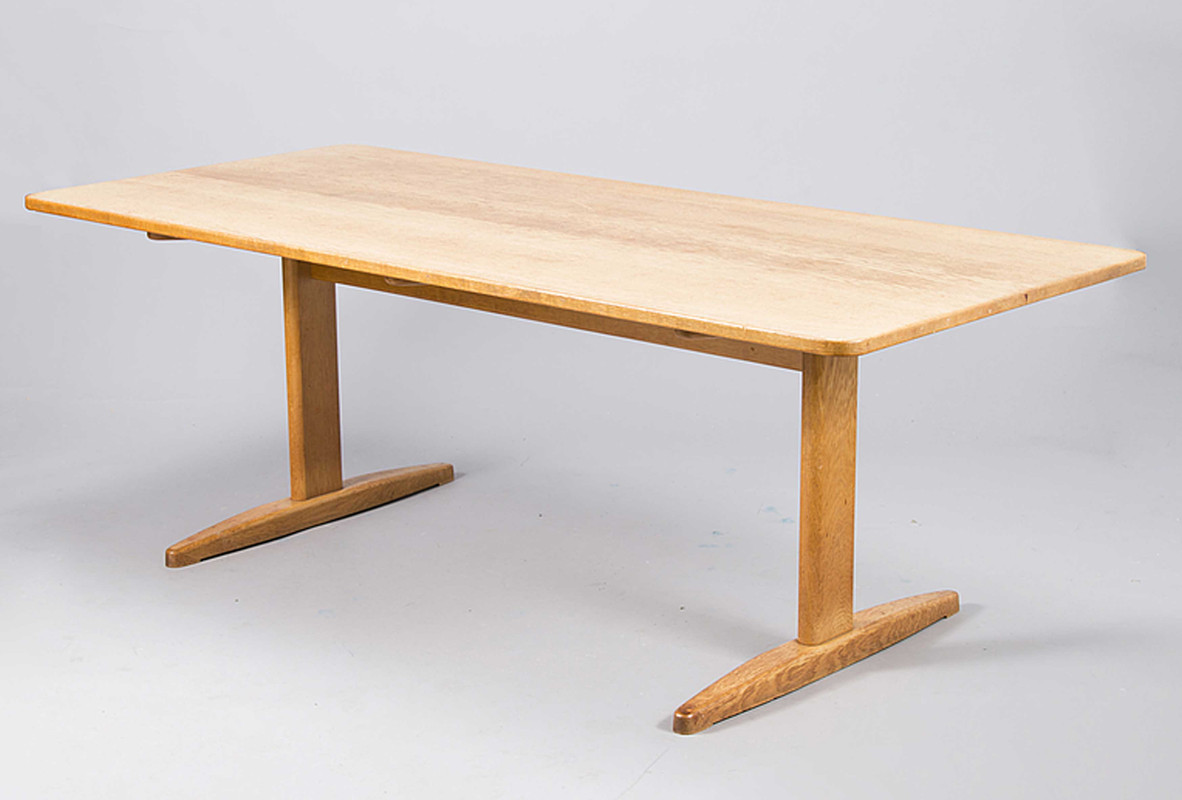

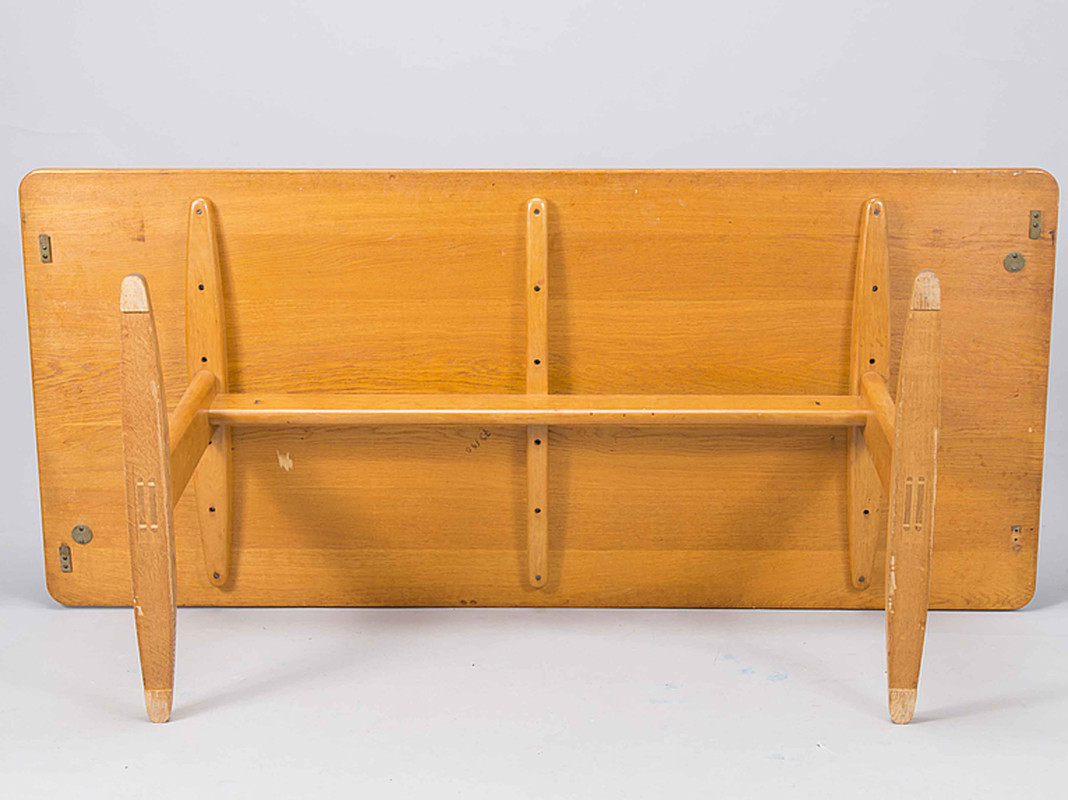
The top will be made from Rock Maple, and 1825mm long (72") x 900mm (35") wide, and 30mm thick. At present my first choice is to use a shallow elliptical router bit, creating a pillowed (very slightly rounded) face to soften the edge. This is in keeping with the chairs, which are all curvy. The second choice - if this leaves the top looking too thick - is to use a shallow undercut chamfer. Note that the top will be curved along all sides.Something like this Nakashima table ...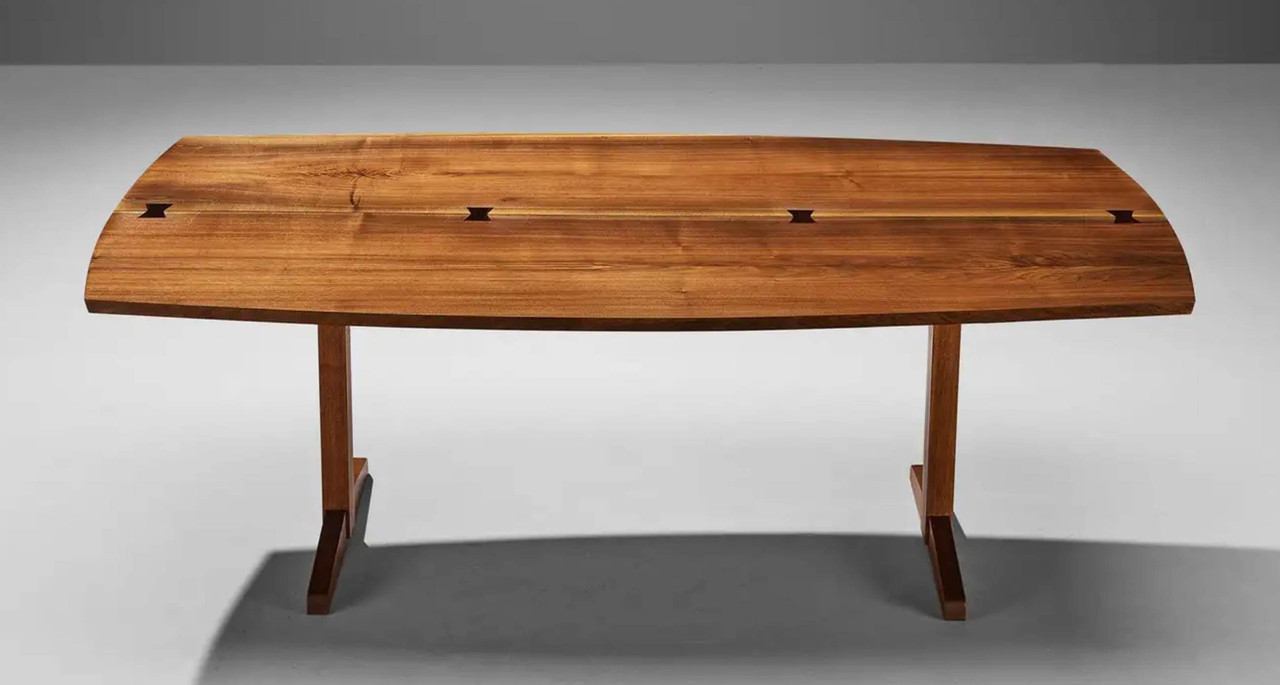

The legs link to the chairs through an oval shape I plan to give them (the legs of the chairs are oval) ... both in the horizontal and vertical parts. Joinery is pinned loose mortise-and-tenon and not the bridle joint in the Nakashima photo.The light Rock Maple top will appear to float on the dark Jarrah base. That is the intention.
A comment about the DC 09 Chairs I built: When we were planning to build a larger table, it was necessary to add two more chairs. My initial thought was to find bentwood carvers to join the existing bent wood chairs, but we did not like their looks, and went searching for something else. Much of our furniture is contemporary, Mid Century-styled (as you may have noticed from my builds), and so I decided to add two modern carvers (we do not mind a mix-and-match), and use the table to blend all the pieces together.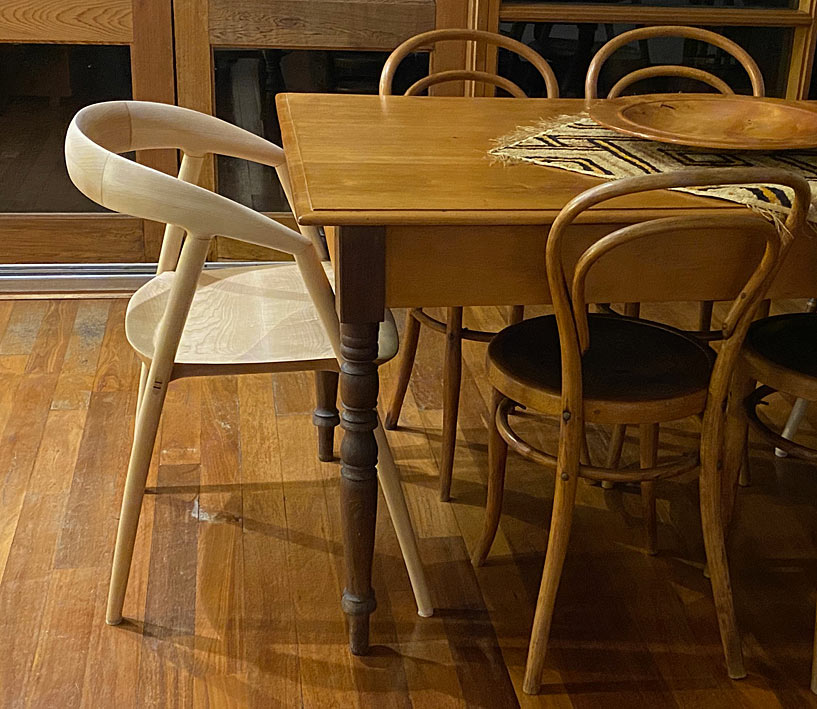
I managed to do a little work on the trestle table this weekend, in between watching the Olympic Games.
The mortise and tenon joinery is all loose tenons, which is easier to do accurately since all are through mortises. Plus I can orient the grain in the tenons for maximum strength (i.e. no run out).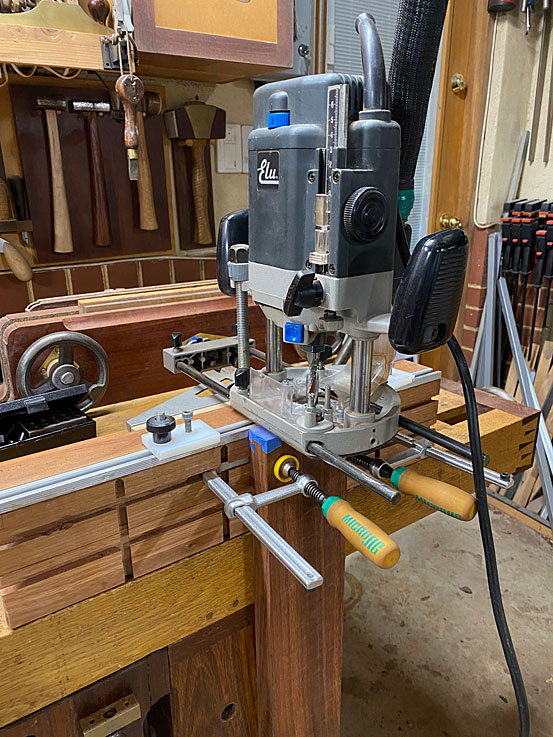
With the exception of the cross support, all mortises are 1/2" x 70mm wide x 40mm deep. The cross support mortises are 1/2" x 40mm wide x 40mm deep.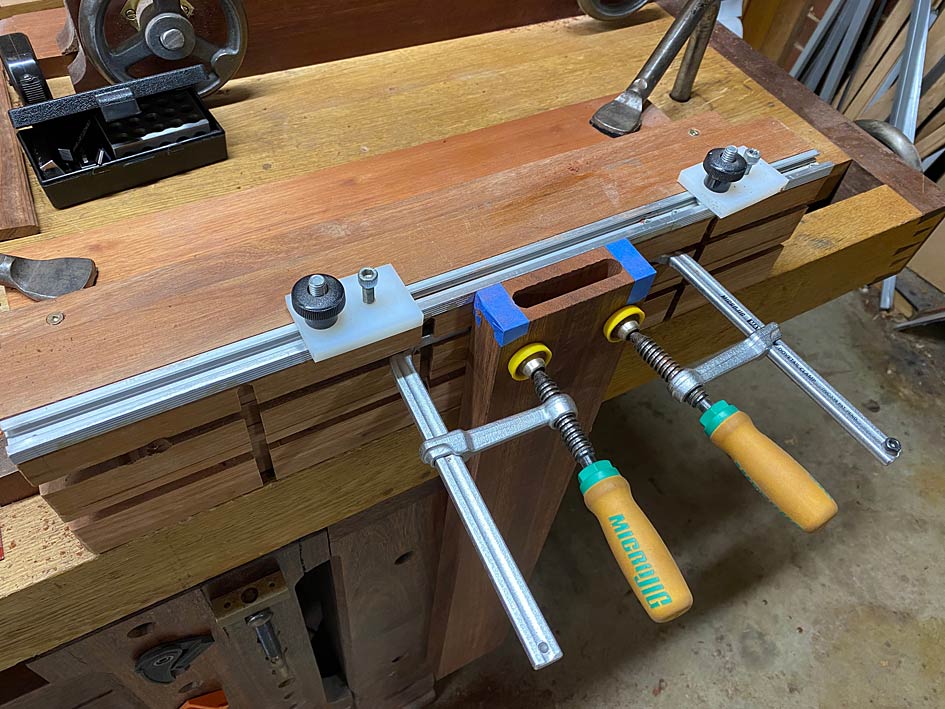
The loose tenon stock is made simply and quickly: thickness quarter sawn Jarrah, saw to width, and round over with a 1/4 round bit in a trim router.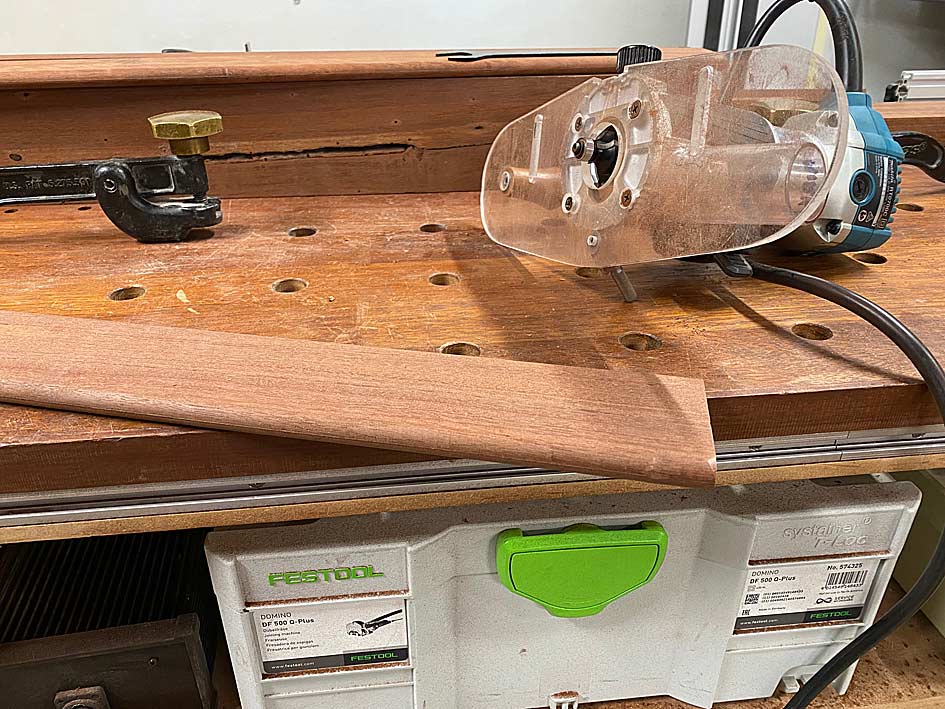
One correction for the loose tenons: the loose tenon is actually 80mm (3 1/8") long. The root is 40mm. And will be pinned at each end. That is pretty substantial. The rail will be wedged.
Regarding the choice of loose tenon joinery in this build: I have a preference for traditional mortise-and-tenon joinery. When I started making the chairs, this is what I did - integrated tenons from the seats. Then it became evident that they were vulnerable to breaking owing to run out. That is not a risk to take with chair legs. I started again, and this time used loose tenons, which allowed me to choose quarter-sawn stock.
The wedged M&T legs ...
... need to be echoed in the table. Hence the round ends (made with a router) in the table legs. Also the oval table legs linking to the oval chair legs.
Now we get to the interesting part. What I start with will be quite different from what ends up finished. There is very little that will not be carved away. Remember, the table is intended to blend with the two chairs I built. For this reason, the two vertical sections and the horizontal cross support will be oval in cross section. I have not seen this before ...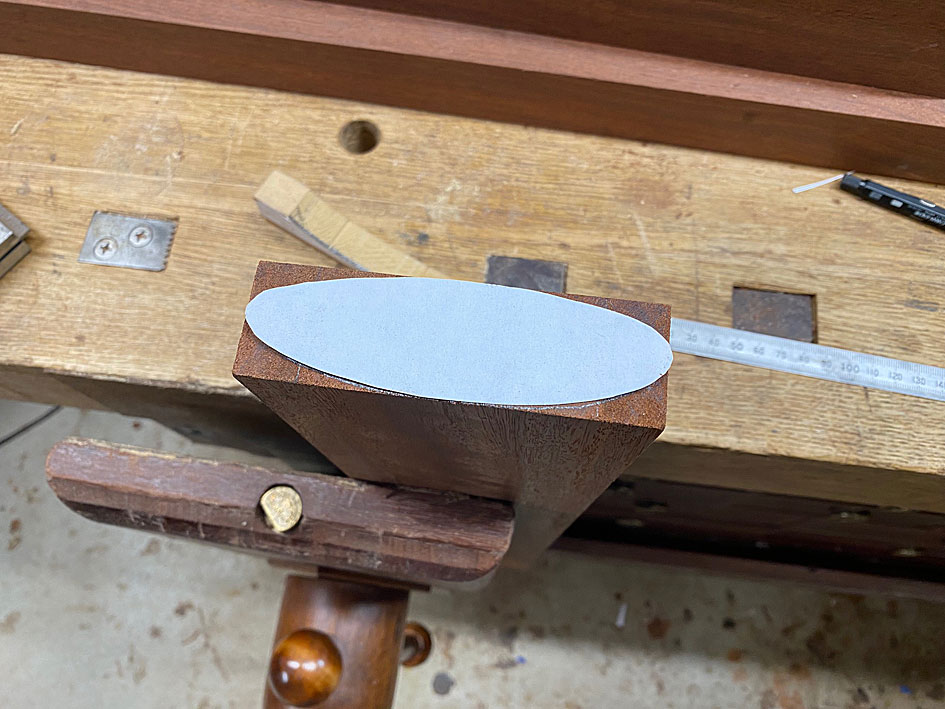
A template for later use ...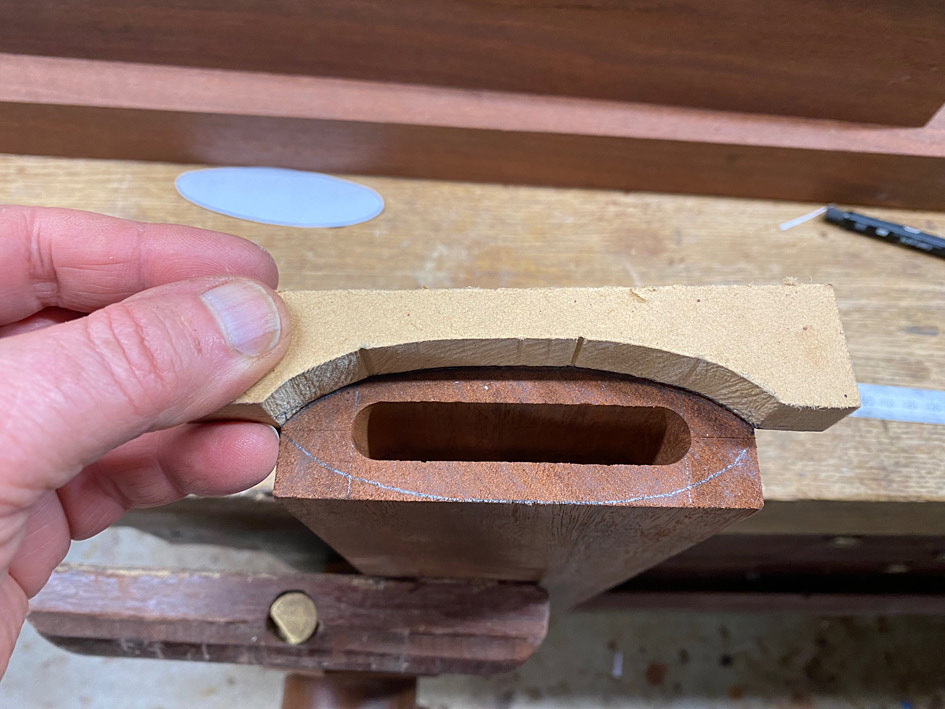
All the base parts cut to length and width, and mortised ...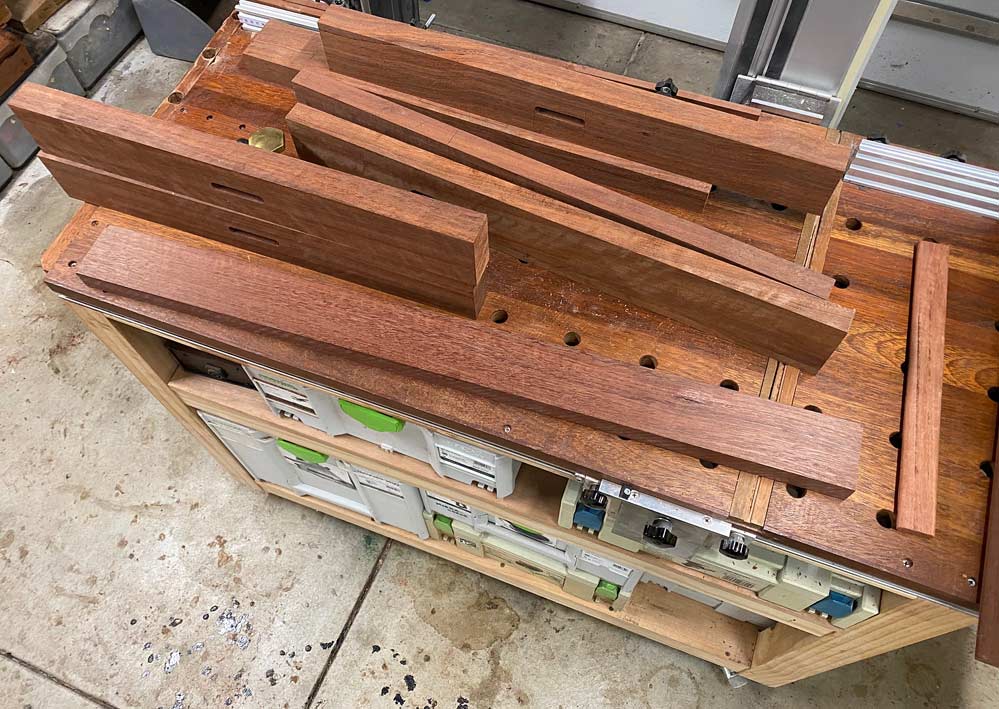
A loose fit. There is just over 1m (40") between the trestle ends, with a 16" overhang planned. 72" long in total. Note that the top support is wider than the base. Both will be carved away for an "organic" blend with the upright sections. It looks a little stick-like at present ...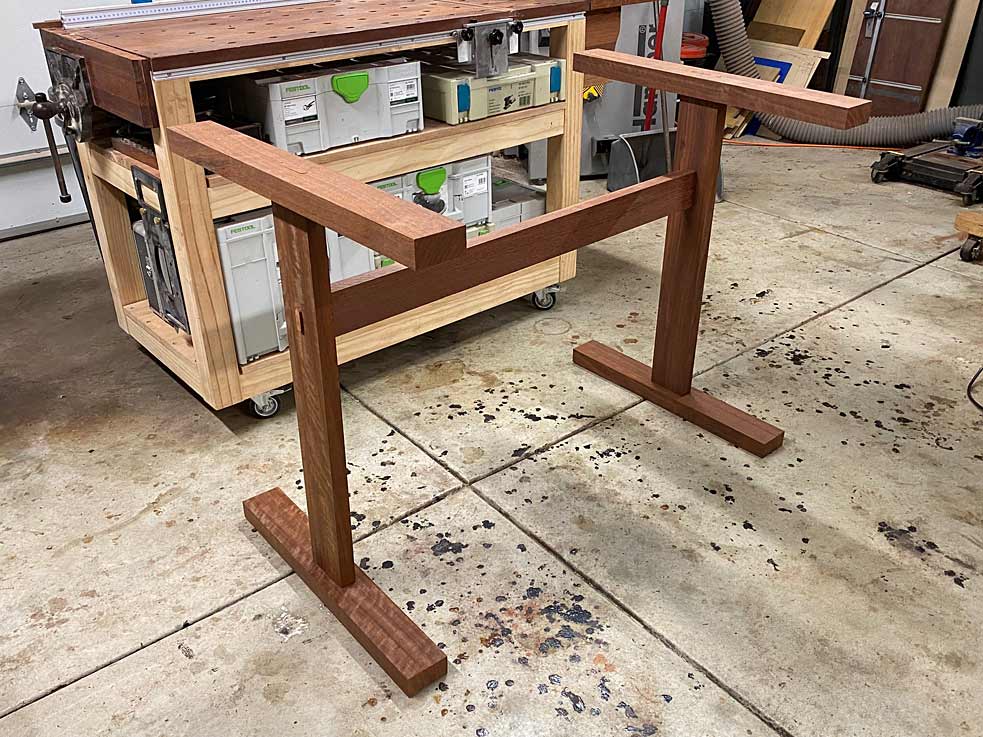
Here is one leg or, rather, one upright. Everyone likes looking at shavings and planes. Start with a jack ... in this case a Stanley #605 with a radiused blade ... follow with a HNT Gordon Trying Plane to remove any tearout, and more shaping with smaller planes ...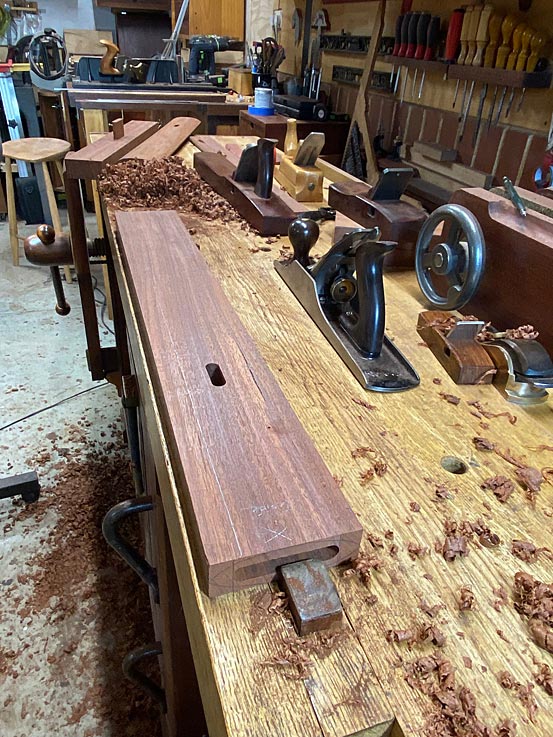
Planing down to the marked curved lines ...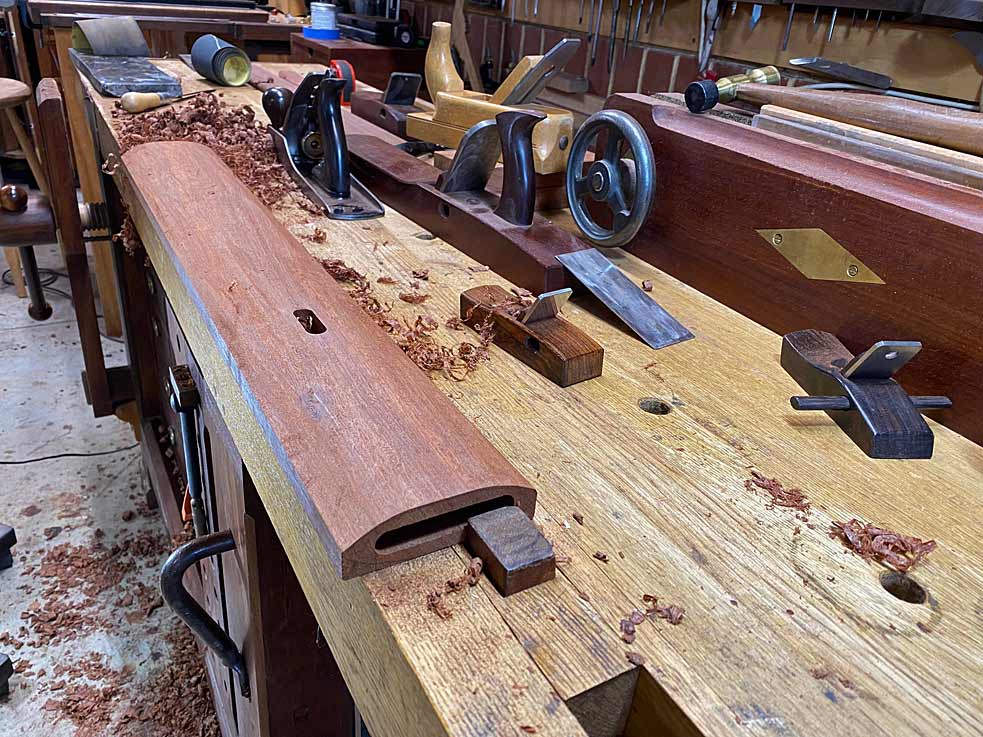
The tiny high angle BU smoother I made worked its magic ...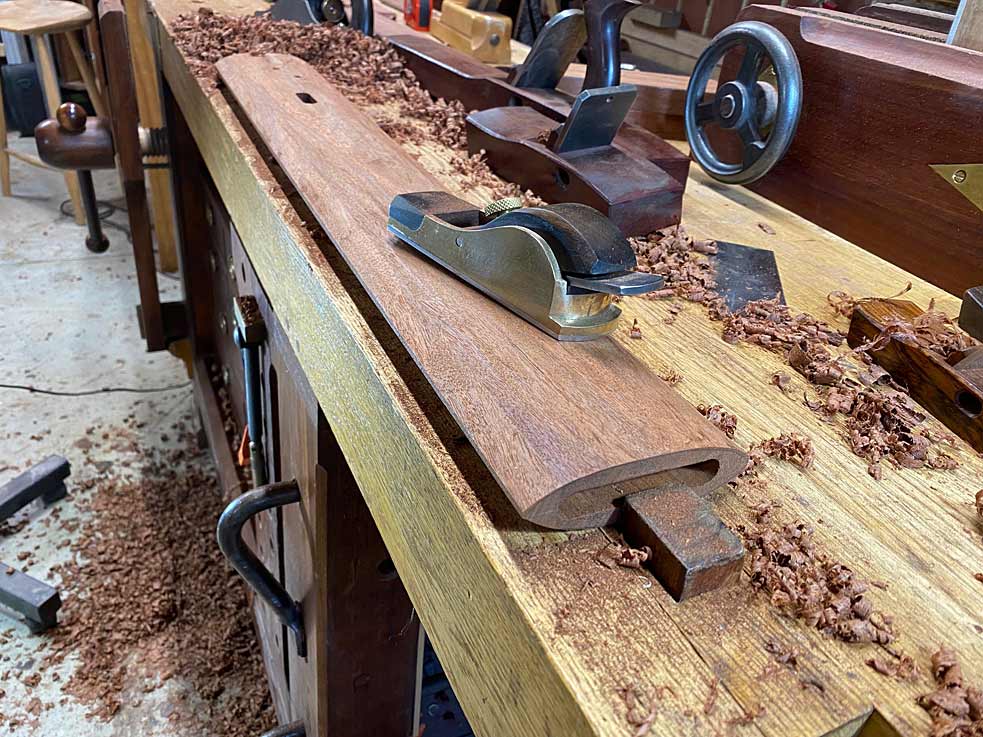
Here the vertical rests on an un-shaped base. That's where the challenge lies with shaping.
Still to be sanded and edges rounded ...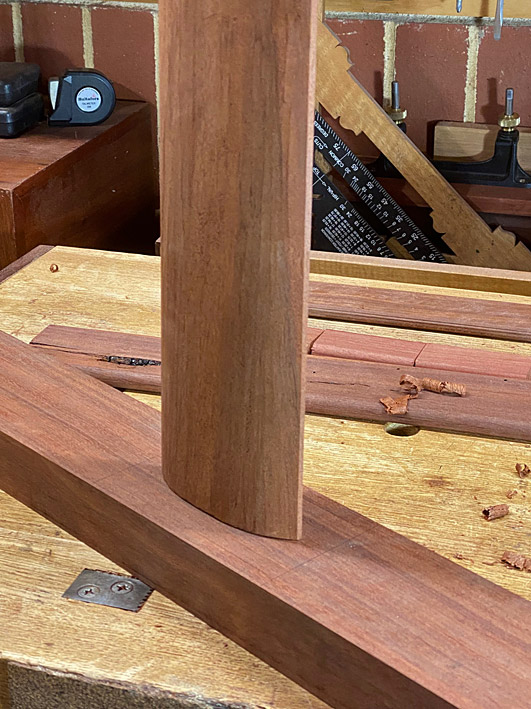
Regards from Perth
Derek
Dining Table - re-visited
Posts
Re: Dining Table - re-visited
#2I prefer 4 legs with a nod to details in the new chairs. The elliptic-egg section legs and profile angles would be my choice. But, it's your sweat and satisfaction.
I have immediate solutions for others challenges, perhaps based on my professional life. My own work is a battle toward a decision.
Re: Dining Table - re-visited
Edited #3Quick review - we left off with then posts shaped into an ellipse ..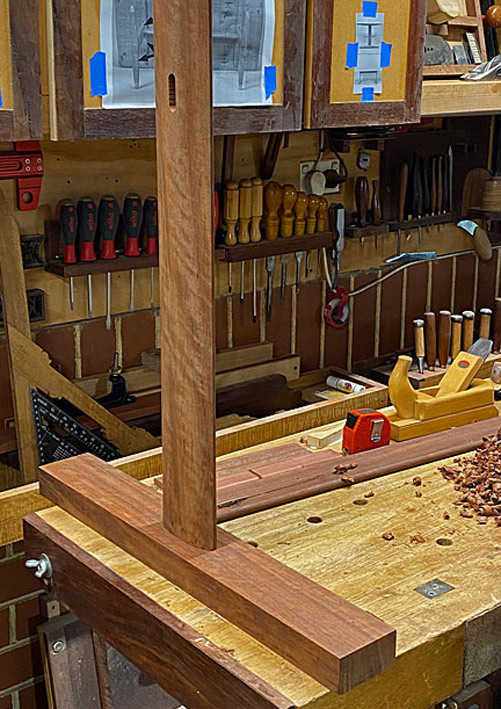
Time to turn that thick blocky base into a shapely, organic foot for the post.
It needs to be said that I binned the first feet I shaped as they ended up too thick looking. I want slim. I realised that a reason for this was that the blocky base was not wide enough (at 80mm), and so I built new ones, this time 110mm wide. In the photo below, the first is being shaped with a scrub plane into a half-ellipse to match the posts ...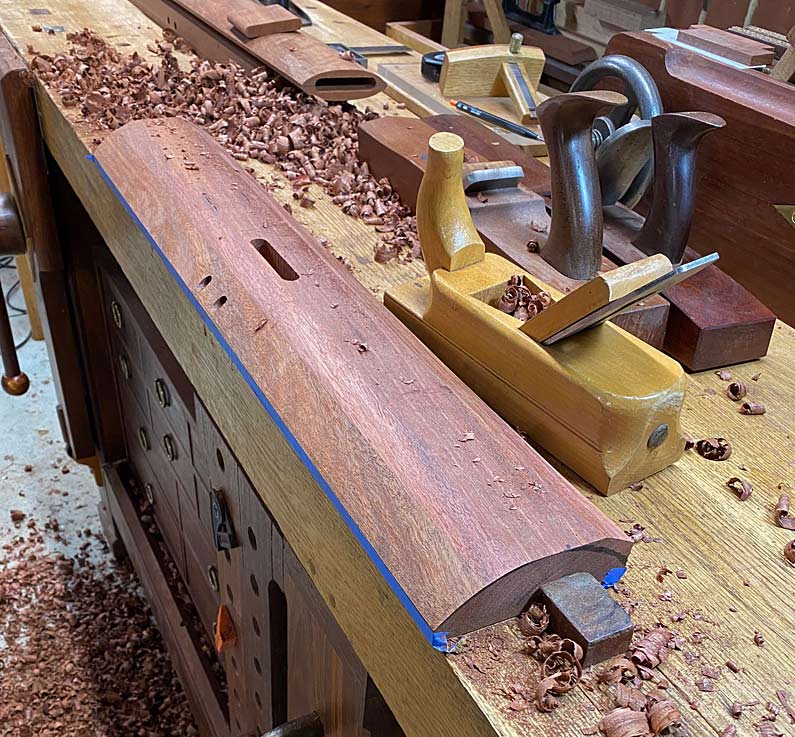
This was followed up with a trying plane ...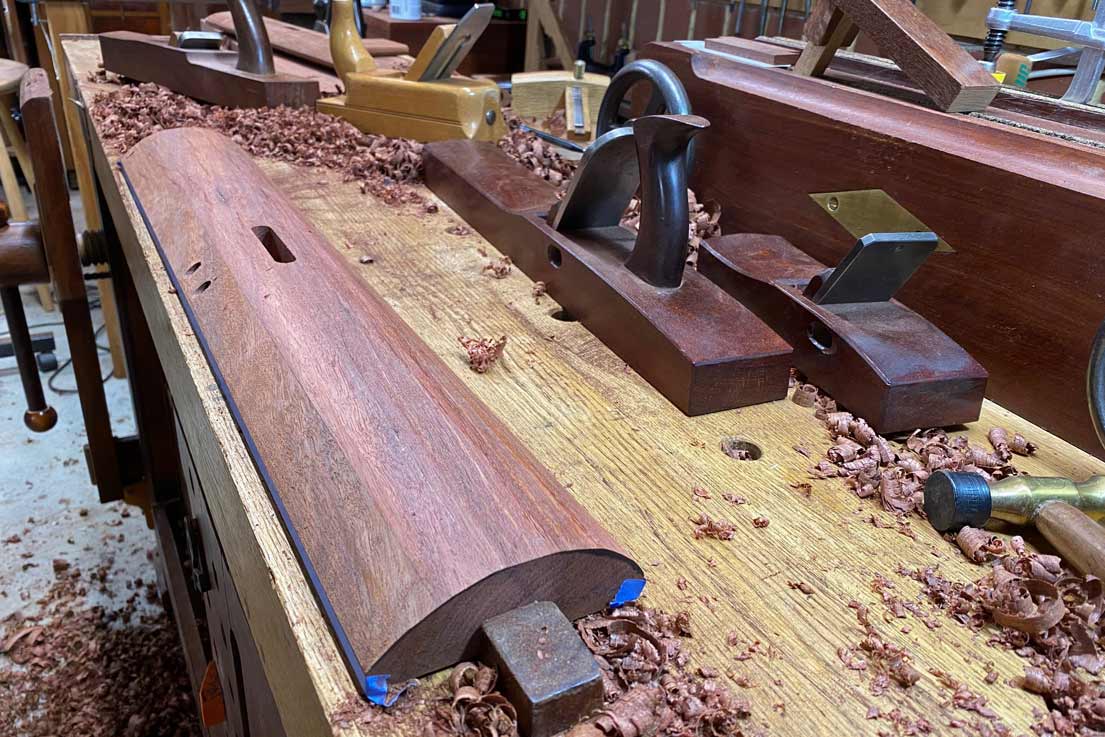
Prior to shaping the base, it was drilled for the dowels which will later be used to draw-bore the mortise-and-tenon joint ...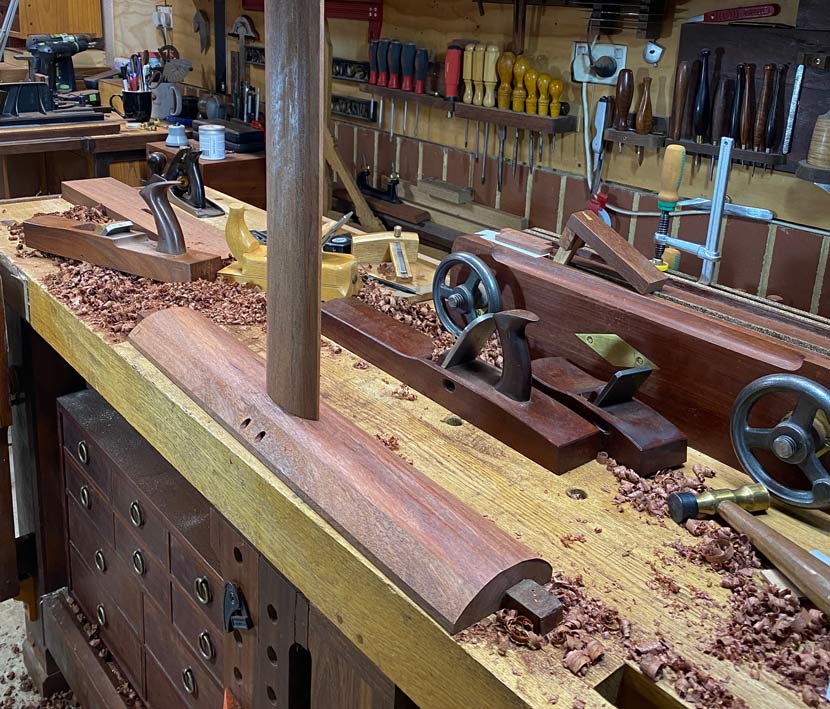
The feet are too thick, and this will be reduced with a taper. Below the beginning and end is marked out ...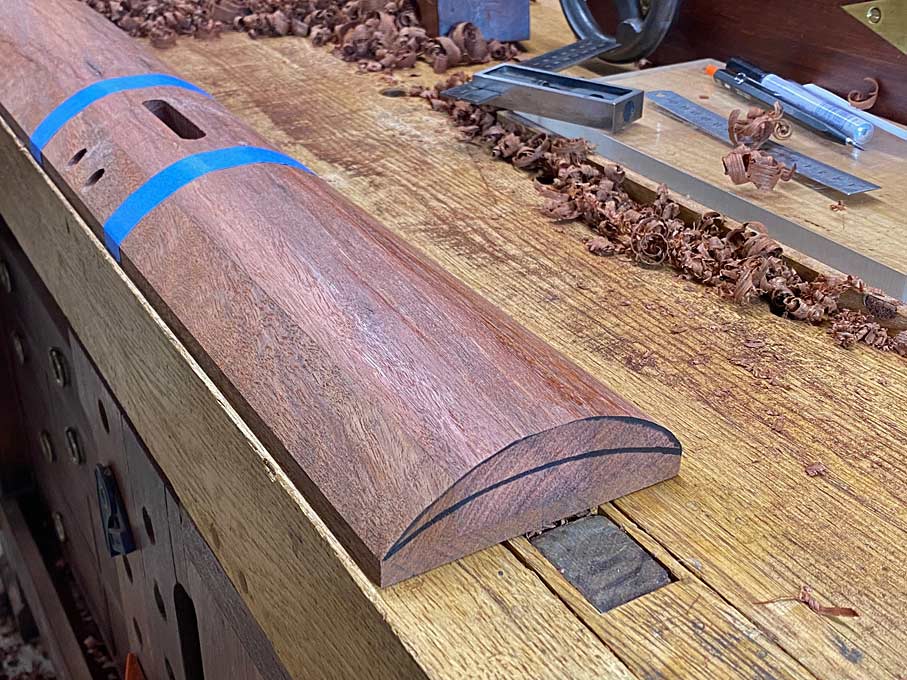
A succession of woodies are used (as was done in shaping the curves). First a scrub plane removed the bulk of the waste. This produces a rough finish ...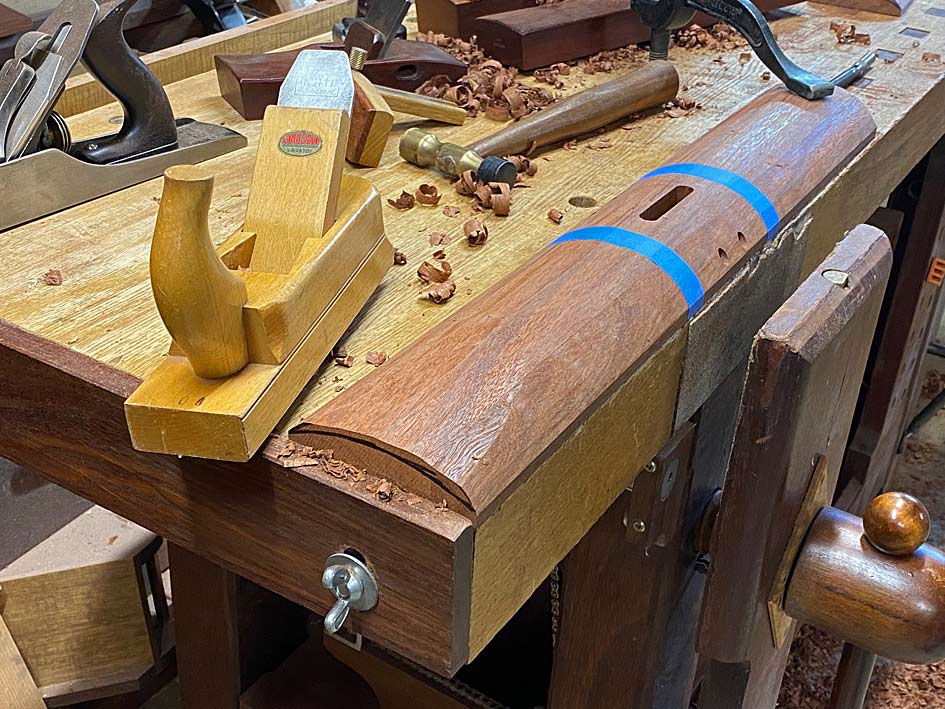
This is followed by a jack plane, which has a less aggressive radius to its blade ...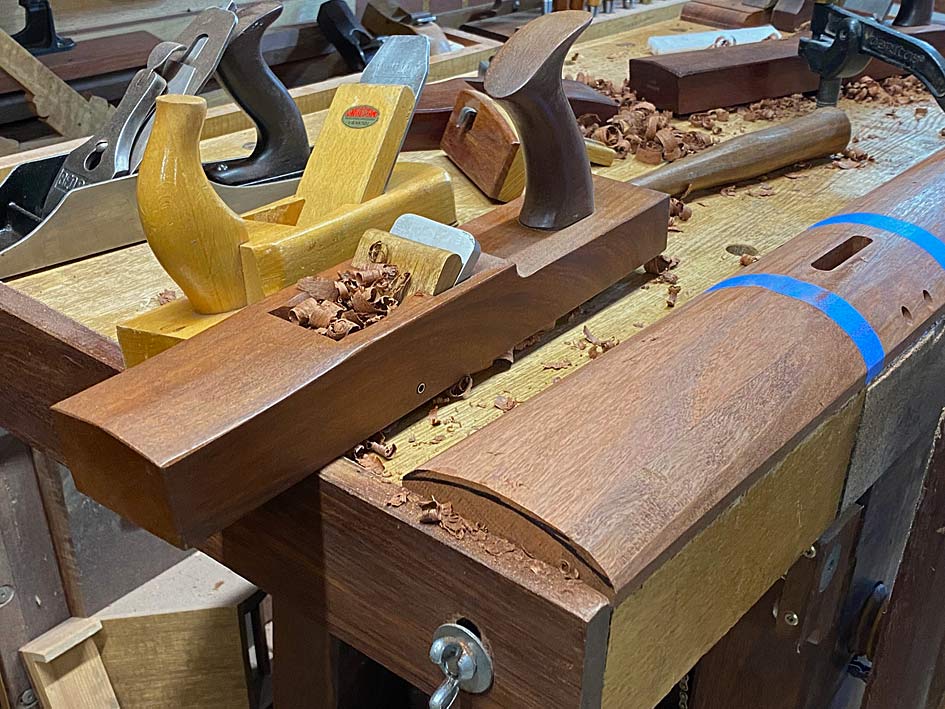
A trying plane now smooths out the surface ...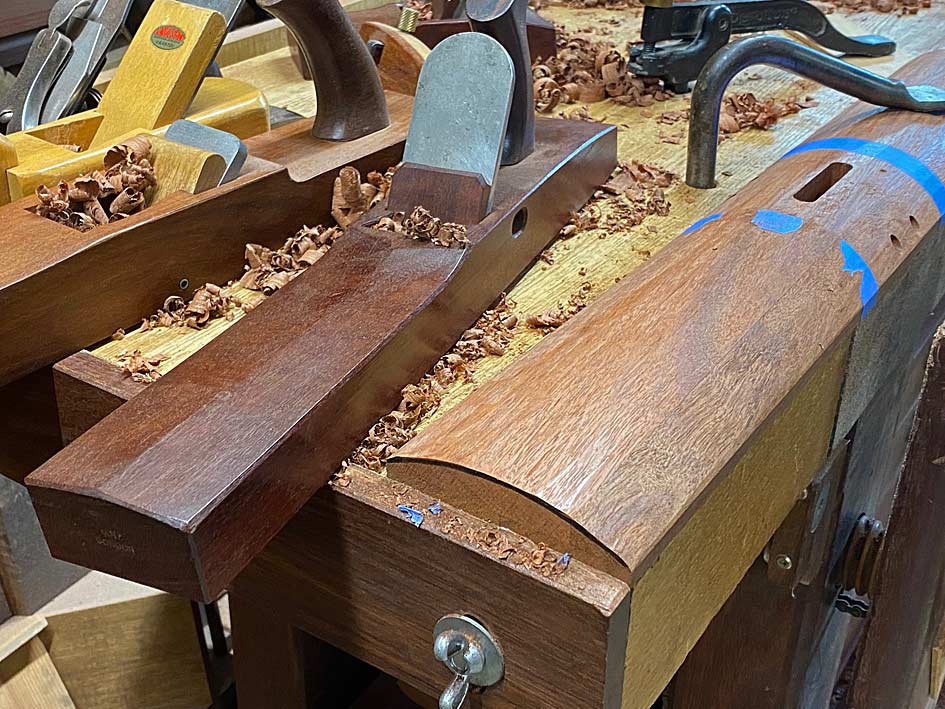
Finally, a smoother is used for the finish ...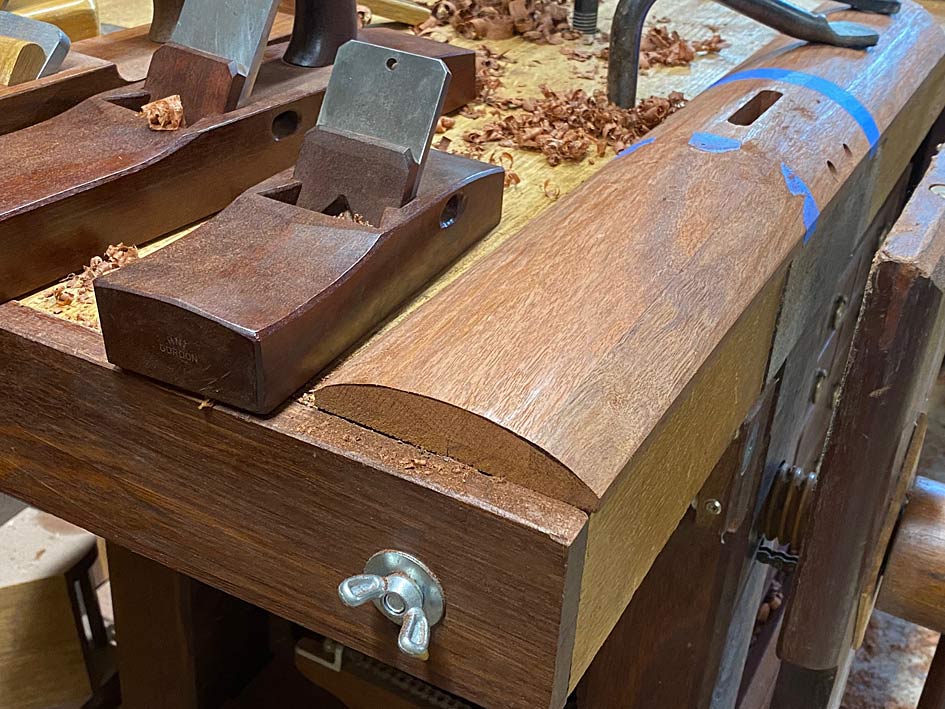
It is relevant at this point to recall that the table top with be curved at the sides and ends, similar to this Nakashima ...
The ends are marked with a slight taper, about 8mm each side ...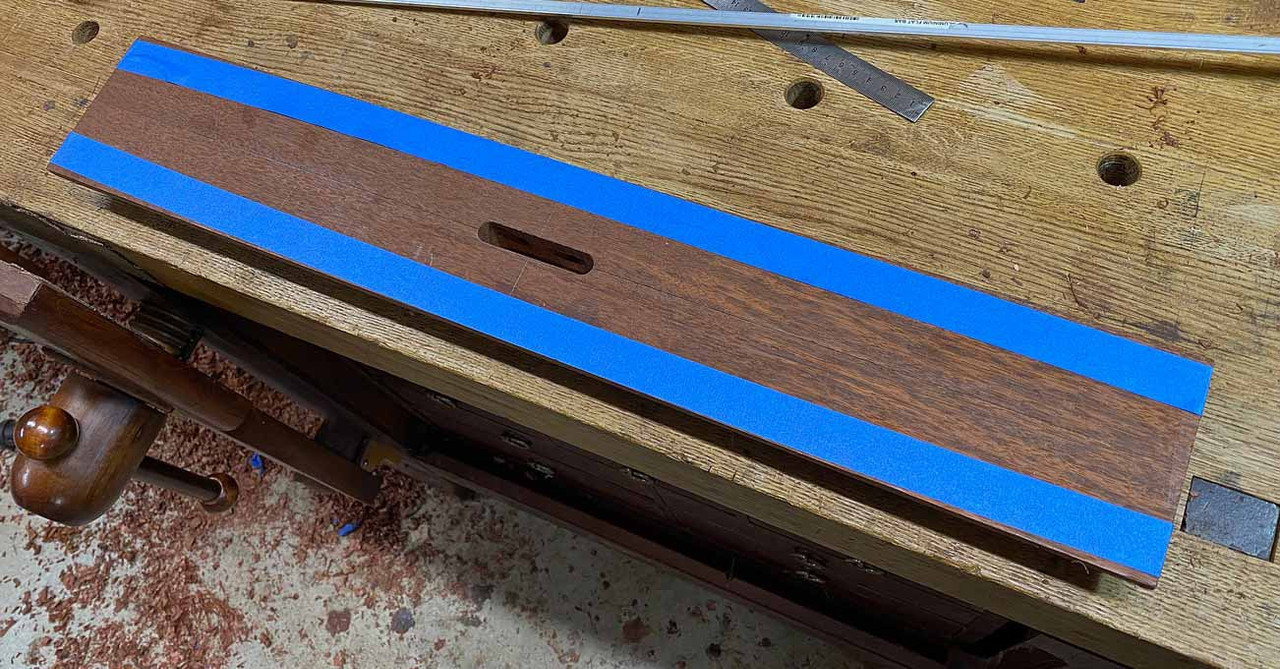
This time I used a Stanley #604 with a close chipbreaker since it handles reversing grain best of all ...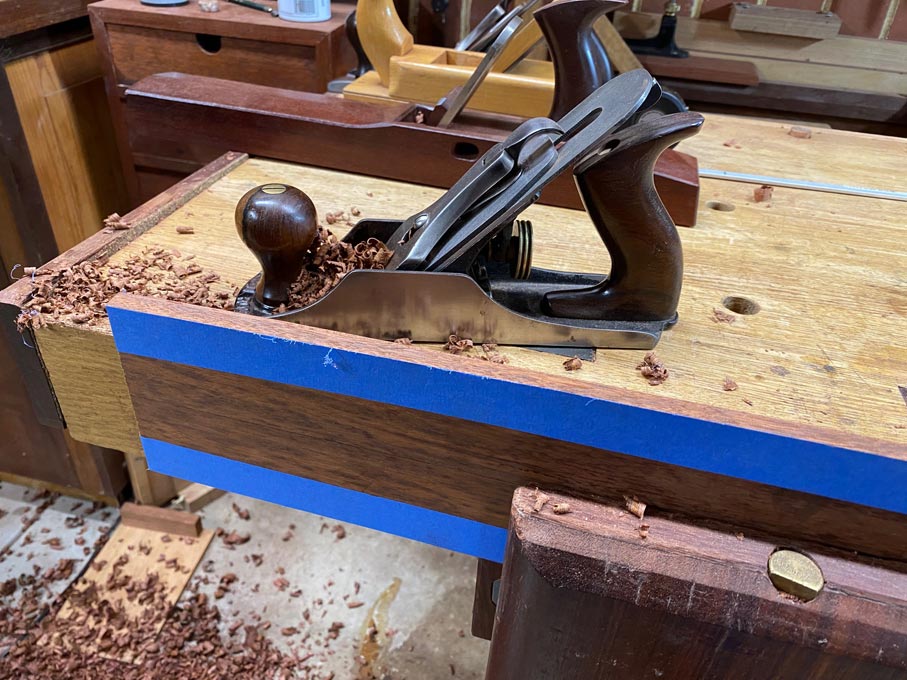
The end curves were marked ..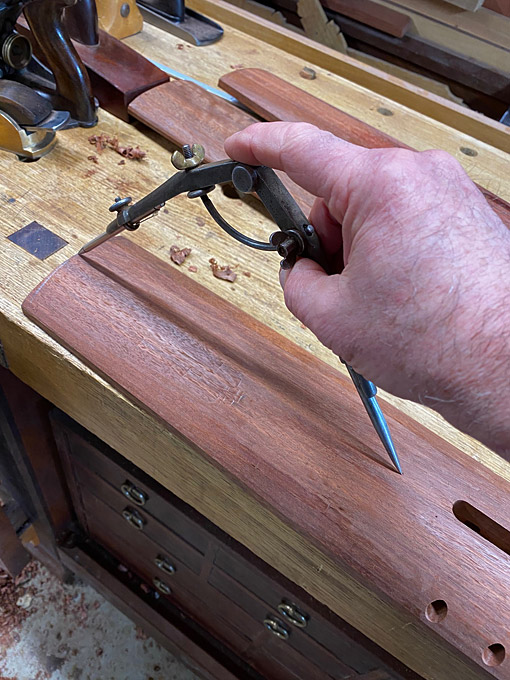
... and the waste removed with a block plane.
This is combination after sanding to 400 grit ...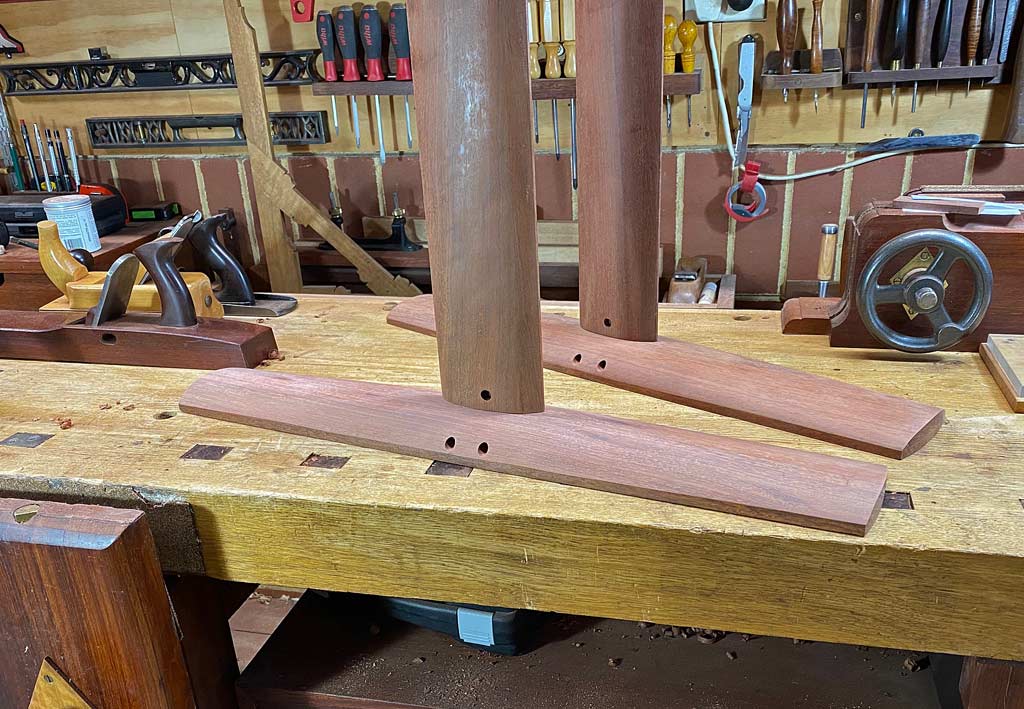
Hopefully, tomorrow may see the trestle table base completed.
Regards from Perth
Derek
Added later 19 h 01 min 47 s:
NEXT:
The last two structural areas for the base were the central rail, which was also planed into an ellipse ...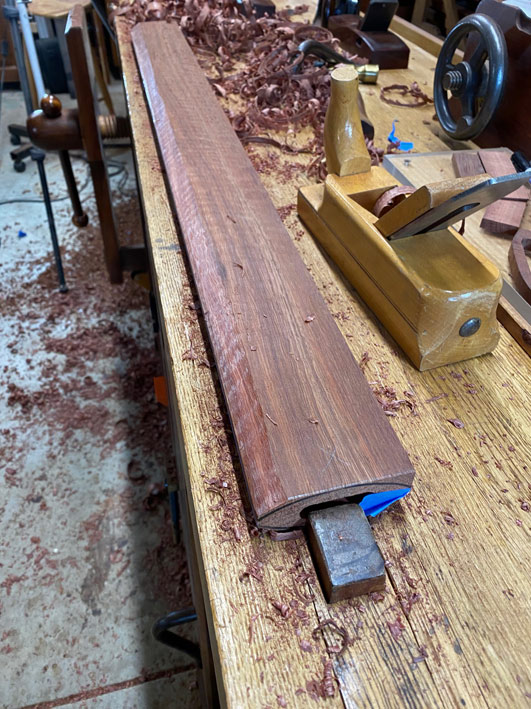
... and the upper, support rails ...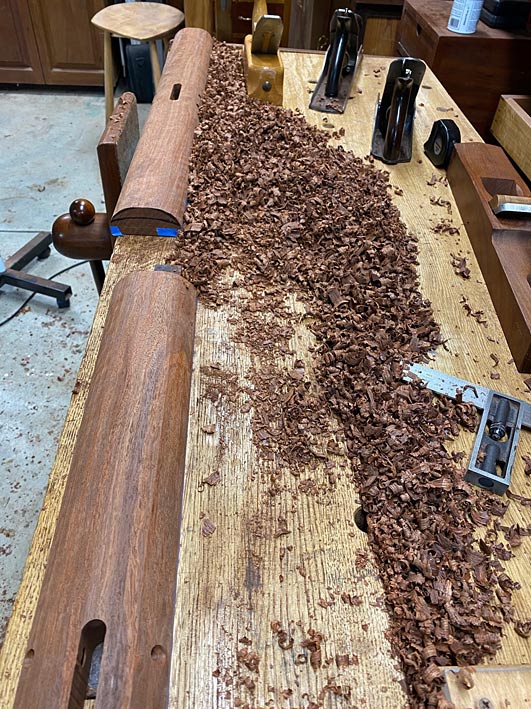
These also required tapering, which I shall not go through again here. Instead, I will move to the completed - but dry and unfinished - trestle base. I would have preferred to have it all done, but the weekend came to an end. Rats.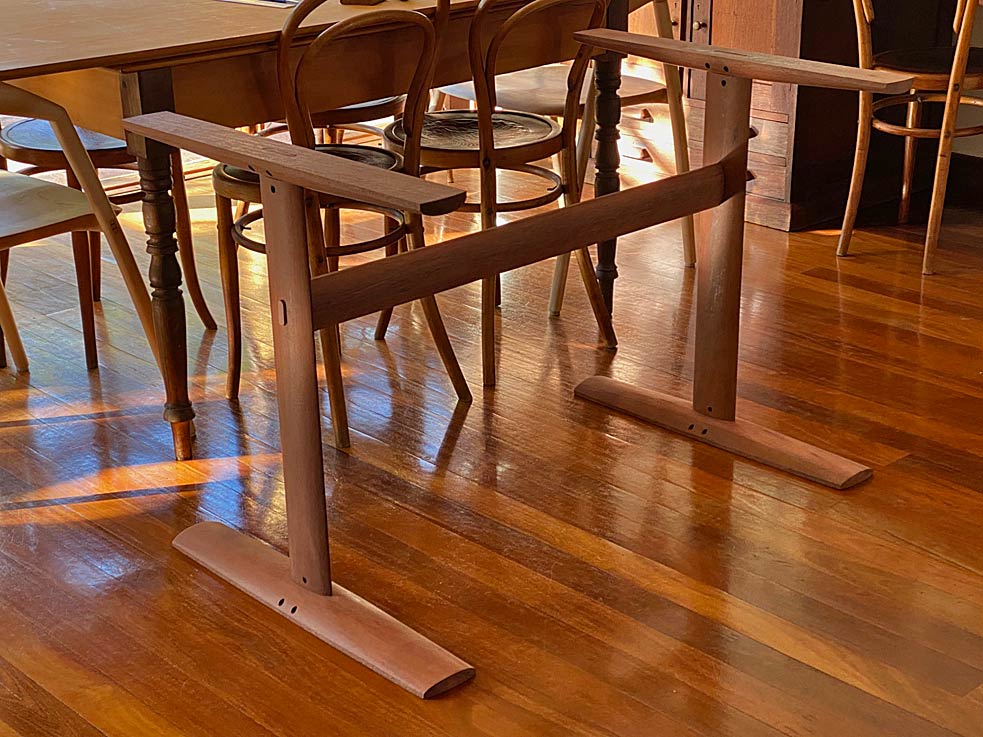
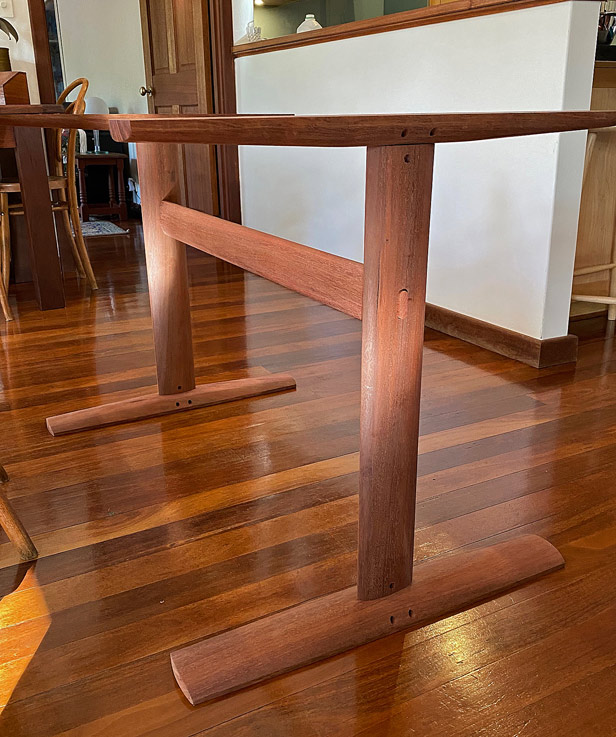
These will provide some idea of the curves and, hopefully, organic feel I was aiming for ...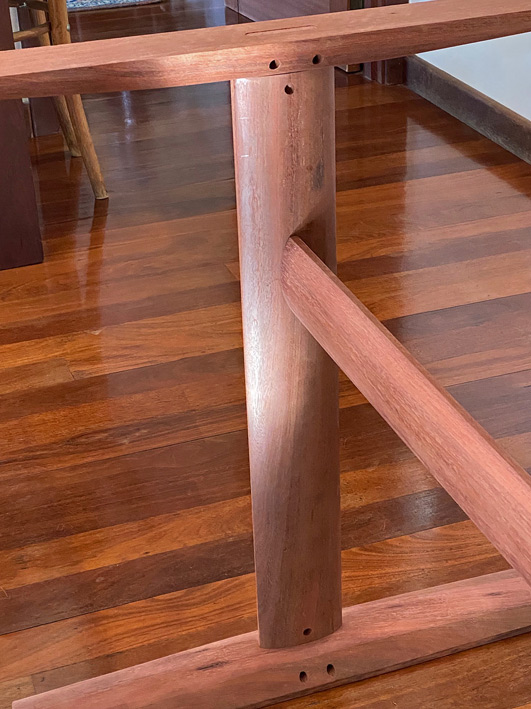
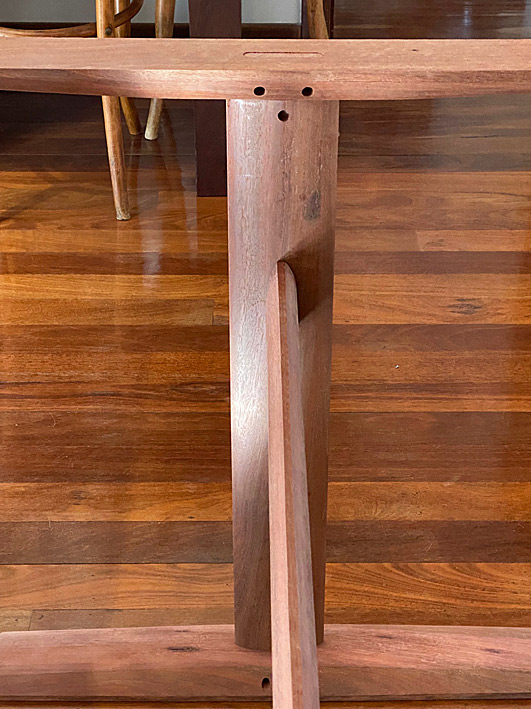
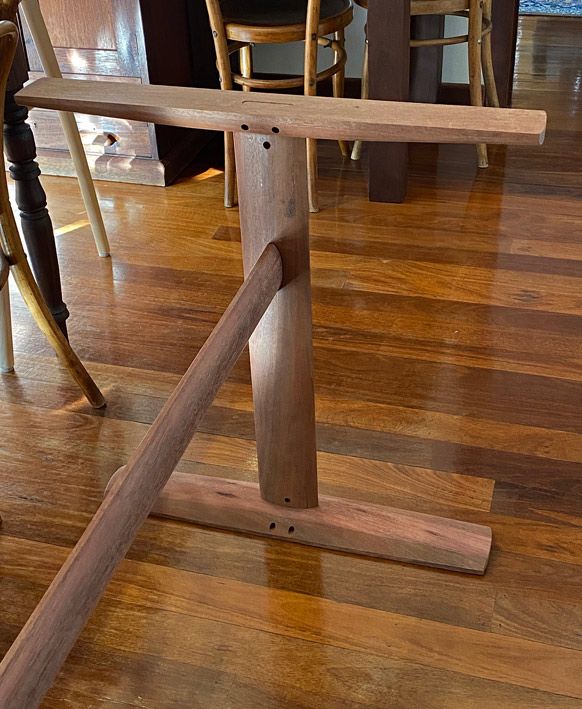
Regards from Perth
Derek
Re: Dining Table - re-visited
#4The table structure looks nice .... and delicate, like the chairs.
Re: Dining Table - re-visited
#5Thanks Bruce. It looks like we are the only ones willing to contribute to this forum. Very sad, End of an era.
Regards from Perth
Derek
Re: Dining Table - re-visited
#6Derek Cohen (in Perth, Australia) wrote:Thanks Bruce. It looks like we are the only ones willing to contribute to this forum. Very sad, End of an era.
Regards from Perth
Derek
Derek
Following your posts, as always.
Got some WWing posts to contribute - eventually. Not as productive or prolific as you are.
Henry
Re: Dining Table - re-visited
#7Glueing up
I have always found glueing up far more stressful than cutting the parts and planing them to fit precisely. My fear is always that something will move and the result will be a mis-match of parts. The additional concern is that the joinery may not be strong enough, and that my insistence on not over-designing joinery will prove that I am a hopeless amateur.
An important feature of the mortise-and-loose-tenon joinery is ensuring that the tenon does not move. Glue alone may suffice, but I have added 3/8" diameter pegs or dowels. Now I recently purchased a dowel maker on Temu for the grand sum of $19 AUD. How good could this be? Well, in short, it is pretty damn good, to my surprise. 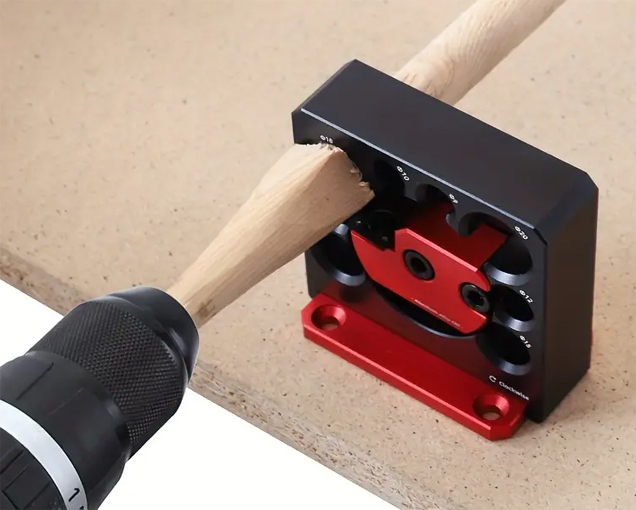
But it would be the wrong way to make pegs/dowels for these joints. That jig make great dowels for filling holes, but for pegging tenons you need grain that does not have run out, is straight and strong. This means making pegs from rived stock. This was then pounded through a LN dowel plate ....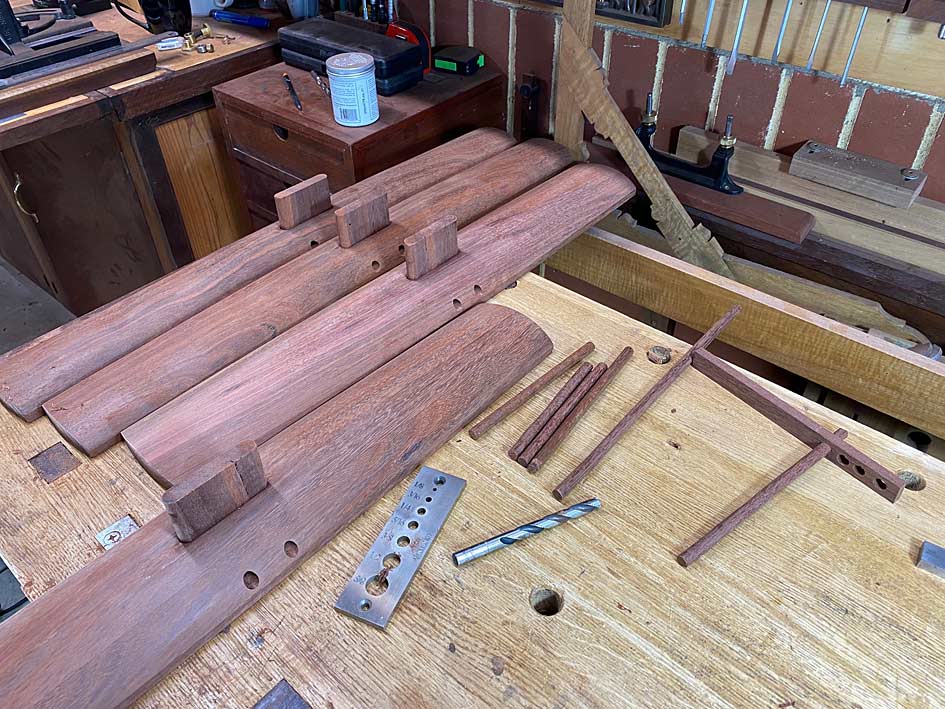
The peg holes had already been drilled in the base and upright, as shown previously. The loose tenons were glued into the bases and upper stretchers (but not the vertical stretcher yet). Now the holes were extended through the tenons ...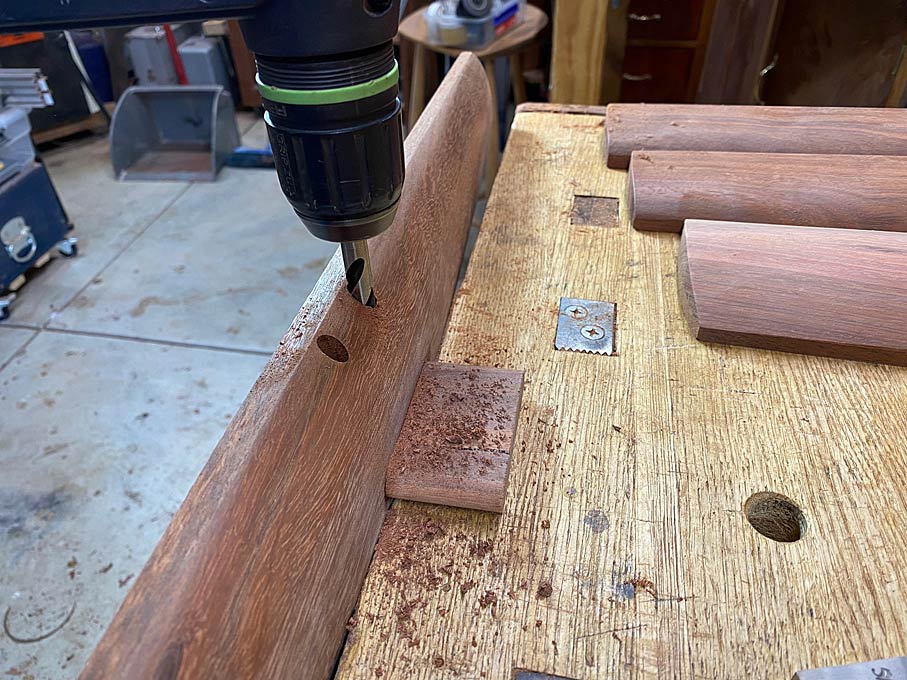
... the excess sawn off ...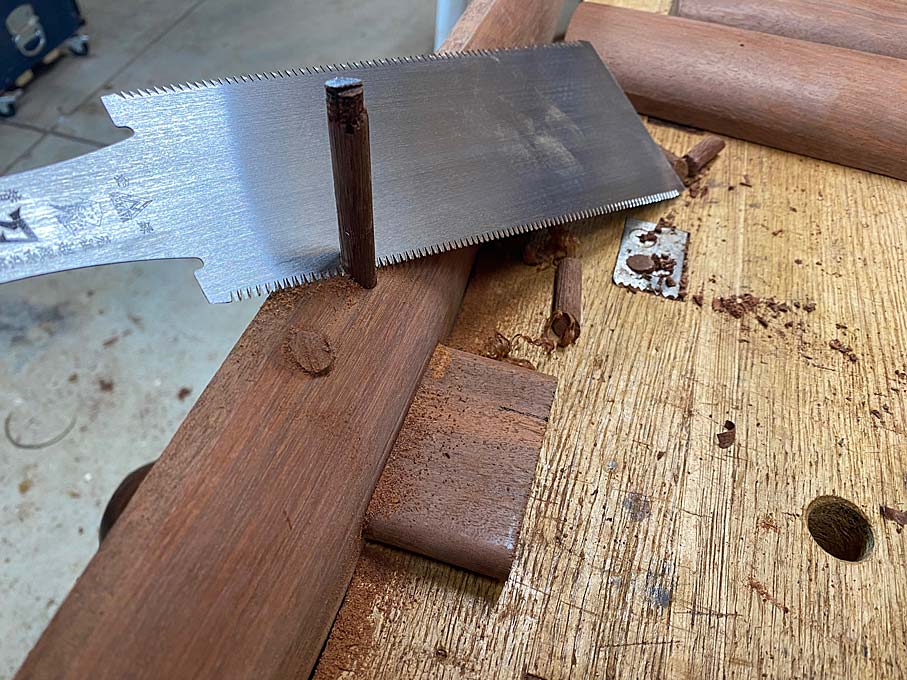
... and the stubs sanded away ...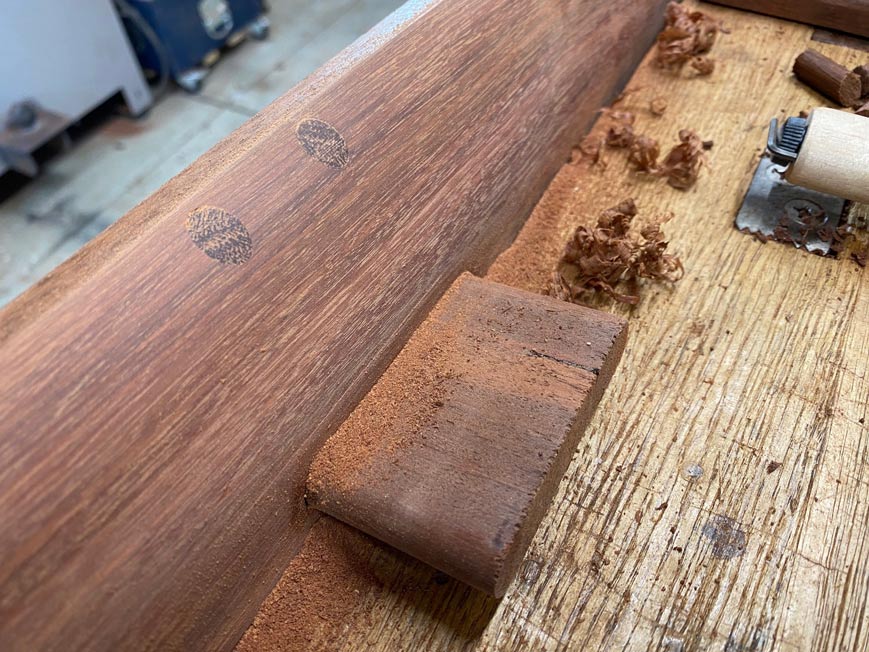
Sanding is the better choice here of using a chisel since the dust will fill any gaps in the pegged holes. Just add glue and sand flush.
Once the base and upper stretchers are complete, the vertical stretcher can be glued and clamped, first to the base ...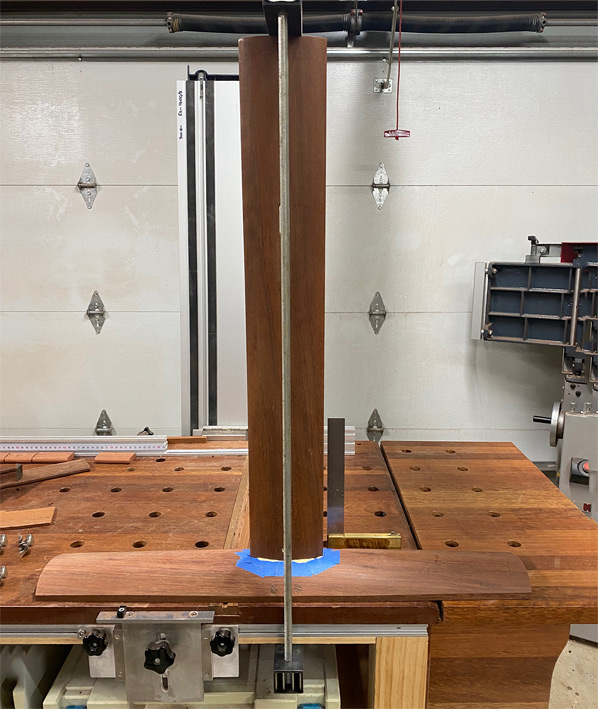
... and then the upper stretcher is added ...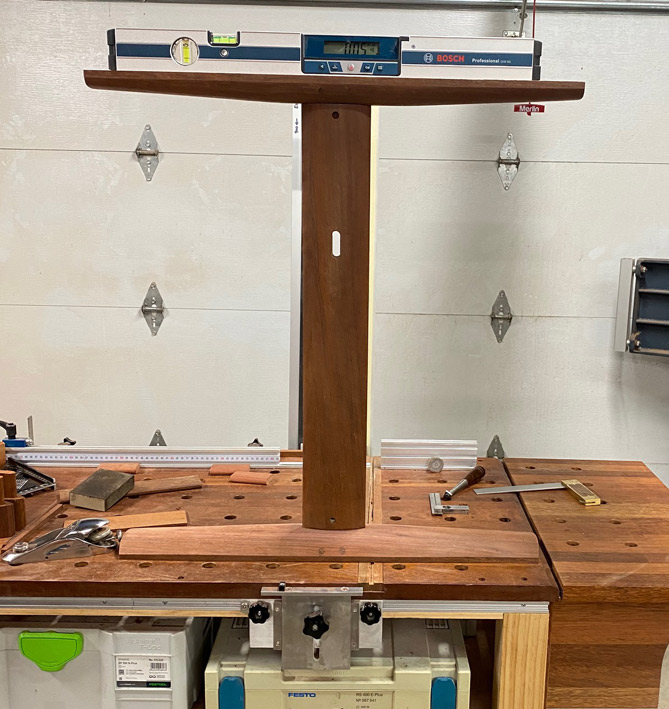
While clamping all together, the level is checked to be parallel. This was found to be within 0.05 degree. Happy with this.
The loose tenons for the cross stretcher are sawn for wedges ...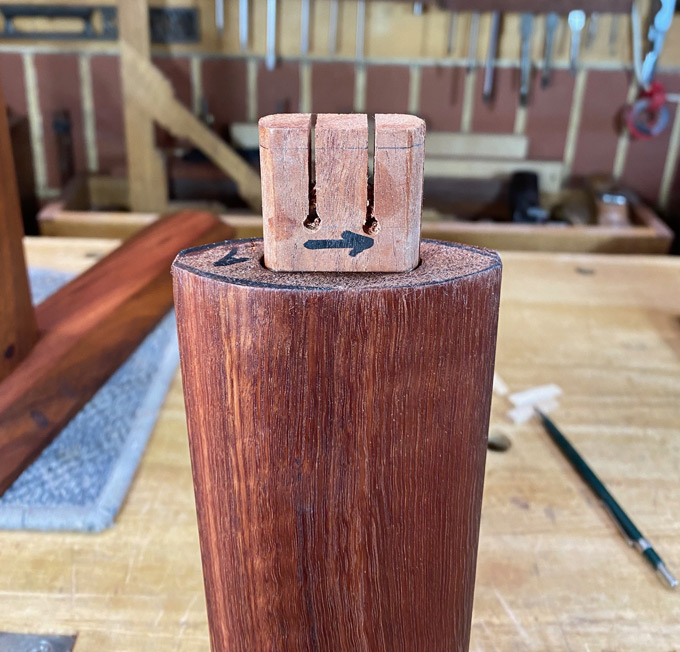
The tenon is shaped for later ...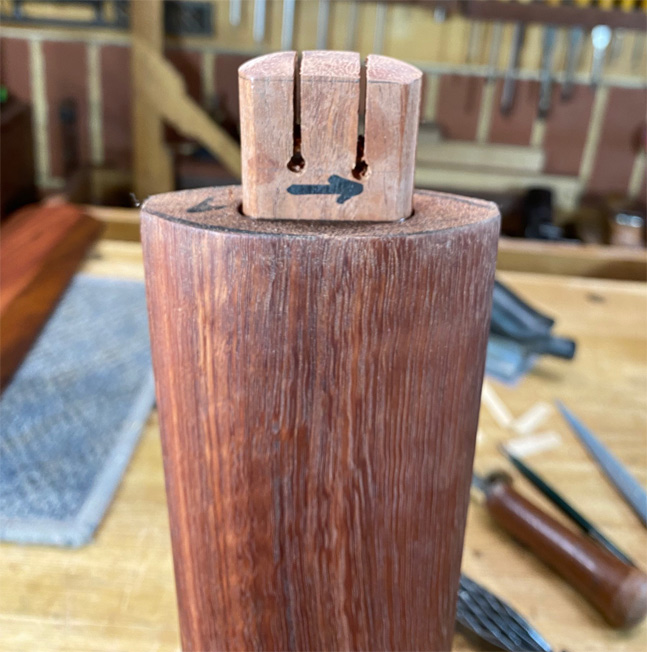
The wedges are sawn roughly to shape, and then planed to match each other using a simple fixture made for the purpose ...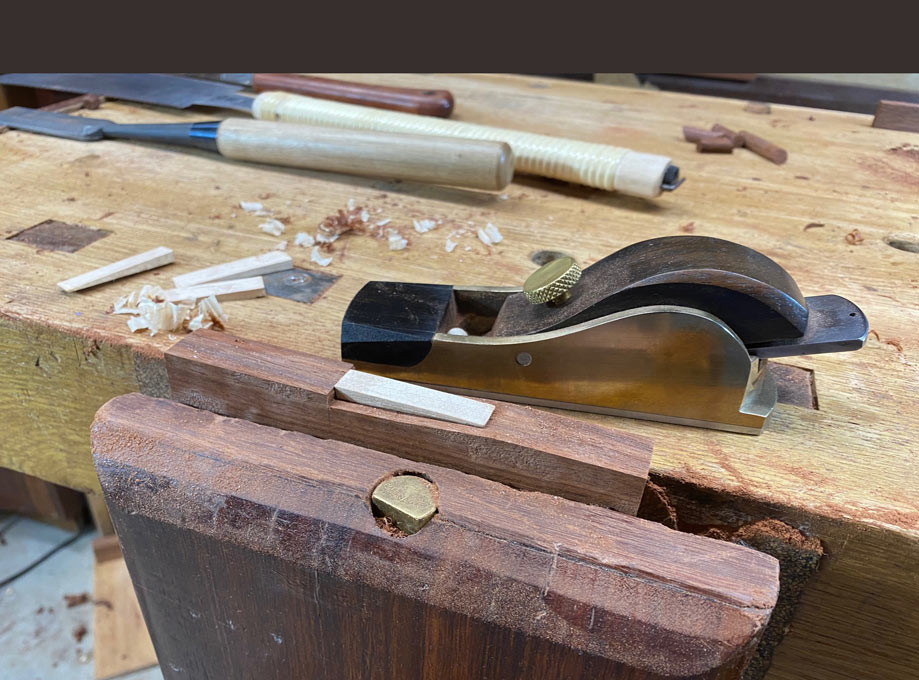
Before the cross stretcher is glued, the underside of the bases are given protective pads (made from Crubber). These raise the ends about 2mm, ensuring both stability on the floor as well as a non-slip ...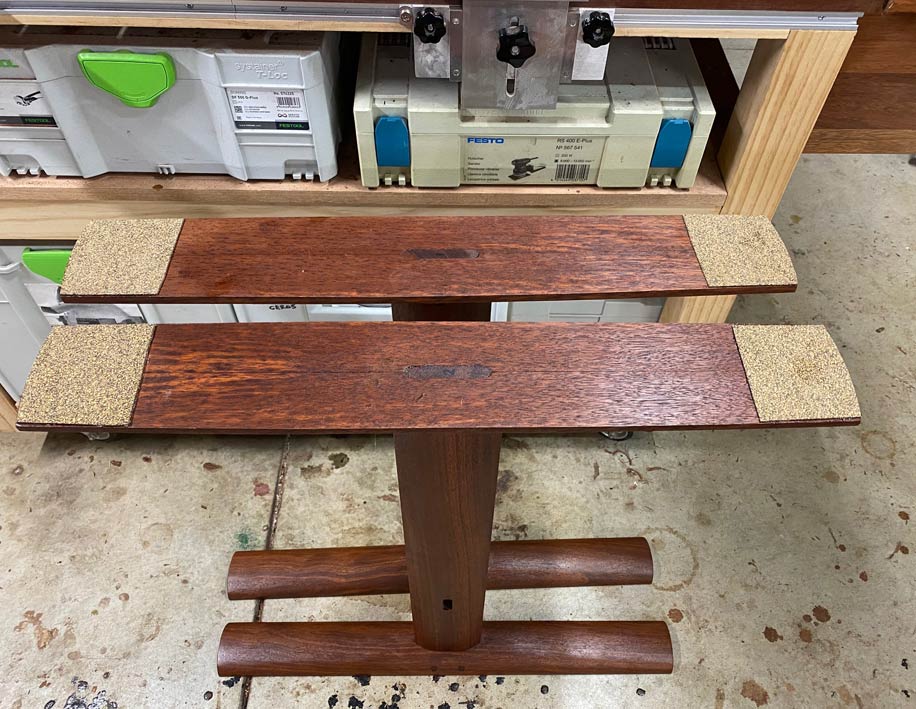
Finally, the cross stretchers are added and the ends clamped together ...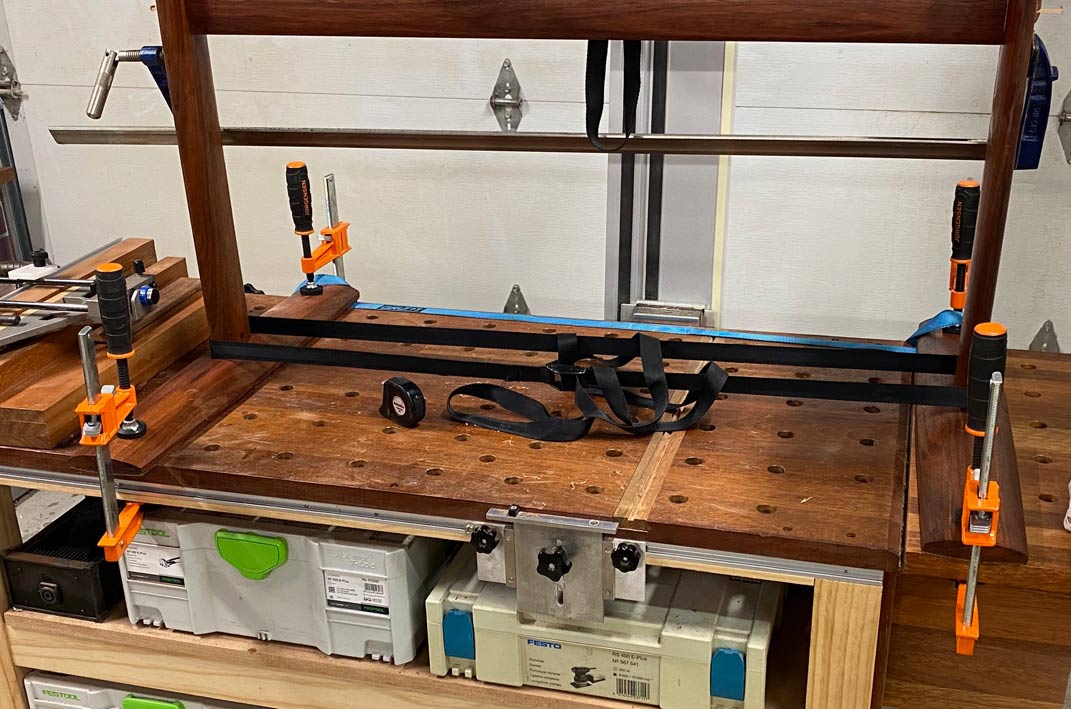
Attention and time was given to ensuring all was perfectly square, and remained so once clamped up ...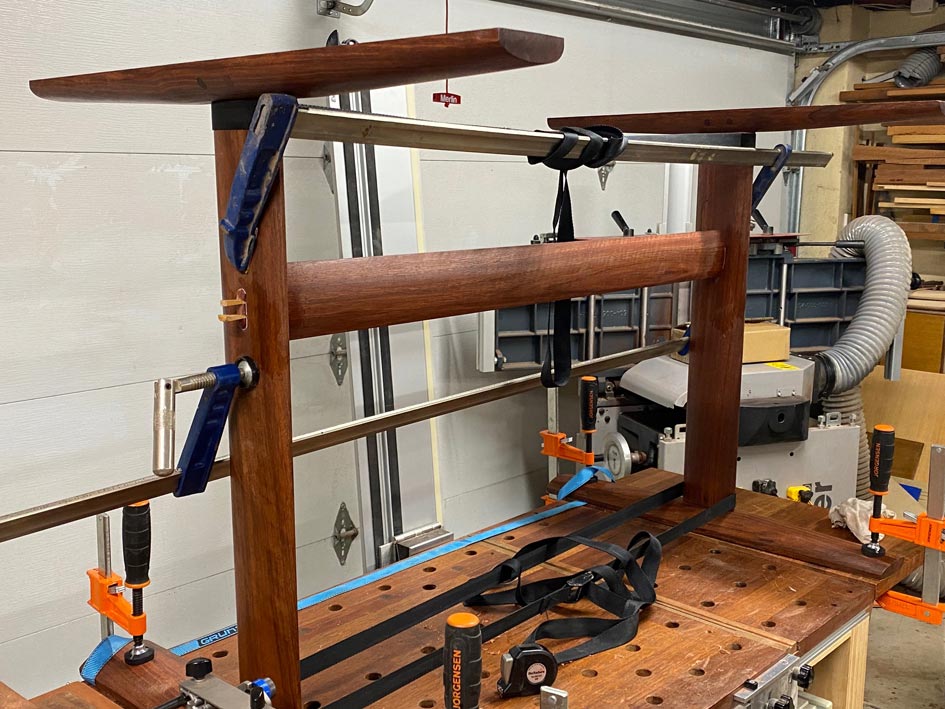
The first coat of Whittle Evolution hard wax oil (Classic) was rubbed on. A second coat was added a day later. The colours in this Jarrah just popped out ...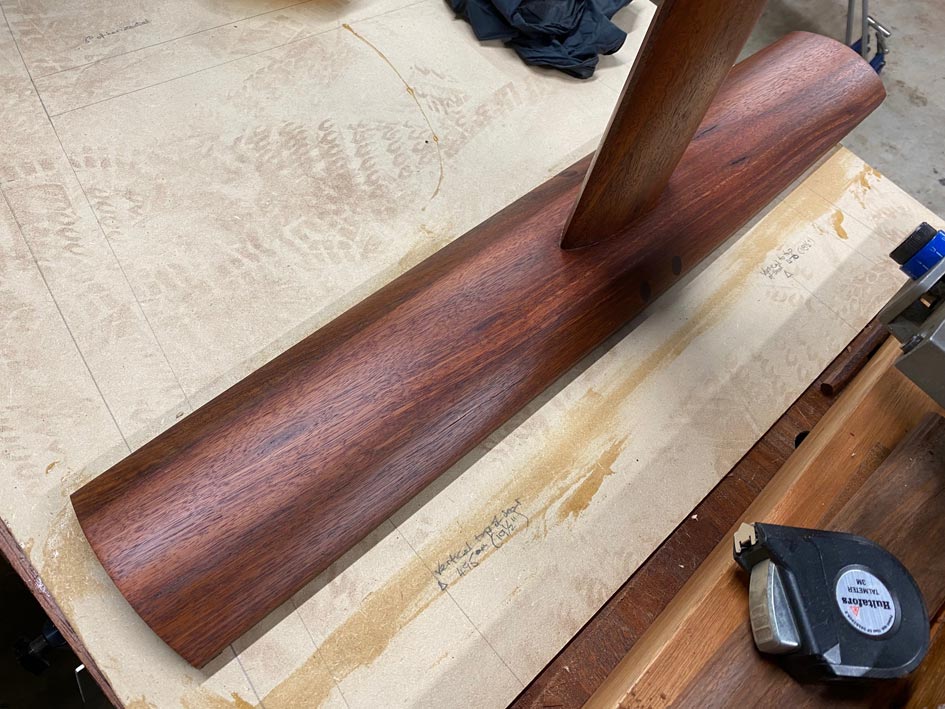
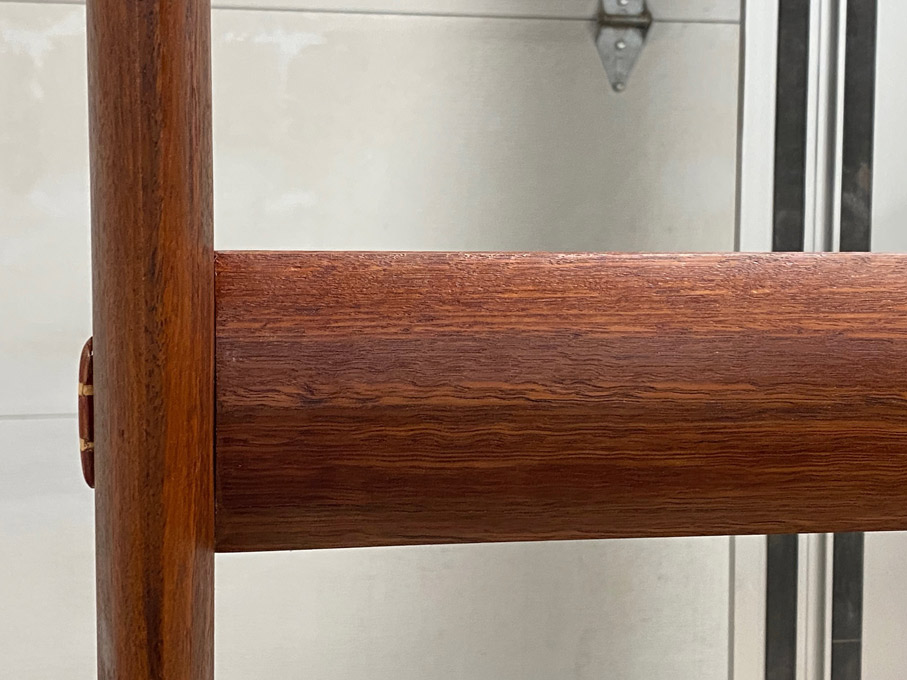
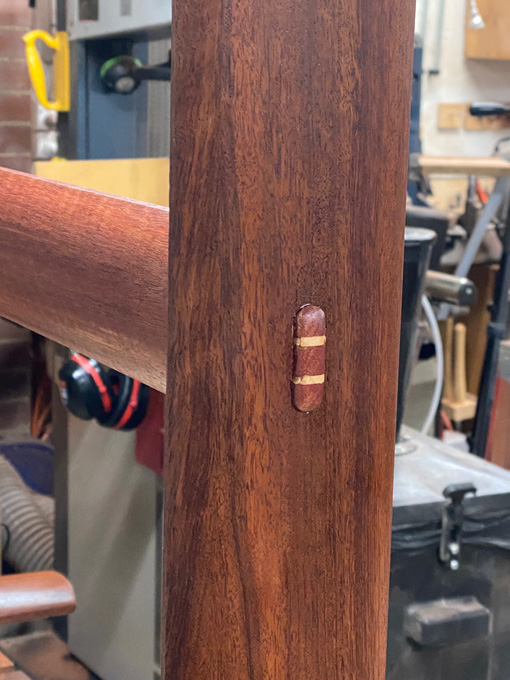
Returning to the design of this trestle table base, the aim was to build something to meld with the DC 09 chairs I built. How have we done? Keep in mind that the table top will be Rock Maple.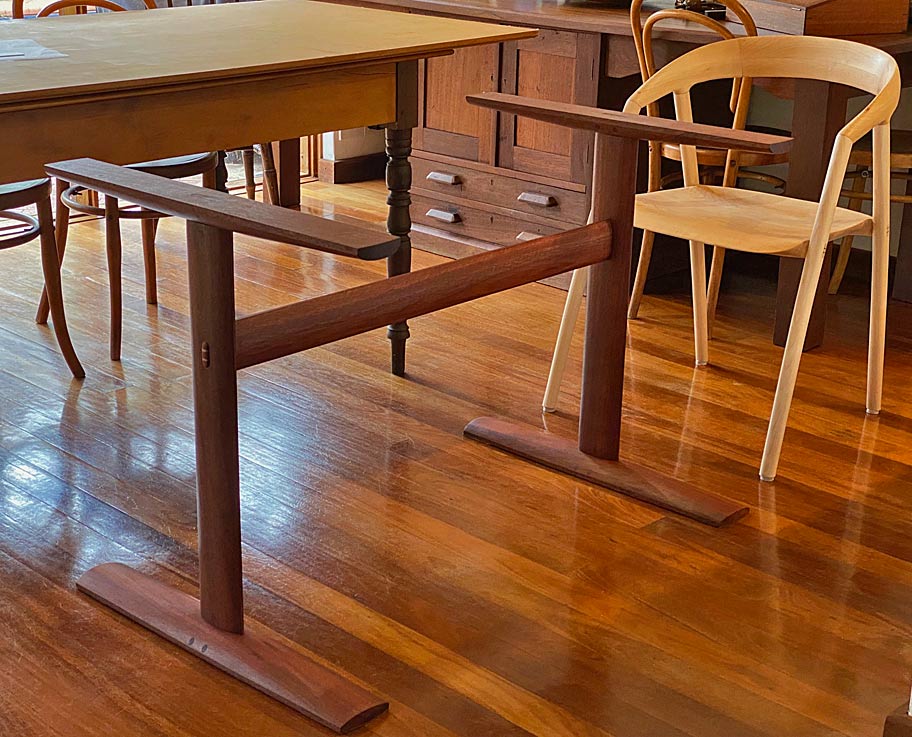
The elliptical sections of the trestle base hopefully match the legs and arms of the chairs ...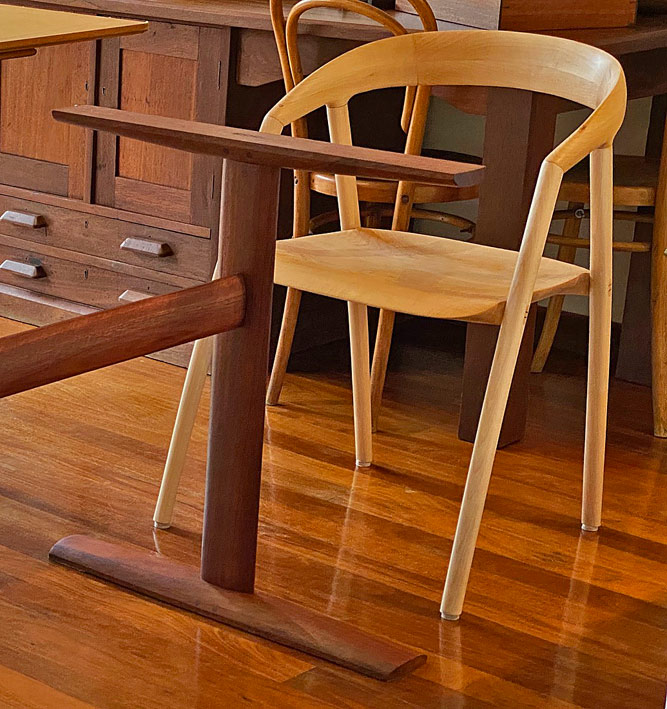
Lastly, with regard the strength and stability of the slim sections in mind, I tested this by pressing very heavily on the ends of the upper rails. They did not budge [smile]
Regards from Perth
Derek
Re: Dining Table - re-visited
#8

Nice table.
Re: Dining Table - re-visited
#9

It’s looking really good, Derek!
Jason
Re: Dining Table - re-visited
#10Derek,
I like the elliptical sections. Great Job, as usual.
Ron
Re: Dining Table - re-visited
#11Thank you for all the pictures. I have learned a lot following your work.
Re: Dining Table - re-visited
#12I'm also a fan of the elliptical sections. It makes me wonder why I don't see them on more furniture.
Re: Dining Table - re-visited
Edited #13Gary, I had not seen them on furniture either, other than in sections of the DC 09 chairs. That provided the idea to use this feature with the table to link the pieces together.
The table top with continue this theme.
Regards from Perth
Derek
Added later 5 d 3 h 15 min 43 s:
Starting on the Table Top
Time to begin the table top. This will end up 1840mm long and 900mm wide, with curved sides.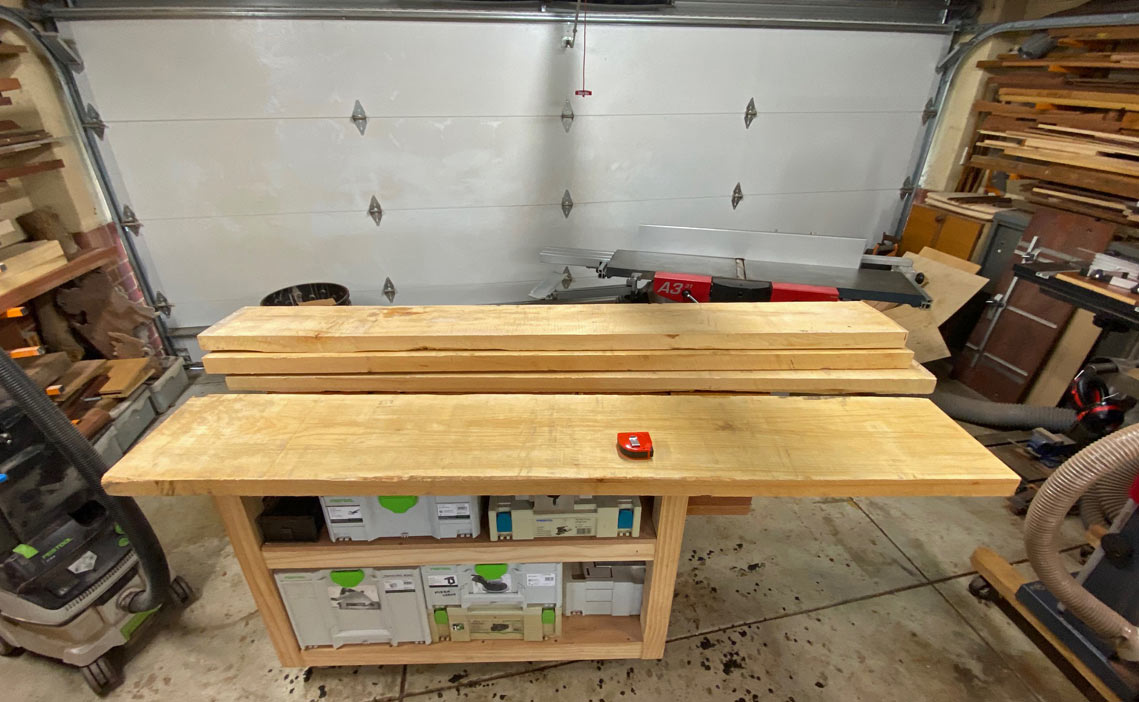
Whoever thought that using machines saved all the grunt work clearly has never built a large table top that started with 2" thick x 10" wide x 6 1/2 feet of Rock Maple! Carrying this around on my own - there is no such thing as "flipping a board" - was a serious workout. Who needs the gym?
One board was just over 12" wide and needed to be cut down to 10". This is too long - and at this stage too heavy - for my slider, and so the ancient track saw came out. Minor issue was the track is short (1400mm) ...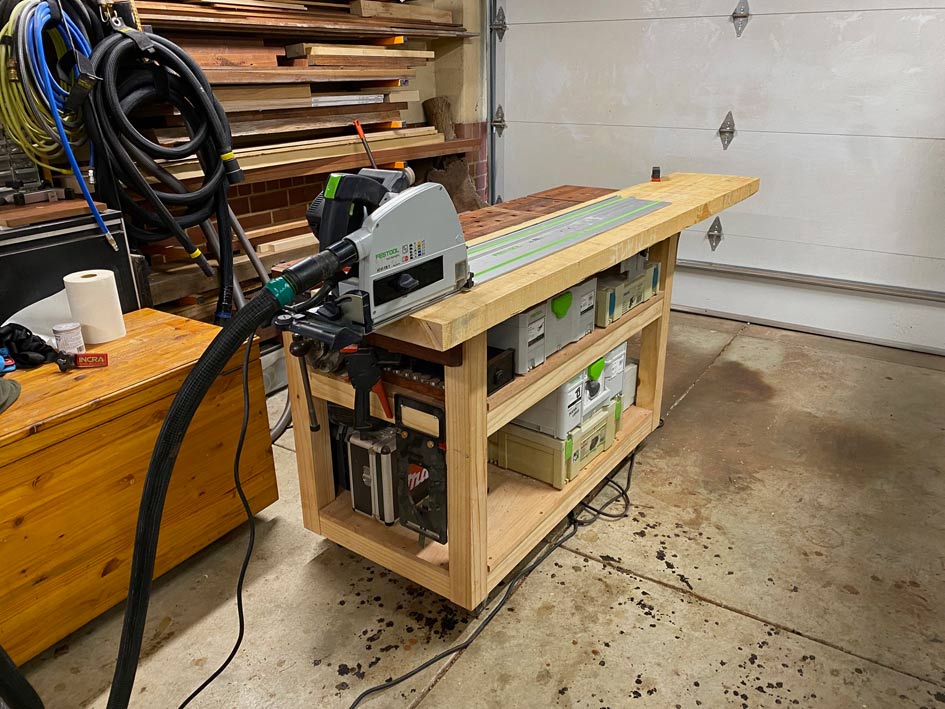
No problem. Just move it down ...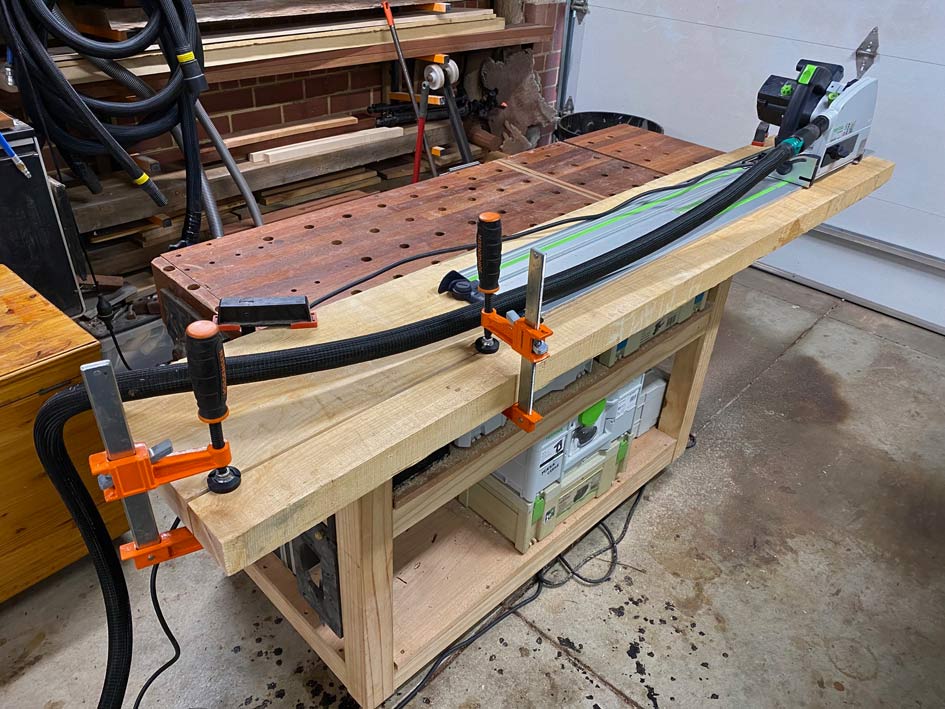
The MFT also works as an in- or outfeed for the jointer and slider ...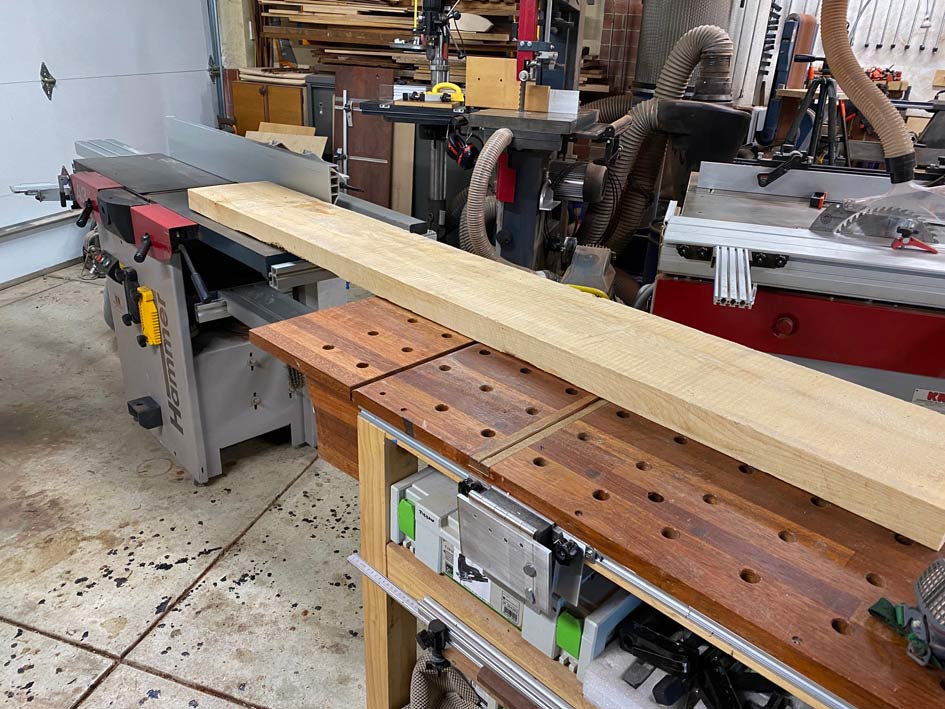
The first two boards I jointed I did in the traditional manner, that is with the hollow side facing down ...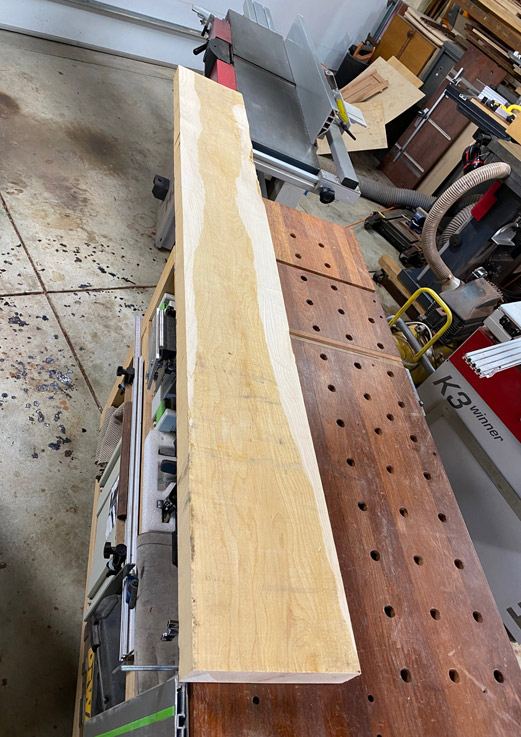
This was a slow and physically exhausting process in spite of the blades set for a deep cut. For the second two boards I flipped them over and ran then over the concave using the fence to balance it on its centre. This was fast! At least twice the speed of hollow-down.
With one jointed side and edge, the boards now needed to be re-sawn to 35mm. The plan was to leave them a little oversize to acclimatise and then thickness to 30mm.
The bandsaw is a Hammer N4400, which is an 18" with a 4 hp motor. Plenty of grunt to drive a 1" carbide Lenox CT Woodmaster blade. But .. running a 1900mm long board on the table is another kettle of fish.
I brought in the drill press table as an infeed, and piled some heavy boards on the slider outfeed as an outfeed ...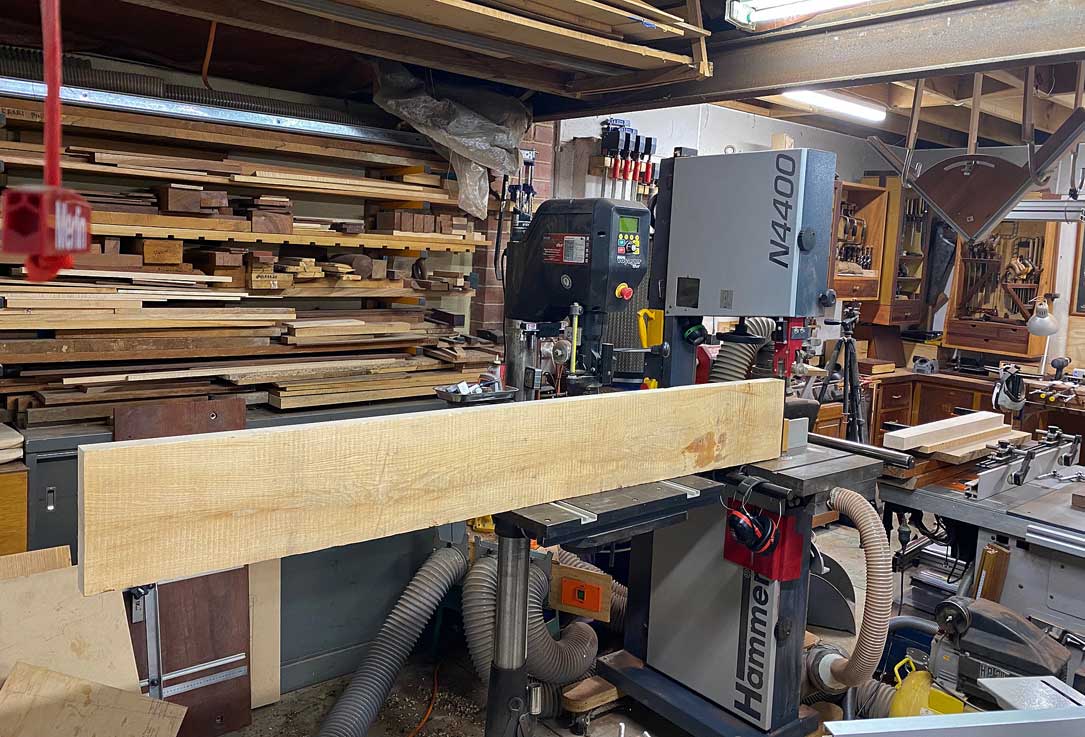
The drill press fence made a great guide ...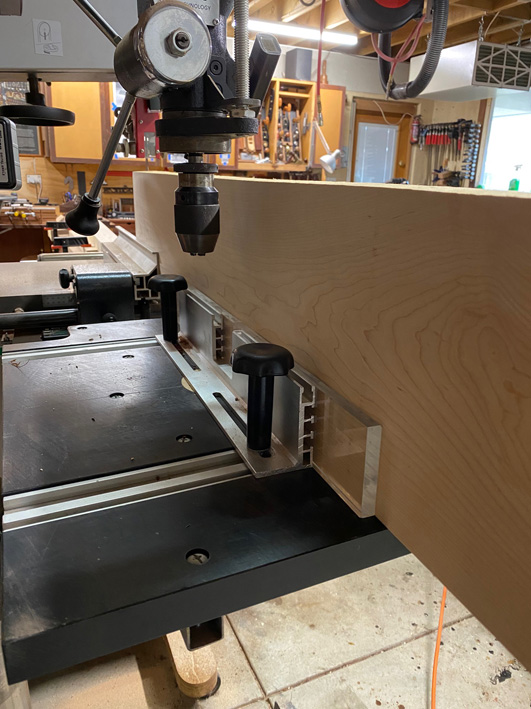
And the re-saw was as good as I could hope for ...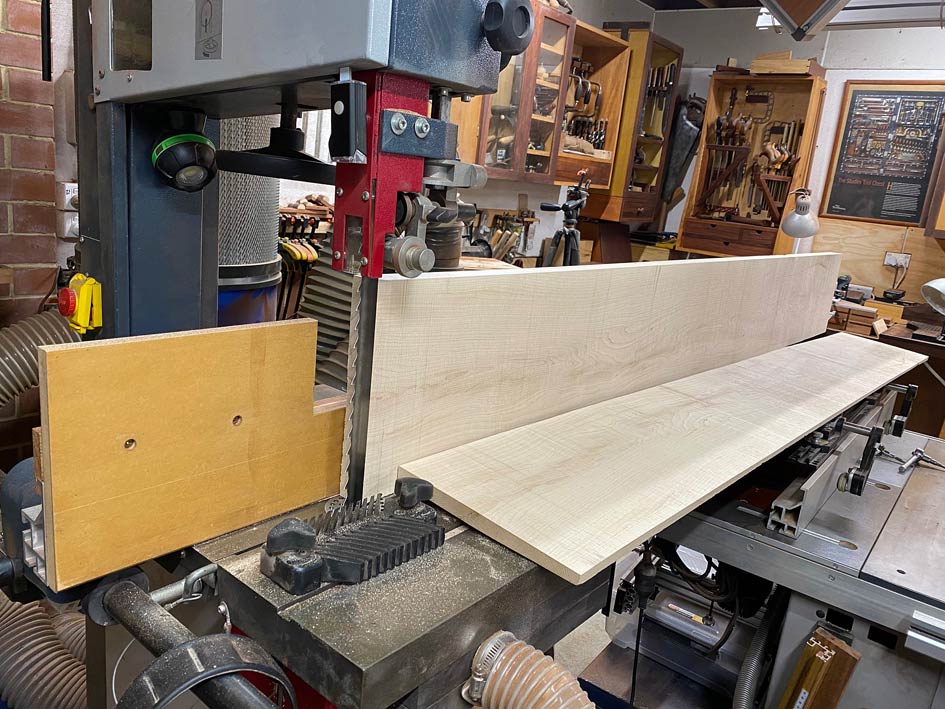
Four boards jointed and thickness planed both sides ...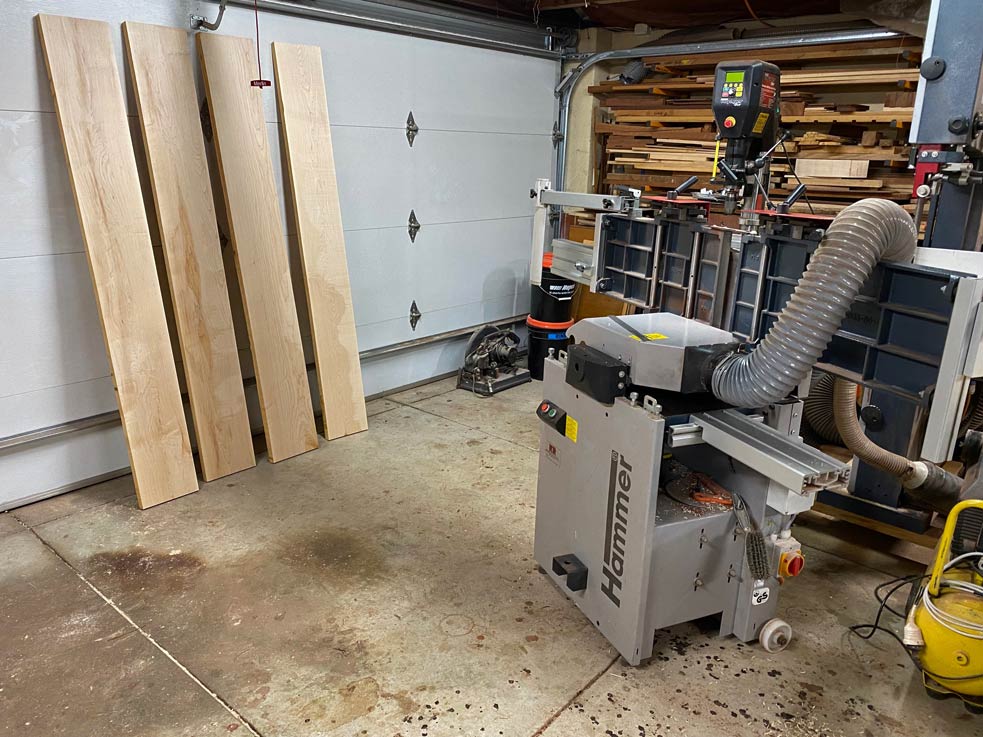
And finally ripped to width ..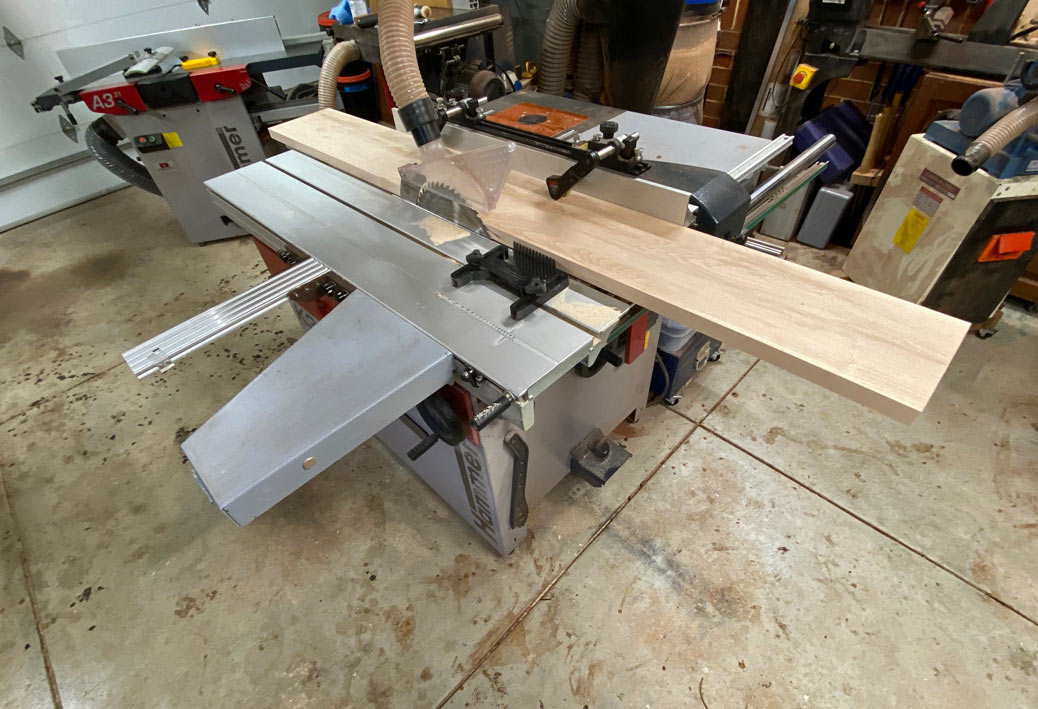
Now we can play at selecting the boards for the top ... try ... flip .. turn ... flip again ... and in the end ...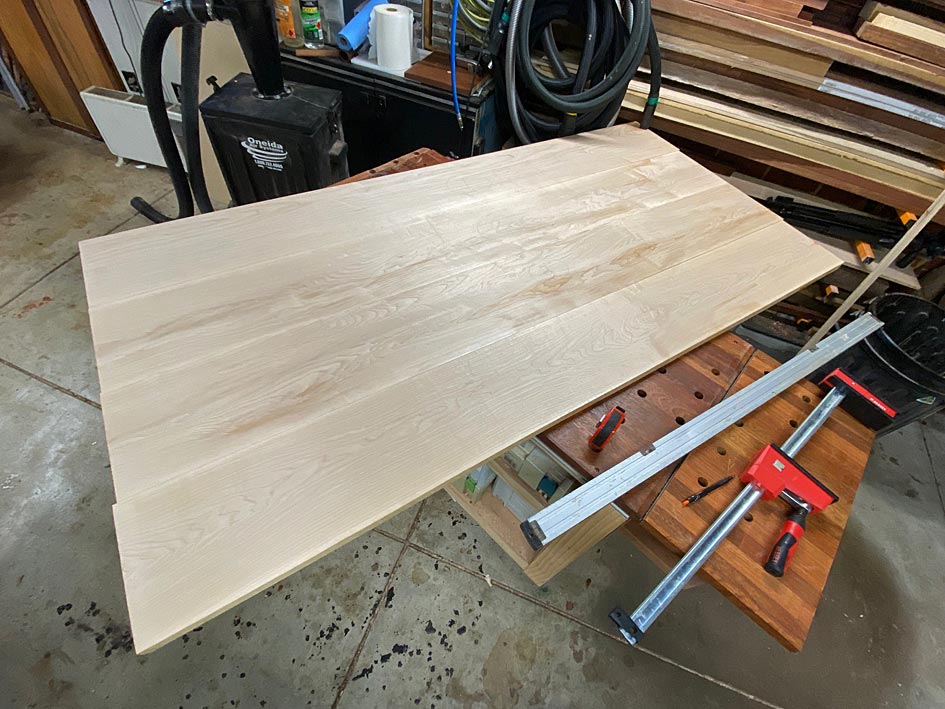
While the boards came off the jointer and slider fairly straight, they needed to be made perfectly straight and square for a gapless joint. This takes place at the bench with a jointer plane ...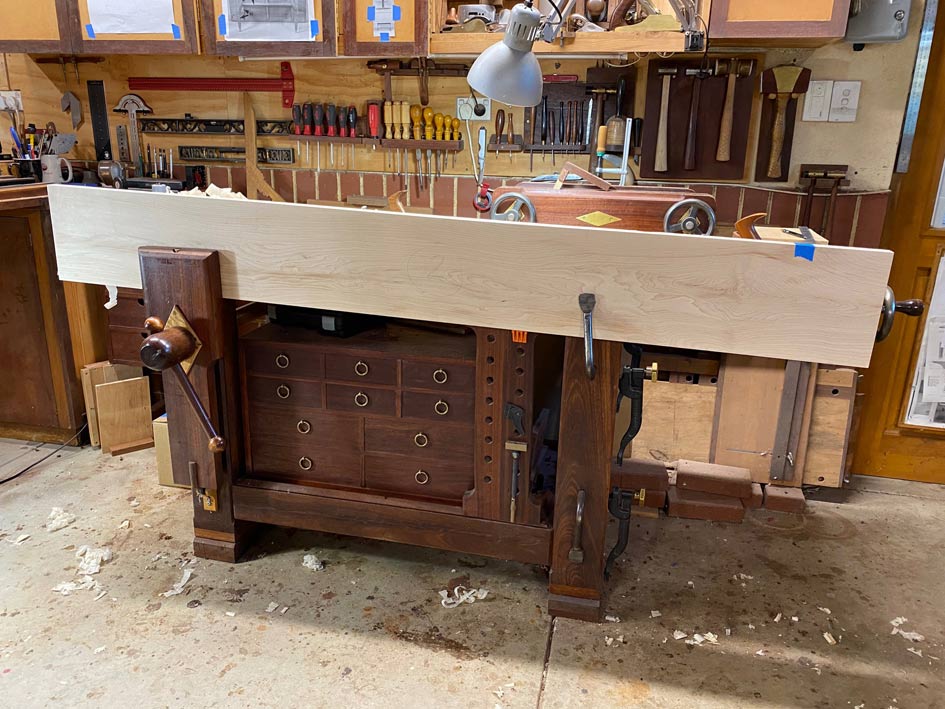
What I do is place two adjacent boards together ...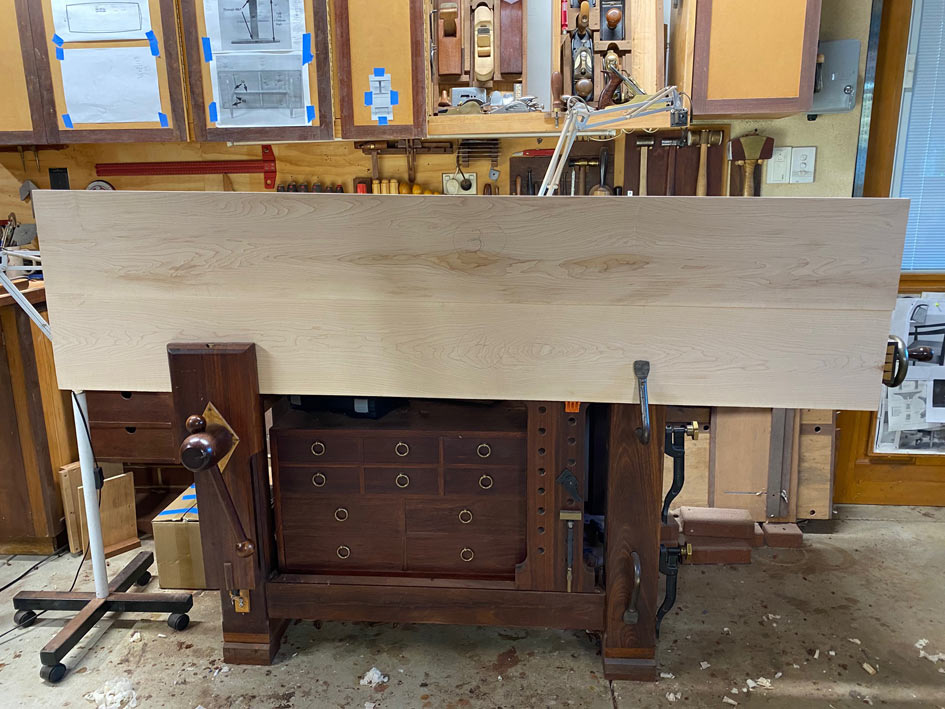
... and shine a light at the rear ...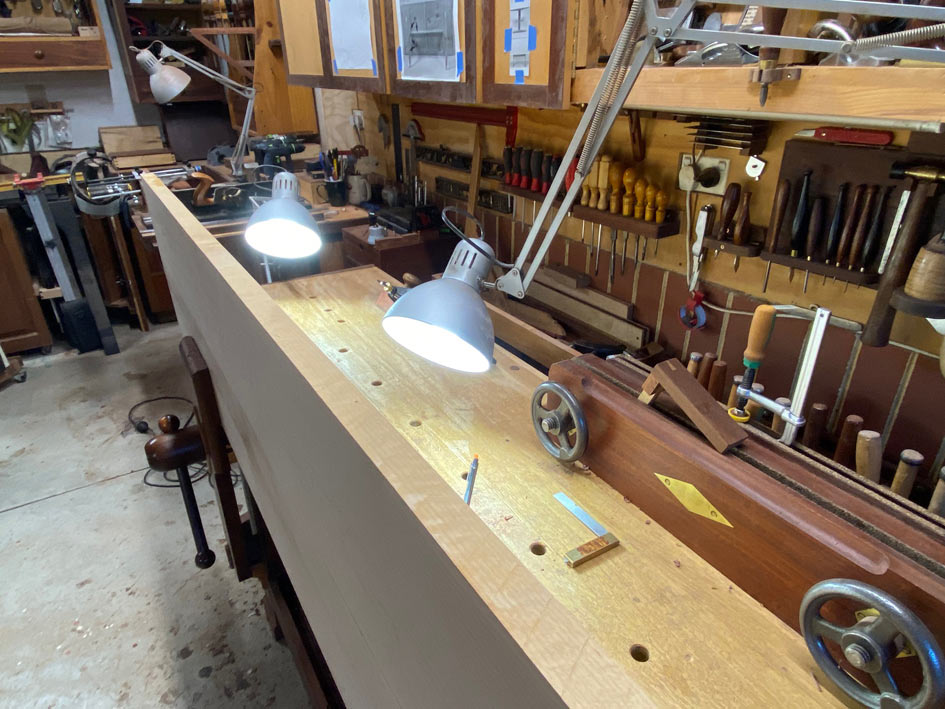
... to show where the gaps are ...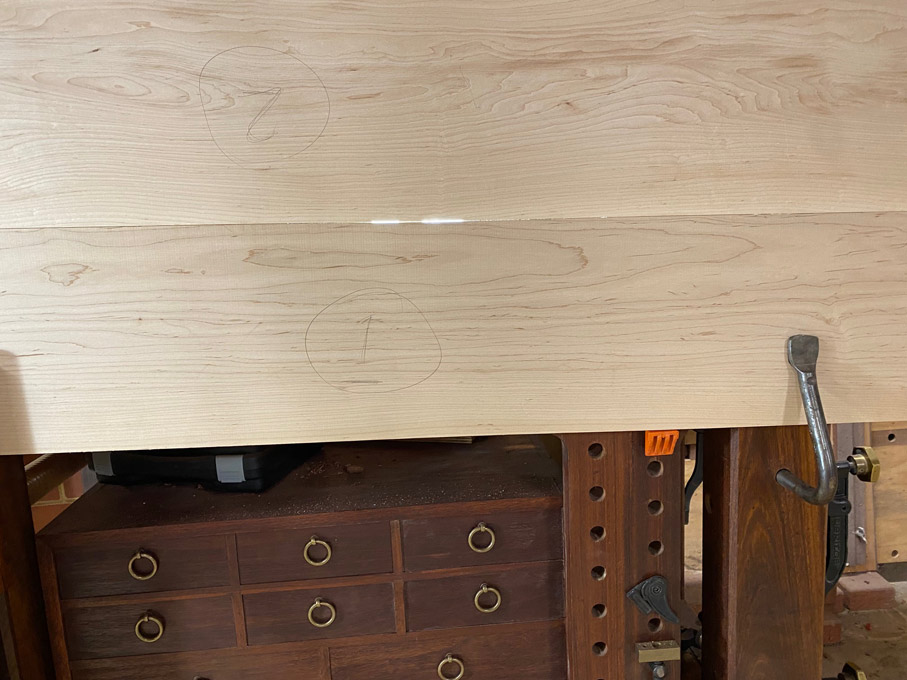
Remove the high spots.
Next, check the edge for square. This one is angles slightly to the right ..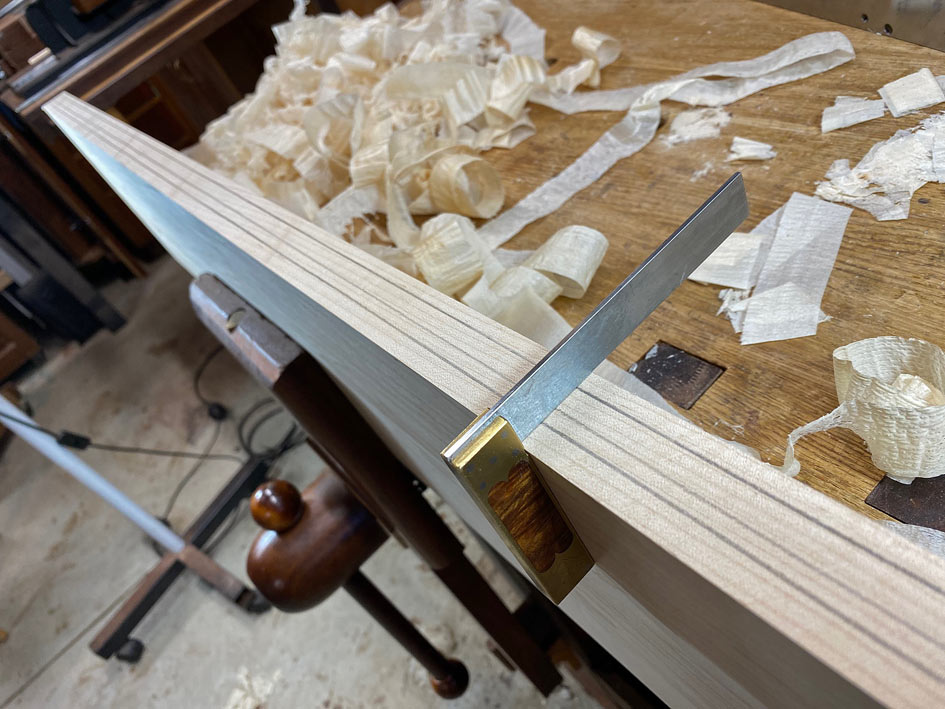
The strategy now id to move the plane over until only the right side of the blade is cutting. You can see the far side line disappearing ...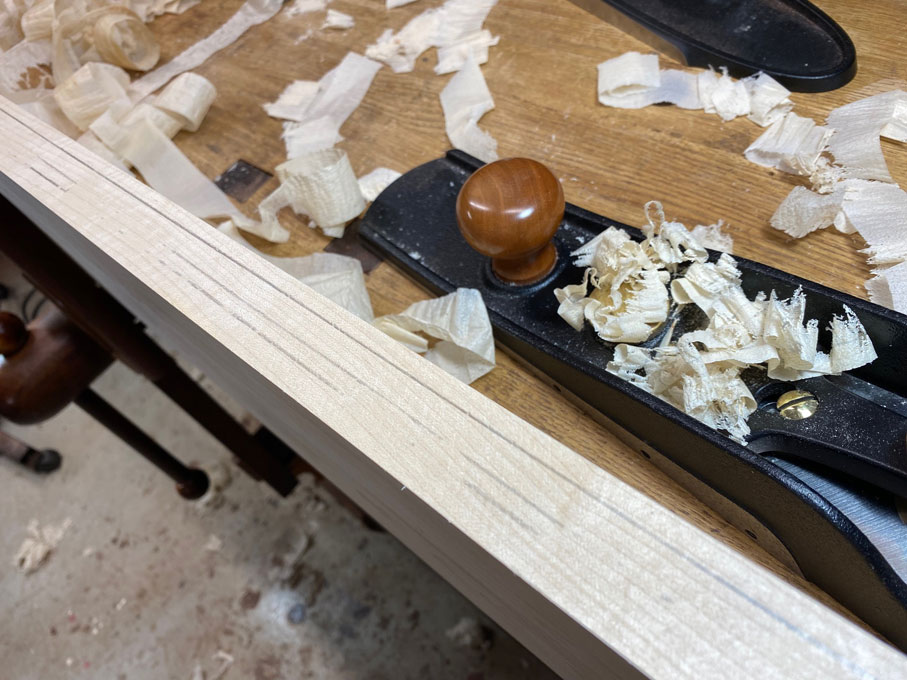
This is the half shaving produced ...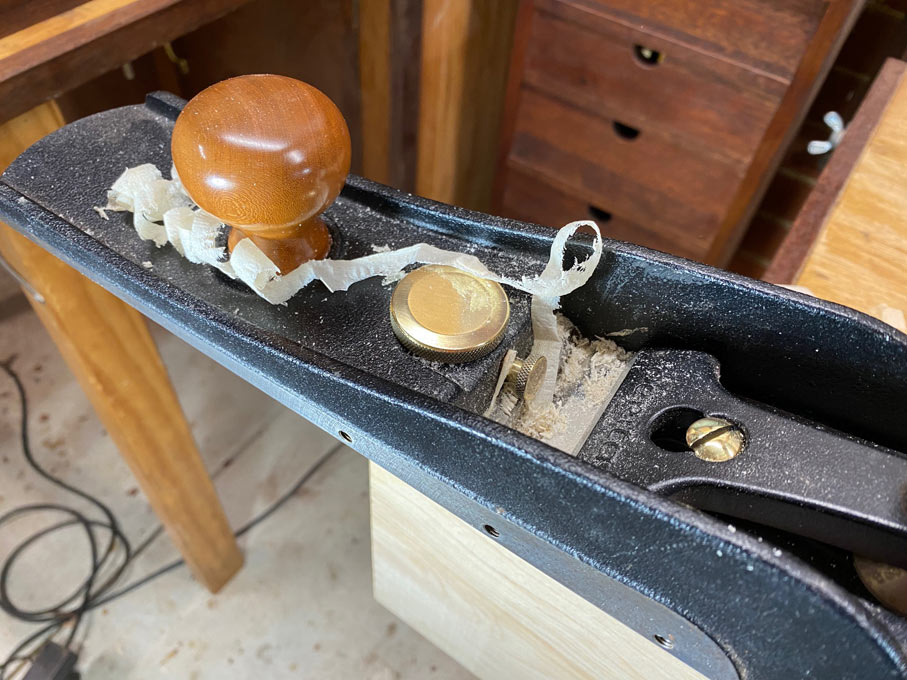
Now that the edge is square, follow this by planing until a full shaving is obtained ...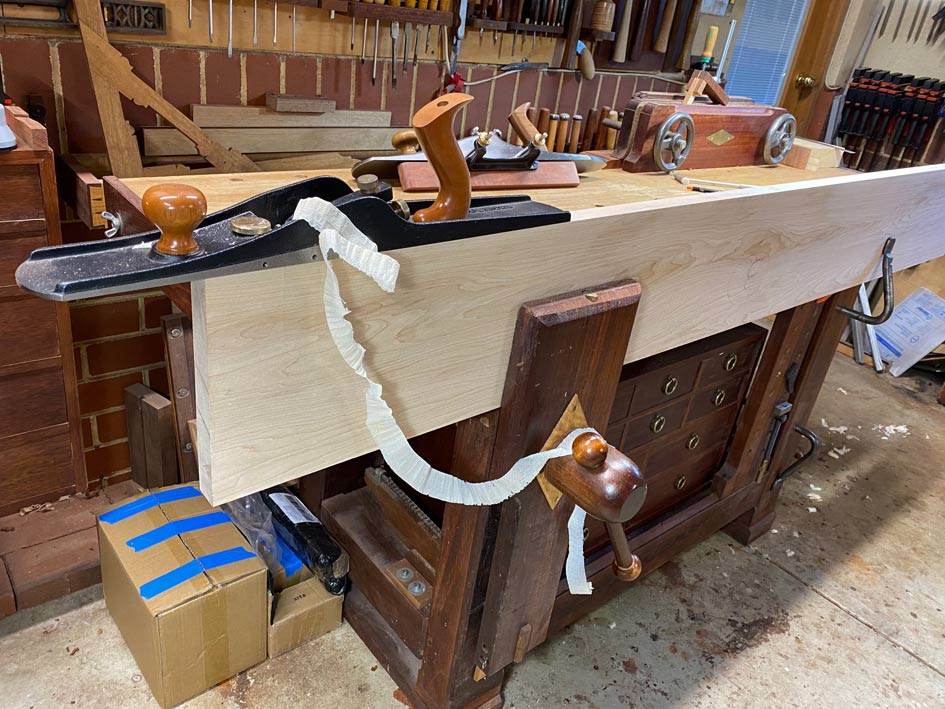
Finish with a fine shaving ...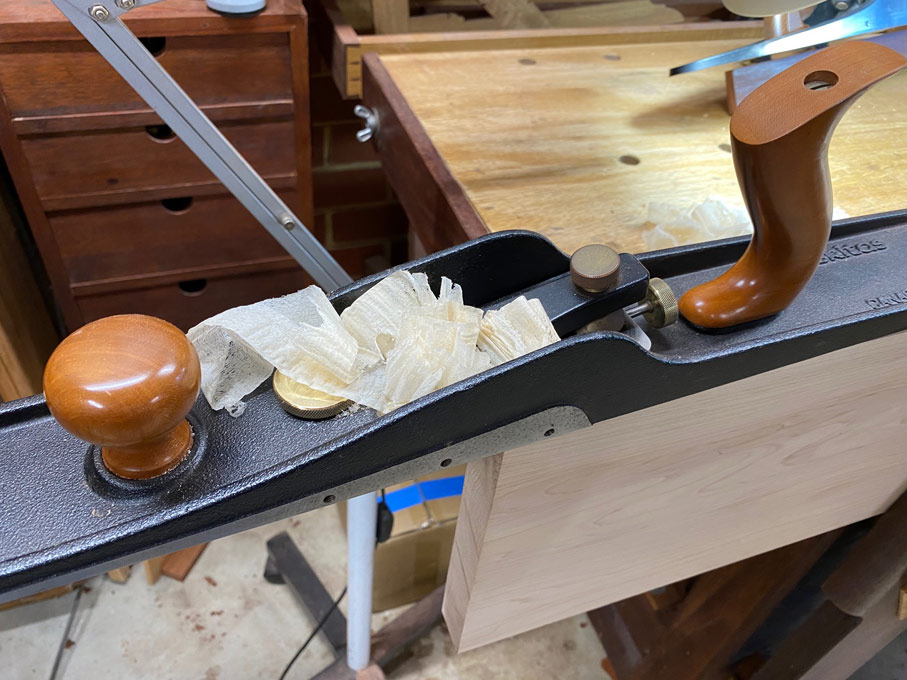
Incidentally, the jointer used here is the Veritas LA Jack. I also have a Veritas Custom #7. Both are excellent. Both get used equally.
The aim is to plane a spring joint - a very fine hollow - at the centre of each board. This will create a gap of around 0.5mm, which can be pulled together with clamp, and serves to avoid the ends of the boards opening up ...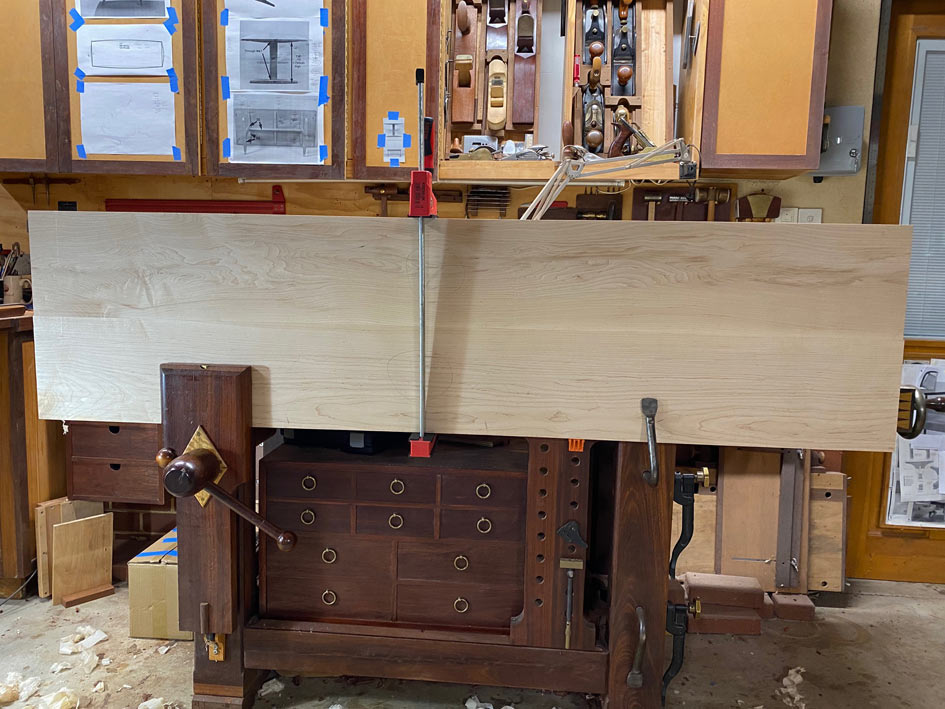
All done, and the next step is to add biscuits to aid in aligning the boards. This is unnecessary for short lengths, but here it aligns the newly jointed tops ...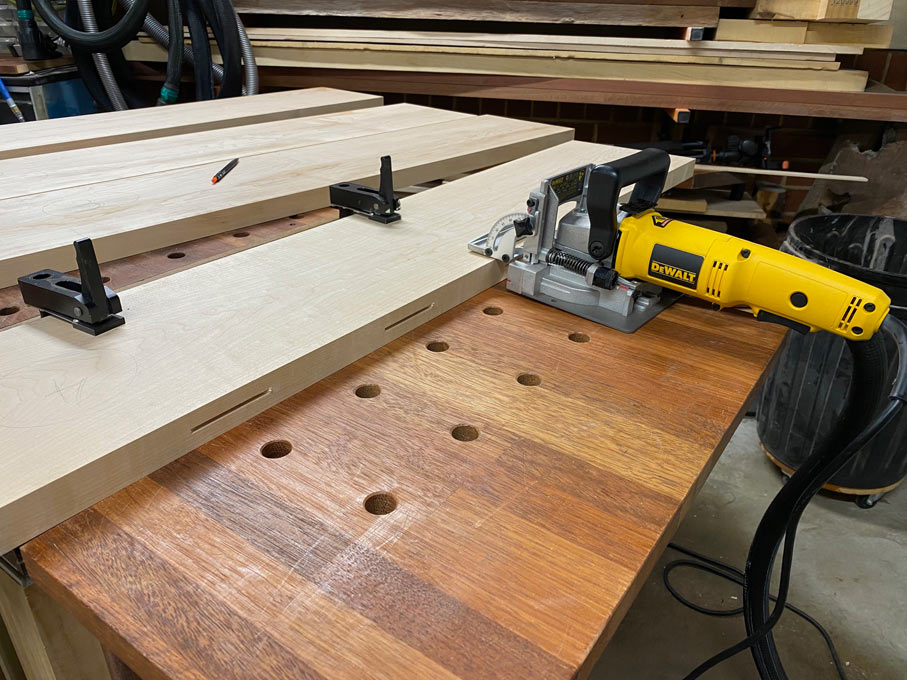
In preparation, the top of the MFT is covered in plastic film ...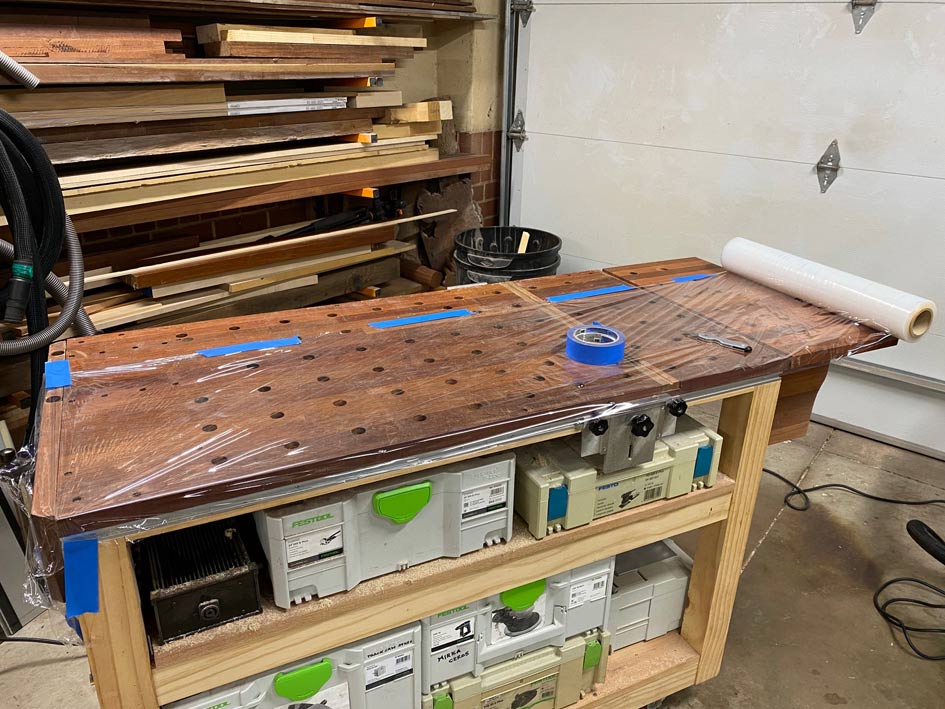
Glue rolled on ...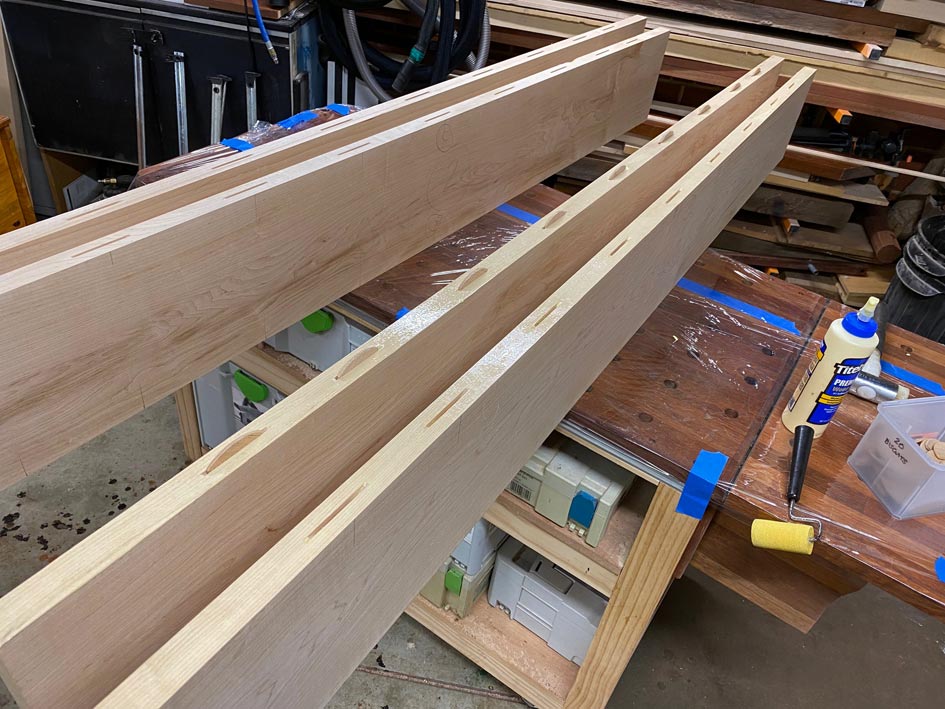
Two board at a time initially ..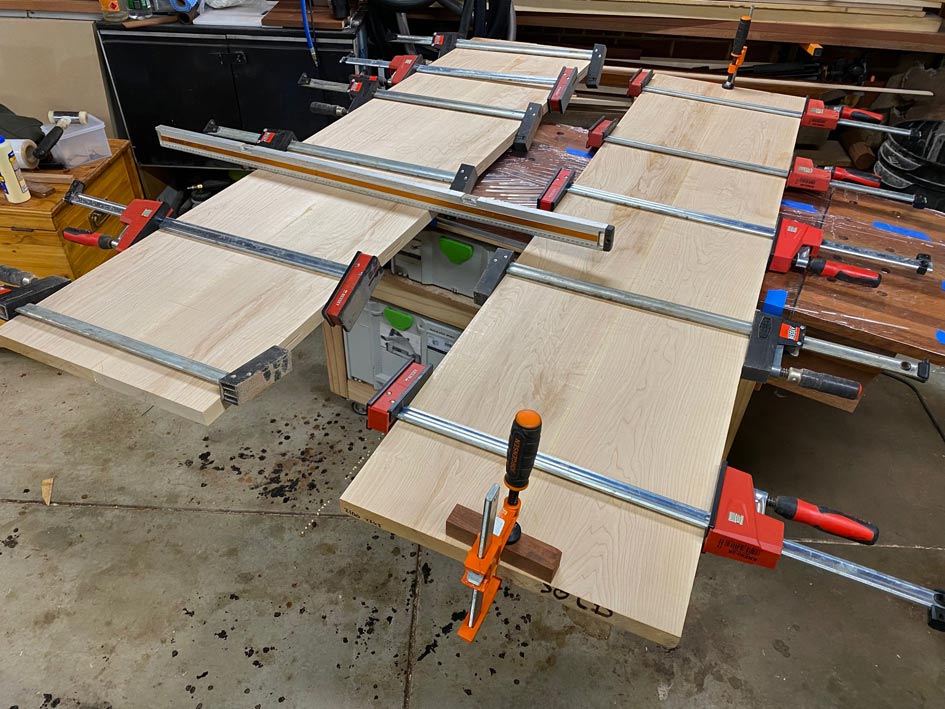
And later joined together ...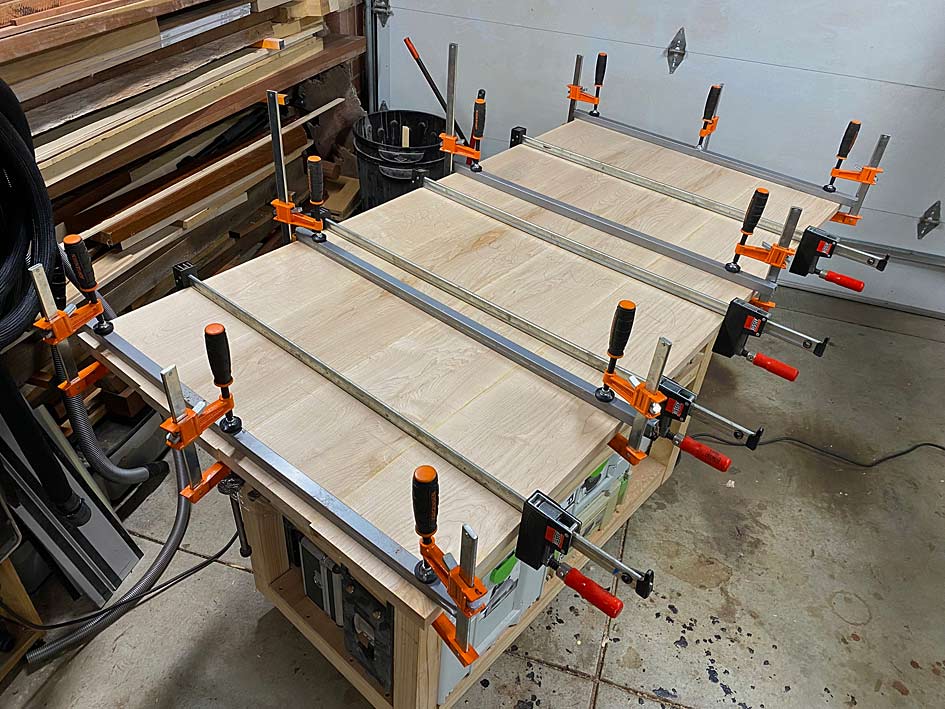
This is where we are at. Back to it next weekend.
Regards from Perth
Derek
Re: Dining Table - re-visited
#14Using the drill press table and fence for infeed on the band saw is a great idea, Derek.
You mentioned jointing with the convex side of the plank down as being easier, but it has another advantage as well: it helps keep the board from bowing when it is put through the planer. Especially in hard maple there is usually tension in the board that is released as wood is removed. That's why many boards start to pinch the blade when ripped on a table saw. If jointing is done by removing the belly from the convex side, when the board is put through the planer there is little wood removed from the middle part of the board. That means the flat surface produced on the jointer stays flat. Removing wood from the ends of the board has much less effect on the overall straightness. When I realized this it resulted in much straighter boards each time I milled stock. I don't hear this mentioned much on forums (or in the shops I worked at) but it's the best tip I have to give anyone who wants to end up with straight stock.
Re: Dining Table - re-visited
#15Interesting Steve. I was focussed on the speed, and the flatness factor did not occur to me. The boards remained pretty flat and equally.
Regards from Perth
Derek
Re: Dining Table - re-visited
#16
My dining table is a trestle table. I prefer them to four leg's. Tough, light weight, uses less timber. I made mine knock down with through tenons for the stretcher. The top is restrained by traditional screwed button blocks.
European Cherry. You can drag and move a trestle table easily without the leg's chattering.
Love the wedged double tenons on the feet.
Always worth the extra effort.
Re: Dining Table - re-visited
#17Thanks Maurice.
As the top rails are rounded and I want to preserve their sleekness, I have decided not to use button blocks, but slotted holes (for movement) through the rails, and screwing into the top.
Thoughts?
Regards from Perth
Derek
Re: Dining Table - re-visited
#18Are you out of the hospital yet? Or, is weight-lifting another hobby? Flinging those boards around is impressive!
You should not need massive numbers of top screws--nor the largest gauge--but save thicker for repairs, if ever needed. I am blown away, now after the fact, at how well maple holds a dinky little screw; and, visa-versa.
You need to invite the football team over for a party. The only *official* way to test furniture. 
Ps. It's a beautiful setting.
Re: Dining Table - re-visited
#19Final Chapter
This is a large post, with many photos, and it takes up to the conclusion of this build. There have been many small details in the design and execution which, when added together, create the final piece. My wife just loves it, and I'm quite pleased myself, so I am happy to share the details for those who are interested in building something similar and with the techniques I used.
With the top glued up, the next step was to mark the outline, which was done by making templates ...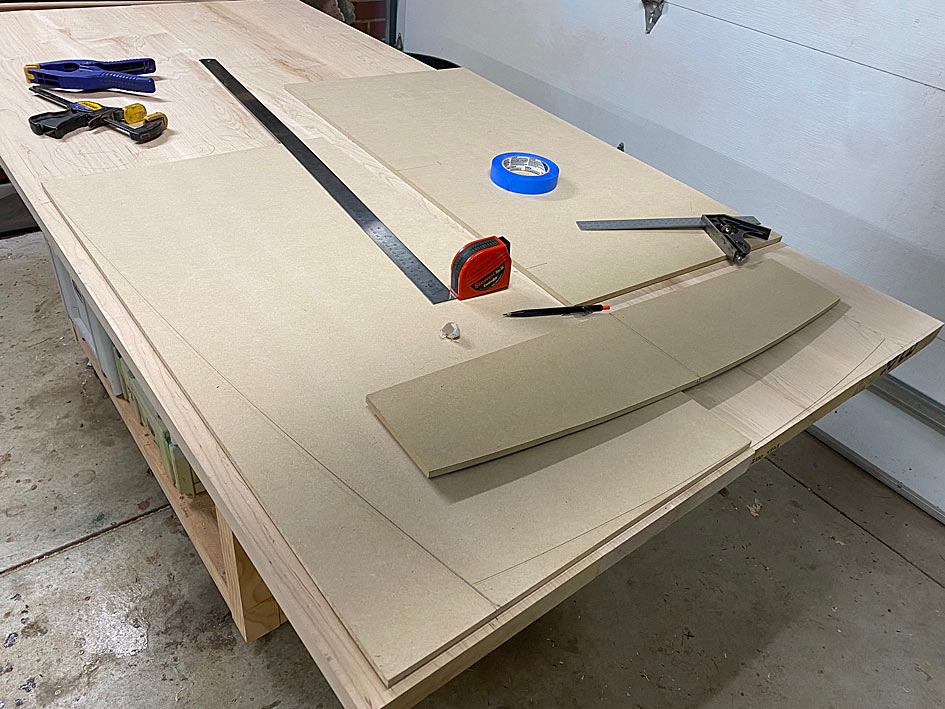
Block plane making shavings of 6mm MDF ...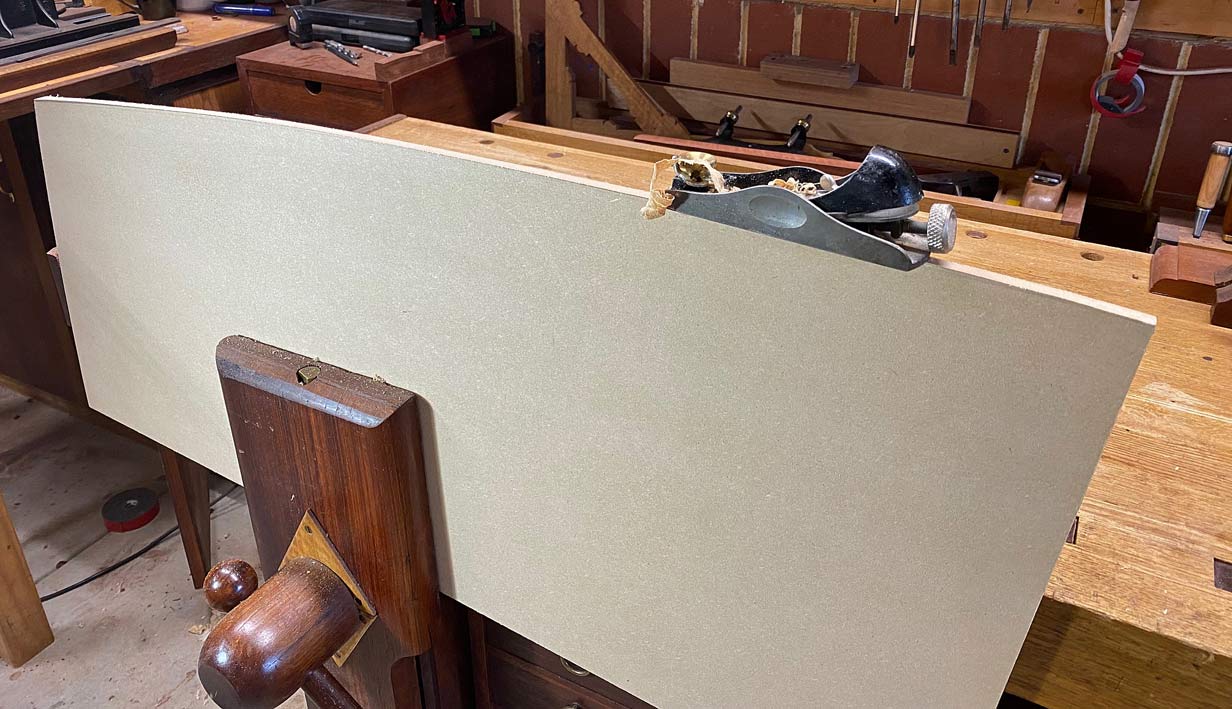
One quarter used four times ...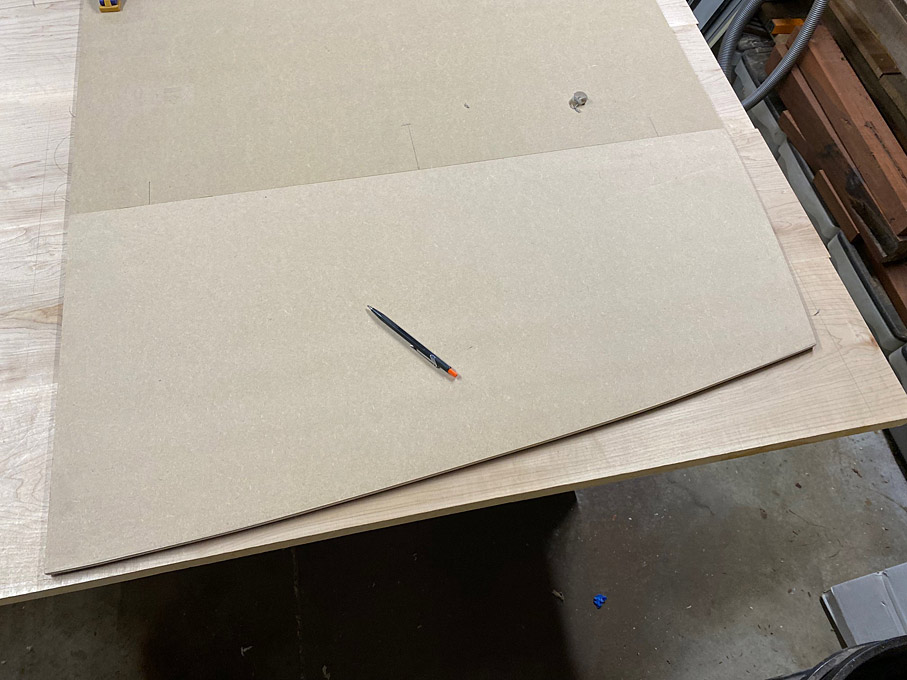
Marked out with blue tape for visibility ...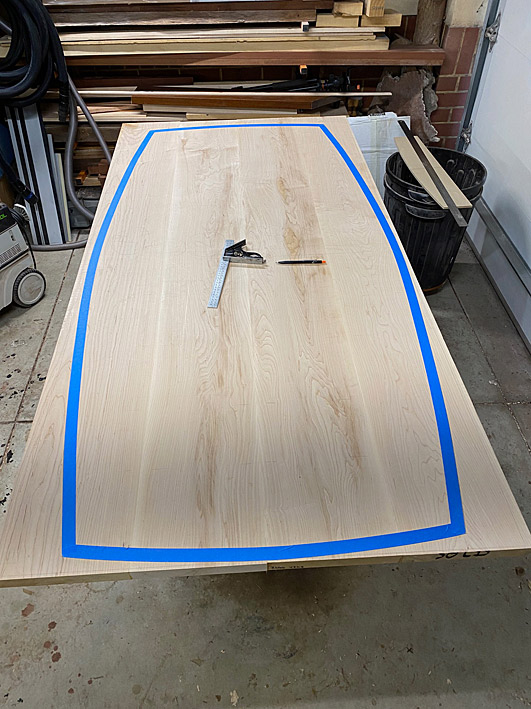
No, I cannot lug this over to the bandsaw. I am not that strong. A jigsaw is used, like a regular person does, cutting close to the line ...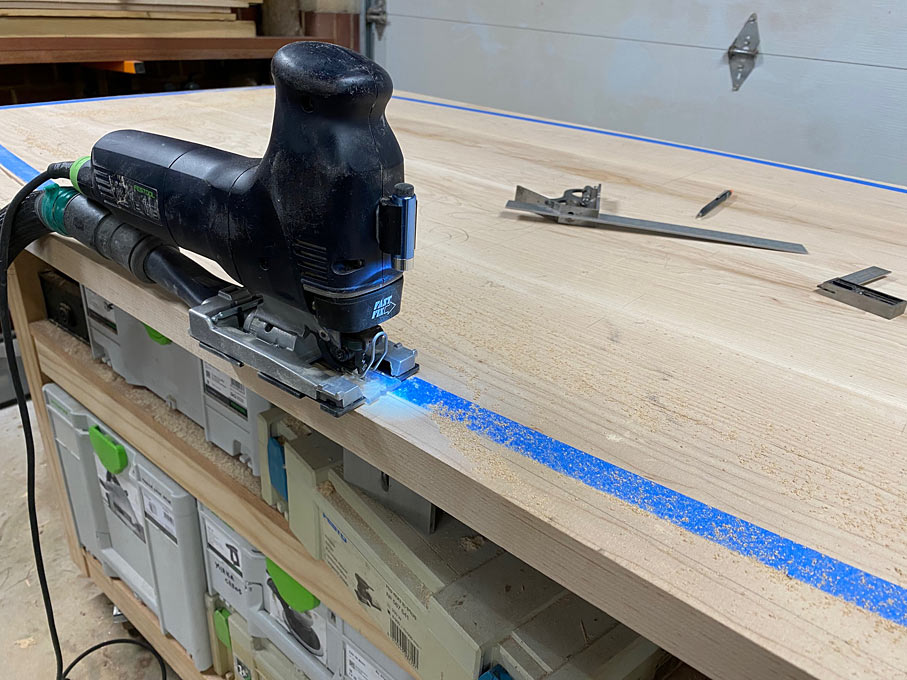
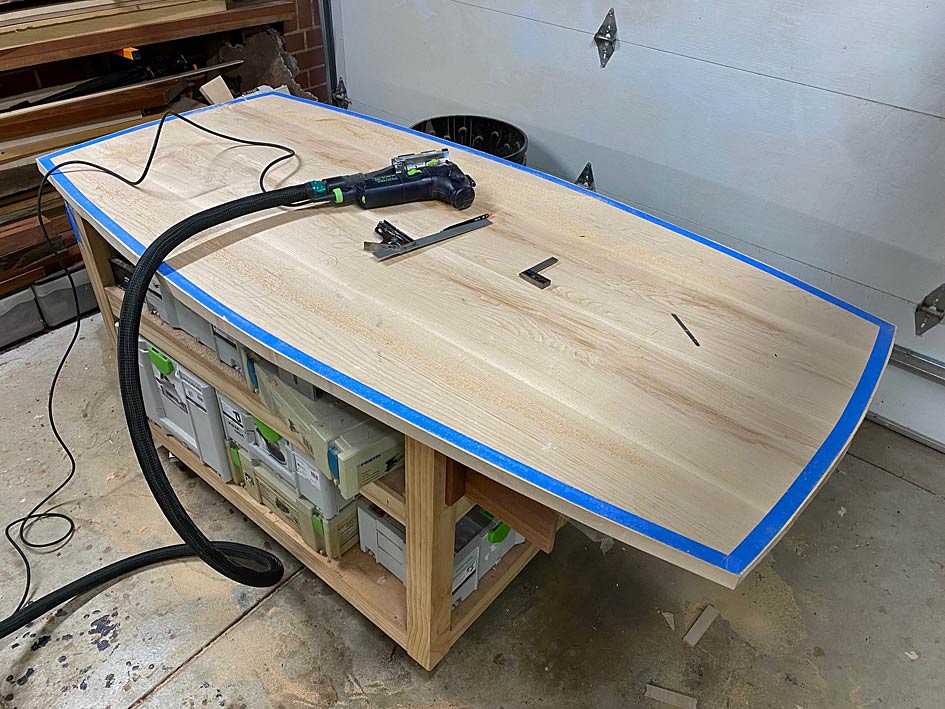
The templates then are used for pattern routing ...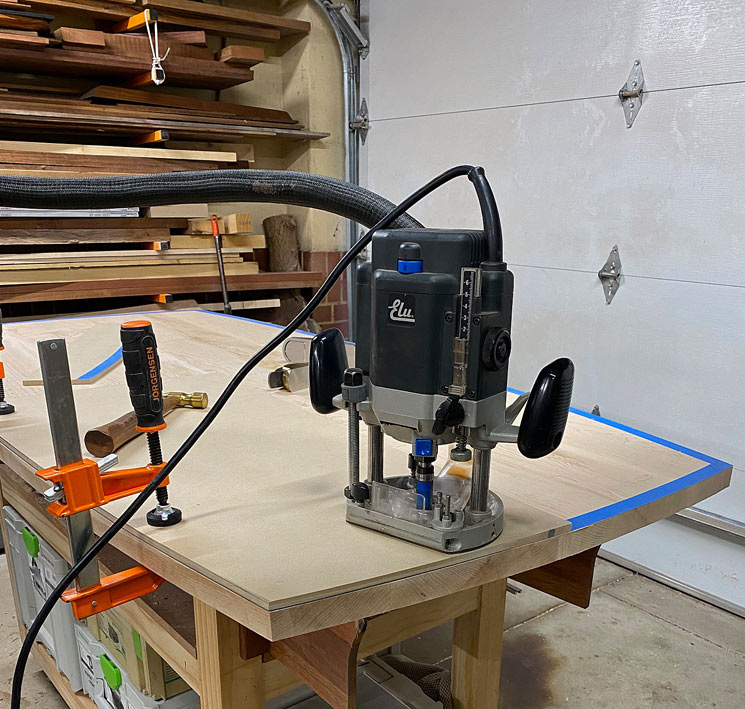
The end grain is smoothed with a block plane. The question is, which works better, a skew block plane or a straight-bladed block plane. Answer: they do the same as one simply holds the straight-bladed plane at an angle 
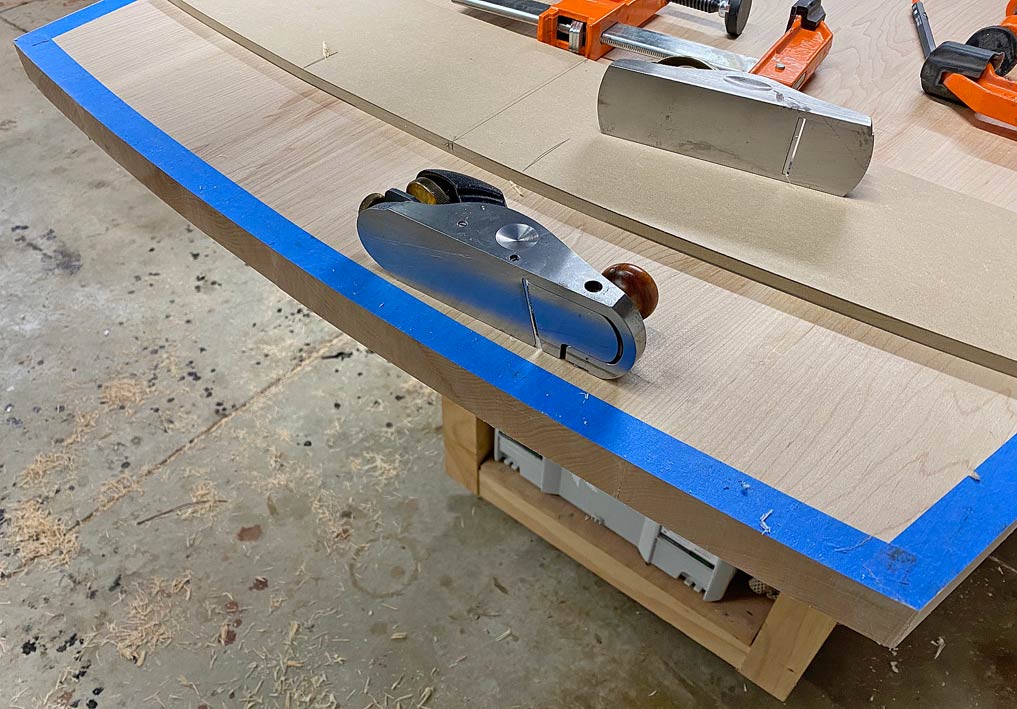
The top is pretty flat. The use of biscuits to level the joints worked well. Now the surface is planed with a smoother. This is the finished surface. No sanding was done ...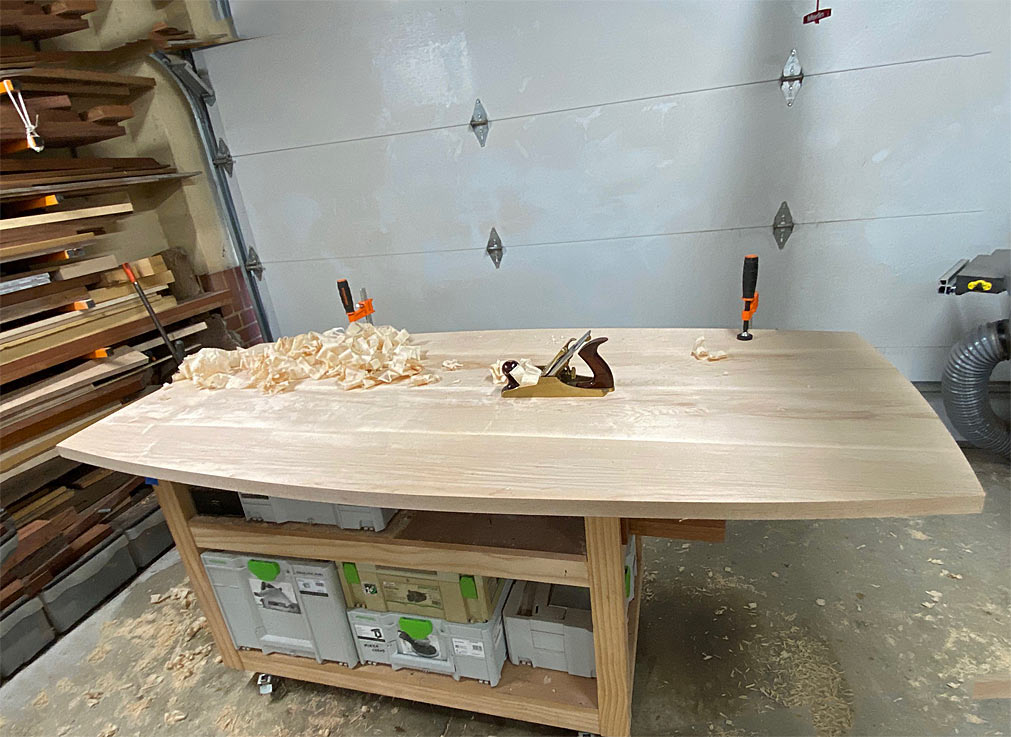
The side edge is 30mm thick. The plan is to chamfer the edges leaving a 10mm face. This is marked in blue tape ...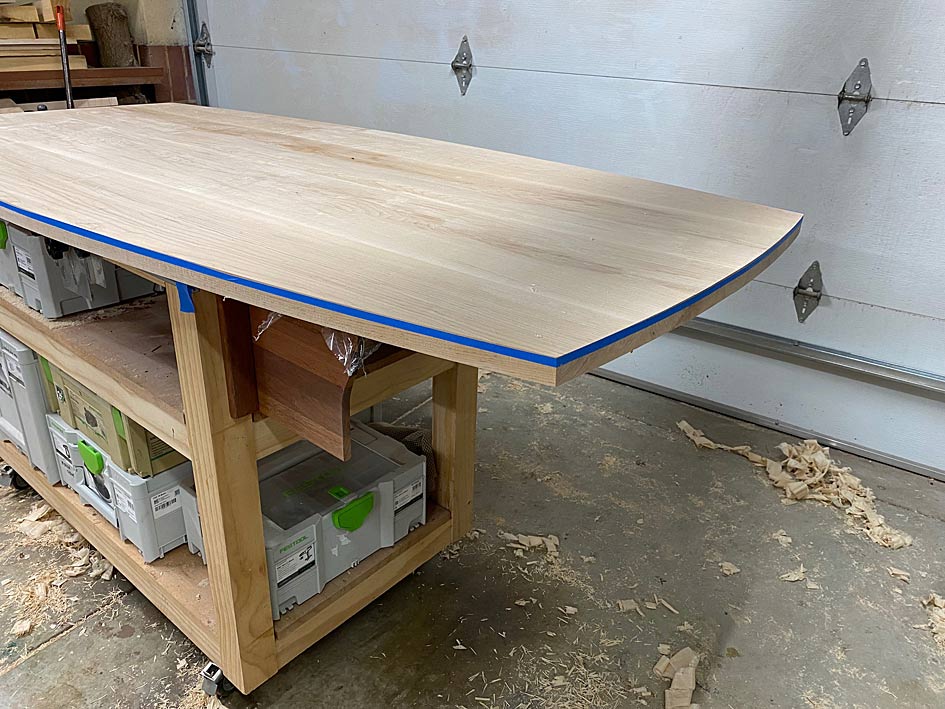
The base is positioned on the underside to determine how far in the chamfer will be made ...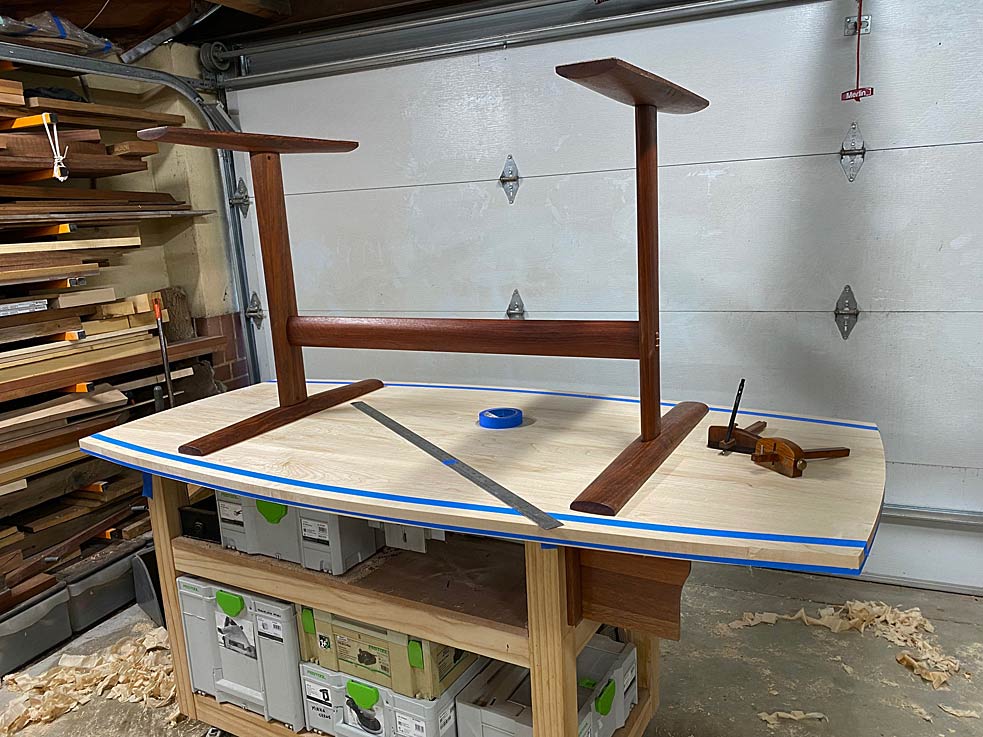
A nice, even if rather old, Festool power planer takes away most of the waste in no time at all ...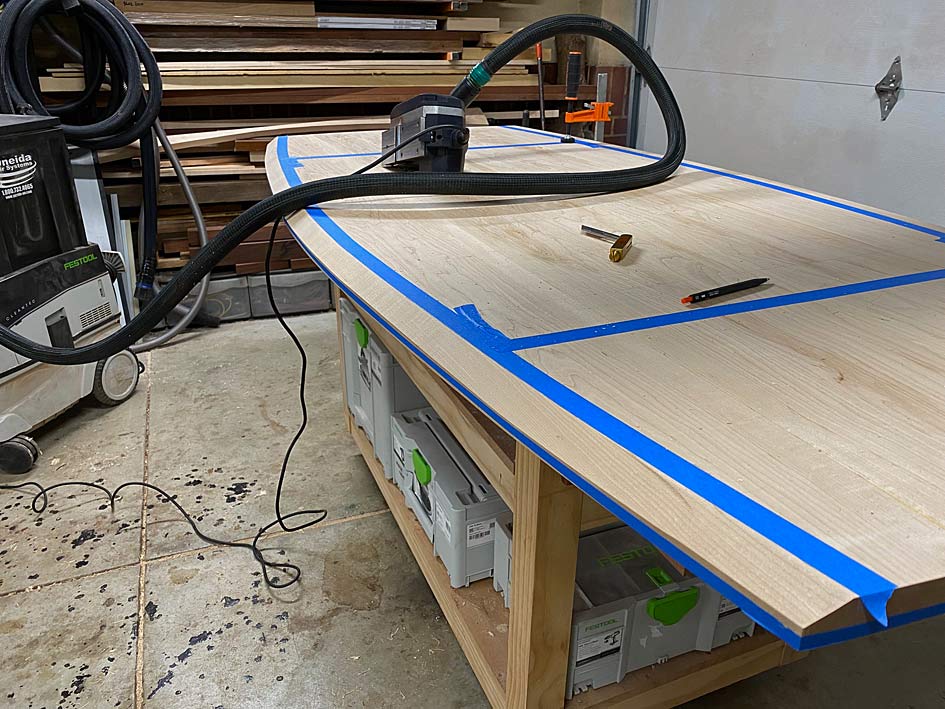
This is finished to the lines with hand planes ...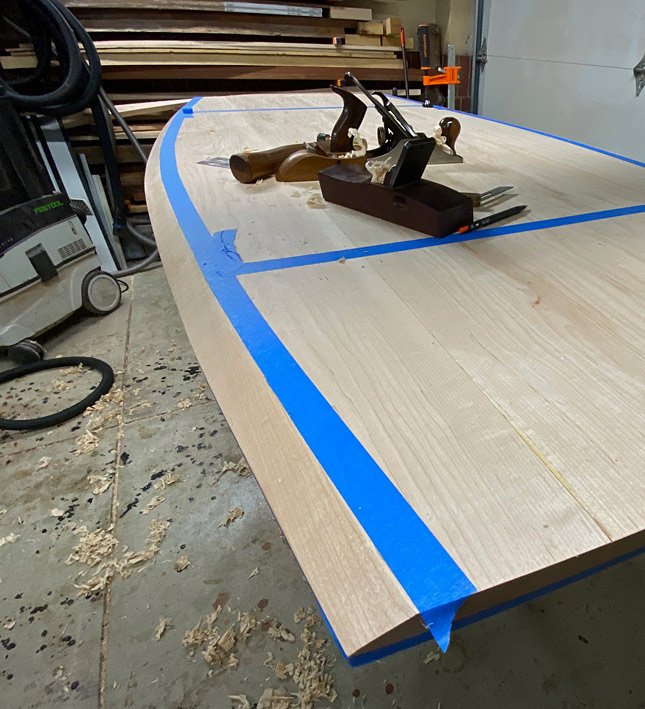
The tow ends of the underside are given a long taper, first using the power planer to remove most of the waste ...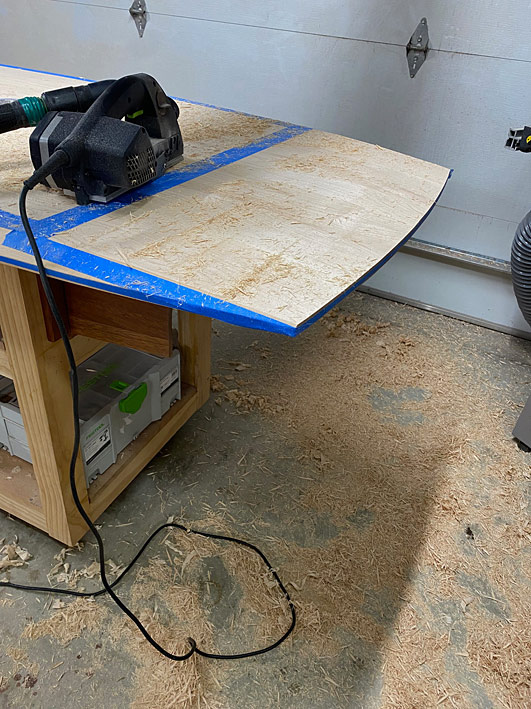
.. and then finished with a LA Jack ...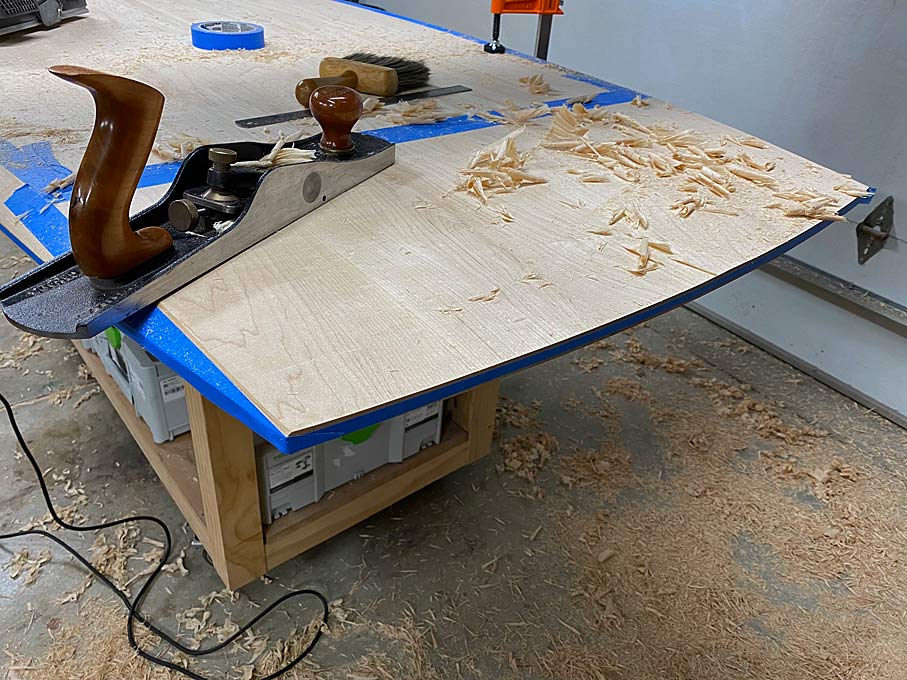
Top done. Time to attach the top to the base.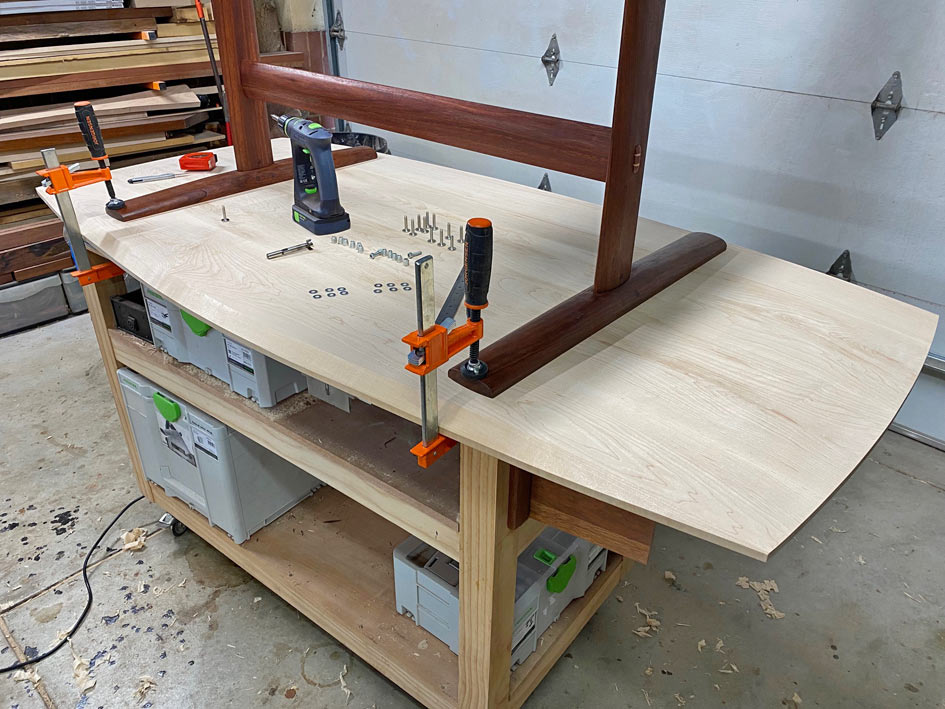
The plan here is to use bolts into metal inserts, as I do not like the idea of inserting wood screws which might cause splitting and also be vulnerable to being pulled out. 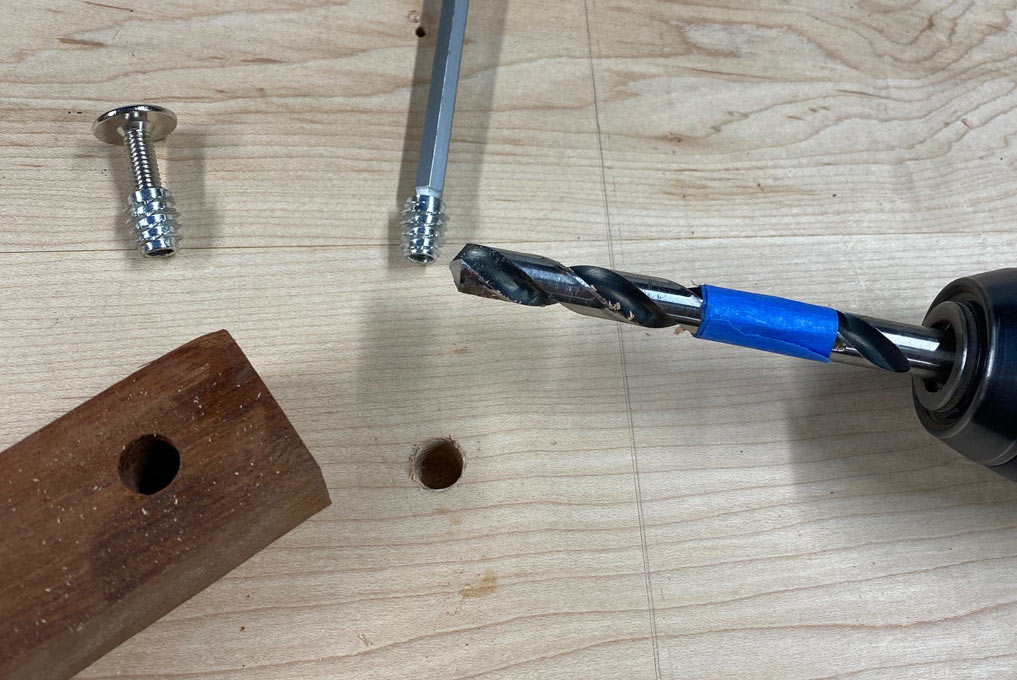
A pilot hole is drilled through the base into the table top to position the bolt holes and inserts.
The holes in the base are made with a 3/4" forstner bit, then drilled for the 6mm bolts using a 7mm twist bit (for a little wiggle room). The hole closest to the leg is fixed while the other two are elongated 2mm each side of the hole for expansion. 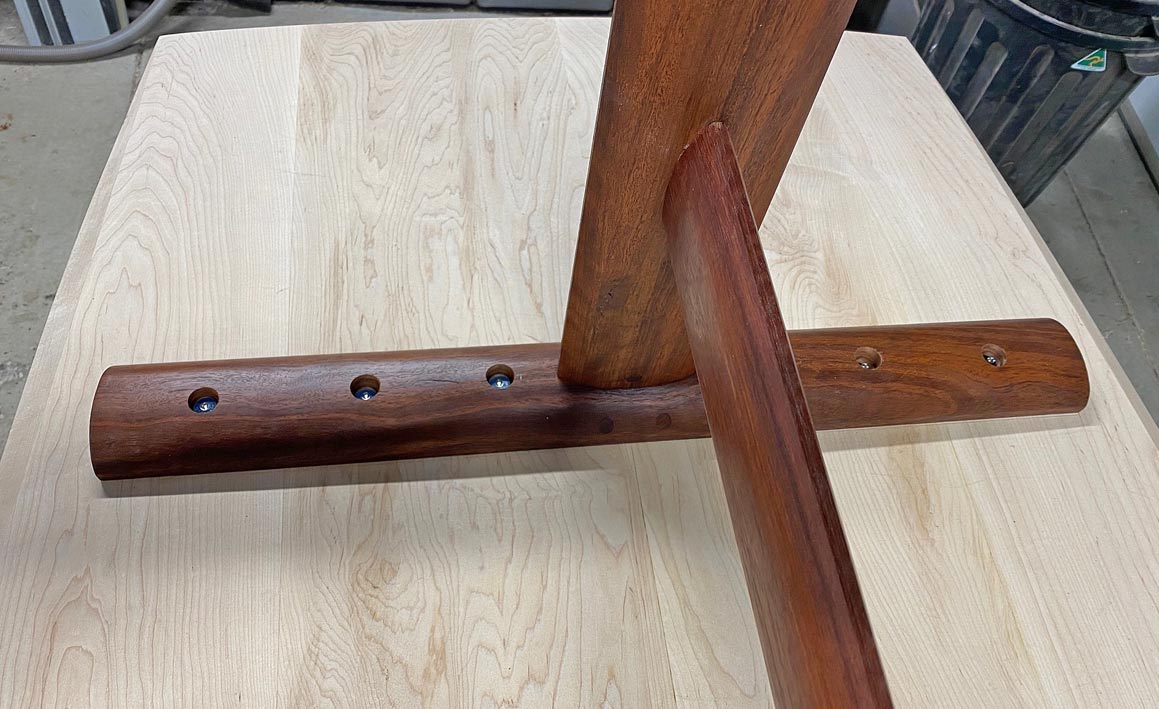
Note that the bolt holes go through the base, rather than using wooden buttons as the holes essentially make the attachment invisible from the sides ...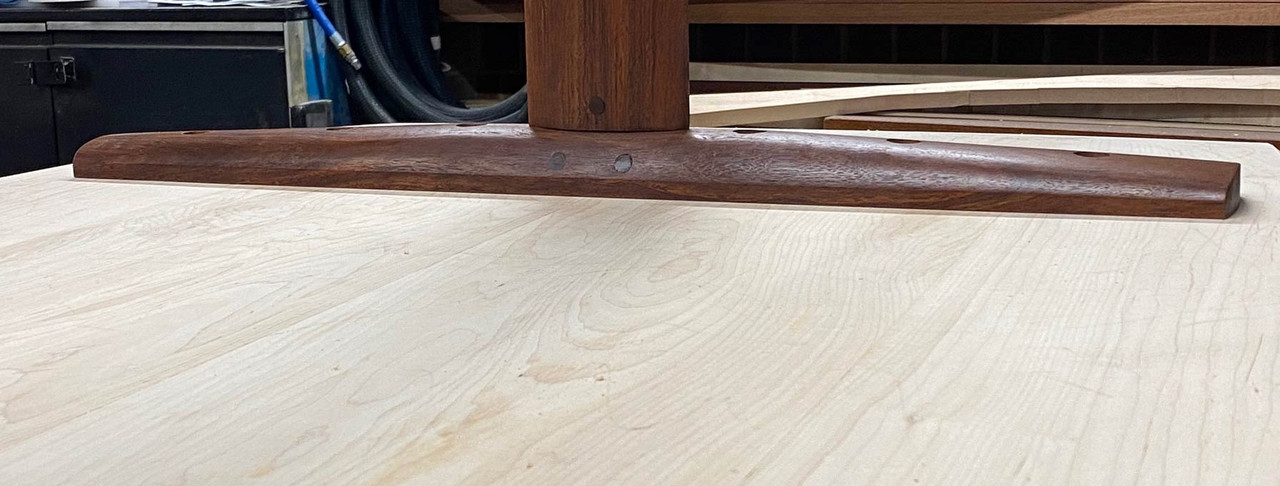
With all attached, the table is done! And two coats of Whittle hard wax oil are rubbed on.
So are we all ready for the unveiling? Drum role ...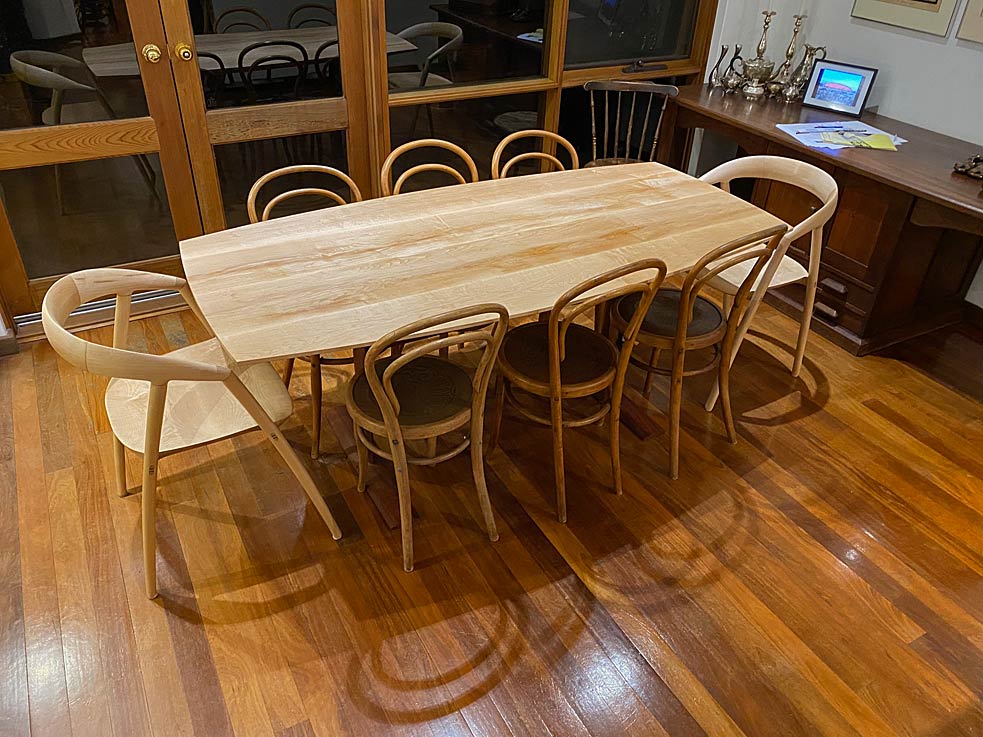
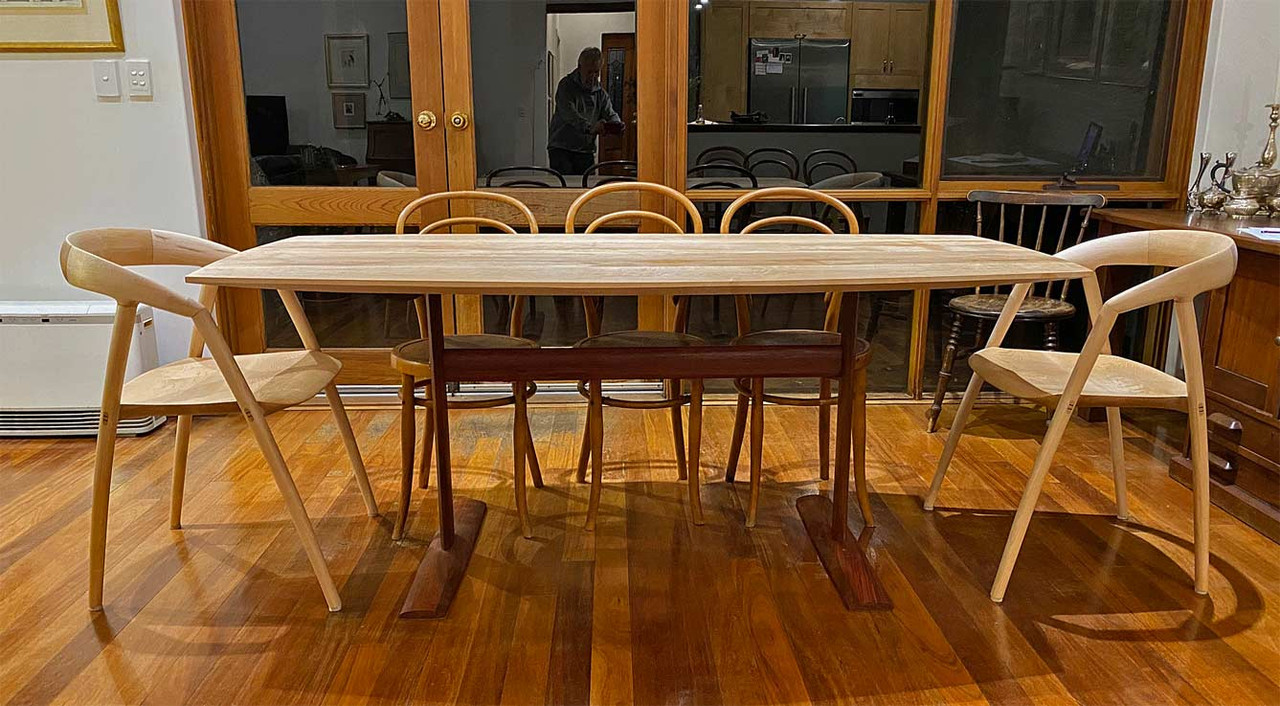
The aim of the design was to unite the table with two DC 09 chairs I built. In common are elliptical sections in the table and chairs. The other chairs are vintage bentwood, and the use of curves allows them to be included. The reason for a trestle table, rather than a traditional four-legged table, was to reduce the number of legs with different angles. This is aided by using dark Jarrah for the base, as the base disappears and the Rock Maple top is left as a line connecting the DC 09 chairs.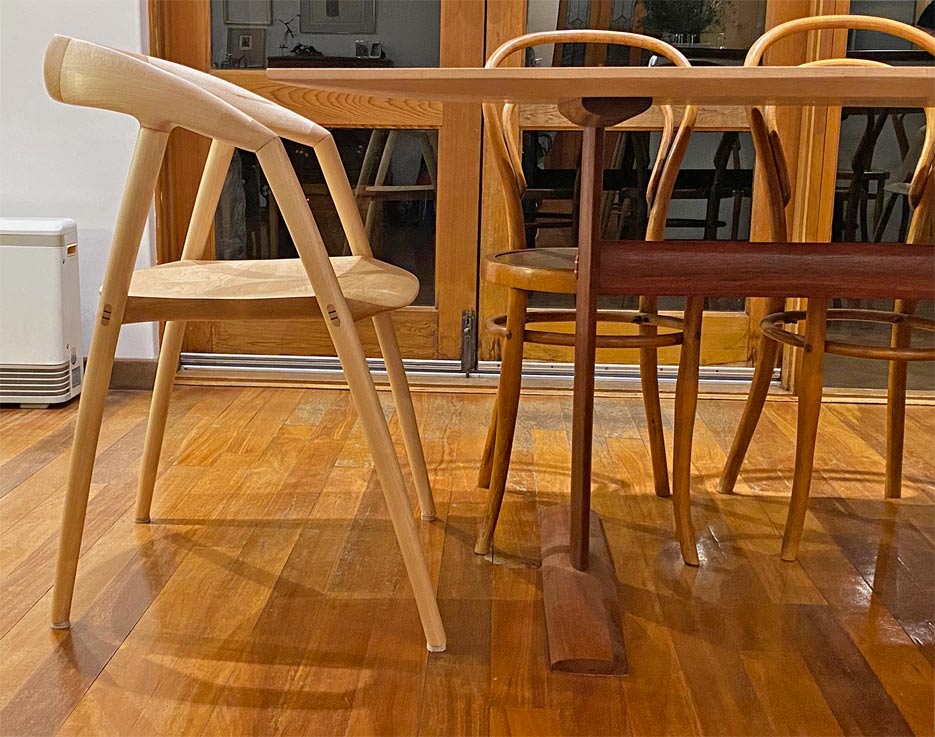
The curves of the top ...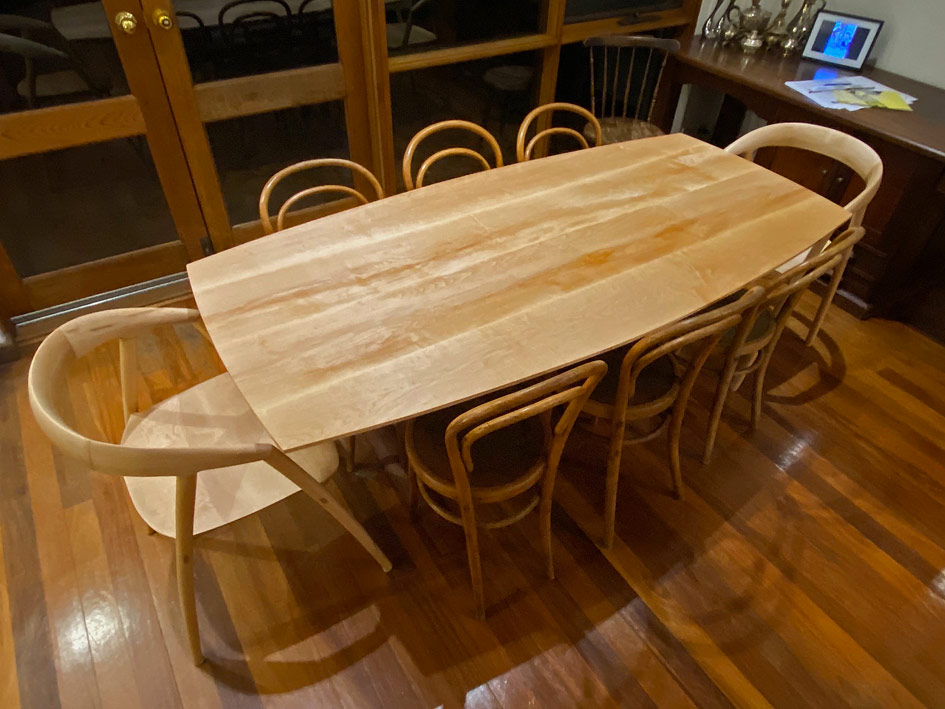
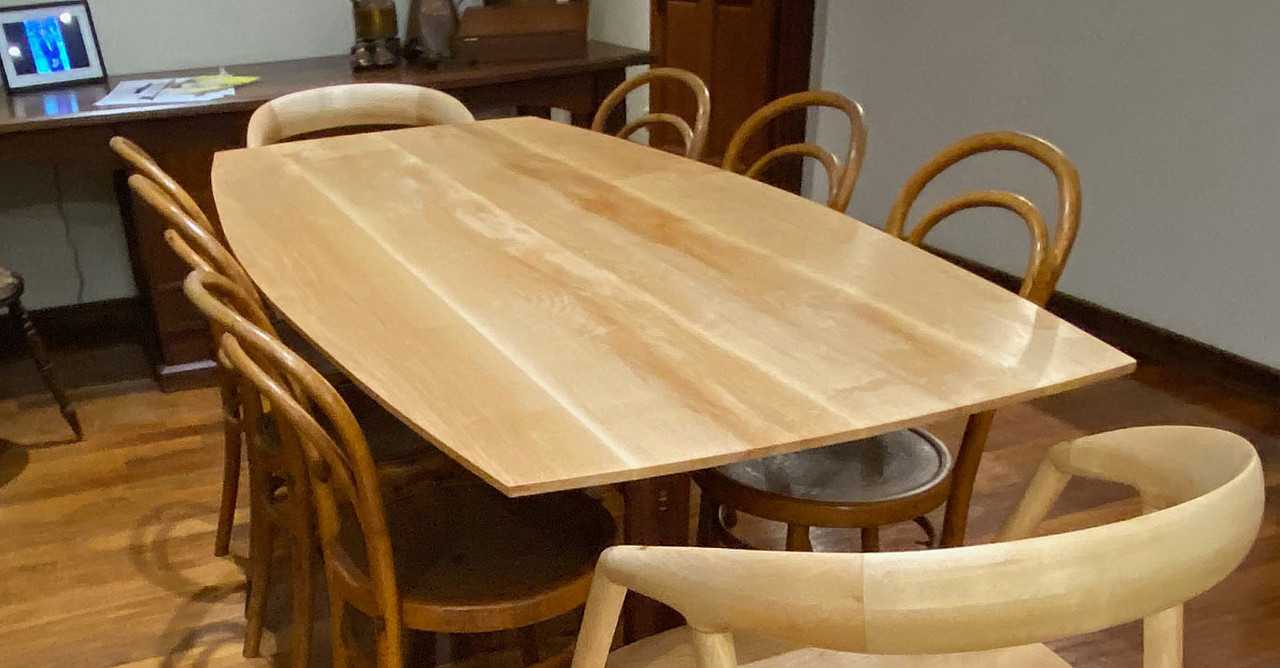
And a final picture from the kitchen area ...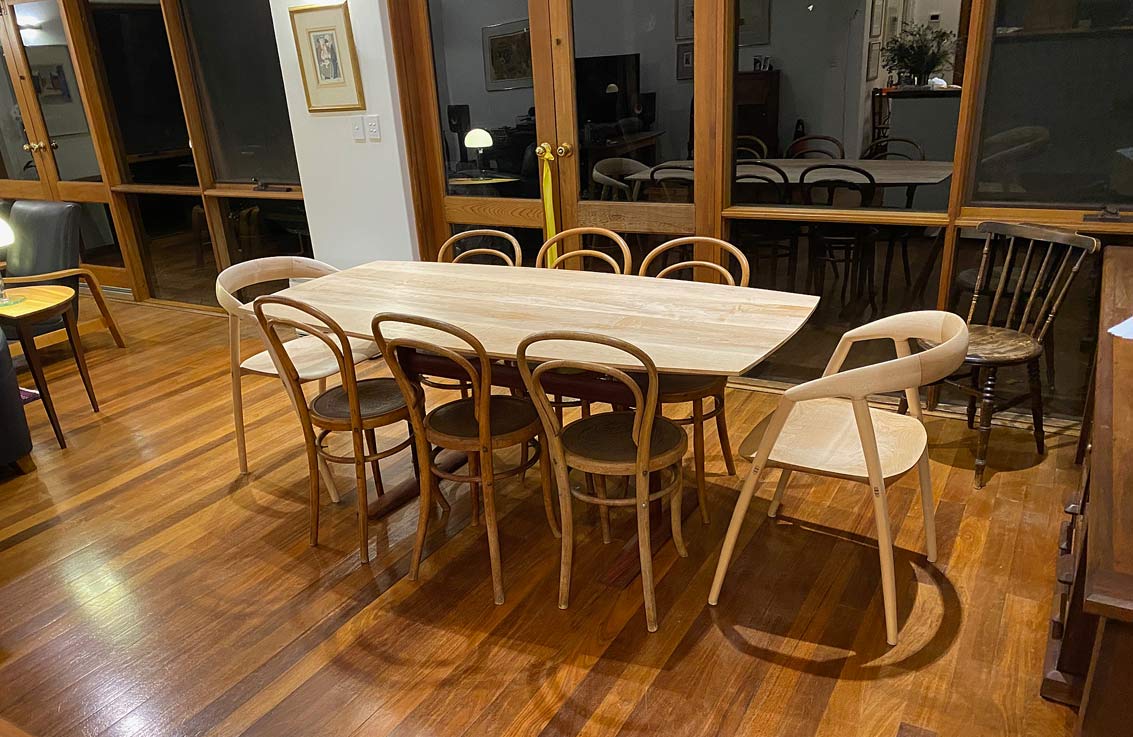
Thanks all for following along with this adventure.
Regards from Perth
Derek
Re: Dining Table - re-visited
#20All I can say is: super nice--! And, best, everyone is happy with the results.
Re: Dining Table - re-visited
#21

Beautiful!
Now all you gotta do is build six more chairs!
Re: Dining Table - re-visited
#22

Your woodworking skills are clearly exceptional, but what truly stands out is your dedication to documenting your progress through photography and thoughtfully organizing it into narrative posts. This effort is both commendable and impressive, as it requires significantly more time and effort than many might realize.
Re: Dining Table - re-visited
#23
Fascinating process. My only slight concern would be allowing enough tolerance in your retaining bolts to allow for movement.
On my work bench there is just one heavy threaded coach bolt in the center to hold down the top. It's all you need on a thick heavy top.
Such a technique would not be advisable here though. Buttons have the huge advantage that they can be loosened slightly and spun to remove the top if required.
I've made many variations of trestle style tables. Traditional and modern. I just really like the concept. With a nice wide stretcher they are remarkably rigid and take phenomenal abuse.
Sadly very few woodworker's work from trestles now. They build these huge space hogging work tables with all sorts of absurd clamping contraptions they saw on YouTube. Then they turn the underside in to storage making it impossible to move.
Fluid space is not understood by many now.
Re: Dining Table - re-visited
Edited #24Thanks Peter.
Is there a Monty Python sketch to celebrate this build?
Regards from Perth
Derek
Added later 11 min 45 s:
Maurice wrote:Fascinating process. My only slight concern would be allowing enough tolerance in your retaining bolts to allow for movement.
On my work bench there is just one heavy threaded coach bolt in the center to hold down the top. It's all you need on a thick heavy top.
Such a technique would not be advisable here though. Buttons have the huge advantage that they can be loosened slightly and spun to remove the top if required.
I've made many variations of trestle style tables. Traditional and modern. I just really like the concept. With a nice wide stretcher they are remarkably rigid and take phenomenal abuse.
Sadly very few woodworker's work from trestles now. They build these huge space hogging work tables with all sorts of absurd clamping contraptions they saw on YouTube. Then they turn the underside in to storage making it impossible to move.
Fluid space is not understood by many now.
Maurice, the bolts have the ability to allow movement. I mentioned in the last post that the first bolt (closest to the leg) is fixed, but the other bolts can move in a slotted hole. Buttons where deliberately not used to avoid their appearance cluttering the underside of the table. KIS.
Your comments on bench design are interesting and provocative. Start a new thread on this topic and present your argument. I've worked on every imaginable surface over a span of 40 years, a lot of this carpentry renovating and fitting out houses. I began building furniture more seriously (but still as an amateur) around 30 years ago, and around a dozen years ago built what is likeky to be my final bench (I am 74). It is dedicated to hand tools and everything you hate I love it!
Recycled Jarrah for the base (roofing timber, here in WA) ..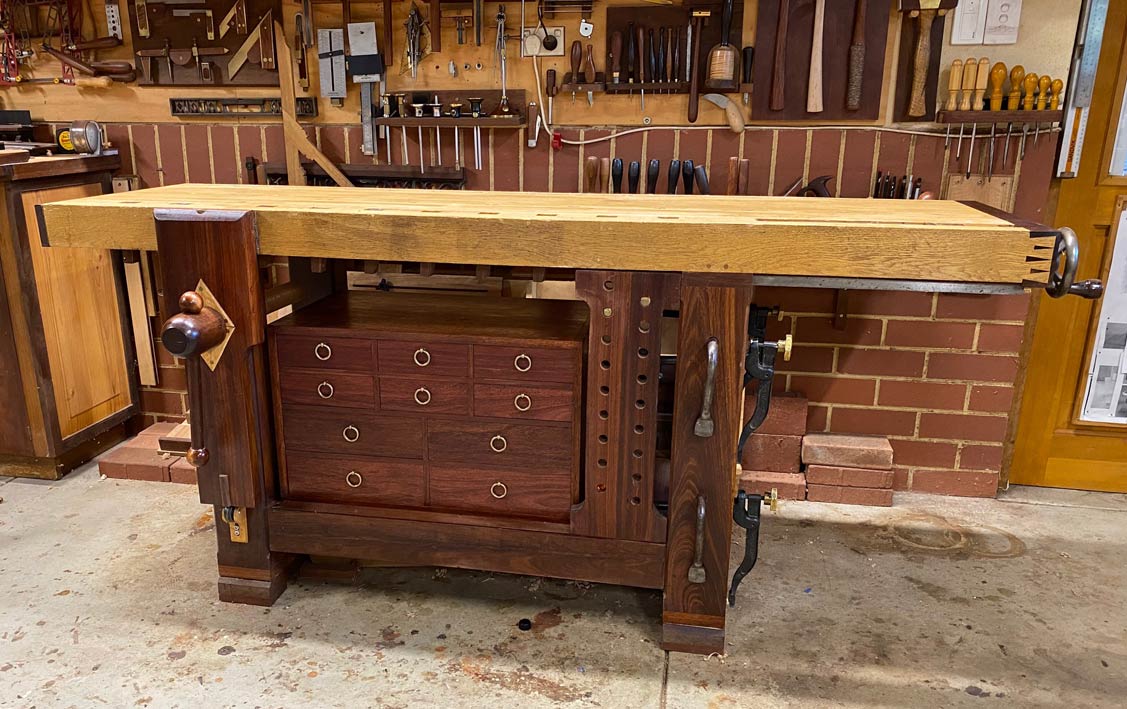
I'll leave it at that for now. Post a new thread.
Regards from Perth
Derek
Re: Dining Table - re-visited
#25
Funny how people always take my opinions as arguments. Different trades have different methods and traditions. It's far more a case of observation rather than remonstration. In a professional shop free space is always at a premium so clutter is the enemy. This is especially true for a pipe organ building workshop where component parts are very large and an entire instrument is being built.
Private shops can often be very tight on space. So the same rules should apply, more so.
I can see your style is very much in Vogue.
The Gentleman's workshop is not a new thing.
In respect of bolt movement my concern was for both planes of movement. Button tongues slide easily and handle loads in two axis better than small screw heads. Expansion and differential movement from top to bottom causing cupping of the upper surface can overload the tiny surface area of a screw and cause gouging. Organ builders have to contend with this problem so they use very large washers and springs to spread the load over a wider area on toe boards.
Other than that my observations were comparisons not critiques.
On the east coast the availability of other hardwoods is better than Jarrah.
Blackbutt, Turpentine, Sydney blue gum, blood wood etc etc..
Spotted gum is quite common here.
The French Joiners bench that Rubio illustrated was at the time the only viable option for vices until cast iron vices rapidly made them obsolete. Where traditional techniques work better I use them. Particularly for Harpsichord making. Hide glue all the way. No cheats, no short cuts.
Many hobby guys don't really grasp the difference between a joiners bench and a cabinet makers bench in terms of priorities and function.
My bench is somewhat of a hybrid because I need it to serve both functions without being to heavy and clunky to move easily.
You take offence where none was intended.
In a commercial shop your bench and tool chest would be in serious danger of being broken in to or stolen.
I've seen it happen. So we keep our tool chests simple and humble and functional.
Again just an observation. Subjectivity is the enemy of maturity.
My most valuable tools I locked up each day. My tool chest heavily secured to a wall.
Organ builders you could always trust not to steal. Not so for other trade's, especially carpenter's.
The pressure to work quickly and efficiently is huge. Profit depends on it.
Organ shop floors are constantly in flux as projects move forward.
I will move my bench to the sunny side if I need good light. Across the room if a keyboard needs to avoid direct exposure to sunlight.
In the old days the Rubio type Joiners bench was static because it was much much longer than that of a finish cabinet maker.
Three, even four times longer and wider.
Jointing by hand is brutal hard work. Boards were NOT jointed on edge in the vice. They were shot. Hinge and lock fitting yes. Mortise cutting yes.
The tail vice is far more used than the other.
In the old days Joiners and carpenter's were pretty much one trade. As indeed my grandfathers business was.
Okay, your hour is up !