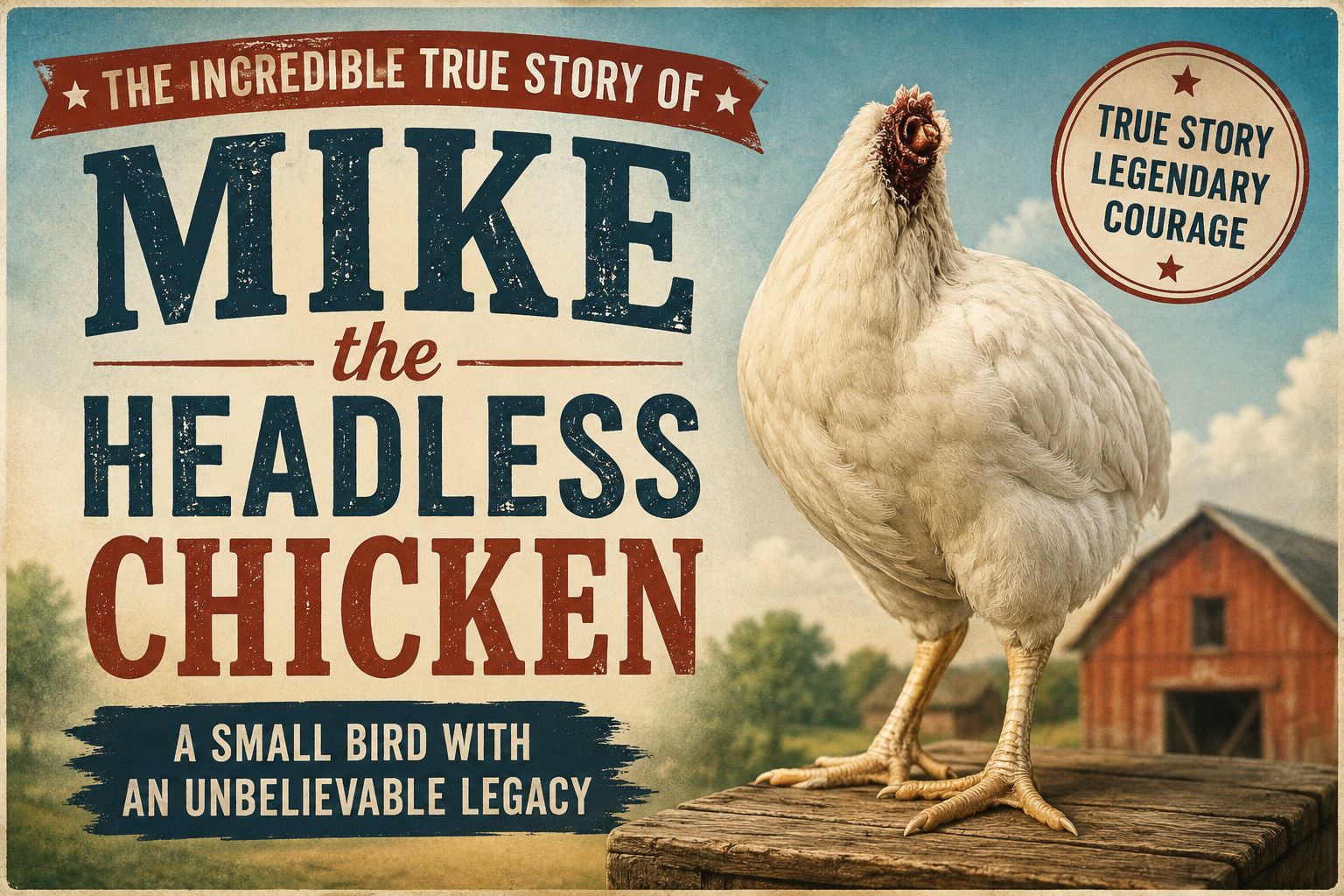
Taking a break from IT-related articles, Mike the Headless Chicken is real, well-documented history — not a hoax. Here’s the story:
The beheading
On September 10, 1945, farmer Lloyd Olsen of Fruita, Colorado, went out to the yard to grab a chicken for dinner (his mother-in-law was visiting, and reportedly wanted fried chicken necks, so he tried to leave extra neck). He picked a young Wyandotte rooster, about five and a half months old, and swung the axe. The swing struck at an off-center angle, severing the head but missing the jugular vein and taking only part of the brainstem. Most of the brainstem and one ear stayed attached to the body, while the severed head kept both eyes and the other ear. A blood clot quickly formed at the wound, preventing him from bleeding to death.
Life after
Instead of dying, the rooster staggered but didn’t falter, and after a few moments began acting normal again — pecking at the ground and trying to preen, even though he had no head to do it with. Olsen kept him alive by feeding him water and grain with an eyedropper. The Olsens named him Mike.
Curious about the science, Olsen took Mike to the University of Utah in Salt Lake City, where researchers confirmed most of his brainstem and one ear were still intact — enough to control basic motor functions, balance, and reflexes, even without the parts of the brain responsible for higher functions like conscious thought.
Sideshow fame
Word got out, and a promoter named Hope Wade took Mike on tour as “the Headless Wonder Chicken,” billing him as a sideshow attraction across the country. He gained national fame and was even featured in Time and Life magazines. Life ran a piece on him in its October 22, 1945 issue. At his peak, he was reportedly earning his owner a small fortune and drawing large curious crowds.
Death
Mike lived for roughly 18 months post-beheading — he died on March 17, 1947, in a motel in Phoenix, Arizona, at about 23 months old, apparently from choking (accounts suggest he began choking in the night and Olsen didn’t have the tool on hand he normally used to clear Mike’s throat).
Legacy
He holds the Guinness World Records title for longest-surviving headless chicken. Fruita, Colorado still holds an annual “Mike the Headless Chicken Day” every May — complete with a 5K “Run Like a Headless Chicken” race and a game called Pin the Head on the Chicken.
Here’s why Mike’s case is more biologically plausible than it sounds, rather than a pure fluke.
Birds are wired differently than mammals
In birds, a lot of what mammals handle in the cerebral cortex is instead handled lower down, in the brainstem region called the tectum. The tectum of the chicken has a layered arrangement of neurons structurally similar to the mammalian cerebral cortex, meaning most of the associative activity in birds happens in the brainstem rather than up in the cerebrum. In a mammal, losing the cortex would wipe out far more function. In a chicken, the brainstem was already doing much of the heavy lifting for balance, coordination, and basic behavior — so losing the cerebrum and most of the skull was a smaller functional hit than it would be for us.
What the brainstem handles on its own
The brainstem is the body’s autopilot. It runs the functions you don’t consciously think about — reflexes that regulate heartbeat and blood pressure, breathing, and coordinated movement responses, all triggered automatically without input from higher brain regions. That’s consistent with what Mike could still do: balance on a perch, walk, flap, and even make crowing-like motions, because those are largely reflexive motor patterns generated by circuits in the brainstem and spinal cord.
The spinal cord adds its own layer
Below the brainstem, the spinal cord contains its own reflex circuits that can function without any input from the brain at all — alpha motor neurons in the spinal cord’s ventral horn receive input from sensory neurons, from upper motor neurons in the brain and brainstem, and from local spinal interneurons. That layered system is why a headless body can still stagger, twitch, or hold posture — the “wiring closet” of the spinal cord can run basic scripts on its own.
What Mike specifically kept
Circling back to the anatomy: the axe blow left most of Mike’s brainstem and one ear intact, which was enough to preserve balance and basic movement control. That’s the crucial detail — it wasn’t that he had “no brain,” it’s that he lost the parts responsible for higher cognition, vision, and the beak/face, while the part responsible for autopilot functions survived. Combined with the clotting that stopped him bleeding out, that was just enough hardware to keep a body walking, balancing, and superficially “being a chicken.”
What he couldn’t do
The catch is exactly what killed him: no head meant no way to swallow on his own, so the Olsens had to feed him a milk-and-water mixture directly into his esophagus with an eyedropper, and no beak meant no way to clear his airway — which is what finally did him in when he choked in that Arizona motel room.
So Mike wasn’t defying biology so much as landing in a very narrow window where avian neuroanatomy, a lucky axe angle, and quick clotting all lined up.


