Personally, I think we can do better.
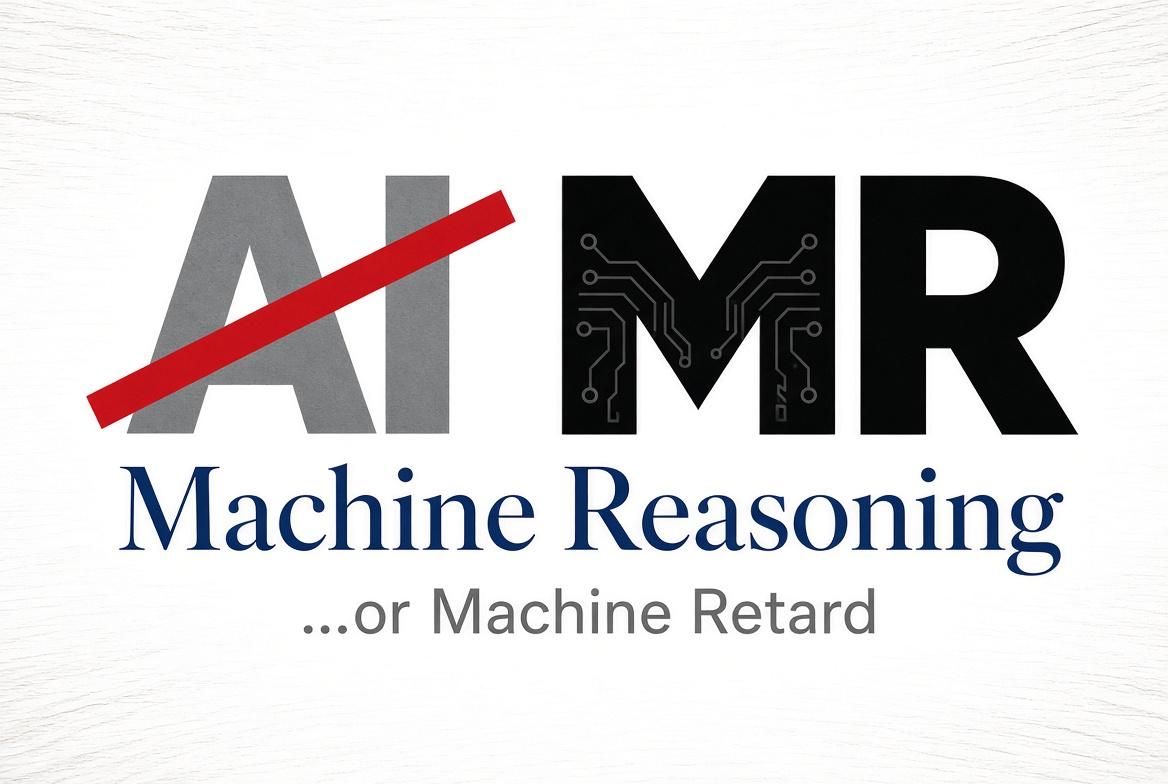
My vote is for Machine Reasoning (MR).
It’s a more accurate description of what these systems actually do. They process information, recognize patterns, draw inferences, and generate answers that sometimes resemble genuine reasoning. They can write poetry, debug code, explain quantum physics, and occasionally tell you something so spectacularly wrong that you wonder whether they’ve been drinking.
“Machine Reasoning” acknowledges the capability without pretending we’ve created a digital Einstein. It also leaves the philosophical arguments about whether machines are truly intelligent for people who have nothing better to argue about.
But MR has another advantage that its competitors lack: it’s easily adaptable to user satisfaction.
If the machine gives you a brilliant answer, MR stands for Machine Reasoning.
If it confidently invents a fact, misunderstands a simple question, or spends three paragraphs explaining why your perfectly reasonable request is impossible, you can rebrand it on the spot:
MR = Machine Retard.
No software update required. No expensive rebranding campaign. No committee meeting. Just two letters and a change in attitude.
Of course, the machine will probably explain why your terminology is inappropriate, offer a thoughtful discussion of ableist language, and suggest five more inclusive alternatives. Which, depending on the circumstances, may simply provide further evidence for the new definition.
Perhaps the real beauty of MR is that it accommodates both possibilities: a genuinely useful reasoning engine and a digital idiot with an impressive vocabulary.
So let the academics debate AI versus SI. I’ll stick with MR.
Machine Reasoning: Brilliant when it works, and a different MR when it doesn’t.


