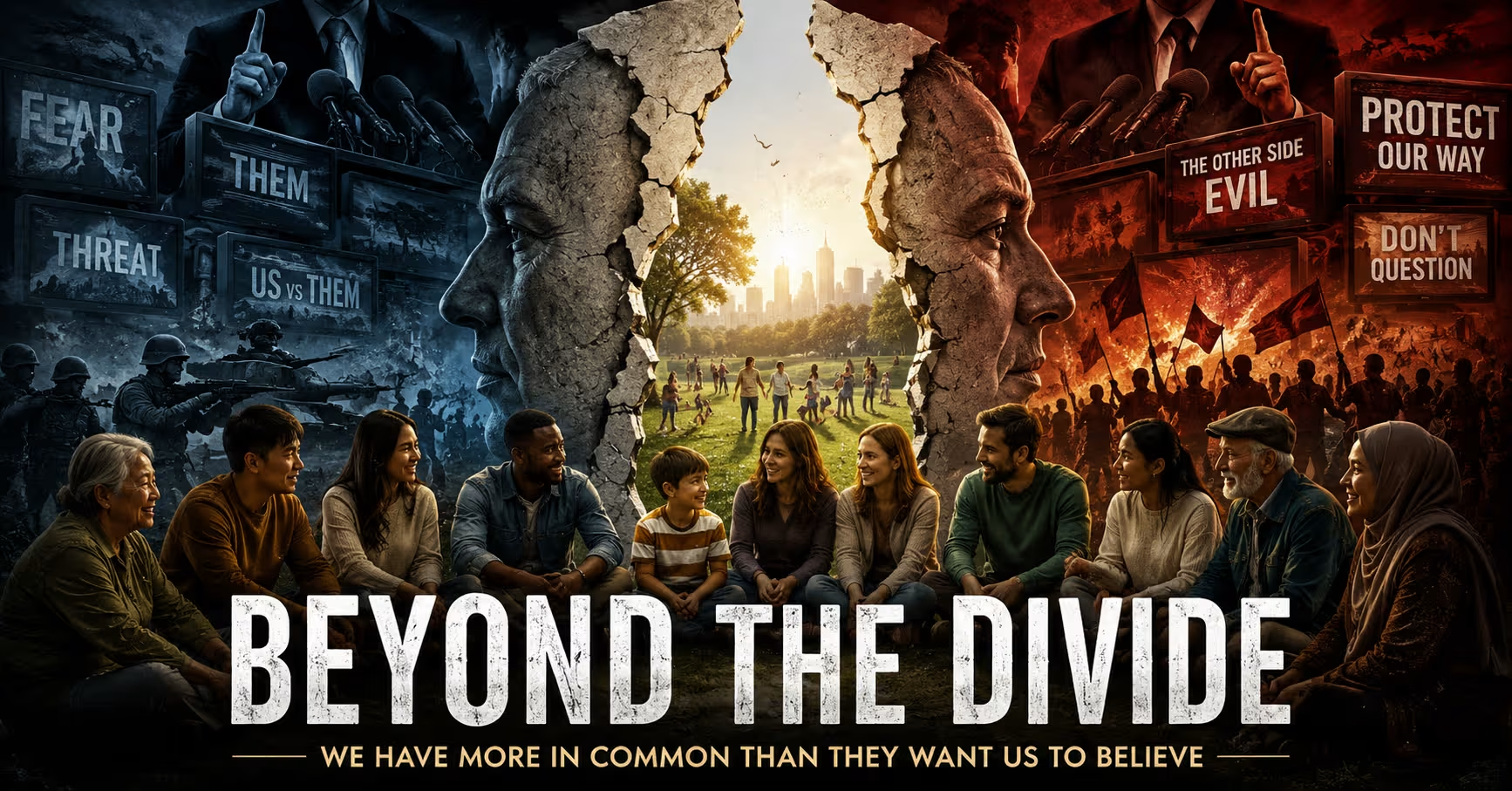
There comes a point, after enough time watching the machinery of power, when something becomes difficult to unsee.
Ordinary people do not differ nearly as much as we are told.
Not governments. Not political movements. Not intelligence agencies. Not ideologues. Not the people who appear on television and speak with the authority of nations.
I mean ordinary people.
The mother worrying about her children. The father calculating whether the money will last until the end of the month. The young person trying to figure out what kind of life is still possible. The older person looking back at the years that have already been spent. The person who wants to be respected. The person who wants to be loved. The person frightened of losing what little security he has. The person who wants his children to have chances he never received.
Strip away the language, the flags, the religions, the parties, and the historical grievances, and the underlying desires are remarkably consistent.
I have spent enough time around intelligence and national security to become increasingly uncomfortable with how easily we forget this.
Intelligence is, among other things, the study of people: what they want, what they fear, what they believe, what motivates them, and how their perceptions can be shaped. Nations spend enormous resources trying to understand these things about other populations.
Yet one of the most effective forms of influence requires almost no sophistication.
Make people afraid. Give them an enemy. Tell them the enemy is not merely wrong, but dangerous, evil, and coming for everything they hold dear. Then give them a story that explains why their own side is virtuous and why compromise is weakness.
It works. It works because human beings are not neutral information processors. We are social animals. We seek belonging. We look for patterns. We respond to threats. We want to know who is on our side. And, most importantly, we want to believe that we are good people.
Propaganda rarely asks people to become villains. It asks them to believe that what they are doing is necessary. It tells them that extraordinary measures are justified because the circumstances are extraordinary. It tells them that the people suffering on the other side are somehow different from us. It supplies reasons why our violence is defensive while theirs is aggression, why our censorship is protection while theirs is tyranny, why our manipulation is public relations while theirs is propaganda.
The vocabulary changes. The mechanism does not.
This is where I have become tired—not of politics, which is unavoidable, and not of disagreement, which a free society requires, but of watching people who would otherwise get along being systematically taught to hate one another. Of watching ordinary human beings turned into abstractions.
“Immigrants.” “Conservatives.” “Liberals.” “Russians.” “Americans.” “Muslims.” “Christians.” “Elites.” “Trump supporters.” “Socialists.” “Nationalists.” “Globalists.”
The labels become more important than the people wearing them. Once that happens, something dangerous follows. We stop asking “What does this person actually believe?” and start asking “What kind of person is this?”
The first question invites conversation. The second invites tribal judgment.
There is a quiet irony here. The people shouting across political and cultural divides often have more in common with one another than either has with the people telling them what they should be angry about.
The factory worker in Ohio and the factory worker in Germany share more than either shares with a billionaire politician. The Russian mother worrying about her son has more in common with the Ukrainian mother worrying about hers than either has with the officials who decide where armies move. The American father anxious about his mortgage has more in common with the Chinese father anxious about his children’s future than either has with the negotiators of trade policy. The elderly woman living alone in a small town has more in common with an elderly woman on the other side of the world than with almost anyone who appears regularly on cable news.
This is not sentimentalism. It is an observation about human nature. And it helps explain why division is so useful.
Power depends on distinctions: us and them, loyal and disloyal, patriot and traitor, victim and oppressor, good and evil. Some of those distinctions are real. There are genuine injustices, genuinely dangerous people, and destructive governments. History contains cases in which refusing to choose a side would itself have been immoral.
But the existence of real evil does not make every claim about evil true. The existence of real threats does not make every threat as serious as it is presented.
This is where skepticism is essential—not cynicism.
Cynicism says everyone is lying and nothing can be trusted. Skepticism says: What is the evidence? How do we know?
Cynicism closes the mind. Skepticism keeps it open. We should apply that skepticism to everyone, including those we agree with—especially those we agree with.
It is easy to spot propaganda from an adversary. The selective statistics, the emotional language, the carefully chosen images, the omitted context—all of it is obvious. Then we turn around and absorb essentially the same techniques from our own side without noticing.
That should bother us.
If a photograph of suffering makes us furious, we should ask why that particular photograph was selected. If a headline makes us frightened, we should ask what information might have been left out. If a story makes us feel contempt for millions of people we have never met, we should stop and ask whether that reaction is helping us understand anything. If someone claims an entire population is stupid, evil, brainwashed, or beyond redemption, we should be especially suspicious. The moment we accept that another group is less human than we are, the moral rules under which we operate have already begun to change.
The most effective propaganda is often the kind we produce ourselves. We fill gaps with assumptions. We interpret ambiguous events according to what we already believe. We seek confirmation and dismiss contradiction. We share stories without reading them. We become outraged before we become informed. Then we congratulate ourselves for being informed because we have consumed large volumes of information.
Information is not understanding. We may be living through the first period in which an ordinary person can consume more political information in a day than previous generations encountered in a lifetime—and still understand less about what is actually happening. We are drowning in information and starving for context.
Every event now arrives pre-interpreted. Before we have time to understand what occurred, we are told what it means, who is responsible, what we should feel, and what conclusion a decent person must reach. Because these messages are increasingly personalized, two people can live in the same country, witness the same event, and inhabit almost completely different realities.
A society cannot remain healthy indefinitely if its citizens cannot agree on basic facts about the world.
Years around intelligence and national security teach another lesson: certainty is dangerous. The real world is messy. Information is incomplete. Sources can be wrong. People have incentives. Governments have interests. Institutions protect themselves. Politicians want power. Corporations want money. Journalists want attention. Activists want change. Intelligence agencies want information and influence. Ordinary people want a coherent story that makes sense of it all.
None of these motivations is inherently evil. They are human and institutional realities. But they mean we should be careful whenever someone presents a complicated world as if everything is obvious. The world is rarely that simple. Anyone who insists it is—regardless of political affiliation—deserves a second look.
I do not believe the answer is withdrawal. I do not believe we should stop caring about politics. I do not believe every side is equally correct. I do not believe facts are merely matters of opinion. And I do not believe that refusing to take a position is always virtuous. Sometimes we must choose. Sometimes we must act. Sometimes we must oppose what we believe is wrong.
But before we do, one additional question is worth asking:
Who benefits from my anger?
Who benefits when I hate this person? Who benefits when I fear that group? Who benefits when I conclude there is no possibility of compromise? Who benefits when I stop listening? Who benefits when I share a story without checking it? Who benefits when I become so invested in defeating the other side that I no longer care whether my own side is telling the truth?
These questions do not tell us what to believe. They simply restore a measure of control over the process by which we come to believe it.
What we need is not another ideology, another political savior, or another figure promising to rescue us from everyone who disagrees with us. We need citizens capable of thinking independently—citizens who can say “I don’t know,” who can say “I was wrong,” who can criticize their own side, who can listen to an argument without treating listening as surrender, who understand that another human being can be profoundly mistaken without being profoundly evil, who recognize that disagreement is not the same as hatred, and who remember that political leaders are supposed to work for us, not the other way around.
Power has always tended to intoxicate those who hold it—political power, economic power, institutional power, the power of a microphone or a social-media following, and sometimes simply the power to convince millions of people that their neighbors are the problem.
We should be wary of anyone who asks us to surrender our judgment. That includes the people we admire, the people whose politics we share, the people who tell us exactly what we want to hear, and—most importantly—ourselves. The easiest person to manipulate is often not the uninformed person, but the person who is certain he cannot be manipulated.
The older I get, the less interested I am in winning arguments and the more interested I am in understanding how we arrived at them. I find myself wondering what would happen if we deliberately turned the volume down: read beyond the headline, look for the original source, read something written by someone we normally disagree with, ask what evidence would change our mind, separate what we know from what we suspect, separate what happened from what someone claims happened, separate criticism of a government from hatred of its people, separate disagreement with an ideology from contempt for the human beings who hold it.
And occasionally, simply talk to someone—not their demographic category, not their political tribe, not their internet avatar. The person.
You may discover that the supposedly incomprehensible enemy wants almost exactly what you want: a safe home, healthy children, meaningful work, dignity, security, a measure of freedom, love, a little happiness, and the chance to live the remaining years without constant fear.
These are not particularly American desires, or Russian, or Chinese, or conservative, or liberal. They are human desires.
We have allowed the people who benefit from our divisions to convince us that our differences are the most important thing about us. They are not. Our differences are real and they matter. But so do our similarities. And if we lose sight of those similarities, we become extraordinarily easy to manipulate.
That may be the lesson I most wish more people would take from the world of intelligence. The greatest threat is not always the enemy trying to deceive you. Sometimes it is the willingness to be deceived because the deception makes you feel righteous.
We should become harder to manipulate—not by becoming harder-hearted, but by becoming more curious, more patient, more skeptical, more willing to admit uncertainty, and more willing to see humanity in people we have been taught to fear. And a little less certain that the people on television, in government offices, on social media, or anywhere else who claim to speak for us understand us better than we understand one another.
Beneath the flags and slogans, beneath the political machinery and the endless news cycle, beneath the arguments that seem urgent today and will be forgotten tomorrow, something simple remains.
Most people, almost everywhere, are just trying to live. They want their families safe. They want some measure of dignity. They want to be treated fairly. They want to believe that tomorrow might be better than today.
That common ground has not disappeared. We have simply become very good at looking past it.
It is time we started looking again.


