Home Articles Forums Gallery Marketplace Videos

WoodCentral Forums

Knowledge You Can Build On — Est. 1998

A Nifty Shooting Plane

Posts

Re: A Nifty Shooting Plane

#26

Re: it's funny..

david weaver

how the slightest little thing out of whack catches our eyes.

Once I sat the plane down on the bench and took a picture, my first thought looking at the wedge and seeing the transition was "ew. bad." I also wanted to test how I'd cut it, though, too, which I haven't done before. That, too, would be a lot easier if the scroll was taller.

that and the bevel - would've looked better stopped from both sides, but I am probably overthinking that. If the handle is too close to the top, it may be tippy

There's another thing that isn't visually very nice, I'll see if anyone else sees it.

Re: A Nifty Shooting Plane

#27

Re: it's funny..

Kees

You didn't center the escapement, or you didn't chamfer one side? One of the eyes almost touches the chamfer line, while on the other side it looks much wider.

Re: A Nifty Shooting Plane

#28

Re: it's funny..

David Weaver

The fat side goes down on the board. No chamfer on that side because it would invite shavings to slip under the plane, and it would reduce the size of the contact base. If I chase the cheek and eye all the way to the side of the plane on that side, it will be thin and weak and give little room for future truing.

It looks funny, though.

Re: A Nifty Shooting Plane

#29

Re: so far....

David Weaver

https://s27.postimg.org/w8ntuq3ib/P1100092.jpg

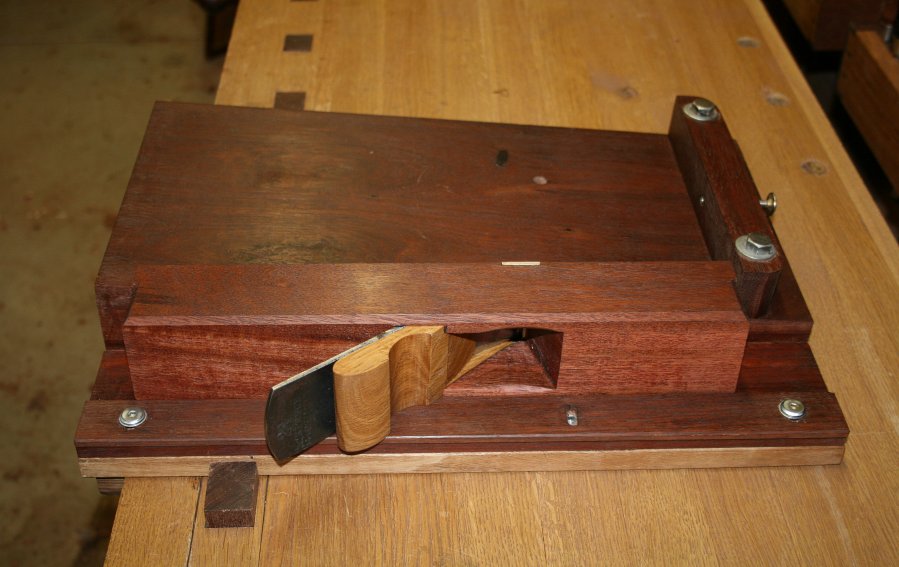
Slick in use. So much so that you have to concentrate on holding it against the fence. It'll require a retaining fixture for the plane, just like the original, at least to be enjoyable to use.

Need to remake the wages with a constant taper end to end to make the scroll look better, and then do a little aesthetic clean up and oil and wax it.

Weight is 10 pounds 10 ounces with both irons, but it feels light and slick on the board.

Re: A Nifty Shooting Plane

#30

Re: so far....

steve voigt

Wow! That's cool. Do you like it?

I would think that an adjustable track (just a strip of wood with some slotted screw holes), kinda like on commercial chutes, would help a lot. Then you wouldn't have to concentrate on holding the plane to the fence as much.

Re: A Nifty Shooting Plane

#31

Re: so far....

david weaver

I think the track/retaining piece on the back side is pretty much a necessity, at least with the combination of waxed MDF and this plane. It's like air hockey.

I think a metal plane with an adjuster (well, I guess they have two adjusters) is much more practical and doesn't require the track, but this is fun to play with.

The one thing that this has on its side (other than the weight and slickness, which will be an asset with a track rather than a detriment) is that the footprint is huge and tall on the side of the plane, so it has zero tendency to tip toward the fence.

Hopefully, I'll have time to do a little wedge re-do this weekend and track down some MDF to make a trial board. If it works well, then I can make a board out of solid beech, maybe, as I've got a bunch of 5/4 quartered on hand. A bit expensive to use to make a chute board, but I do think with a track, it will be practical to use - which is more than I expected.

I already have a nice miter jack, but I guess with two directions, there's almost an obligation to make a board that does miters both ways, too.

Re: A Nifty Shooting Plane

#32

It works! (oddball shooting plane)

david weaver

And it works really well and is not at all hard to set.

I have a horrible problem of not thinking of the viewer, and should've:

* shot the ends of more pieces of wood - people would rather see tools working than talked about, even if they learn nothing from it

* showed the plane shooting first and then talked about it second, soooooo...

Go to 8:00 in the video to see the plane working - skip all of the talk and repetition. Major pissed that youtube no longer allows you to add annotations, too - which I could've put at the beginning for most of the people who just want to see a plane shooting.

https://www.youtube.com/watch?v=MSusq2iW14o&lc=z12ds1hqft32y1o1w223vtpxvznpz5oae04

Re: A Nifty Shooting Plane

#33

Re: It works! (oddball shooting plane)

steve voigt

Nice work dude! Looks like a fun plane to use.

Btw, I enjoyed your comments about shooting at the beginning. I agree completely; I rarely shoot anything. I think a lot of the shooting board mania is a case of applying power-tool thinking to hand tool ww'ing. So for example you see people shooting both ends of all their rails and stiles (so they can use a marking gauge to mark the shoulders), when saw-cut ends would've been perfectly fine.

But even if shooting is not all that important, it's nice to have a shoot board and good plane for occasional use--and now you do! :)

Re: A Nifty Shooting Plane

#34

Re: shooting boards..

david weaver

.I always like to speculate what is driving the fascination with things marketed to beginners....

.. like dovetail markers, marking knives, various jigs (like the shooting boards), etc.

I think the attraction to shooting (and I thought it was really neat 12 years ago) is that you can make something accurate almost without influence (whereas jointing a narrow edge or something, or sawing a tenon to the line is an act of influence from us).

Plus, comments like "you can shorten your stick by a thousandth of an inch at a time" tend to attract people who think of potential problems without knowing what they are.

I'm a little at a loss with what to do with the ends of this plane. I guess there's nothing to do but leave them sharp (since nothing is rounded), but the resulting plane is a bit boxy looking. Video suggests I need to round an eye line or two a little more - that's always easier to see on a second look like in a picture or on a video.

I'll bet you could sell this design (modified to whatever suits you aesthetically).

Re: A Nifty Shooting Plane

#35

Re:Shooting end grain

Wiley Horne--So. Calif.

Hi David and Steve,

That is a terrific plane. Congratulations. I'd like to take partial exception to the idea that shooting end grain is for beginners only. There is a germ of truth in it, the example that Steve mentioned for instance. But there are a number of exceptions. Here are two, IMO:

1. Drawer sides, end, and front to be dovetailed.

2. A mitered table top edge, to get seamless joins at the miters.

Really love the plane!

Wiley

Re: A Nifty Shooting Plane

#36

Re:Shooting end grain

david weaver

Hi Wiley -

Thanks for the kind words about the plane :)

Certainly all of those things are relevant uses (I'll admit on drawers of any size, though, I just plane them to a mark with a #4 because it doesn't require pulling up a shooting board - and it feels good to plane those freehand)

Miter dovetails, mandatory of course (but on a miter jack). and on small sticking, that's usually the end of a tenon for me, or a stile that will have the ends cut off flush later and planed in situ.

What I'm referring to, though, is the notion (and it got me, too - I had a LN #9 at one point as well as a LV BU jack) that you're going to start as a beginner and have the shooting board be essential and used all the time, and you need to spend a lot of money on the board as well as a special plane. I made more test cuts with those planes than I did using them for furniture work. They were fun to make test cuts with. If this plane turns out to work well once I make a miter shooter for it, I may actually use it to trim mouldings, though - it'll be quicker than a miter jack and potentially less awkward, but a miter board is going to be large and awkward itself.

(If I had a good tablesaw, I'd probably have square drawer ends to start with from using a crosscut sled. I don't have a good tablesaw, though).

I'll eat my miter plane about my comments if I ever make a bunch of small things, though, that I can't plane to a mark.

Plus, I've seen your work and it is lovely at the very least, so whatever methods you use to do it, I can't criticize!

Re: A Nifty Shooting Plane

#37

Re:Shooting end grain

steve voigt

Hi Wiley, I didn't mean to imply that shooting boards are for beginners only. I have a shooting board, and I use it. I do think though, that the importance of one is frequently overstated. I think that's what David was getting at in his video, and I agree.

After going on two years of making little but planes, my furniture chops are getting rusty, but typically I wouldn't use a shooting board for any carcase ends, frame and panel parts, or drawer parts, unless the last are particularly thin. So, one can make a lot of projects, especially when starting out, without needing the shooting board.

You're right that for long mitres etc they are handy, no doubt.

I guess my long-winded point is that they are a secondary or tertiary shop appliance, not an essential one. But each to his own, of course.

Re: A Nifty Shooting Plane

#38

Re:Shooting end grain

Brian Holcombe

That's interesting I used to use a shooting board very commonly and now find it much less so, but still I use it fairly often.

David, the plane looks awesome and takes a beautiful shaving. Definitely better than my setup.

Re: A Nifty Shooting Plane

#39

For me shooting boards are essential

Bill Tindall, E.Tn.

Like all the plane work I do a plane is a means of removing precise amounts of material for fitting with minimal risk of removing too much.

A shooting board enables me to extend this philosophy to the ends of boards. What better way to remove a few thousands of length or adjust an angle by a few arc minutes?

If I was better at the table saw I suppose it could install a cross cut blade and fiddle with the miter to get just the angle I need and the amount of material removed and leave a finished surface...... but it is way faster and less risky to fit a drawer front to its opening, with an accurate reveal, with a shooting board(for me at least).

It is a lot easier to see scribe lines on a drawer side end that has been shot.

It is less risky adjusting a miter with a shooting board than a table saw.

I could not install cock bead with out one.

And the list goes on. I regard a shooting board one of the essential elements to my building of stuff. It is the single most useful discovery I have made here at WoodCentral. It hangs in reach of the bench.

Re: A Nifty Shooting Plane

#40

Re:Shooting end grain

david weaver

I'd make you one at cost if I had the irons (just because I know you'd use it), but now I've only got one long thin one left in 2 1/2" (not a great big fan of those because the cap iron doesn't stay put, but it's probably not critical on a plane of those type)

If you have interest in a one-holer (forward only) that's about 26 inches long with a handle of this type, let me know. That'd be really quick to make.

I'm sure there are better planes on the market, though (the metal ones with skewed irons).

Re: A Nifty Shooting Plane

#41

ditto.....

roger lance

Its a little amusing to me that rough and tough, no nonsense B. Tindal is the one to defend the use of a shooting board.

I'm a fan also.....and if I want to do really good, precise work.....especially on drawers.....the shooting board is essential.

Hey Bill.....maybe us power tool guys are changing.

Re: A Nifty Shooting Plane

#42

Try this without one

Bill Tindall, E.Tn.


No doubt there are other ways but it is trivial with a shooting board. Takes patience and no skill, right up my alley.

Re: A Nifty Shooting Plane

#43

Re:Shooting end grain

Brian Holcombe

Thanks David! That is very generous of you, I'll send you an email shortly.

Re: A Nifty Shooting Plane

#44

Shooting boards and more

Derek Cohen (in Perth, Australia)

I always like to speculate what is driving the fascination with things marketed to beginners....

.. like dovetail markers, marking knives, various jigs (like the shooting boards), etc.

I think the attraction to shooting (and I thought it was really neat 12 years ago) is that you can make something accurate almost without influence (whereas jointing a narrow edge or something, or sawing a tenon to the line is an act of influence from us).

David, I think that you make provocative statements because you actually believe in them, rather than to stir commentary. We have had this discussion on another forum, where I asked you whether you would have not purchased all your LN planes 10 years ago if someone had then said all you need is a Stanley #4, or purchased and also built in-fill planes during that period ... and here you are buying them again! :) Not to mention enough sharpening stones to line the wall of my workshop ... rather than just the 2 you use today ... :O

You know I am teasing you, and that we agree that most want to learn from their own experiences.

However I do want to add that many of the tools you mentioned above are not simply for beginners. We all need a marking knife - and, indeed, I dare you to mark slim dovetails without a suitable marking knife. I use a dovetail marker by choice. I could just as easily saw dovetails with my eyes closed, but the pieces I design and build are not slapped together - call me obsessional if you will, but I prefer neat work. And shooting boards .... well ...

Wiley and Bill made enough comments, so I shall not repeat them. It is sufficient to state that piston fitting drawers without a shooting board is a recipe for a sloppy fit. Yes, you can plane to a scribed line with a #4, but why do you want to do it the hard way? There is some sort of masochistic streak underneath all this, David? :)

I began using a shooting board about 20 years ago. These were just basic flat boards using a Stanley #5 1/2. They worked.

Then about a dozen or more years ago I discovered ramped shooting boards built by Michael Connor, an Australian building bench accessories and guitars. The advantage they offered (less jarring at entry and more control) when using a plane with a square blade was not lost on me. I build a few of my own design over the years, finding pleasure the same creative drive that pushes you to build planes, and I enjoyed the workmanship that went into them. Personally, I would not purchase a jig I could make for myself, but I recognise that there are some who are willing to pay for a well made shooting board. Several years ago I built a couple of boards for woodworkers in the USA, but I am not in the business of doing so, and will not do so again.

Here is an example of a ramped shooting board with a strike block plane I built (37 degree bed):

Add this donkey's ear, and it is great with mitres ...


Incidentally, watching your video, I was reminded how I recommend that a shooting plane is pushed: do not pull it back and "run" at the board. This will damage the blade and can also cause the plane to lose control. Instead, just rest the blade against the board, and push it through. A sharp blade and a finer cut will enable this.

These days I use a combination that is a dream. I picked up a Stanley #51/52 shooting board and plane about 10 years ago cheaply on eBay (Australia) as the plane had a broken frog (which is irreplaceable). I repaired it and used this for some years, until I was given a birthday present of a LN #51. The combination is just stunning. As it happens, the LN has been replaced by the Veritas version, and this is less pretty (to my eyes) but a remarkable performer.


Excessive? Oh definitely! Level of enjoyment and pleasure? Off the scale. And used regularly.

I wrote this to you elsewhere:

“The test of the machine is the satisfaction it gives you. There isn't any other test. If the machine produces tranquility it's right. If it disturbs you it's wrong until either the machine or your mind is changed.” (Robert Pirsig, Zen and the Art of Motorcycle Riding)

Regards from Perth

Derek

Re: A Nifty Shooting Plane

#45

Re: It works! (oddball shooting plane) *LINK*

Kees

A few years ago I had this same discussion sawmillcreek. At that time I looked into the history of shootingboards and found something interesting. The first mention of shooting boards for anything other then miters was in the 19th century! Before that time, no one thought it important enough to write about, not even Roubo who explored every little detail in the workshop! There is quite some material about mitre blocks in 18th century German texts.

In the 19th century it is first mentioned by Nicholson when shooting long grain edged of very thin stuff. Then in the Joiner and cabinetmaker it is finally used in the context we know: shooting the end of a board for dovetailing.

This little foray into the history illustrates nicely how I look at shooting boards. Usefull but not the end all and be all. Nice for dovetails, not so usefull for M&T the way I do them. For mitres a true mitre jack works nicer.

But the video was fun David, I liked the rambling too, but shooting a few more sticks would have been more impressive.


http://www.sawmillcreek.org/showthread.php?222644-History-of-shooting-boards

Re: A Nifty Shooting Plane

#46

Re: Try this without one

Kees

Looks nice, better then mine, but how do you use a shooting board in this context?

I understood that this was done in the past by making a normal stopped dado, and then only mitering the front 1/2" or so. Not much space for a shootingboard.

Re: A Nifty Shooting Plane

#47

Re: Try this without one

Kees

This is what I mean.


And then marking the divider with a pencil and cutting to the line.


Re: A Nifty Shooting Plane

#48

Re: It works! (oddball shooting plane)

David Weaver

I agree on shooting more. I realized watching it that the talk could've been 2 minutes with several minutes of shooting, and the shooting at the beginning. Most people aren't going to care about the details, they just want to see the tools in use. I'd be surprised if another one shows up made on YouTube, meaning the details probably aren't that important to most.

Re: A Nifty Shooting Plane

#49

Re:Shooting end grain

Warren in Lancaster, PA

Years ago shooting boards were used for thin stuff (like veneers) and very short miters etc. All things where one might have trouble balancing a plane if it were done in a vise. Nicholson (1812) mentions these specific uses. Nicholson, incidentally, uses the term shooting for planing an edge straight, whether end grain, long grain, in the vise or not. I think it was about twenty years ago that I first heard of using a shooting board for work where the work could easily be done in a vise. Of course a skilled person can balance the plane more easily than a beginner.

I made a shooting board in 1982 when I had to make a lot of very small boxes. I haven't used it since. I made some new shelves in my shop in 1985; the board has occupied the same spot on this shelf ever since.