Re: About the performance
Derek Cohen (in Perth, Australia)
I agree with David's post below; there's something wrong with my setup. I'm pretty sure it's the fact that I've never been able to get a really fine edge on A2. When I got the Norris, LN was selling after market A2 blades for them. I ordeed one. They were out of stock, but sent me a W1 as an interim until the A2s came in. They sent the A2 later. I was never able to get it to work in that plane. I sharpened it countless times, but I never felt like I got it as sharp as it needed to be. Also, it was thicker than the original iron and was prone to closing off the mouth and the plane would jam. I tried the W1 they sent and had much better luck. It was much easier to sharpen and it was a little thinner than the A2 iron. I've stuck with it and I'm happy. I'm sure I'd have better luck with diamonds on A2, but I'm not set up for that. I have the original Norris iron. It's whatever tool steel Norris used back in the day. Easy to sharpen and works great. I have stored it away for safekeeping.
My Bedrock 4 1/2 is a standard angle plane. It did O.K. on the curly maple, but I had some tearout. I used it for the initial passes and switched to the Norris for the finish. It has a LN A2 iron, so It probably suffers from sharpness issues too. Same with my LN 4 1/2. I'm pretty sure the problem with that plane is that I don't have it sharp enough. I need to address the A2 sharpening issues. All are very good planes. The problem is mine, not the planes. I'm cognizant of the chipbreaker issues and always set my chipbreakers close. There are no issues with sole flatness on either of the planes, so I'm certain it is a sharpening issue. I probably erred when I said the Bedrock and the LN "couldn't handle" the curly maple. what I should have said is that MY Bedrock and LN 4 1/2s couldn't handle it. My Norris works great and I'm comfortable with it. It's too easy to reach for it for projects like this. I need to get off my duff and fix my sharpening problem. Otherwise, my two very nice planes are wasted.
BTW, I have LN A2 replacement irons in all my other bench planes and thy seem to work fine. They would probably work better if I got the sharpening issue straightened out.
Hi Hank
If you are not getting A2 sharp enough, then you need to look at either your equipment or your technique, or both. W1 and O1 steels are certainly easier to hone than A2, but any steel should get as sharp as one would ever want if you use the appropriate media. I have A2, O1, M2, M4 and PM-V11 irons in Stanley, Veritas and LN Bailey-style planes. Some of these are very tough steels. All perform the way they are expected to. My blades are hollow ground (reducing the steel to sharpen) and worked on either Spyderco or Sigma stones.
For all this, I do not believe that it is sharpness alone that produces such differences in the performances of your planes.
I am curious why the Norris was the star. It likely has a bed of 47 degrees, and I do not see this as significant. Nor do I view the infill construction as a major contributor to performance - the extra mass can help with some planes, but then I have had equally superior performances from light planes.
I agree with David - just did not want to say this before hearing from you - that the set up of the Stanley and LN is suspect. A properly closed up chipbreaker is an amazing game-changer. I can plane interlocked woods using a simple Stanley with greater success than some very high-angled planes. 47 degrees is not high. 62 degrees is high.
Years ago I bought a LN #3 with a 55 degree frog. It could not cope with my local woods. It remained on the shelf until I learned to use a chipbreaker. Now that plane has a 45 degree frog, uses an A2 or Clifton O1 blade, and fears no timber. A Veritas custom #4 has a 42 degree frog. This is even more capable of a fine finish, and it too handles any surface into the grain.
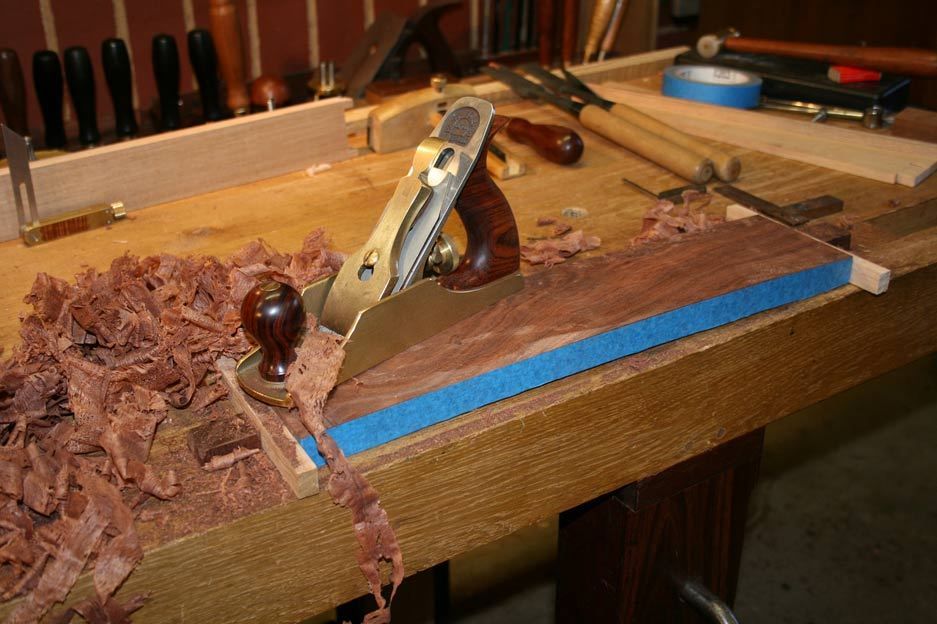
If your Bailey planes are not hacking it, then it can only be sharpness and set up. If your Norris is using a less abrasion-resistant steel, then you are likely using the incorrect media and/or the wrong technique for honing. What do you do? And when planing with your chipbreaker closed up, do the shavings straighten up?
Regards from Perth
Derek
 [/URL]
 [/URL]