New WoodChat!
Home Articles Forums Gallery Marketplace Videos

WoodCentral Forums

Knowledge You Can Build On — Est. 1998

Abingdon, VA – Tree Cutting & Portable Sawmill

Finish Planing

Posts

Re: Finish Planing

#26

Re: In defence of A2

Derek Cohen (in Perth, Australia)

I know you're limited somewhat in terms of what you get locally, but the bulk of hand tool woodworking in the US and most places in the world is done with something more similar to cherry.

My comments were made in respect to abrasive woods (stated several times). I am not trying to defend A2 against O1 in a general sense. In Oz, many woodworkers have come to prefer HSS (M2) blades.

Most people taking a board off of a power planer and then just removing the ripples will probably never do the work that it takes to get a sense for that, there is nothing driving trying to take a thicker shaving until the last pass. Dimensioning sent me in that direction - as in, even the few times I take wood off of a planing machine, I will smooth much faster now than I did five years ago when I didn't dimension anything by hand. Only the very last pass is backed off in thickness.

I am not sure what this has to do with the price of eggs. I dimension by hand more than I dimension by machine (I do both). It is especially relevant that an edge lasts when having to dimension abrasive woods. The smoother is of little consequence here. My jack plane has a D2 blade. My jointer has a PM-V11 blade.

Regards from Perth

Derek

Re: Finish Planing

#27

Re: In defence of A2

david weaver

I guess it's just a difference in opinion. Jarrah and others don't wear an iron as fast as cocobolo, and I can't imagine wanting to change the iron in my jack plane or try plane to something alloyed. Each time I get it out, roll a wire edge on a washita, strop it and put it back in the plane, I'm reminded why I like it that much.

I can do the same thing with A2, it just requires more maintenance of the grind to keep the edge small, and more back and forth on the washita to thin the bevel and then more time on the strop. There is no time advantage with A2, though. I used to sharpen it with shaptons, where it sharpens easily, but then there is care with the stone. I used loose diamonds following a diamond hone (which reminds me, the trouble with sharpening is that all of the methods will work), but I found the loose diamonds to be a pain in my shop, I guess I can't keep contamination at bay, and the feel of steel on steel or steel on iron is pretty lacking.

I have no regard for D2 for woodworking (I've tried it). It's like rubber and it chips no matter what. Not in large chunks, just in a bunch of small chips right away.

Re: Finish Planing

#28

Re: In defence of A2

Derek Cohen (in Perth, Australia)

I have no regard for D2 for woodworking (I've tried it). It's like rubber and it chips no matter what. Not in large chunks, just in a bunch of small chips right away.

I've not experienced this, David. The D2 I have works beautifully.

I guess it is all in the heat-treating. Philip Marcou (Marcou planes, but also a professional furniture maker for more than 20 years) swears by D2 for his smoothers (one of the alternatives he offers).

Ray Isles morticing chisels also appear to manage quite well.

Regards from Perth

Derek

Re: Finish Planing

#29

Re: In defence of A2

david weaver

It's hard to judge the mortise chisels, because they are used at a steep final angle and they don't need the keenest edge to work well (they are moving bulk, where a large amount of the resistance is wedging rather than the edge).

I was going to say "i had a set of them", but I still do have one - I sold the rest of the set, but they are good chisels.

I guess it's all in perception. And it's kind of a pointless discussion, except to note when talking about soft try plane irons, the really hard ones are no treat, and probably the bulk of irons I have are similar to Brians, and the dwight and french irons I have are even softer. They also work a treat in try plane work, but I think they'd leave one wanting in smoother work.

Goes along the same lines of knowing that if I took my try plane (which has a water hardening butcher laminated iron in it) and compared it to the LV plane I have (a custom with a V11 iron), the LV would probably take twice the length of smoother shavings. When the job turns to taking a hundredth of beech off at a time, which is really cranking, the try plane will do more work before resharpening (partly because I can't comfortably get the same amount of wood off with the LV plane - it's not as heavy or long, I guess).

5+ years ago, I would've gotten the V11 iron every time, I guess I would've judged them on smoothing, and if you put the butcher iron in a plane and judged it for when the clearance was lacking to take a 1 thousandth shaving, it doesn't take very long. For some reason, the gap disappears with heavier shavings.

I don't sharpen my jack plane often enough to worry about what steel is in it. If I dimension wood for a couple of hours in a given weekend, I don't think I've ever sharpened it more than twice, and sometimes maybe not at all.

(George has the same sentiment regarding D2 as I do - it was made for dies and not as an edge steel).

Re: Finish Planing

#30

Hank, I have to say..

david weaver

...something that was glossed over in this electrons vs. protons debate that has sprung up.

And that is, what a wonderful gesture for your wife to get you such a fine example of a craftsman made tool that you can use and enjoy.

And the Norris is cleaned so nicely that I mistook it for a modern plane when browsing past it.

Re: Finish Planing

#31

Wholeheartedly agree!  An

Wiley Horne--So. Calif.

inspired gift, and a forever gift. In addition, she and Konrad came up with a fantastic block of infill to match the occasion, that surely was the pick of his extremely fine wood collection. The plane crystallizes a host of commitments and connections.

Wiley

Re: Finish Planing

#32

Re: About the performance

TomD

That is a marriage made in heaven. My cow hide is glued down to a piece of mahogany and has stayed in good condition for eons. Only thing is you might want to check on the price of your horse butt. If it is horween it may be worth more than your plane, well a lot anyway.

Re: Finish Planing

#33

Re: Thank you David and Wiley

Hank Knight

I am very grateful for my wife and my daughter. They have put up with a lot from me, and they continue to support me and my obsession with this hobby. Kaye did, indeed have a wonderful time with Konrad. He made a video of his crafting my plane and sent it to her. It was in the box with the plane under the tree. Every time I mention his name she comments on what a nice guy he is. That has certainly been my experience.

Thank you both for commenting on my family.

Re: Finish Planing

#34

Re: In defence of A2

Brian Holcombe

If I want something really hard wearing, I have a blue 1 blade from Yokoyama kunio which wears well, sharpens on a Shinden suita (just barely, but it does) and doesn't microchip.

O1, white 1, K120, Tougou-Kou, W1 all wear beautifully for me and sharpen on natural stones which are nice to use. The hardwoods I use don't require super hard wearing steels, but it's nice to have a few in planes that I don't want to take apart all the time. For smoothers I prefer a super keen edge to an edge which stays sharp but then begins to degrade with strange effects and requires 3x the time to resharpen.

A2 always requires me to grind, which adds a time component that I could do without.

Re: Finish Planing

#35

In these discussions ..

Derek Cohen (in Perth, Australia)

.. I am aware that we offer views from a different perspective. Many of our observations differ simply because our experiences differ because our raw materials differ. We go "Yes ... but" as a result.

The constant concern I have is that many others here will not relate to much of this discussion - how many use the steels you prefer ... where does one easily/reliably find good vintage steel or blades from Yokoyama Kunio ... and whom here has the motivation to seek them out to replace perfectly good blades that come with an LN or LV plane? Should one just see vintage Stanleys with laminated iron as the preferred option? Of course, this is silly .. an extreme view. But then some of us enjoy these extremes - they are an interest, a hobby, and there is nothing wrong with that.

It is important to be aware that most others simply want to make their A2 blades work as well as possible. An that's where we return to the thread begun by Hank. It is not about what we prefer, but what advice we can give to users of A2.

Regards from Perth

Derek

Re: Finish Planing

#36

Re: In these discussions ..

david weaver

Cut out the kunio and kiyotada and we're left with what came in older tools. That stuff is accessible, and cheap. I've never bought a stanley 4 that cost more than a lie nielsen iron, and the NOS double irons I've gotten have been about $25 plus shipping.

That's not the only consideration (price), but accessibility is there.

I don't know what causes people to have trouble sharpening A2, but in the case where someone like hank can finish plane with something else, why bother setting up a separate sharpening media or processes? It's probably a wire edge issue, but I don't have a problem with them, or V11 even, on oilstones - it's possible to sharpen all of them on oilstones, even without compound. Cheaper, too, which is not the intention necessarily, but cheaper is there. (washita followed by owyhee jasper removes the wire edge and creates something similar to what a synthetic stone does - it does take some skill to use those two).

There's no real benefit to those steels, except to beginners. There may be a detriment in that they never encourage you to explore taking thicker shavings, which I'm sure is far closer to history than taking gobs of 1 thousandth shavings as most boutique planes are shown to do now.

In fact, when you get down to it with the new premium planes, if you do heavy work with them and a vintage plane, you will quickly put the premium planes away. Once you compare wooden to them, the gap grows by a factor of ten. Their soles are too finely ground, and they have the highest amount of friction of anything you could think of short of a heavier plane of the same type.

At any rate, diemaking alloys became popular with makers because they're well behaved, and maybe because Karl Holtey led the way, but Karl needs a little extra something in his planes to separate them from others. They would be nicer planes to use with a blue #1 laminated steel iron, but nobody has the skill to make those in the western world. T1 (which would make a better blade steel than most of what is used now) has been available for a long time, and similar stuff was tinkered with in razors, and it fell on its face because the market would've been experienced users. It would've been easily available to use in tools, and the stones to sharpen it (carborundum corporation) have been available in everything up to razor hone fineness for over a hundred years.

Professional users didn't adopt any of that. It's marketable now because beginners are taught to sharpen things paint by numbers, often in slow processes (and some manufacturers tell the same beginners not to use a power grinder....on diemaking steel blades), and everyone is made to believe that sharpening is something difficult enough to put it off as far as possible.

Re: Finish Planing

#37

Re: Previous discussions

Warren in Lancaster, PA

We have been down this road before. In 2011 Bill Tindall asked for a chisel recommendation and I suggested 19th century. Derek Cohen wrote:

Of course, this is silly .. an extreme view. But then some of us enjoy these extremes - they are an interest, a hobby, and there is nothing wrong with that.

I always thought it was the A2 and PMv11 that were aimed at amateurs. Derek suggested that CPM M4, 3V, and 10V were are all more important and more available for chisels than cast steel. I don't know if he actually uses these chisels.

In 2011 David Weaver used ceramic stones for sharpening. I think he has learned quite a bit since then.

Re: Finish Planing

#38

Re: Previous discussions

david weaver

I have learned that the edge coming off of a washita is almost as keen, but it is one step. If I have a steel that doesn't sharpen on washitas, I have something that I won't often use.

I do have some bimetal or HSS chisels, but I saved those for flush trimming infills to steel on an infill plane, something they take very little damage on. They're also good for cutting the burrs off of a japanese chisel hoop.

My chisels take less damage these days than they did 5 years ago. They rarely take any that doesn't look like wear. Familiarity with the tools and stones, I guess.

Re: Finish Planing

#39

Re: In these discussions ..

Brian Holcombe

I've been pulled back from the extremes, the extremes in my opinion being exotic alloy steels that take specialized stones to work with them and along with them the gateway alloy which is A2.

I put many many hours on my tools between resharpenings. I can put a full days planing efforts (12 hours of stock prep) on the try plane on one sharpening, thats more than what I can get out of A2 before needing to refresh the edge. I went 6 months without sharpening the jack plane....if this is not long enough between sharpening I'm not sure what to advise.

Re: Finish Planing

#40

Re: Previous discussions

TomD

Cast is really available on the US and Canada. Don't know if it is equally distributed, but there are tons of tool shows, and tool barns. Oz was opened up in a similar time frame, but whether they can get things as easily, I don't know. I know for machine tools they were locally and sparsely made.

Fine woodworking has the advantage of extremely available tools (of course we complicate maters), and extremely available materials. But step off that path even a little and whole activities are driven by access to materials, and tools. Regions make a huge difference. I just ran out of epoxy, to get more I will have to order it, send it to a border place, make a 200 mile trip to pick it up, risk arrest to drag it across the border, twice. Anywhere in the US, I would have it at the door by tuesday. Of course the route I take also affects my costs, and if the dollar dips or rises, everything changes again.

Access is regional, what works for David will not work for me, or maybe Derek. On the positive, I have a lot of beech. :)

Re: Finish Planing

#41

Re: In these discussions .. The answer

TomD

"It is important to be aware that most others simply want to make their A2 blades work as well as possible. An that's where we return to the thread begun by Hank. It is not about what we prefer, but what advice we can give to users of A2."

The Answer:

I have yet to find a steel that doesn't sharpen on King stones. If they aren't getting the job done, it is being done wrong, or one needs to reach out to one of the things that speeds the process up.

- Microbevels

- Hollow grinds

- in some cases jigs, particularly the LV, though most of my experience is with the first one.

- In some cases diamonds

- power. These days power is cheaper than fritzing around with changes in stones.

A plane that is easy to cycle doesn't make the edge come up any faster, but the process is a lot better. Most of the fast to cycle planes are also better general designs.

If I had A2 that I didn't like. I wouldn't buy a different blade and all kinds of stones. I would power grind it and take advantage of the hollow so I was only polishing a sliver. It may make the A2 wear out a little faster, but not as fast as trashing it.

Chris Schwartz has probably done as much as anyone to convince us not to burn any electrons and take the activity back several centuries, often in the wrong direction. But one of his books does point out the greed for power grinding even way back when..

Re: Finish Planing

#42

Better!

Hank Knight

I spent some quality time this morning sharpening the A2 irons in my Bedrock and L-N 4 1/2s. I started with a fine India stone and followed with a translucent Arkansas, like I always do. Then I finished up with some 0.5 micron diamond paste on horesbutt as Tom D suggested. Thanks Tom! I was able to get the A2 irons a lot sharper than I have before, and the planes worked fine on my maple chest parts:

[URL=http://s50.photobucket.com/user/hankknight/media/Chest%20of%20Drawers/image_zpssyvwaq2c.jpeg.html][/URL]

Several reasons for that, I think. First, you guys (y'all in my neck of the woods) convinced me that the problem was me and not the A2 steel. Second, I paid a lot more attention to my technique and spent a good bit of time on the stones. Third, I think Tom's suggestion to charge my strop with diamonds before I ran out and spent a lot of money on new gear was a good one. There was a slight difference in the feel of the iron on the strop. I suppose it was the diamonds vs. the green stick I usually use. In any event, both planes worked better than I've been able to get them to work before. I still had a couple of tricky spots on the maple panels that I fixed with my Norris and Konrad's little infill smoother, but all in all, I'm happy with my 4 1/2s. Thanks to all of you (all y'all), I now know that they work like they are supposed to. I think my sharpening of A2 will probably improve too, now that I've gotten the hang of it. I appreciate the motivation and suggestions everyone gave me on this thread very much. Thanks

There was an unexpected benefit from this exercise. I haven't tried to use my L-No 4 1/2 for a long time, maybe over a year. When I took the cap iron/iron assembly out, I discovered a large blob of rust on the edge of the iron and cap iron. I must have dripped sweat on it last time I put it away, or it could have gotten some moisture on it in the flood we had here several months ago. However it got there, I'm glad I found it. It hadn't pitted yet, but it would have for sure if I'd left it much longer. Thanks again, everyone for getting me off my duff to deal with all of this. I appreciate it.

Hank

Re: Finish Planing

#43

Derek, see "Better" below


Re: Finish Planing

#44

An often overlooked fact

Bill Tindall, E.Tn.

Mix and matching technology from different centuries and cultures may not lead to the optimum result that was achieved with the technology originally optimized for these centuries and cultures. This situation is especially true when combining steel and abrasive technology. The situation continues when matching technology with methods of work. For example, Brian finds A2, or at least the variety he has experience with, unsuitable for his work. Others, whose work style differs greatly, find A2 superior.

I find that woodworkers that make stuff are not fools. People have optimized what works for them. Those seeking advice need to put recommendations in the context of the whole process. For those that seek advice, and combine some technology and work methods for here and there, a research project lies ahead to find what best works for them, if indeed any of the advice they received is relevant to their situation.

I am reminded of the old timer that dismissed those new carbide blades. He never could get them sharp with his file as he routinely did with his steel blades. Sometimes you can't adapt new technology half way.

Re: Finish Planing

#45

Re: Better!

Derek Cohen (in Perth, Australia)

Hi Hank

That's great! It is necessary to move up a notch from the oilstones. That makes all the difference. A strop is not much extra work, and it should be a quick way of maintaining the edge as you work.

Some years ago I compared chisels honed on 0.5 micron diamond paste and 0.5 micron (nominal) Veritas green compound on horse butt leather. The edges were comparable, but I found the green compound chisel felt smoother in action.

http://www.inthewoodshop.com/WoodworkTechniques/Stroppingwithgreenrougeversesdiamondpaste.html

In the last few years I moved away from compound-on-leather to compound-on-hardwood. This has less tendency to round over the edge. Which ever floats your boat.

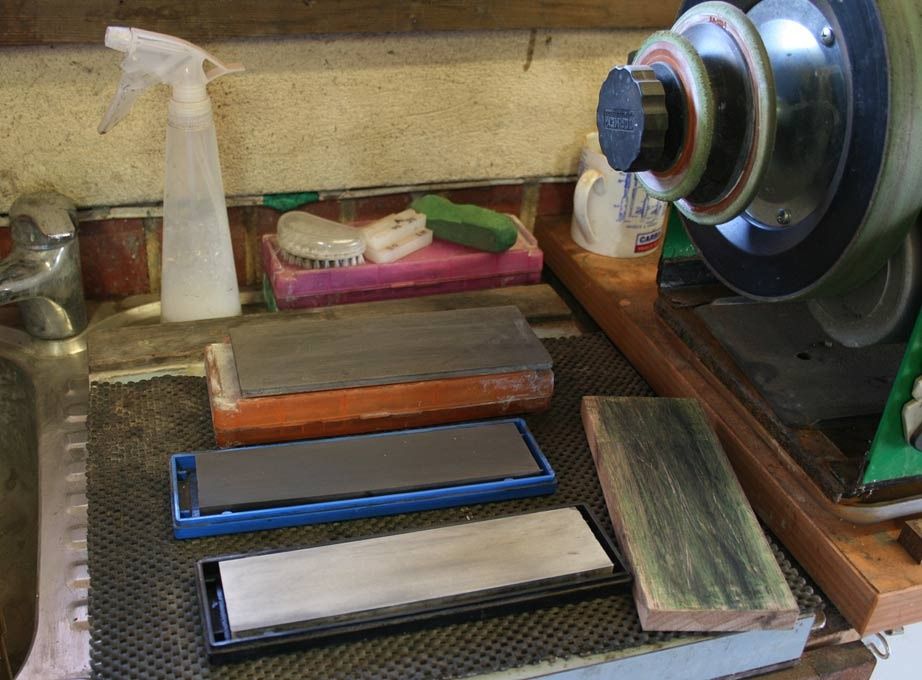
"Strop" on right, with Medium and Ultra Fine Spydercos ...


Regards from Perth

Derek

Re: Finish Planing

#46

Exactly, Bill.

Derek Cohen (in Perth, Australia)

There are rarely any absolutes in this world, especially in woodworking. So many options. What is important is what works best for one. Try something else if it does not. Keep an open mind.

I have rarely seen any cast or vintage steel of worth in Perth. The woodworking history of Australia is essentially British, and while there is a rich inheritance from the UK in Oz, that is largely on the east coast. Perth is far west (think: further than the width of the USA to get to Sydney) and small (population doubled to 1.5 million in the last 10 years). I am a member of the local Old Tools chapter and attend their tool sales, but the gleanings are very slim (unless one wants heavy firmer chisels, which are essentially carpenter tools). This is the point I made earlier - old vintage high carbon laminated steel may be wonderful stuff, but it is not equally easy to access. My most used steels are, in fact, PM-V11 and White Steel.

Regards from Perth

Derek

Re: Finish Planing

#47

Re: Better!

Hank Knight

Thanks for the Link, Derek. I have tried a number of different stropping compounds and have settled on Lee Valley's green crayon as an all-purpose one that works well with most everything I use. I think to really get to the bottom of my A2 sharpening issue, I need to use diamonds at more than just the final stropping stage. Since all of my Stanley bench planes have L-N replacement A2 irons, it probably makes sense to go ahead and bite the bullet and buy the stuff I need for diamond sharpening. It's curious to me, however, that I've not had issues with my other planes, only the 4 1/2s. Nevertheless, I think I will enjoy a faster sharpening experience with all of them using diamonds. If there were other set-up issues with my 4 1/2s, I must have fixed them because they worked fine today after I got the irons sharp.

Re: Finish Planing

#48

Happy to be an opportunist

Brian Holcombe

If anyone would like to trade LN O1 irons for superior A2 irons please let me know :D

Re: Finish Planing

#49

Re: I am so pleased...

david weaver

...to have put planes in the hands of someone who "gets it". :)

Re: Finish Planing

#50

Re: Better!

david weaver

I would call a move to spydercos a move back, or a lateral move, at best, but that's just me.

I had them until about a month ago. I really liked the shaptons, too - they cut fast and they're not sloppy, but in the end it still is more combined time to use them than oilstones and they're less capable.

The reason I didn't tolerate spydercos is because on plain steel, they're slower than oilstones, and they really don't have an affinity for carving tools, either. That is, a fine india stone and a follow-up oilstone is faster than spydercos on carving tools.

Neither type ever needs to be flattened by a skilled user, but the washita is king of sharpening economy (in terms of time - it may not be economical to buy these days if someone wants one with a label guaranteeing what it is).