We value your privacy.
We use cookies to enhance your browsing experience, analyse site traffic, and personalise content.
By clicking “Accept all”, you consent to our use of cookies. You can also choose
“Essential only” or learn more.
I have been thinking a bit about this. So, without doing actually any testing, just from memory and hearsay, I think that a high pitch plane behaves completely different from a close set chipbreaker.
Kees, I would reject that. That is the whole point of my post - that both end up with a Type 2 chip formation. I am not commenting further than that at this stage, as this is just an attempt to understand what is happening at the sharp end. Call it hypothesizing, but with a rationale. We have to start somewhere.
Here is the K & K photo ...
... and here are two planes, one a Bevel Down common angle (45 degree) frog with a close set chip breaker, and the other, a Bevel Up (12 degree bed) with a 60 degree included angle ....
OK, the drawings were done quickly and roughly (so don't go measuring the angles!), but you can see what I am referring to.
All of these examples are of Type II chips, which involve the sudden bending of a shaving (which is what prevents tear out).
Re-read my original post in the context of this one.
- The shaving looks different. In a high pitch, single iron bevel down plane the shaving looks like an accordeon. In a plane with a properly set chipbreaker the shaving looks quite straight, maybe with a bit of waves in its surface.
The shaving is exactly the same shape - bent at right angles (or close to it) - as it comes off the blade.
- Pushing the high pitch planes is harder to do.
I find that this happens most with the BD plane when the chip breaker is set too close to the edge of the blade. Pushing a BU plane with a high cutting angle is actually less work that the equivalent angled BD plane (and that one I have tested - it is not theoretical).
- The edge wears faster in a high pitched plane.
That is true as far as I my experiments go (I posted one only weeks ago), but it has nothing to do with the issue at hand.
- The wood surface looks different in moderately hard hardwoods.
This is unproven, just heresay from a few individuals here. Time we did some testing?
Maybe we should invent a new type of shaving. Type 4, cut at 45 degrees and then a little later bend over. That's the big difference I think, the cutting at 45 degrees. You wrote about the steep edge breaking the shaving, but when I look at Kato I can't imagine much breaking going on. It looks like bending, not breaking. And because the shaving looks so different on macroscale, I can only think that it looks different on micro scale too.
But I think I agree about the wood surface. Last year I did some testing on oak, maple and jatoba and could detect really no difference in the surface. But I think some more testing is in order, to debunk some popular believes.
Maybe we should invent a new type of shaving. Type 4, cut at 45 degrees and then a little later bend over. That's the big difference I think, the cutting at 45 degrees. You wrote about the steep edge breaking the shaving, but when I look at Kato I can't imagine much breaking going on. It looks like bending, not breaking.
Bending ... breaking ... it is the same thing. If a shaving actually "broke", it would not flow out of the plane mouth. And of course it does, so we are simply describing the shape of the shaving at the edge of the blade.
What is really important is Newton's Third Law: A force is a push or a pull upon an object that results from its interaction with another object. The direction of the force on the first object is opposite to the direction of the force on the second object.
What this means to me is that the closer the chip breaker is to the edge of the blade and the higher the angle of its leading edge, the greater the upward force of the shaving (= increased bend). Equally, the greater the downforce of the plane on the wood surface.
The more we back off the chip breaker or the lower its leading edge, the lower the upward force on the shaving (= decreased bend) and the downforce on the plane.
Where are the structural engineers or physicists here? Someone explain that this reasoning is rubbish - or not.
But I think I agree about the wood surface. Last year I did some testing on oak, maple and jatoba and could detect really no difference in the surface. But I think some more testing is in order, to debunk some popular believes.
I think it is a bit more then just nomenclature. Breaking robs the shaving from its ability to lift a splinter, it takes the beam strength out of the shaving. While bending gives the shaving the ability to support itself. It is being bent back down into the surface.
And of course breaking is not really a 100% break. It's more like bruising.
Of course, ultimately I don't really know what's going on at the microscopic level. And I suspect you don't really know either.
Why would you fool around with taking apart disposable razors and handling the blades when you can just go to the local auto parts store and buy a set of feelers for a few bucks? I'm cheap, but man, you sure got me beat!!!
1. the closer the chip breaker is to the edge of the blade, the greater the down force at the blade edge, and the greater the effort to push the plane.
Nah, nah
It is more like pushing through deep water with your legs. There IS NO SIGNIFICANT down force. It is all just in line force, compression.
There is the initial down force from the blade angle but putting a steeper thing further up the blade isn't going to do it. It has to be right at the edge not back from it. The actual "cutting" takes place in the ten thousandths or even hundred thousandths of an inch AT THE WOOD on a cellular if not molecular order of magnitude, dude, not a tho or two up the blade.
Nah, nah
The down force you are demonstrating would take MUCH, MUCH, MUCH more material (M. M. M. M. M. for short) than there is happening with a thin little gossamer shaving flowing over the top of the plane PRESSING DOWN on something.
They say water is like concrete when you are falling into it at terminal velocity. That is because there is so much of it.
Hitting a sheet of wood shaving at that speed would be unnoticeable.
Do you see that ?
Now, hit the perfectly aligned edge of that sheet supported by a large mass and it could do some damage.
Seems like what I recall from watching "the video" that put me off it was that they didn't use a particularly hard or even remotely figured or problem to plane wood.
OK it is quaint to know that if some body stole all your good planes and you just had to finish a project in less time than it would take to go to the local Woodcrap store to get another LN bevel up and hone the blade that there is a way to get that figured wood planed without tear out.
Come to think of it I bet I could drive to the store, buy the BU LN plane and hone a decent bevel up blade in less time than it would take to fart around with making Mr. :
" I wish I was a decent plane but I was made in the mass produced, made to sell rather than use and just for rough carpentry at that, plane factory"
into a thing that works if I hold my tung just right.
I really don't see the pretty colors here . . . though I keep drinking the cool aide.
No . . . that's all right . . . don't thank me . . . glad to contribute to the discussion . . .
All this close set mouth with near no camber blade and a chip breaker filed perfect to follow it within a thou or so sounds good . . .
but
tear out starts in the flattening stages with the highly cambered blade and a wider throat opening taking mondo shavings.
If we have tear out then it takes like a hunurt years to plane them out using the finish plane.
BU with the correct geometry for the wood being cut, trial and error for that batch of wood going from shallow to steeper, takes thick shavings with little or no tear out and so the finish planing goes much faster.
Trying to match a chip breaker to a cambered blade and then sharpen the blade to maintain that radius (or to change the radius of the chip breaker to match the ever changing blade and to have multiple blades and keep straight which chip breakers go with which blades . . .
all to save a little planing effort, assuming one can consistently hit "the sweet spot" amidst all this chaos
so as to take thicker shavings
makes me calmly reach for the good old new fangled never-used-by-the-old-guys-cause-there-aren't-any-old-BUs-around-so-why-consider-using-one-my-self bevel up plane and . . .
smile.
PS: with the steepest angle I have ever found even ocassionally needed, 54° sharpening angle for like a 66° cutting angle, the finish is glassy and no way inferior. Takes a bit of sharpening know how. Forget the average
"strop it and go" method. Maybe the high quality strops I have recently learned about but I know an edge from all stones up to at least 8000 Old Norton or Shapton using a jig will do this nicely.
I don't know about you but at this stage I am still CUTTING and not scraping.
Reading your last two messages I can only conclude that you have no idea what you are talking about.
To answer some of your concerns:
About the force from the shaving on the blade, it actually is very real. The Japanese guys actually meassured the forces involved (instead of comparing it to water). With increased capiron effect they meassured an increase in the horizontal force from 2.2 kgf to 3.5 kgf. That's 60% increase! They also meassured the vertical force, where you can see the effect of the shaving on the blade. With a sharp blade, this helps to pull the edge into the wood. A dull blade with a wearbevel devellops a force upwards, pushing the edge out of the wood.
They used a pretty simple, homogenous kind of wood. Of course they did! How can you get anything like a repeatable result if the wood changes every few mm? The planed the wood against the grain though. And this kind of wood can tear out just as well as a piece of curly maple, as demonstrated in the video when they didn't use capiron at all. So, the results are completely valid, also for figured wood.
Regarding the jack plane, the results are also valid for the jackplane. In the jackplane, you take a much thicker shaving, so the capiron can be a lot further away. The capiron can be placed as close to the camber as possible, even overlapping the corners doesn't harm, because the corners don't do any cutting anway. You could even camber the capiron a bit. Anyway, the result of avoiding tearout with a double iron jackplane is much much much better then with a single iron 45 degree single iron plane. I know, I have them both. Without the capiron you are really ripping up the surface. You won't eliminate tearout completely with the caprion in a jackplane, but at least reduce it to a level where smoothing is a reasonable job. Doing the same with a high pitch plane needs 50 to 55 degree of pitch, which means too much planing resistance to be regarded as fun. Oh, and the capiron is fully effective in a jointer too.
So go back to your shop and continue to polish up your posh planes a bit more, without disturbing our intelligent discussions any more. Don't forget your sunglasses.
Oh, BTW, the old guys did have the bevel up plane allready. The steel mitre plane, an infill type plane, with a 20 to 25 degree bedding and the blade positioned bevel up. Was used at least since the 18th century. Still they by far prefered the double ironed wooden plane at 45 degrees. Maybe we can learn something from them?
I used to believe the stuff that you're trying to reason out. Much easier, etc, all that stuff. But your assumptions are incorrect, you can't present an argument against something when you don't understand how it works.
It's easier to push the common pitch plane with a cap iron (than a steep pitched plane), and you never profile a cap iron to match an iron. Any part of a cambered iron that does not extend past the cap iron will physically never be in the cut because the cap iron never extends past the mouth of the plane.
I wasted a lot of money believing what you believe. All of the magazines and blogs told me I was right at the time - spend more, it'll get easier. Luckily, the extra money isn't really an issue. I still have the expensive planes, western and japanese. I have an infill set at 55 degrees with a 3-4 thousandth mouth and another panel plane set at about 9 thousandths. That panel plane did not become a super stellar performer (it's common pitch or close to it) until I started using the cap iron properly with it - even a mouth just under a hudredth and a 9 pound plane can make for rough planing that is massively smoothed out by introducting the cap iron a step off of where it straightens out the chip.
I have been using three stock stanley bench planes for months now with stock irons and stock chipbreakers, sometimes a wooden jack is substituted. I spend less time planing taking deeper cuts, and I have been sharpening with a single stone and a grinder, and the surface is brighter (the predominant wood is cherry here) than it was when I was using the high angle planes. There is little tearout now with the jack (a quarter of what there was before and nothing catastrophic) and nothing that comes from it that does not get removed as a part of jointing and smoothing (i.e., there are no extra shavings taken to "remove tearout", such things might cause you to overshoot a thickness mark, but working down to a mark with thin cautious shavings is a pain).
There is probably great reason why stanley and others went with a double iron plane at common pitch. The people who *used planes for a living* chose that design over here where there wasn't social pressure to do things like buy a norris smoother (there *was* social pressure in england to spend the money on those things whether or not a craftsman needed them).
If you *like* the bling bling planes (I do) and you like to use them because being a gentleman woodworker type is what you like, that's fine. If you want to argue a technical weakness about something chosen and used by several hundred years of professional craftsmen, then you'll end up on the wrong side of it. Been there, done that. Warren won.
Tonight I have been trying to see a difference in surface finish, planing with a high pitched beech single iron beech plane and my normal beech smoother with double iron. I tried several medium density hardwoods. A softish maple, American wallnut, even some pine. Planed the boards on the left with one plane, on the right with the other, so I could compare them directly. I tried planing with the grain, or against. I looked under the light, in the shadow, with raking or direct light, with a magnifying glass and without.
Conclusion: I am unable to see a difference in surface quality.
Regarding the resistance while planing. I can't say the high pitched plane was much harder to push. But the feel is completely different between both planes. The normal woody feels like it is really cutting. The 55 degree smoother feels like it is harder to keep the blade in the cut. The sound is also completely different. The 45 degree one makes a swoosh sound, the 55 degree one more like a screech. Shavings from the 45 degree plane are quite straight and really jump out of the plane. The 55 degree plane makes the usual accordeon shavings which have a habbit of staying in the throat.
When I go for feel alone, the double iron plane is a clear winner.
That's an interesting comparison! I do have one suggestion, which is to examine the wedge on the 55 degree/single iron plane. Especially the back of the wedge. Put a straight edge lengthwise down the wedge, left right and center, against back-lighting. Are there light leaks? Where?
Overall, make sure that the back of the wedge is straight, then scrape it ever so slightly concave in the middle--this is to ensure that you have solid contact down near the mouth, between the horns of the wedge, the iron, and the plane bed.
When you say 'accordion shaving', are you talking about continuous loose folds or crunched-up folds that have a V section looking from the side? The latter is what I associate with an 'accordion fold'. Not trying to parse words here, but rather just understand what the shaving looks like.
Here is a picture with some oak shavings so you can judge yourself if this is an accordeon shaving. I see these kind of shavings in other high angle planes too, for example when I look at the videos from Brese planes.
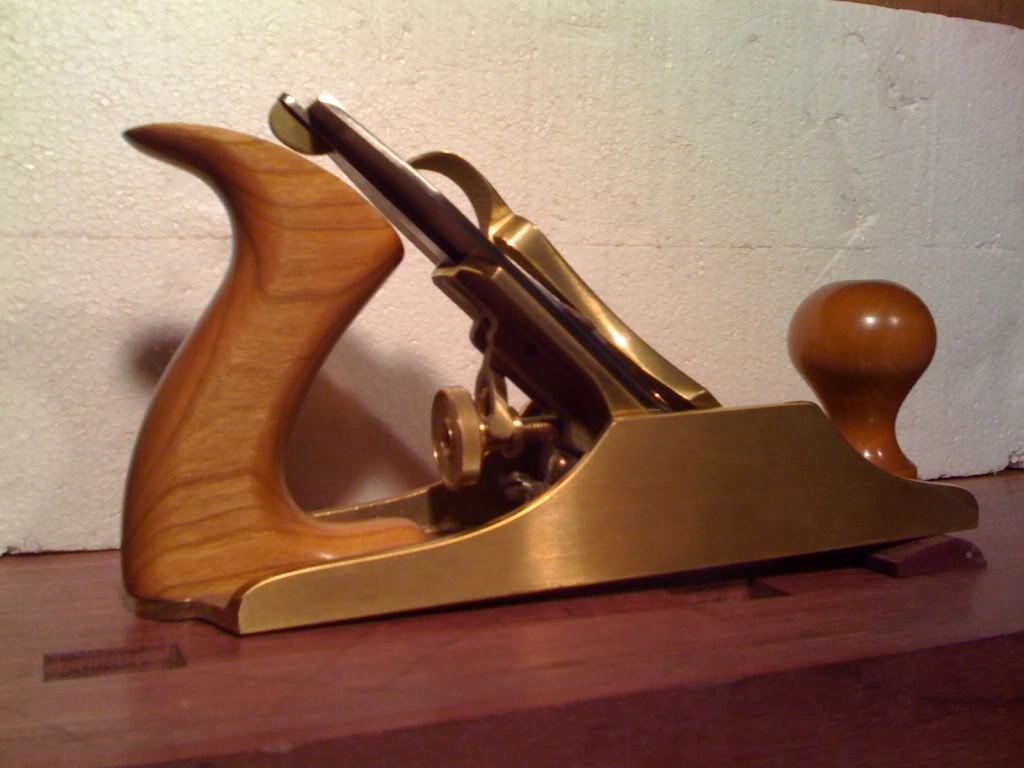
This plane I made in 2011. It's not a huge succes, tends to clog and sometimes it tends to chatter. I put a lot of effort in fitting the wedge and bedding of the plane, so I think that is correct now. I do think the wedge prongs are too short, which could explain the chattering (sometimes, not always!)
Kees, no offense, but are you sure the back (a misnomer; I mean the side of the iron that the logo is on) of the iron is flat, at least near the cutting edge? you have serrations that run the length of your shavings; when I have those, they generally match up with tiny serrations on the blade itself, perpendicular to the cutting edge.
Not sure what you're referring to....Are you asking him about the shaving parting along the annual ring lines of the quartered stick he is planing? Or something else?
First, why didn't I see any discussion of edge keenness? Is it the same from trial to trial? Are they quantifying it? Did they address it, and I just missed it?
Second (the first question was in 4 parts), what is "orthogonal cutting"? Does this mean unskewed?
Don't take me too serious and unwilling to learn. We got to talk about something right ?
Here are some thoughts that came to me on reading the "you don't know what you are talking about" and
Posh planes ?
That's funny.
My bevel down that I started with that failed to cut the purple heart cleanly no matter what I did with the chip breaker and throat (until I back beveled it) which led to all the "erroneous" and blasphemous ACTUAL WORKING KNOWLEDGE AND EXPERIENCE.
Well
that bevel down actually costs more than the bevel up that successfully planed the wood with no fuss. When I was done with that first purple heart plank I think I recall the plane saying something like : " Yaaaawwnnnn what else yah got ?" No fettling, no futzing just a steeper setting on the old sharpening jig and . . . well the results have been rehashed way too often in most all my posts.
I like looking at it though. More sole drag from the bronze by the way.
After the hard stuff planing any other wood is just a stroll. A cake walk. A veritable pleasure.
And of course there is no reason to use a steep angle on the friendly wood except in the areas of gnarly figure and the wood is so much softer I don't think I would even notice much difference using a slightly easier cutting plane.
So what you are saying is I should re visit those planes that work just fine on the softer woods and re experiment with all the things I experimented with before and I will come up with a different result ?
I think you misunderstood part of my post which emphasized I realize steeper angles require more effort. I only go as steep as is necessary,
I repeat . . . I only go as steep as is necessary, starting down around 25° sharpening angle (or 30) with a bed of what was that number ?
Oh yah 12°
So combine those and we get 37° to 42° and I could plane most of the walnut and cherry and what have you with those.
That has more resistance than 45° bevel down right ?
I am getting confused here.
Oh and there was that clampy ony bend the blade down sheet metal thing that adds some in the way stuff but that makes planing even easier.
Right ?
I am still confused about that but . . .
I almost said I would go back and try it again with the bevel down.
I can't quite make myself do it. Yet.
I been bit by that dog before.
I like this other nice dog over here.
I suppose I deserve what I get coming across all, you know . . . like a ______ (rhymes with stick).
So I will take the "you don't know what you are talking about " comment.
Just to reassure me that I don't know what I am talking about would you post a photo or two of tables that you made and planed from rough to finish with hand planes,
Bevel down hand planes,
Tables made from similar wood to the purple heart and bubinga from which I learned my blasphemous and devil like ways ?
I am not so sure birds eye maple counts but that is what I expect to see.
Apparently Derek has the good'n weird woods over in his neighbor hood.
What I am saying is . . . when I can plane some of the extraordinarily difficult woods I KNOW I can plane all the softer and less difficult woods.
No camber to the cap iron. Funny. The last person who told me I don't know how to cut wood said that was what I was failing to do and that I should curve that puppy so I could get it right down within a thou of the edge all along it.
I was just regurgitating what I "learned" from him.
Don't need to do it with the jack for the deep cuts. That was where I started.
cambered blade, straight ish chip breaker.
For heavy cuts the plane still buzzed and felt unprofessional. Then it got dull fairly rapidly and in my inexperience I kept planing and domed the surface.
The scrub felt much better (had a back bevel for the hard stuff), cut longer with the thicker blade and so did the bevel up jack.
I know bevel up and lots of camber for heavy cuts is bad, bad, bad.
I am trying to stop.
It is a bad habit I can't seem to break. Probably with the softer woods I won't hate the way the bevel down jack feels.
Social pressure to buy planes ? That's a new one. Hmmm.
I remember Jim Kingshott and his planes. Similar to this one
Oh wait that wasn't the infill you mentioned. He must have over came the pressure.
Some one mentioned posh ?
There's posh.
I consider the LN's and V's that I have to be the absolute minimum that will actually do the job. One of those brands, which shall remain unspecified, I have on many occasion found to be less than adequate and so required further attention after the purchase. So not THAT posh I assure you.
I will consider that I don't know what I am talking about.
I must say there must be different levels to this learning how to plane thing.
I feel like a person who has just finished running the Boston marathon or climbing Everest with oxygen and being told that I don't know what I am talking about by someone who has just ran a one hundred mile event or has done Everest without oxygen.
I feel your comment is a bit strong but there is some truth to it. Here some where.
OK I have to say the quote. I love this :
I feel like the little boy in a room half full of horse manure. Shoveling like mad and saying to himself "there MUST be a pony here some where".
I am sure I botched it but If you are reading this please correct me on your original one. Ha, ha, ha. One of the best things I ever read.
Seems like a fun, old fashioned , family Christmas to hardly spend any time sharpening (cause the blade is so soft) and not need those various angled blades and sharpening jigs. Just slide that magic bent piece of sheet metal up there and plane any thing. Anything ANYTHING.
Easier, quicker, faster, lighter.
Wow.
You know though, The last person that told me how stupid what I was saying was, I bought a plane he recommended. It planes well.
The other day I was planing a little tiny block of lignum vitae and on a whim I grabbed that plane he recommended, bevel down, steep bed, no magic sheet metal though
M.S.M.
Before I was done the soft steel blade dulled enough the blade began to chatter. Or was it because the blade was less well supported than the BU ?
I know, I could have stropped it or honed it or sumpin.
What I did was grab my bevel up block plane, that by the way cost about one third as much as the first plane and finished the job with that. Literally . . . put a nice finish on the work. I don't recall any excessive strain to do it.
I may be just too neander to notice.
I did notice there was no chatter though.
Do you think there was and I just imagined it was a nice experience?
Yah that was probably it. I was delirious with BU running all around my brain.
The block of wood was like two inches by one and an eighth. Seems like I ought to be able to plane that off without sharpening. The blade on the chatter plane was freshly sharpened and to perfection and un used. The BU had been used some but still a very nice edge.
Oh well. Another erroneous ACTUAL EXPERIENCE to relate.
PS: I always have the sunglasses handy otherwise I get blinded handling the bevel up blades. Searing glint off the facets you know.
I had to take that photo through my welding helmet just so you wouldn't be blinded for life from looking at that photo. I'm used to it. And being Vulcan I have an extra lens that covers my eye in extreme cases such as this one.
Thirst thing before I read the rest of your post, did you see the smileys under my post? Allthough I mean what I write, the style was in jest, a little bit like how your writing style is. And like you, i enjoy discussions, without taking them too seriously.
Your a funny bloke Winton. I read your text and I smile, allthough I didn't understand half of it.
Anyway, absolutely no problem with me when you prefer your bevel up planes. That's not my take on this at all. It's not a pissing contest about which plane is better. For me, it's about all these millions of people who have a few old Stanleys or woodies with a capiron, and who have no idea how to use it to its full potential. I was one of them, two years ago.
I don't have LN planes, or bevel up ones, so the point is a bit mood for me. I get along with the old stuff on the kinds of wood that I use. When you want to know what you can do on really silly wood with a standard Stanley plane, you should ask Warren.
I made this table last winter, using only handtools, from the rough boles to the finished product. It's wallnut from Belgium. There are some tricky areas around the large knots with really hard wood, reversing grain and even some curling going on.
My little German scrub plane and the large wooden fore plane where the main players on the field. The scrub doesn't have a backbevel, is used only across the grain though. The foreplane has a mildly cambered caprion and a 10" camber on the blade itself. I don't know what the distance was, something like 1/32 I guess. At this stage of the game it is all about damage controll, not introducing deap tearout, while you still get loads of work done as quickly as possible. The light weight of the wooden planes is a real bonus here. And I couldn't live without the capiron in this plane.
The sharpness of the blade in the Kato/Kawai study was closely controlled but the method used to sharpen it is given only as "a hand sharpening method described in the previous article" with a reference to the Wood Research Society Bulletin, 35(2), pp. 77-84 (1986). I don't believe that article has been translated from the Japanese.
For the electron microscope images of the wear on the blades an abrasive emulsion of .3 micron alumina was used on a metal polishing plate. These guys know how to sharpen.
Orthogonal cutting refers to blades moving in a straight line, like the blade of a hand plane. It is distinguished from rotary cutting, the sort that happens in a power jointer or planer.


 [/URL]
 [/URL]
 [/URL]
 [/URL]

 [/URL]


