Shooting Board Plans?
Texchappy
Can someone link me to a good article or plans for making a shooting board? Or even better have a pictorial of you making yours?
Knowledge You Can Build On — Est. 1998
Shooting Board Plans?
Texchappy
Can someone link me to a good article or plans for making a shooting board? Or even better have a pictorial of you making yours?
Re: Shooting Board Plans?
roger lance
See Derek Cohen's site...InTheWoodshop.com....many articles....great photos ....great explanations....including shooting boards.
Re: Shooting Board Plans?
Sean FitzGerald
http://www.popularwoodworking.com/wp-content/uploads/2010/11/ShootingBoard2.pdf
Re Derek's: Well Crap...
Texchappy
Derek Cohen's are so pretty now I'm intimidated 

Plans from Lie Nielsen
Michael Donaldson
http://www.lie-nielsen.com/pdf/shootingboard.pdf
I am getting ready to make a lot of shop jigs and fixtures, the Lie Nielsen shooting board is one of them. The only think I am going to change is that I plan to make a traditional donkey's ear so I can shoot miters for boxes.
Thanks and a question
Texchappy
Thanks Sean and Michael for the PDF's
Michael, on that Lie-Nielson one, I guess it is a ramp less version?
Re: Thanks and a question
Michael Donaldson
It is rampless, but it is pretty simple. I may end up adding a ramp to it as I start to use it. I will also be making a dedicated shooting board plane, so in all likelihood, I will be tweaking the shooting board to match the plane.
Re: Thanks and a question
Derek Cohen (in Perth, Australia)
I've made a bunch of the LN style before. They work ... they all work. My version added edging in hardwood as I was not happy to plane into MDF ...
http://www.inthewoodshop.com/ShopMadeTools/ShootingBoardsfortheLNHandtoolEvent.html

One of the mods I would recommend to everyone is this "running fence" that comes from the Stanley #52. It significantly increases stability ..
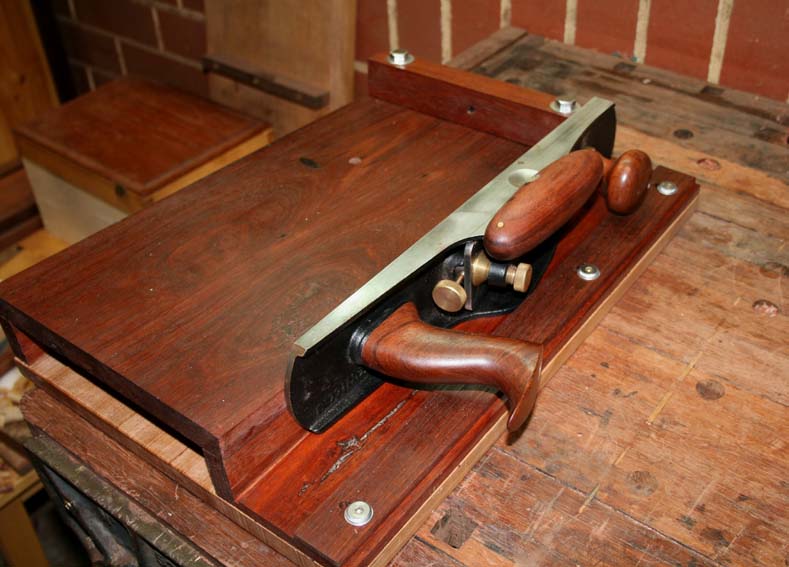
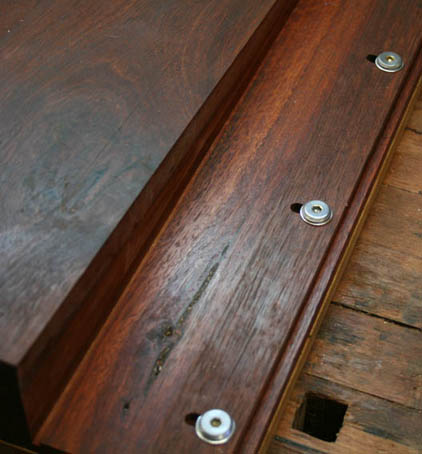
There are all sorts of add-ons, such as a mitre fence and a donkey's ear. My preference is to connect them via the main (square) fence. If you build micro-adjustability into the main fence, then the add-ons automatically have this as well. Wood moves, gets worn, damaged. It is a good feature to have.
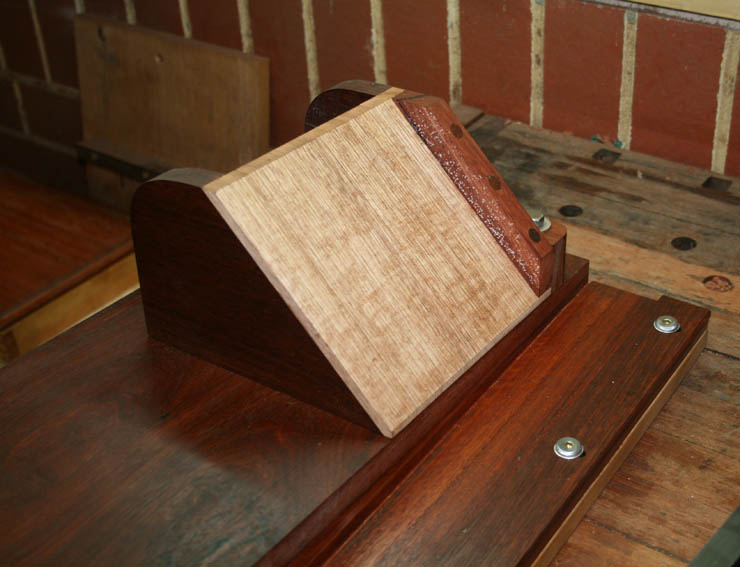
My fancy-shmancy boards are nice to use and look at, but keep in mind that a shooting board is a very simple concept. Don't overreach yourself at the start. You will do just as well building furniture or boxes or drawers with a simple MDF version.
Basic principle on building a shooting board here: http://www.inthewoodshop.com/ShopMadeTools/Setting%20Up%20and%20Using%20a%20Shooting%20Board4.html
Regards from Perth
Derek
Like to see a picture of that plane
Texchappy
when you're done Michael if ya don't mind.
Derek's Site
Texchappy
Spent a good while digging through your site Derek; lot's of good info there. I'll probably do a simple mdf version first but add a hardwood strip for the reason you mentioned.
I still haven't gotten a plane to use with it really. Right now I'm using my 48mm kanna.
I'm thinking seriously about trying to find a cheap user #5 while I'm waiting for my old street tools.
Re: Derek's Site
Michael Brady
A couple of things that are relevant:
No matter how pretty your shooting board is, if the blade (cutting edge) is not perfectly presented at 90 degrees to the work piece, your purpose is spoiled. The plane's iron must be adjusted just right and parallel to the plane sole. I saw a classic example of this at an L-N tool event where a beautiful #51 wasn't cutting anywhere close to 90 degree edges because someone had fiddled with the lateral adjuster. I saw probably ten people use the plane that way and marvel at how nice it was. None of them looked at the board to check the results.
Bench planes, which include the ubiquitous low-angle jacks, are not ideally suited to the purpose of shooting
since they have shallow cheeks (side walls) and may not remain perpendicular to the work piece during the cutting pass. The hot dog attachments can help with this. The extra mass of longer planes help with shooting, if they are super sharp (they aren't the ideal low angle for planing end grain).
It may sound funny but...
Texchappy
I am concerned about getting the thing square. How does one assure that it is?
@Michael Brady: so if bench planes aren't ideal, what are the options? I know I could try and find a vintage 51; I know LN makes one for a minuscule $500 (ouch). Are there cost efficient options?

(Message Deleted by Poster)
Kanna shooting
Texchappy
Pull!
As I got to thinking about this I started to wonder about my little kanna as a usable shooting plane. It's got a fairly low angle of attack. The side of the dai is square (or could be made do without much effort). I've spent the last few minutes searching on Wilbur's blog for where he talked about using a shooting board with his kannas (didn't find it dag nabbit).
I know squat about kanna...
David Barnett
...so I wouldn't be much help, but maybe Wilbur can give you a direct link, and certainly Wilbur, Tom, Wiley, et al. can answer your question. You said your kanna is little? That might present a problem.
So would you say you kanna help, David?
Bench planes work fine...
John in NM
Perhaps specialty planes work better, I wouldn't know having never seemed to have any difficulty using my single #5 for shooting.
I don't even know if the cheeks are square or not, seems like I do a test shoot and check that for square, and use the lateral adjuster to get it right. Nothing much to it really.
My approach if I were you, would be to find a cheap #5, get it sharp, and build a serviceable shooting board. If you like the results get to building things with it and build a prettier one when you wear out the first or just get tired of it. If you don't like the results, start looking for some of the other options like dedicated shooting planes or a miter trimmer.
That's how my Scottish forebears would've said it.
Re: It may sound funny but...
TomD
"I am concerned about getting the thing square. How does one assure that it is?"
It isn't a problem, that is why jigs work. You can place, say, one piece of MDF over another with absolute accuracy, pin them, pull the pins, apply glue, insert pins, and it will return to perfection. You can tune with shims, you can make the fence adjustable, it's easy.
The thing about jigs is that they leverage some point of certainty in the shop, and put it somewhere else. So if you have a great table saw, you saw up the 4 pieces required to make a shooting board, and they reflect the certainty of the table saw in your planing. Now in your case from what I have discerned, I am not sure where the points of certainty are for you. Do you have a square that you can rely on, what about the local HD store saw. You can hand plane the parts but then it would be great to have a bench or a sharp plane. This is the difficulty when starting out. What do you have to leverage to make what else?
"@Michael Brady: so if bench planes aren't ideal, what are the options? I know I could try and find a vintage 51; I know LN makes one for a minuscule $500 (ouch). Are there cost efficient options? "
I've been doing this for over 30 years, and I never had a 51. My shooting board is just 4 pieces of MDF glued together. When I showed it at seminars 15 years ago people thought it was pretty neat. But standards of cool factor keep rising. Standards of accuracy are based on the same things as ever. Unless you want to, don't get all caught up in the blizzard of consumerism that this activity is all about for some people. You can make a shooting plane, but any sharp plane will work. And if you know how to plane, you can freehand accuracy also. Shooting boards just speed some operations up.
Re: Kanna shooting
TomD
They do shoot with Kanna, there were some pics in the Landis Woorkbench Book. The only issue is that it is a pull stroke, not a push one. I just chose to make mine push so it would hook over the front of my bench. No biggie, you can find some way of attaching whatever to your bench.
Re: Thanks and a question
TomD
The ramp is a work around for no shear angle on the plane. At least when used with an LN 51 you have the shear angle built in. Low angle planes also have a fair bit of cutting power.
Consumerism and stuff I 'should' make
Texchappy
Tom, you mention 'leveraging' a point of certainty and that's exactly how I feel - uncertain
There's a list of stuff I feel I 'should' make myself...
Bench hooks (already bought from bad axe)
Shooting board (hey, I can buy a plywood one for $130 - ouch)
Marking gauge (though every time I read Schwarz I keep coming back to the tite-mark)
Panel Gauge
Saw Benches (but my two tiny saws aren't up to the task so yet another expense; then do I want low Japanese or traditional english)
mallet (could get a chester plane adjusting for $57 and a Chris Schwarz approve in-fill mallet for $185)
moxon vise
straight edge
winding sticks
square
partridge with optional pear tree
...but am intimidated because I don't feel I have the right tools yet or the skill.
I can see where you could buy your way into this and spend quite a bunch without developing the skill to make these bench accessories etc.
So where do I start?!?!?!
Re: Consumerism and stuff I 'should' make
Bob Hackett
You start with a plan and the wood. The plan tells you what steps you need to take to turn that wood into a finished project. Each step in that plan will require certain tools and perhaps a jig or two.
So, the plan and the wood drives everything else.
Have you looked into the nearest WWing club yet? Best value for money, guaranteed.
Re: Consumerism and stuff I 'should' make
Texchappy
Bob, haven't looked yet because I still can't drive.
Re: Consumerism and stuff I 'should' make
TomD
"There's a list of stuff I feel I 'should' make myself...
Bench hooks (already bought from bad axe)"
Those look like if you put those on your table, and have you plane on it's side on the table you have a shooting board. Done.
"Shooting board (hey, I can buy a plywood one for $130 - ouch)"
130. Forget it, and see above.
"Marking gauge (though every time I read Schwarz I keep coming back to the tite-mark)"
I don't like that type, but if you have the money, you need more than one over time. The Japanese wooden ones are the best, and you can make one pretty much out of scrap in an evening. Stop reading CS!!
"Panel Gauge"
Not needed. I have a longer beam for my Japanese gauge, and i use it when I can find it. This is a perfect example of a tool that would speed up operations in a busy shop
"Saw Benches (but my two tiny saws aren't up to the task so yet another expense; then do I want low Japanese or traditional english)"
I don't own any of these, particularly for the size of work you are talking about, it can all be done in a vise. I would focus on equipping your existing bench with a good vise, and some dogs.
"mallet (could get a chester plane adjusting for $57 and a Chris Schwarz approve in-fill mallet for $185)"
Useless crap. I bought a brass hammer with a wooden insert, never use it. Get a plastic hammer, or just use anything lying around. This is stuff that is nice to have, when it actually works, but it will not affect the way your work comes out at all. I refer to this kind of stuff as "having no points in it". From golf, or shooting. Stuff that will not affect your score.
"moxon vise"
Well for one thing. your current bench is in all likelihood already to high. This comes close to having no points in it either. Nice to have, though I generally prefer the trend to joint benches, particularly if you
a) have a bench that looks good, but won't hold anything
b) have space and moving problems down the road
"straight edge"
I have bought tons of measuring gear. Some of it is more useful than other stuff, but in general it is always money well spent. If you are planing on buying machine tools you need a really good quality rule, for woodworking you can get by with a straight piece of wood, or an aluminum rule of decent quality.
"winding sticks"
I have a few sets, I use a couple of pieces of aluminum extrusion for the most part. You probably don't need these unless you are planing on doing the plane thing, and you will be so much happier if you use a fat surface for abrading.
"square"
Consistently I have used the 6" machinist's squares. Wooden squares and the Japanese squares are also good. If you drop the wooden squares they usually don't go out of set. If you buy a 100 dollar square it is a walmart square the first time you drop it.
"partridge with optional pear tree
...but am intimidated because I don't feel I have the right tools yet or the skill.
I can see where you could buy your way into this and spend quite a bunch without developing the skill to make these bench accessories etc.
So where do I start?!?!?! "
It doesn't mater so much where, as that you start somewhere. If you just want to buy the tools, that is OK too. Buying a lot of really cool tools can hurt though. At some point you are the guy with 4000 dollars of hand tools, and that first/next joint had better damn well look like it. So that becomes another reason to put off making anything. Some of the first steps can be really difficult and frustrating. Anything connected to woodworking is pretty easy for me, other than sculpture type carving. But I remember a time when it was difficult.


