New WoodChat!
Home Articles Forums Gallery Marketplace Videos

WoodCentral Forums

Knowledge You Can Build On — Est. 1998

This is the most versatile work station you will ever use

bevel up plane/retailer question

Posts

bevel up plane/retailer question

#1

bevel up plane/retailer question

ray

Can someone provide a list of the possible disadvantes of purchasing a bevel up smoother instead of a traditional #4 smoother plane. There appears to be a substantial amount of positive plublicity for the bevel up style. I understand that the type of wood to be worked may be important in this discussion. I will not be working with anthing more difficult than red/white oak.

I am in the Minneapolis area and I cannot find a retailer that carries LV or LN planes. How

does one make an informed decsion with out a place to try them out or at least talk to a knowledgeable person? I stopped at one store and while looking at wood river planes, I asked where they were manuafactured. The salesperson said that he didn'tknow.

I am very new to this and have only about 3 weeks experience with a low angle block plane so far.

Thanks

Re: bevel up plane/retailer question

#2

Moses Yoder

Re: bevel up plane/retailer question

Moses Yoder

In the plane contests we have had there were no disadvantages to having a bevel up plane. In fact, those won more often than not. There are several advantages to the bevel up plane and you could buy either an LN or LV and I'm pretty sure they would take it back if you aren't happy. I try to use this option with discretion though. The best way to know what to buy if you have no experience is to ask a question here then toss out half the responses and make a decision based on the other half. Live and learn. Eventually you will have 6 of each plane anyway so you might as well get started.

Re: bevel up plane/retailer question

#3

Wood shows, or perhaps woodworking clubs

Bill Houghton, Sebastopol, CA

I believe both LN and LV show up at the big wood shows - and Minneapolis is a big enough city that there should be some shows there from time to time.

Alternatively, perhaps there are Wood Central folks in the Cities who own one or both of these companies' tools and would be willing to let you try them out; or a woodworking club in the area with members who would do the same.

Re: bevel up plane/retailer question

#4

Re: bevel up plane/retailer question

David Hay Denver

My understanding is that a bevel-up plane gives you more options with respect to the effective angle of the cut. With a bevel-down plane, you're limited to one angle, that of the frog. With a bevel-up plane, you can adjust the angle you want by regrinding or swapping out the blade. So if you're planing end grain, you might use a blade with a low angle. If you're smoothing highly figured wood, you can use a blade with a relatively steep angle.

David

Re: bevel up plane/retailer question

#5

Don't forget used...

Tony - Memphis

My first was an old #4 from a reputable dealer whose policy is "I send it and if you don't like it, send it back." I think he is only on eBay now and doesn't deal that way anymore. But there are lots of good deals and dealers on eBay. You may can find one local too. I recently got a LN #5 bevel up from Santa and I really like it. I find myself using it more than the #4. Maybe its just a feel thing? You sure can't go wrong with an LN or a LV, but you might get a better value going with something used and learning a bit with that. My old #4 has been beat up a bit, but it works like a champ. I replaced teh iron with a late model a while back and that made it even a little better. I noticed that PWW has a free preview of their videos online this weekend. Chris's plane video might help you deicde. His book is very informative too. Good luck with your quest and enjoy your new toy!

Tony

Re: bevel up plane/retailer question

#6

Re: bevel up plane/retailer question

George Clark

I would encourage you to consider a bevel up jack over a smoother. I have heard Thomas Lie-Nielson state, on more than one occasion, that it is the most versatile plane they offer. It will function an a smoother, jack and jointer, shoot end grain and handle highly figured grain with just a change in sharpening angle. A couple of extra blades and possibly a toothed blade and you can handle a lot of projects. LV and LN both make quality products and stand behind them. You won't go wrong with either.

Re: bevel up plane/retailer question

#7

Re: bevel up plane .....opinion

George in snowy Lowell, Mich.

Ray

As people have said everyone has an opinion.

I have a number of planes some for special purposes and some for just plain planing. I love my low angle #4 bevel up smoother. I use it when I know there might be issues with what I am trying to do end grain, squirrelly grain etc.. I use my conventional #4 for things where I just need to smooth or level or work to a thickness or width. If I just had one #4 plane I would probably have the low angle bevel up version.

As was mentioned you will probably acquire more so just get on with it. They can be had cheaply at garage sales etc. Before you know it you will need to build a wall cabinet to hold/display your arsenal of woodworking tools.

The sound of the shavings coming off the wood is sooo sweeet!

Work safe

George

Re: bevel up plane/retailer question

#8

Re: bevel up plane/retailer question

Pam Niedermayer - Austin, TX

That's what I was going to say, thanks for saving me some time. :)

I'll add that many have bought the LV LA Jack and like it as much or more than the LN; and that using one of these planes gets you going right out of the box. As you refine your needs you can replace the LA Jack function by function, you don't have to buy piles of planes at one time.

Pam

Re: bevel up plane/retailer question

#9

Re: bevel up plane/retailer question

Pam Niedermayer - Austin, TX

Of course, the trick is guessing which half to throw out.

Pam

Re: bevel up plane/retailer question

#10

Re: bevel up plane/retailer question

wilbur

Here are the main differences as I understand them. Disclaimer: overall, I like bevel down planes more than bevel up planes. Warning: some of these may only be important to plane geeks, but hey, this is the hand tool forum. ;)

1. Camber. Camber on your blade is important for setting up and using planes. Without going all through the math, you need to have a more aggressive camber on a bevel up plane than a bevel down plane to achieve the same effect. Derek Cohen has a great write up about this: http://www.inthewoodshop.com/WoodworkTechniques/TheSecretToCamberinBUPlaneBlades.html

2. Wear bevel. A wear bevel appears on the face of the blade that is down as the plane is used. For a bevel down plane, this appears on the bevel, and is pretty easy to get rid of with more sharpening. On a bevel up plane, the wear bevel appears on the back of the blade, which is harder to manage, according to some.

As far as the flexibility of a bevel up plane in terms of swapping blades with different bevels goes, you can easily change the performance of a bevel down plane to match these. Want a lower angle? Skew the bevel down plane by 30� or so, and you have an effective bed angle of 37�, just like putting a 25� blade on a low angle bevel down plane. Want a higher angle? Keep an extra blade around with a back bevel.

In actuality, either type of plane will give you excellent results. The most important difference is how the planes feel in use. The bevel up planes have a lower center of gravity, which changes the feel in use. Some like it, some don't. Lee Valley and Lie-Nielsen have different styles of totes and knobs on their planes, and each style has their fans.

Since you don't have any retailers that carry either plane, I'd strongly consider just ordering a plane from each company, and give them a try. Both Lee Valley and Lie-Nielsen have excellent customer service and return policies. Even if you're out the return shipping cost, it's less than I would spend on gas and tolls to get to the nearest Woodcraft to me.

Other options include:

1. Lie-Nielsen has a hand tool event coming to Minneapolis March 18-19. Go there, and try out their bevel up and bevel down planes, and ask lots of questions. http://www.lie-nielsen.com//?pg=1

2. Wait until The Woodworking Shows comes back to the Twin Cities, where Lee Valley is very likely going to be, but they were just there in December, and it still costs money to get into the show.

Re: bevel up plane/retailer question

#11

Re: bevel up plane/retailer question

Derek Cohen (in Perth, Australia)

Can someone provide a list of the possible disadvantes of purchasing a bevel up smoother instead of a traditional #4 smoother plane.

Hi Ray

I use both BU and BD planes, probably equally. I consider there are advantages and disadvantages, which I will try to outline as briefly as possible.

The one generalisation I will make is that BU planes offer the easiest way to obtain cutting angles at the extremes - low and high. Low cutting angles (such as 37 - 40 degrees) are preferred for planing endgrain (e.g. shooting boards) and crossgrain (e.g. when flattening a panel). High- to -very-high cutting angles (50 - 65 degrees) are preferred when planing hardwoods and interlocked grain. BU planes achieve the cutting angle off the blade's bevel, which means that a couple of blades will see you through here.

BD planes rule for me when it comes to sharpening. I prefer to sharpen freehand directly on a hollow grind, and then add a camber to the profile. This is not possible to do on BU blades with high bevel angles (one can do it with low cutting angles however). Basically, one needs to use (high) secondary microbevel on a low primary bevel when sharpening BU plane blades. This is extremely easy to do with a honing guide, but not possible when freehanding. Consequently I use a honing guide with all BU planes.

It is a testament to the exceptional performance and ease of use of BU planes that I use them. My preference would otherwise be a BD woodie, sans adjuster. These I could just removes the blade when it dull, swipe it freehand over a stone, and back to work .... not because I am rushing to meet a deadline; rather because I am single-minded (!) and find the intrusion of sharpening a hassle.

Most of my BD planes have high bed angles. This is where the BD plane achieves its cutting angle. In my experience (which is not necessarily that of others), one of the advantages of BU planes is the low centre of gravity and effort, which makes for easier pushing. Given similar BU- and BD planes with the same cutting angles, the BU plane will be easier to push. Most BD planes, such as the Stanley-type, have a high centre of gravity and effort. There are some advantages to this in turns of developing a sense of the vertical, but that is for another day. To keep the centree of effort low, I prefer BD planes that are razee-shaped or low profile .. such as the HNT Gordon range.


I must emphasise that if you are not going pursue working with hardwoods, etc, then a standard angle plane (45 degrees) will do all that you want it to do. Here I am referring to the common Stanley-style plane.

There are other areas of debate in the BU-BD arena, such as edge holding and blade wear. We could get emotive here, and no doubt someone will raise it. My view is that this is a non-issue.

For someone starting out I consiuder a BU smoother, such as the LV LA Smoother, to be exceptional. It is easy to use, easy to adjust, and will bring a smile to your face since it almost ensures success. Both BU and BD planes have advantages and disadvantages when it comes to setting up a plane...

My re-handled LAS ...
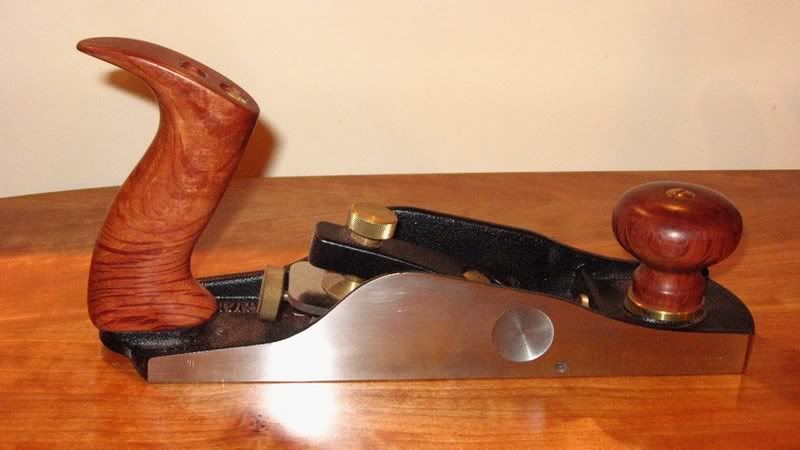

The BU plane does not use a cap iron (chip breaker), which is frankly a pain in the wotsit to adjust on a BD plane. Both LV and LN make adjusters on their BU planes that offer very positive action with minimal backlash. BD Stanley-style planes, even the wonderfully built LNs, have more backlash than BU planes.

BD planes, such as the Stanley-style (not woodies or non-adjuster infills), typically have an easier ability to adjust the blade on-the-fly (since the lever cap is not typically used with as much downforce). This is a useful facility, but note that non-adjuster planes do not appear to be diminished by its absence.


I have done a few reviews on BU planes, generally comparing them against their equivalent BD version.

The first review I did was on a Stanley #62 I restored. I cannot believe that was only 6 1/2 years ago. BU planes have really taken off since then ... http://www.inthewoodshop.com/ToolReviews/Son%20of%20Stan%20or%20LV%20and%20its%20development%20of%20the%20Bevel%20Up%20Jack%20plane..html


Here are a couple of others:

http://www.inthewoodshop.com/ToolReviews/The%20Veritas%20Low%20Angle%20Smoothing%20Plane.html

http://www.inthewoodshop.com/ToolReviews/The%20Veritas%20Lee%20Valley%20Bevel%20Up%20Smoother.html

Regards from Perth

Derek (OK, that wasn't short at all! :) )

Re: bevel up plane/retailer question

#12

Re: bevel up plane/retailer question

raymond Bohn

I just received my Lie Nielsen catalog. I have not seen the term BU in ther catalog, only in the Lee Valley literature. From what I am seeing in your responses is that: low angle = bevel up. Is that correct?

All of you have been very helpful. Thanks

Re: bevel up plane/retailer question

#13

Re: bevel up plane/retailer question

Bruce, a MN Galoot

Thanks, Wilbur, I didn't know L-N was holding an event in the Twin Cities, and I live here, or close anyway. I'll bet that they use local luminaries, and don't have their demonstrations by the same people at all their events. I say that because Mike Siemsen is doing a demonstration, and if you ever get the chance, he's definitely worth catching. He's the guy who beat Frank K in the dovetail competition at the last WIA. Wait, I'll bet you DID see him.

Anyway, Thanks.

bh

Re: bevel up plane/retailer question

#14

No answer to your question, but

Bruce, a MN Galoot

did you make it to the MWTCA tool show at Medina last weekend? I looked for you, but since I didn't know whom to look for...

Re: bevel up plane/retailer question

#15

Terminology

Bill Houghton, Sebastopol, CA

Bevel up/bevel down refers to how the cutting iron is placed in the plane, and is just what it sounds like, but it gets more complex.

Bevel down

Planes with the iron bedded at an angle (to the sole - all these bedding angles are measured from the sole) of 40 or so degrees and up (45 degrees being the common minimum angle nowadays) are placed in the plane with the bevel down. The basic cutting angle is then the bedding angle, because the angle at which the iron is sharpened doesn't affect the angle at which it presents to the wood.

Lie-Nielsen offers higher angles - 50 and 60 degrees - with replacement frogs in their bench planes. These are said to reduce tearout in difficult-to-plane-well woods like birdseye maple, at the cost of more planing effort.

Slight exception here: you can increase the planing angle of any bevel-down plane by honing a back bevel on the iron - that is, hone the back (normally non-beveled) side of the iron a little. One plane maker goes so far as to bed his irons at an angle such that, if you flip the iron over, it presents at 90 degrees, thus becoming a scraper plane.

Bevel-up planes

When you get down to 30 degrees or lower, you can't put the iron in bevel-down because the cutting edge will start to lift off the sole of the plane (put another way, the heel of the bevel will interfere with the cutting edge actually touching the wood). So the iron's put in bevel up. The highest common angle used here is 20 degrees (although there are some not uncommon used planes with angles of 23-25 degrees), and is often called "standard" angle (as in "standard angle block plane"). The cutting angle is then bedding angle of the iron plus the angle at which the iron's sharpened. A standard angle block plane, with an iron sharpened at 25 degrees, presents a cutting edge to the wood at 45 degrees, the same as a bevel-down bench plane with a bedding angle of 45 degrees.

It's hard to maintain a good edge on a plane iron if the sharpening angle is much less than 25 degrees.

The other common bedding angle in a bevel-up plane is 12 degrees; this is most often called "low angle." This will, indeed, give you a lower cutting angle: 12 degrees bedding + 25 degrees sharpening = 37 degrees. This low angle slices end grain more effectively than a higher angle.

But note: if you sharpen the iron of a low angle bevel-up plane at, say, 33 degrees, you'll get a 45 degree cutting angle. 38 degrees of sharpening gives you 50 degrees of cutting angle; 48 degrees of sharpening gives you 60 degrees of cutting; and so on. This is a feature that has, in recent years, dramatically increased the number of low angle bevel-up planes made and sold: with one plane and several irons, you effectively get multiple cutting angles with a lower investment, allowing you to tackle end grain, plain and simple wood like pine or straight-grained cherry or birch, and difficult woods, all with one plane.

People sometimes confuse the issue by treating "bevel up" and "low angle" as interchangeable terms. They're not. I think the confusion has crept in because the major makers of bevel-up bench planes, Lee Valley and Lie-Nielsen, offer their bevel-up bench planes in low angle configuration only - there not being any discernible virtues to a bevel-up standard angle bench plane.

Re: bevel up plane/retailer question

#16

Re: bevel up plane/retailer question

TomD

1) First off the positive publicity is just because they are new. You can sell me a bevel up, but I already have 70+ bevel downs, and that would apply to the majority of the installed base. Also, you can inside an hour make a bevel down plane that is the equal of any you can buy. This is less done with low angle planes, metal has a place because the low angle ramp typically found is appropriate in metal.

2) Even if one or the other is better, bevel upness or downess is not a big deal, and would be low down on my list of important attributes to a plane. So the question doesn't have much practical importance to me. But it is fun to discuss.

3) If you already have a BU block plane, that is well adjusted, you can learn everything you need to know about bevel up planes.

4) Of the things that mater, probably the single most important pro feature of bevel ups is their lack of complexity which makes sharpening them and turning around the blade through a cycle much more practical. They also have for the same screw feed, more adjustment for depth of cut. They tend to loose a setting less, they tend to have more of the streamlined features since most bevel ups are recently made planes, vs one could be referring to any plane over millennia with a BD. Anything older than a decade tends to be worse. You get junk like nasty lever caps, stamped cheesy breakers, loose adjustments, bad blades, and general lack of tolerance. You also tend to run into the plane kit problem. None of this has to do with the geometric niceties of of bu vs bd, it's just realities that mater even more. However, it is relatively easy to convert a BD plane to be single blade chipbreaker free, and screw cap for ease of turn around, they just don't come that way for the most part.

5) There are differences in weight and feel, but probably you can get use to anything.

6) The biggest disadvantage to BUs is the lack of a breaker. Sure breakers are not mostly needed, but that doesn't make them non-functional. They work well in certain situations. One could have breakers with BU planes, they could be even better than what we currently get on BD planes, but there does not appear to be demand.

7) You can adjust cutting angles on BD planes but it requires back bevels which are not as simple as simply having a different main bevel. However this is another one of those silly issues in most situations. First of all it is just one of those stupidities of commoditized planes they come in few bed angles and cost a lot of money. These planes were not intended for serious work. One is supposed to have BD choices of pitch in one's armoury, so it shouldn't be an issue. And in any case, one can always have a steep enough pitch and then just skew the plane to instantly get every pitch down to zero. So I wouldn't buy a BU plane on that alone.

8) one thing I like about BD planes is the rearward force rests more on the bed, and less on retention mechanisms, seems more solid.

Re: bevel up plane/retailer question

#17

Re: bevel up plane/retailer question

wilbur

Hi Bruce,

I have had the pleasure of meeting Mike and seeing him do demonstrations at WIA. He's a great guy.

Re: bevel up plane/retailer question

#18

Disadvantages

Warren in Lancaster, PA

Here is a list of disadvantages of a bevel up plane.

1. Wear Bevel. The wear bevel is a major component of dulling. Since this bevel is worn parallel to the sole of the plane it appears mostly on the underside of the blade. With a bevel down plane this occurs on the bevel side and is easily removed during sharpening. With a bevel up plane, the wear bevel occurs on the back (flat) and so takes considerably more sharpening to remove.

2. Extra Blades. Needed only for bevel up.

3. Jig. Needed for high angle blades. Extra sharpening time to set up.

4. More Effort. Needed for high angle blades vis a vis a standard 45 degree cutting angle.

5. Poorer Surface. Higher angle blades use more of a scraping action, less shearing; surface is cloudy.

Re: bevel up plane/retailer question

#19

Re: Disadvantages?

Bob Hackett

4 and 5 sound more like disadvantages of a bevel down plane.

The bevel up plane cuts at a lower angle,that`s why some folks use Bevel up/low angle as interchangeable terms.

More than one iron is still cheaper than more than one complete plane no matter how you look at it.

Re: bevel up plane/retailer question

#20

Not this time Warren

Derek Cohen (in Perth, Australia)

Warren, you wrote:

1. Wear Bevel. The wear bevel is a major component of dulling. Since this bevel is worn parallel to the sole of the plane it appears mostly on the underside of the blade. With a bevel down plane this occurs on the bevel side and is easily removed during sharpening. With a bevel up plane, the wear bevel occurs on the back (flat) and so takes considerably more sharpening to remove.

2. Extra Blades. Needed only for bevel up.

3. Jig. Needed for high angle blades. Extra sharpening time to set up.

4. More Effort. Needed for high angle blades vis a vis a standard 45 degree cutting angle.

5. Poorer Surface. Higher angle blades use more of a scraping action, less shearing; surface is cloudy.

1. As I mentioned before, someone would raise the issue of the wear bevel. Well the jury is still out on this. No, I don't dispute that there is a wear bevel on the "wrong" side of the blade, but this does not seem to get in the way of performance with a BU plane. Thousands of users don't appear to notice its presence.

2. Extra blades are only needed if you want to use a BU plane for a different task. This is an advantage, not a disadvantage. The ease of setting up a second (or third) blade is completed with a level of ease that a BD plane cannot compete against.

3. I agree that a honing guide is needed for a high angle secondary bevel. However this is only a disadvantage for those (such as myself) who prefer to freehand. Those who typically use honing guides to sharpen do not have an issue.

4. No. BU planes have less effort in planing than BD planes (for the same cutting angle). Of course if you only see the BU plane as cutting at 60 degrees and a BD plane at 45 degrees, and both take a fine shaving, then you get your skewed result.

5. The surface result should be the same if the same cutting angle is used, regardless of whether it comes from a BU or BD plane. However what you seem to be thinking of is the performance of a high cutting angle. Well, I have both BD and BU planes that have high cutting angles. Now what was that point?

Regards from Perth

Derek

Re: bevel up plane/retailer question

#21

Re: Disadvantages?

Warren in Lancaster, PA

Bob, there is no need for more than one plane. If you use a plane with a cap iron you only need one plane and one cutting iron. If you have an actual cutting angle less than 45, then yes, it is marginally less effort than at 45. But it is not like the difference in effort that comes with planing at 55, 60 or more compared to planing in the 40 to 45 range; that kind of difference is what I was referring to in #4. I specifically said "high angle blades" were more effort.

Re: bevel up plane/retailer question

#22

Re: bevel up plane/retailer question

Jerry Nicholson

You might have noticed that you didn't get an absolutely definitive answer to this question :b

I think the Wood River planes are made in China. LV planes are made in Canada, LN planes are made in the US. I think you would have to go to Canada to see an LV plane in a store since Rob Lee hasn't seen fit to open stores in the US. (Note to Rob: Somewhere around Wichita Kansas would be a great place for the first US Lee Valley store. My wife would probably disagree with that idea!)

I have a flock of Stanley planes (I got carried away!) but use my LV bevel up planes the most. I see having several blades with different cutting angles as a positive feature.

Jerry

Re: bevel up plane/retailer question

#23

Re: Disadvantages - I agree with Derek

North of the Border

Based on my use of the LA Jack, BU Smoother, and BU Jointer, none of the "disadvantages" you suggested apply to me. I am not against BD planes (I also own a junior jack #5 1/4 BD), but after using the LA/BU planes, I seldom touch a BD plane these days. The ease of adjustments, lower center of gravity, etc. of the LV BU planes won me over the choice. For beginners, I'd recommend BU planes but also encourage them to use or have a BD plane so they can have working knowledge and experience of both designs. Pricewise, they're pretty much the same.

As for where one can buy LV planes, go to leevalley.com. Excellent shipping service, among others.

Re: bevel up plane/retailer question

#24

Let me get this straight *LINK*

Larry Williams

"4. No. BU planes have less effort in planing than BD planes (for the same cutting angle). Of course if you only see the BU plane as cutting at 60 degrees and a BD plane at 45 degrees, and both take a fine shaving, then you get your skewed result...."

When wood is cut, it deflects ahead of the cutting edge to the point where it can easily be severed by that cutting edge. If I set up a 12� bevel-up plane to have a 55� angle of attack I'd need a 43� bevel. What you're saying is that a 43� knife edge is easier to push into wood than a 30� knife edge? Do the laws of physics change South of the Equator?

BTW, the steeper the angle of attack the more the wood deflects ahead of the cutting edge. The same goes for the angle of the bevel, the more obtuse the cutting edge the greater the deflection. The greater the deflection, the greater the needed clearance angle. This isn't opinion, Derek, it's physics--real science.

I know from experience that I loose clearance if I hone a 55� bevel down plane at 35�. It's very obvious in the performance of the plane. 15� of clearance isn't enough for a 55� cutting angle.

Konrad Sauer has some wear bevel photos in a blog he wrote last July on the topic of wear bevels on low angle planes. The link is below. You'll have to scroll past another post about an injury he had--sorry about that.


Konrad Sauer's July blog post

Re: bevel up plane/retailer question

#25

The Jury

Warren in Lancaster, PA

So the jury is still out on the wear bevel? On February 19, 2006, just five years ago today, VTAndy asked if there were any disadvantages to bevel up planes. Here is part of what I wrote that day:

2. Wear Bevel. The wear bevel is an important component of blade dulling. The wear bevel is a flat spot worn on the edge parallel to the sole of the plane, and it needs to be removed in sharpening. On a bevel down plane the wear bevel occurs mostly on the bevel side; on the bevel up plane it occurs mostly on the flat side of the iron. Since you are doing most of your sharpening on the bevel side, when you sharpen, the wear bevel is removed from a bevel down smoother several times faster than a bevel up.

You also participated in that thread, Derek, at least four posts, but did not contribute any disadvantages. So the jury is still out, eh? Five years in deliberation?