by Bob Smalser, Seabeck, WA
A Chamberlain 19' Gunning Dory

A turn-of-the-last-century sport boat originally from Massachusetts' dory builder William Chamberlain, this light dory was designed to safely carry two hunters, dogs, and gear to offshore islands in November weather. It's a lighter version of his double-ended Surf (Rescue) Dory with rig features from his larger Beachcomber racing dory, which was in turn a purpose-built version of working dories dating back to when sawmills first began producing boards economically.
Simple, with a working man's elegance, the boat is a great family beach cruiser in addition to a sporting boat. I tried to keep my work both true to the latter end of the boat's period prior to WWII, and also the purpose of the boat. All painted and varnished surfaces were rubbed out to tone down the shine, and all the bronze and brass on the boat will be left to patina naturally. Marsh-grass brown-red hulls and Navy grey interiors were the typical camouflage of the era for duck hunting. Being a sport rather than a work boat allows me to tart it up a bit…hopefully without going, ahem, overboard.
The fitting-out at the end of a project is always incredibly slow and time-consuming….but that fine detail work has always been my favorite part, whether a restoration like this one, or new work. So, we'll jump from the ribs and strakes part of construction right to the end game in this and related articles.

All major fittings are bronze or marine brass either salvaged from derelict boats of the era…
Click the link to learn about bedding hardware.

…or made from scratch.
Click the link for the rudder story.

Tiller yoke and thwart, mainsheet block, sternsheets and stern painter…

…toggle-and-eye fittings on yacht-grade manila would be more period correct than the button snaps I used on my leather work, but I'm not that much of a purist when it comes to function…where you don't need their strength, toggles require two hands while snaps just one, and when you do, elastic cord does a much better job than manila.
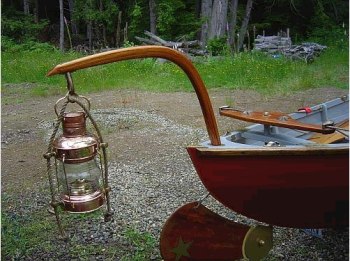
A nice Leeds reproduction oil anchor lamp and laminated mast that stow away until you are caught out after dark…

…along with period bearing compass and fog horn…and some tools and spares.

Mainsheet block, swivel and served wire pennant…along with the Center for Woodenboat's original registration number.

Hiking stick, tiller control lines, boat hook and side seats.
Click the link for the floorboards story.

Hiking stick stowed beneath the thwart, Wilcox's smallest winch and handle, Wilcox bilge pump, oar stowage…
Click the link for the winch handle pocket story.

…and hinged centerboard trunk cap with Herreshoff jibsheet cleat. It's hinged at the thwart because I used a larger oak Beachcomber centerboard rather than the light plywood board John Gardner drew in his plans for the boat.
Click the link for the complete centerboard story.
One complaint about these as sailers is they are too light, with no carry in troughs…my larger, heavier, lead-weighted board and heavy false bottom seem to have corrected that, although I may add some lead shot bags along side the trunk later for solo sailing, as in 25kts and 3' seas, the boat points surprisingly well, but it's impossible to go to windward without a dedicated and energetic bailer.

Centerboard control rod and boat hook…

…the boathook grooved on the underside to register the location of the hook in the dark.

Oars…

…and oarlocks.

Jibsheet comb, lashed marline side stay, English Cocker Spaniel. Side stays aren't a usual feature of rigs this small (90sf of sail), but I use them to lengthen the life of the centerboard trunk joints. Lashed marline ILO turnbuckle is real quick to cut in an emergency to free the rig.

Jibsheet comb, wall-knotted fender and leather oar buttons.

Salvaged gooseneck with fabricated bronze mast band…

…that folds to make a neat bundle either for rowing or to stow inside the boat.

The two boom bridles are lashed for head room…
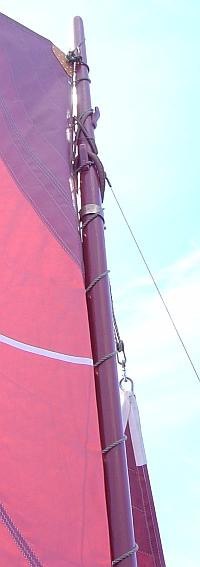

…and the mast shoulder cleats were built to hold the leathered side stay and jib halyard eyes firmly in place when stepping and unstepping the rig, which can be done safely while afloat with the board down. The mast and boom are hollow Doug Fir…the rig weighing around 35lbs.

Busy, but very functional. Oar, bow painter and beach hook and chain stowage, still allowing access to the storage compartment and still providing a seat.

Shucks…this boat even motorsails.
Comments (0)
No comments yet. Be the first!
Leave a Comment