Home Articles Forums Gallery Marketplace Videos

WoodCentral Forums

Knowledge You Can Build On — Est. 1998

Light vs Heavy planes

Posts

Light vs Heavy planes

#1

Light vs Heavy planes

Derek Cohen (in Perth, Australia)

There has been some controversy over many years as to the part played by mass in a plane. Some argue that it improves planing and others that it is irrelevant. Higher mass is typically a feature of premium, especially custom planes - among vintage planes, names such as Spier and Norris come to the fore, while Brese, Sauer and Steiner, Holtey, Daed, are among the modern planemakers. Lower mass is found in woodies, such as HNT Gordon, and metal planes such as Stanley. Modern planes, such as Lie Nielsen and Veritas fall into the middle ground.

The heavier planes were considered de rigueur about 15 years ago. Many of these planes were single iron and high mass, thick irons and a tight mouth were believed to be necessary for performance planing. Generally they fell out of favour, and this was partly as high cutting angles on bevel up planes gained momentum, and then this was accelerated when the close up chipbreaker returned to the equation.

My high mass planes have sat on the shelf for many years as I found a preference for lighter, more nimble planes which require less physical effort to move around. In smoothers, I like small planes, such as #3 size, and have a few that get rotated, such as a Stanley #3, LN #3, and a Veritas Custom #4 (come on Rob, where’s the #3?). I also have a wonderful high angle woody by HNT Gordon.

In recent months, spurred by curiosity, I have used a Marcou BU smoother and a LN #4 1/2 Anniversary.
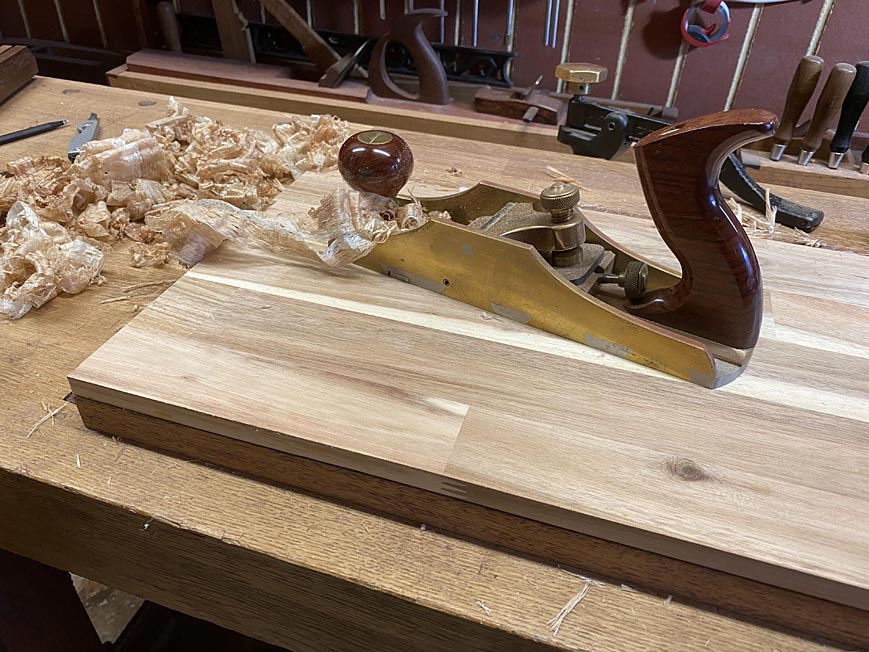

Note that the LN is planing into the grain of interlocked Jarrah ...
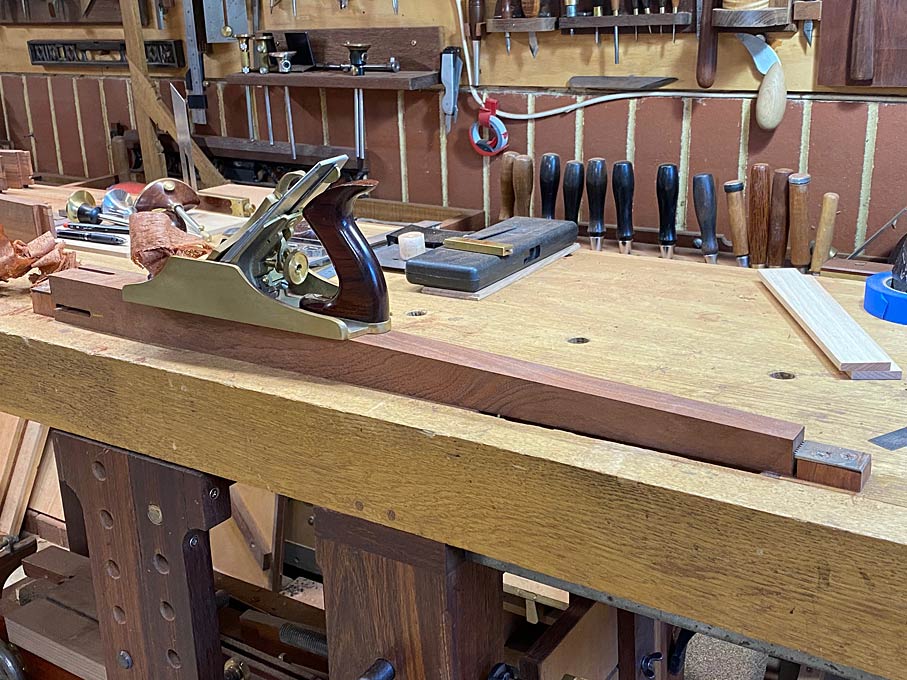

What was this like?

Well, firstly it brought a smile to my face. Planing was effortless. Push the monster forward, and it peeled off a shaving and left a glowing surface behind. “Monster” is the appropriate term since these planes are not just large physically, but they feel large .. and there is the rub. They disconnect one from the wood. It is a little like pushing a board over a power jointer (although the other way around). There is little that is delicate about this experience so, for those who have a yen for the Jim Krenov spirit, these planes are not for you.

But they perform or, rather, I believe that the extra mass makes performance easier to achieve, which is likely to suit a lesser experienced person.

Interestingly, many years ago I described the Marcou as the best performing smoother I had used. This is a bevel up plane, which I set up with a 60 degree cutting angle. I wrote a review years and years ago about this plane, and my esteem for it has not altered. One of the planes it was compared with was a LN #4 1/2. That did quite well .. but that was pre-chipbreaker days. The LN Anniversary, used here, has a lot more mass than the standard LN #4 1/2. It came with a 50 degree frog, which I have replaced with a 45 degree from (after an unhappy and brief time with the 55 degree frog .. can one say immovable tank?). Closing down the chipbreaker is a revelation with this plane. It could go into reversing grain where the Marcou could not. Simple a powerhouse in every way.

High mass? Definitely not for someone planing all day and every day. But otherwise .. yes .. it does add up to more in a number of ways.

Regards from Perth

Derek

Re: Light vs Heavy planes

#2

Re: Light vs Heavy planes

Bruce Mack

I have the ductile iron L-N 4-1/2. I bought this at a L-N event where the demonstrator was a small woman who wielded it like a lightsaber. Sadly the force isn't with me. This magnificent plane is too big for my work but would have been perfect when I made credenzas and big chests of drawers.

Re: Light vs Heavy planes

#3

Re: Light vs Heavy planes

Jonathan Elliott

Looking forward to the thoughts and experiences this topic hopefully spurs. Personal preference is a large player but there are other interesting points to be discussed.

Thanks for starting the conversation Derek.

Jonathan

Re: Light vs Heavy planes

#5

Re: Light vs Heavy planes

Jim Matthews

I doubt my favorite plane weighs two pounds.

Re: Light vs Heavy planes

#6

not the direction I went

Bill Tindall, E.Tn.

May depend on what one does with a plane. I almost entirely fit parts with my planes, drawers most recently and case parts before that. I never plane large surfaces. I have gravitated to the lightest plane in my collection, a Stanley 605, here fitting the height of a drawer front.


I took a heavier LN plane to the class in the Headley shop. Steve Hamilton picked it up and declared it too heavy. (This shop uses planes similar to what I do)

So there are two cases where a lighter plane is preferred. For the undecided, using a plane will eventually tell one what is best for them in the kind of work they do. I suggest being wary of other's advice on the matter.

Re: Light vs Heavy planes

#7

5 1/4

John in NM

I had a 5 1/4 years ago when I worked in a shop, I used it as you do. It was very handy as it was long but narrow and light enough to wield with one hand using the frog as a grip (an uncomfortable one :D ). Unfortunately I dropped it on the floor one day, broke it in half. I would have replaced it by now if I did more work with planes. Its blade and lever cap went into making a wood scrub plane that I used a lot when I used planes. Not having a big planer, I've had to smooth tops by hand, which I found surprisingly easy.

Re: Light vs Heavy planes

#8

Re: reframing the issue

Steve Voigt

Derek,

I appreciate you bringing up the topic and laying your cards on the table. As a maker of wooden planes, I am obviously biased, so that's my disclaimer. All the same, a couple comments are in order.

First, I have a bone to pick with how you frame the issue. You define a "premium, custom" plane exclusively as an infill or metal-bodied plane. Raney did the same thing in an article that someone recently reposted on Sawmill creek. I think this is very unfair. Wooden plane makers build planes one at a time or in small batches; they are every bit as custom as the metal planes. They are made to very high standards, so they are every bit as "premium" or "high end" as the infills, even if the price tag is lower.

Second, I disagree with how you lump metal Stanley planes in with "woodies" as being "lower mass." A Stanley jack is roughly twice the weight of a beech jack: the difference is huge. The only "low mass" planes are woodies: metal planes are either heavy (Stanley), really heavy (modern copies of Stanley), or extremely heavy (infills and related).

As to the issue of which is preferable: it has to be framed in terms of the work one does. If one is merely smoothing off the ripples left by an expensive combo machine like you use, then it doesn't matter that much. But if one is doing heavy work, it matters a lot. I would suggest a simple formula: the ideal weight is inversely proportional to the amount of physical labor required. Try flattening a large table top with a no.5 followed by no.8, then try the same with vintage beech jack and try planes. I think there is no comparison, none. Though I will close by reiterating that I am biased on the topic.

Re: Light vs Heavy planes

#9

Re: reframing the issue

Derek Cohen (in Perth, Australia)

Steve, you have my sincere apology for not referring to wooden planes under the premium category.

I do have an excuse! :)

The topic was heavy vs light, and I was more focussed on the heavy and the light than the Premium. Premium, per se, was not really the issue, and so I hardly spent ant time mentioning this in regard to wooden planes.

Regards from Perth

Derek

Re: Light vs Heavy planes

#10

The experiment and conclusion are both confusing

Bill Tindall, E.Tn.

This discussion is not as focused as your typical submission. The stated topic is light vs heavy planes but the text scurries off in several directions ending in a conclusion- "yes .. it does add up to more in a number of ways" - not clearly supported by any preceding data. I was distracted by why you are planing a leg up hill and what the journey through frog angles had to do with the subject title.

Will you clearly state, what is the benefit you found for a heavy plane and what comparative data led to this conclusion?

Steve makes the case that a light plane excels in heavy work. If a light plane excels in heavy work would it not excel in any work, and if not why?

Re: Light vs Heavy planes

#11

At some point..

David Weaver

.I bought the bronze LN 4 - as I recall, to have something to compare to when putting together infills. the weight of the bronze (and the stickiness of it - the softer the wood, the more stick it is and you have to wax constantly) is more like infill proportion in old planes than stanley smoother, and it's *nothing* like the weight of the plane you're testing.

What I remember is that at first, I thought the LN plane was much smoother as it seemed to stay in the cut without feeling much. But when I looked at the surface, what was occurring was that when either plane tore out, both did. But, i couldn't feel minor tearout with the LN. I could feel it in the stanley. It wasn't a performance difference, but a feel difference.

This probably makes them especially attractive to beginners - you plane through the tearout a little and can't feel it!!

Infill panel planes for some reason are very heavy (mostly) until they went away from rosewood infills. No clue why a spiers smoother may weigh 3 1/2 pounds and a 15 1/2" panel plane could be 8 - I guess it's assumed that you'll be doing heavy work with it.

In the wood that we have here (at least that we typically use), no amount of waxing can make an infill panel plane (or a stanley jointer) keep up with a wooden try plane, but you wouldn't want to size much macassar ebony with a wooden try plane, either, and it's perfectly tolerable with an infill panel plane or stanley jointer.

Re: Light vs Heavy planes

#12

Friction, and more

Bill Tindall, E.Tn.

When I made some wooden planes I was struck by how effortlessly they slid across a wood surface. If they required the same lack of skill to adjust them I would still be using them.

The coefficient of friction of wood on wood is a piddly 0.2, about third that of steel on wood. The resistive force of friction is the object's mass times the coefficient of friction. One can see that a steel plane weighing times more than a wooden plane will be many times harder to push across a wood surface, considering only the resistance of friction and not the additional force to create a shaving. So, both weight and coefficient of friction conspire to make a wooden plane the more effortless choice when considering pushing or pulling it.

The force difference when lifting is obvious.

I was initially drawn to a heavy plane because it held in the cut better. Mr. Weaver taught me that a properly sharp blade will hold in the wood without the benefit of the plane's mass. I confirm this wisdom every time I plane something and when this situation begins to fail it is time to sharpen. So, there is no practical benefit of more mass for this aspect of planing.

Momentum is proportional to mass. More momentum could be beneficial if there was a case where the resistive force changed abruptly during the planing stroke, like hitting a knot or grain reversal. In this situation a heavy plane would be smoother to push.

Re: Light vs Heavy planes

#13

Re: Heavy and light

Steve Voigt

Steve makes the case that a light plane excels in heavy work. If a light plane excels in heavy work would it not excel in any work, and if not why?

In my opinion a light plane excels in any work. My point was that if you are doing a short session of smooth planing, it will not be physically taxing and the added weight of the metal plane will be bearable. It's when the work gets hard and the hours get long that the difference is thrown into sharp relief.

Re: Light vs Heavy planes

#14

The best case for heavy planes...

David Weaver

..that I've seen is when you're doing something like making an infill plane.....so, I guess that means..

....this is starting to sound like majoring in integrative arts.

"job opportunities for integrative arts graduates are teaching at the college level, and......"

OK!! (I have actually seen an integrative arts graduate teaching roomba....

....or zoomba, or goomba)

If someone had a whole lot of fitting work to do with macassar ebony or wanted to plane really thin pieces of rosewood in a jig of some sort and you couldn't give a plane the little bump start (especially if the quality of wood wasn't that great), heavy planes are good at those things.

If you manage to find awful ash or cherry that's just running out into the face left and right, heavy planes are good at that. Cutting half blinds in it that don't fall apart will cure using it more than once, though.

But, it's a lot like the arguments that used to exist on woodnet and SMC - that if you don't get a plane capable of those things, then you'll be high and dry and need to get it later.

i've planed ebony, cocobolo rosewood, etc, from rough. I wonder how many other people have actually done that for more than curiosity. I certainly haven't planed a cases-worth of the stuff, either. Just plane bodies and guitar neck blanks. All of it planes nicely and saws reasonably well, but at greatly reduced speed of progress (thinner shavings).

Re: Light vs Heavy planes

#15

another factor

Bill Tindall, E.Tn.

Without thinking I don't know why I pick up my lightest jack for anything it is capable of doing. It could be because I can feel what it is doing, a factor Derek mentions lacking in the heaviest plane. I rarely plane for more than a few seconds at a time so fatigue is not a factor.

Re: Light vs Heavy planes

#16

If you're trimming furniture...

David Weaver

I'm sure at some point, you're trimming small or narrow parts, etc, and handling the weight of one of those heavy planes isn't going to be what you're looking for.

I think it's a beginner's advantage in getting a plane started and keeping it in the cut, but using the cap iron kind of cancels it out.

The whole thing of taking a 4 or 5 and spinning it around the knob and then pulling it back toward you is a no-no with a smoother that weighs a whole bunch more.

Re: Light vs Heavy planes

#17

Inertia and figured wood

Jim Matthews

I'm on a kick to use figured lumber where possible.

I'm finding heavier planes lead to more tear out (it's the grain, not the plane).

In this application an itty-bitty no-name Japanese plane with a Osae-gani bodged out of a Stanley scraper works wonders : low mass provides tactile feedback of tear out.

Wood selection is just another example of my most common shop activity; fixing problems of my own creation.

Re: Light vs Heavy planes

#18

Re: Jim, what is Osae-gani?


Re: Light vs Heavy planes

#19

Re: Light vs Heavy planes

TomD

I have a lot of planes, quite a variety of different styles, and weights. I think weight is mostly useful for keeping the iron in the cut, and momentum in the cut.

Pull planes, which are mostly Japanese, but they don't have to be, solve both these problems. They will stay fully engaged in the cut because the geometry is radically different. Essentially you are pulling on the edge as though it were a fish hook, or anchor, and it just sucks into the cut. It won't stutter. A western plane is more like a pole vault, or like playing road hockey and catching a pothole, and going over the handlebars. You lift up out of the cut. Of course, both use hand positions ahead and behind the edge, so it is a matter of degree.

The problem of momentum is solved by speed. Whether it is a cultural thing, or a thing about the type of plane, I find these planes are often used at about twice the velocity of western planes. and your body is pulling, sorta like a tug of war, you weight can hang off the plane. Though the handles are not what most people might want to be hanging from. The plane might be that much better if it was also heavier, but it is not necessary, so why wear oneself out.

----------------------------------------------

One thing I found given having been making and collecting planes for 40 years (user type collecting), is some planes just work better. There is something about the whole being greater than the sum of the parts, that is just incomparable. I have one "Norris" like block plane that is just superb, it is heavy. Well worth it. But I have block planes that are half that weight, and are also good. But that Norris one is special. It is just good. I would not generalize that the key is the weight.

-------------------------------------------

A thing about that period is that it was all about making fine shavings. There was one guy who had a lot of infill planes and would report on their nuances of relative performance, with charts, and so forth. He had never tried wooden planes, or maybe it was Japanese planes, but had interesting data on what he had. I think we have progressed beyond that point. Super fine shavings were old hat for me, at the time. But one way or another anyone can make them. In addition people discovered the breaker, which was not a secret to the folks who had been around either. But the internet is like that. It gets the gold, eventually. I have seen the same thing happen in other areas of interest. I have seen an amazing expansion in archery knowledge, something else I have been doing for a long time. Archery is different, because it is explicitly and implicitly competitive. But woodworking is not competitive at the technical level. The last few percent of performance don't decide anything.

Re: Light vs Heavy planes

#20

Osae-gani

Jim Matthews

Chipbreaker to you and me.

Like most aspects of the Japanese plane, there are subtle requirements for best function.

I liken a properly setup Kanna to a handmade British roadster: it comes alive just before it requires service.

http://www.toolsfromjapan.com/store/index.php?main_page=page&id=9&chapter=5

Re: Light vs Heavy planes

#21

Re: Light vs Heavy planes

Warren in Lancaster, PA

The heavier planes were considered de rigueur about 15 years ago. Many of these planes were single iron and high mass, thick irons and a tight mouth were believed to be necessary for performance planing.

I think you make a mistake thinking that everyone has been on the same wavelength as you. I have spoken on this forum in favor of light, double iron planes and against high angle planing and thick irons for the 15 years I have been involved on this forum. Maybe you were one who thought I did not know what I was talking about. De rigueur? I don't think so.

Fifteen years ago there was a psychologist from California who thought himself an expert on planes. It was pitiful.

Re: Light vs Heavy planes

#22

Not a positive contribution to the discussion

Bill Tindall, E.Tn.

This discussion was generating some useful insights. You didn't add anything helpful. If you don't know how to make a positive contribution study what Steve wrote. It is a model for what a response should look like when you have an alternative view.

Re: Light vs Heavy planes

#23

Re: Osae-gani

David Weaver

Raney chewed me out once because I said that the planes are relatively simple. They are in the same way many hand made things are. You can generally get an iron and build a dai around it and if you feel the need for a ledge, you can faff with that.

But ultimately, fitting wooden planes is fitting wooden planes.

Some things are reversed (which I think is where raney was getting tied up in thinking things are complicated) - the bed of the plane is convex instead of flat or slightly concave (And the irons are made to match it a little bit. Not sure that with the weight of the iron, the convexity is much more than an artifact of fitting at the edges.

The tapers are reversed and the abutments have to be precise enough since there's no wedge - precise enough to keep the iron tight but not prevent it from getting it to the end of the plane.

And rather than the body of the plane outlasting several irons, the irons outlast several dais.

But more than most other planes, they're best for someone who is constantly using and adjusting a plane, and best for clean wood (the penalty for nicks is severe in terms of time).

---

separately, I remember reading a japanese retailer or instruction site translated via google that was describing the care requirements and movement of the planes. It said something flatly like "if you are a casual user who may use a plane and then have weeks or months before you use it again, you shouldn't consider using japanese planes. They will not work well after a time of inattention and such a user will spend more time adjusting the plane than using".

Well, there goes the boutique market!! The guy who got me into woodworking goes several years between uses with some of his planes.

Re: Light vs Heavy planes

#24

Re: Light vs Heavy planes

joelmoskowitz

I collect and use Norris's and Bedrocks. Some are superb. Some suck. The finest single planes I have used were wooden planes by Clark & Williams. I have have gotten superb performance from the one Japanese plane I have.

If I had to make any rule of thumb it would be that fit and finish (and iron bedding) are far more important in determining plane performance than weight or material.

By that rule the reason planes by all the premium makers work so well is that they are well made.

There are many reasons to use one style of plane other another, and within a specific maker there are ranges of quality. Some like it light, some like it heavy. Some like it pretty and some like low maintenance.

Re: Light vs Heavy planes

#25

Re: Light vs Heavy planes

Derek Cohen (in Perth, Australia)

Oh, Warren ... this thread is not about you. Chill out.

There have been some really interesting comments. I see them written for the forum - they are not for me to respond to, unless I have something to offer back. I'm just enjoying reading them all.

By-the-by .. the "Californian Psychologist" you refer to is Lyn Mangiameli. He wrote the most wonderful articles and was the inspiration for my first reviews. I miss his contributions.

Now there is an idea ... how about an article by you? I would read that.

Regards from Perth

Derek