WoodCentral Forums

Est. 1998 — 27 years of woodworking knowledge

LV replacement cap irons......

Posts

LV replacement cap irons......

#1

LV replacement cap irons......

roger lance

With all the talk about cap irons and their effects, I'm interested to know peoples' assessment of the LV replacement cap irons for Stanley/Record planes.

Do they make a significant improvement?.....slight improvement?.....no difference?......what? They sell for $30+.....look substantial.....are machined well.

Are they worth the investment?

Re: LV replacement cap irons......

#2

Re: LV replacement cap irons......

david weaver

If you have a physical issue with your current cap irons (e.g., something is damaged or worn out), they're definitely an improvement.

If you just like the style better, they're an improvement.

If it's just about controlling tearout or holding the iron down, as long as a plane is well set, it won't really make much of a difference.

In general, they are good basic cap irons and do what a cap iron should do. Actually, I guess that's true about all of them. The only real duds I've seen are the caps that came with shepherd planes (those were workable, just really crude and mine had some adjustment problems due to not matching the slot in the iron).

Re: LV replacement cap irons......

#3

Re: LV replacement cap irons......

Hank Knight

Hi Roger,

I don'g have any experience with Lee Valley replacement grasp irons, so I can't speak specifically to them. Nevertheless, I can say the Lie Nielsen replacement cap irons have worked well for me. All of my bench planes are Stanley Bedrocks. I found the Stanley cap irons to be made of mild steel, often poorly fitted to the iron and deformed easily. I could bend them back into shape and file them to fit the plane iron, but I would have to tinker with them often to get optimum performance. I replaced all of my plane irons with LN replacements irons and, while I was at it, I replaced the cap irons too. The LN cap Irons are very stiff and precision ground. They fit precisely to the iron. I've not had to adjust one since I first set them up a number of years ago. As I said, I have no experience with Lee Valley cap irons, but I would guess they have similar characteristics of stiffness and precision grinding to the LN ones. I think my LN replacement cap irons are worth the investment.

My $.02

Hank

Re: LV replacement cap irons......

#4

Re: LV replacement cap irons......

roger lance

Hank.....I'm mainly a LV guy.....so I referenced them.....but, I did look up Lie-Nielsen cap irons/chip breakers and they said that they were the first to come out with this thicker, flatter design.....and that other tool makers were imitating their design (which is probably aimed at LV since its cap irons are very much like LN).

At any rate, I've had similar experiences as you have had with the stock cap irons on Stanley planes and I think these LV, LN, and now Hock replacements are a valid improvement.....more than just something shiny to add on.

Re: LV replacement cap irons......

#5

Re: LV replacement cap irons......

Patrick Chase

What on earth are people doing to their cap irons?

The stamped Stanley-type cap irons may not look stylish, but the continuously rounded, cornerless profile is actually reasonably good for shaving ejection when close-set. The leading edge angle of ~45 deg is also a good starting point. The newer "solid" ones are a step down in both respects, though they certainly look and feel pretty and can be reprofiled to address both issues. Some of my favorite cap irons right now are the ones on "classic" (non-custom) LV bevel-down planes, as they're basically well-made stamped irons. I have never seen wear as a problem with those mild steel cap irons, as they fundamentally are not subjected to wear-inducing use when employed properly.

Also, setting a cap iron is an utterly trivial activity. Loosen, slide, tighten, done. I often do it more than once per sharpening if I encounter stuff that needs a tighter set.

Finally, how can you "not have to adjust one" for "a number of years"? The cap iron needs to be within ~1/100" of the edge to completely prevent tearout on difficult stuff, and that means that it needs to be reset after every significant sharpening at a minimum (and more often than that if you're going back and forth between easy and difficult woods). You would have to either not sharpen, or have the cap iron set a mile back from the edge to avoid adjusting it for that long. There's also the small question of how you remove any wire edge from the iron back without removing the cap iron...

Re: LV replacement cap irons......

#6

Re: LV replacement cap irons...... *LINK*

Derek Cohen (in Perth, Australia)

Hi Roger

I wrote up a comparison of the LV, LN, Clifton (two-piece), Hock, and Stanley chipbreakers in late 2013 (link below). I would like to update this piece now, since my use of chipbreakers has dominated in the past 5 years.

At that time I much preferred the solid style of the LV and LN over the thinner and flexier Stanley. I still dislike the Clifton, as the toe section can move. I have not changed my position in these areas. However, there are changes I would now make to the solid chipbreakers.

What I would like to see in the solid types is a slight bend to add a little spring. What I dislike about the Stanley is that it has too much spring. Too little spring in the solid types makes the leading edge vulnerable to opening up, which is especially bad news when the chipbreaker is placed very close to the edge of the blade. Too much spring makes it easier for the hump to compress and the chipbreaker move forward .. and over the front of the blade. Even lever cap pressure can do this. One adjusts to this factor over time, being careful with downforce. Experience reduces the problem but it does not remove the issue.

With the solid types from LN and LV, I add a touch of spring through a very slight bend in the forward section.

The new Custom Veritas has been introduced since that article was written. It is different in the way it attaches and, while this chipbreaker may only be used on their planes, there is a feature that is highlighted. This is ease of setting up.

With the Custom Veritas, the chipbreaker screw is on the same side as the chipbreaker, and adjustments take place in full sight ...
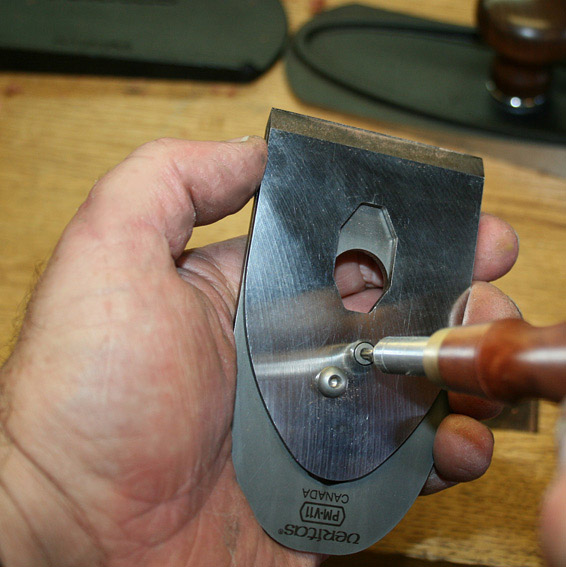

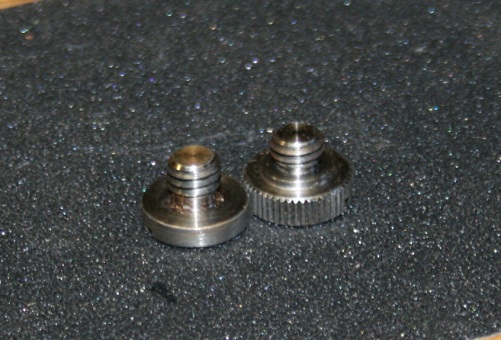
This makes the task easier. In a similar manner, the chipbreaker screw that Lee Valley supply with their "Stanley" chipbreaker makes it easier to set up. The screw is thicker and the knurling is wider. It is easier to grip and finger-tighten.

That's it on the right, compared with a LN screw. Note that the Stanley screw has the same dimensions as the LN, but has knurling where the LN has none ...
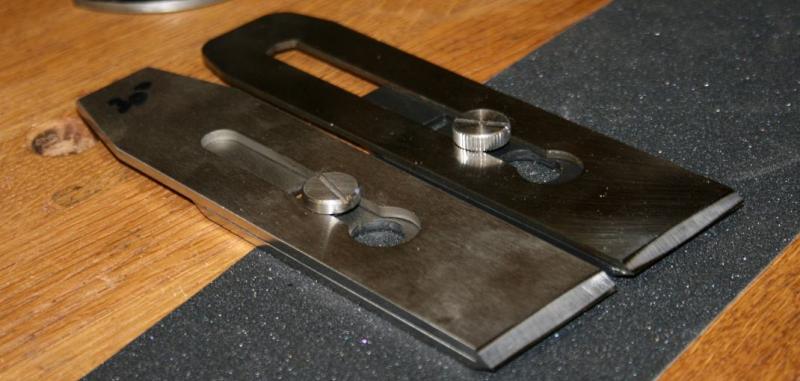

The LV and LN chipbreakers are not interchangeable if you plan to set the chipbreaker up close on a Stanley plane ... or is it the other way around? (> one cannot use a LV chipbreaker in a LN plane - I think this is correct). The reason is that its adjustment slots is a 1/4" higher.


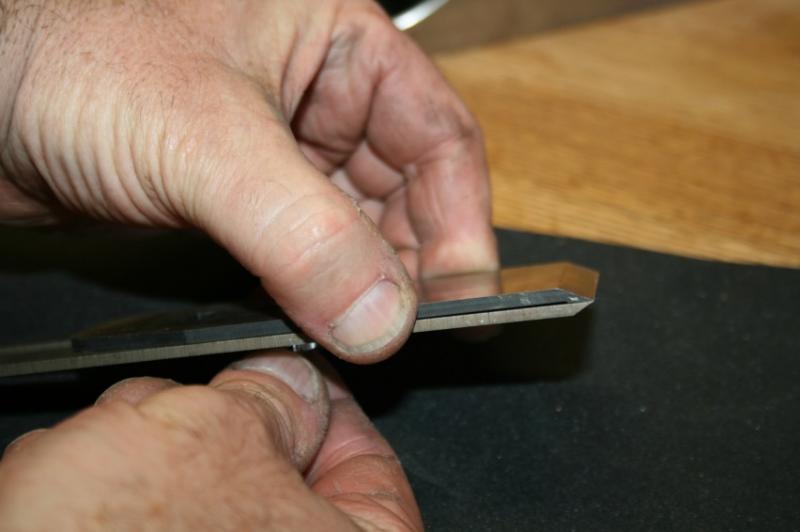
The main issue with solid chipbreakers is that they come with a 30 degree bevel. This is too low for common angle planes. It should be a simple matter to add a higher secondary bevel (say 50 degrees), however one must be careful not to be too enthusiastic about its size with the LN, as it has a smaller flat section.

LN on the left, LV on the right ...
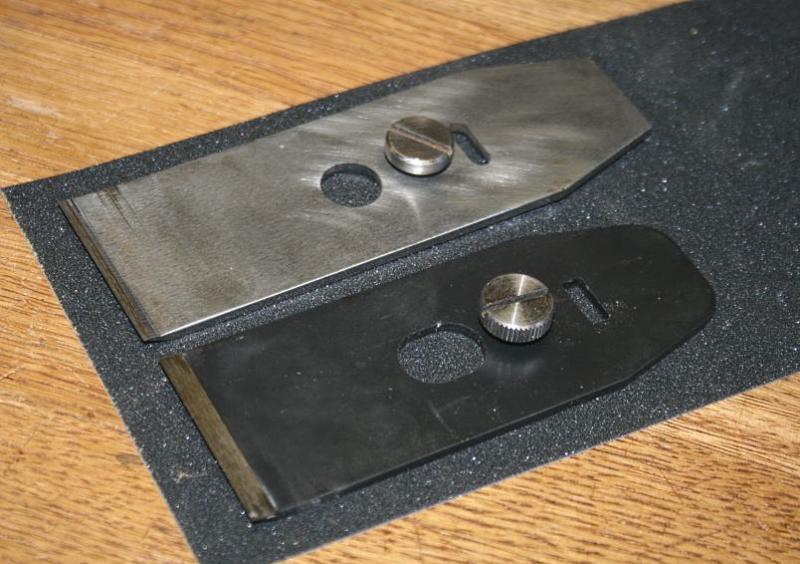

I have also experimented with rounding the front of these chipbreakers in imitation of the Stanley, keeping the leading edge at the same 45-50 degrees. I cannot say that I notice a big difference. I think that there is a slight improvement with the rounded edge, but it just does not stand out consistently enough to state it is a definite improvement.

I dislike the Clifton because the Stay Sets I have tried have been jiggly. I have seen the original Record stay set, and it was much better machined. Hock are very solidly made, but the small ones I have (for Krenov style planes) are short and they cannot be induced to create spring.

The bottom line is that all the different types have pros and cons. Stanley work well, with care. LN/LV work well, with slight modifications. All work adequately without any changes.

Regards from Perth

Derek


The Lee Valley Chipbreaker

Re: LV replacement cap irons......

#7

Re: It's worth a chuckle

david weaver

that LN describes other people copying their tools. Most of the tools they have (and they are really excellent) are pretty much copies of someone else's design.

I sort of wish they would've just made a heavier stamped version of the stanley cap iron (a sentiment that I see Derek is now expressing - and derek could accuse me of copying him by saying that i've said that before, but it wouldn't take long to find my saying the same thing), but that's not what they've made.

Warren made a humorous post (though I'm guessing he didn't intend it as such) either here or on another forum when it was asserted how great the LN cap iron is and how much "improved" it is (paraphrased: "how do you improve something that you don't know much about?").

At any rate, I've failed to find any function problem in any of the makes. I did have to do heavy work to the shepherd cap, but I doubt you'll run into one of those.

Re: LV replacement cap irons......

#8

Re: LV replacement cap irons......

Hank Knight

"Finally, how can you "not have to adjust one" for "a number of years"? "

Patrick, I started to rise to you bait, but your post probably merits some reply if only to clarify my use of the word "adjust" in my original post.

Of course I remove the cap iron from my plane irons when I sharpen them, and their placement on the cutting iron requires adjustment when reattaching the cap iron after sharpening, stropping, etc. When I said in my original post that I had not had to "adjust" my LN cap irons in a number of years, I was referring to the "tweaking" of the fit between the cap iron and the cutting iron that I often found necessary with the original Stanley cap irons. As Derek pointed out in his post below, the spring required for the Stanley cap iron to maintain gap-free contact with the cutting iron often causes the leading edge of the cap iron to lift perceptibly from the cutting iron when the cap iron screw is tightened. This lifting creates a gap that allows shavings to enter and wedge between the cap iron and the cutting iron and clog. When that happens, tinkering with the cap iron is required to compel it to again mate with the cutting iron with gap-free contact across its leading edge. Sometimes merely bending the cap iron to introduce more spring would suffice, but often regrinding and honing the contact surface was necessary when wear was significant or the softer steel of the cap iron deformed slightly with use. This is the "adjustment" I referred to in my post, and I haven't had to take any of these measures to correct the fit of my LN cap irons since I started using therm some years ago.

Hank

Re: LV replacement cap irons......

#9

Re: LV replacement cap irons......

david weaver

I'd replace the cap iron, too. If it needs constant fiddling, then enough of it must've been ground away that it's an issue with maintaining the hump.

Of all of the planes I've had, I haven't had any that needed bent more than once, but I have also had a cap iron or two that looked like it had some of its life ground off and I just threw it in the trash instead.

My experience with the Hock, LV, LN caps (I've had all of them) is they're practically the same thing. A no or low spring version of old wooden cap irons. Once in a while, one will claim to be like the old wooden cap irons, but they're not. Even the flattest wooden caps still have some spring (unless they, too, have been ground and bent).

A friend of mine honed an LN cap iron at stock angle and found out that it couldn't hold up to planing (it was 25 or 30 degrees) - that's the only issue I've seen. From time to time, someone will say that they've found a hardened cap to be an advantage, but I think they're in the weeds. They hold up fine at the angle we actually use them (50 degrees and up) and are easily corrected.

Re: LV replacement cap irons......

#10

Re: I should add..

david weaver

though all work fine, the LN and LV caps are better finished and a bit thicker than the hock. The hock is a bit crude (which doesn't keep it from working, but it's worth noting if you have the choice elsewhere).

I went out and looked at the hock price and see that at some places, it challenges $40. I wouldn't give $40 for it if it came with a bucket of water and my shoes were on fire.

Also, as an side for setting your stanley caps in the future, they shouldn't move after you get them partially set. That is, finger tighten the screw a little and move the cap into position, if it's set up right, it won't change more than a tiny fraction of a thousandth if everything is in order.

If you want to diagnose that on another one at some point that otherwise seems fine, feel free to post.

I don't know if it's apparent, but I have a passing interest in the cap iron some days..... :\

Re: LV replacement cap irons......

#11

Heavier Stanley cap-iron

Patrick Chase

The only modern maker that I know of that did a heavier, higher-precision version of the Stanley sheet-metal cap iron is Veritas, in their "classic"/non-custom BD planes:

http://www.leevalley.com/us/wood/Page.aspx?p=46294&cat=1,41182,41187,46294

http://www.leevalley.com/us/wood/page.aspx?p=44751&cat=1,41182,41187&ap=1

http://www.leevalley.com/us/wood/page.aspx?p=47298&cat=1,41182

http://www.leevalley.com/us/wood/page.aspx?p=45156&cat=1,41182

In my experience they're a snap to tune up for close-set use. Unfortunately LV decided to "follow the market" with their subsequent custom plane platform.

Re: LV replacement cap irons......

#12

Re: Heavier Stanley cap-iron

david weaver

that's the one that I referred it when I originally made that comment, but I've never had that plane type (one of the few) and never used one.

It's a beginner's market now, though, and if LN says their version is improved, most beginners and "instructors" will have them convinced. "veterans" tend to buy nothing at all or satisfy an odd jones (pre-war norris, etc).

I have had a record or two that had an extra thick cap iron like that, but I can't remember the circumstances (as in, I don't remember if it was one of the later records, etc. I have only three record planes in my house, one is a stay set and only one of the other had a survivable cap, so I don't remember where that cap went, but i liked it).

I still generally prefer the stanley cap over all others because I like that spring in a metal plane. Derek's issues with shavings going through are more of a very hard wood issue. I've had it once in a great while with cocobolo (only on the flat side - cocobolo crumbles on the quartered side and has no "beam strength" , to steal Larry's word), but it's infrequent and minor enough that I've ignored it. If I planed only cococoblo, I wouldn't like it so much. It's kind of like the "iron is too soft" thing that I used to get bent on. It's too soft for 5% of what I plane, but it's more useful to be able to sharpen faster when that happens than it is to go chase wundersteel. The cap iron makes it so that the wear isn't an issue until it's really an issue, if you know what I mean, whereas it becomes an issue pretty quickly without the use of the cap.

Re: LV replacement cap irons......

#13

Re: LV replacement cap irons......

Patrick Chase

Ah, sorry Hank, I misunderstood you.

That does bring me back to my question about what you're doing to these cap irons. Like David I've always found that tuning the sheet-metal ones is also a one-time exercise unless there's something fundamentally defective about the iron (for example loss of preload as David describes). In my experience maintainability is a wash between the two.

I do want to circle back to a point that David and Derek both raised: Springiness. Both the stamped and milled cap irons are effectively leaf springs, i.e. they bend as you tighten the center screw and thereby apply preload to hold the leading edge down.

The stamped cap-irons are low-constant springs with a lot of preload, meaning that the spring is soft but it gets bent a lot when tightened. In contrast the newer milled ones are high-constant springs with minimal preload, meaning that the spring is stiffer but it doesn't get bent much. Both can hold the cap-iron edge to the iron back just fine, but IMO the "low-constant/high-preload" kind (stamped irons) are easier to adjust which is important when you're working with close sets.

The reason they're easier to adjust is because it's easier to apply intermediate levels of tension, where the cap iron is tight enough that it doesn't accidentally shift but loose enough that it can easily be "nudged" into position. I don't have much luck finding that happy medium with the LN cap irons in particular - they seem to go from "loose" to "locked" in a small fraction of a screw turn.

The LV custom irons are probably the best of the milled lot, as I find that I can dial in "tweak-friendly" tension with the cap screws. They're not without downside though, as the cap iron tends to "walk" if you tighten the screws in the order LV suggests. I think Derek covers this in his review, and he's right.

Re: LV replacement cap irons......

#14

Crude cap irons

Patrick Chase

There is such a thing as a cap iron that's so crude that it acts as a shaving trap.

Exhibit A in that regard is WoodRiver/Quangsheng. The milled LN-style caps on their planes have a very rough finish on the face with deep vertical (from tip->top) striations. The first time I encountered one I trued and cleaned the edge, honed a polished 50 deg "breaking face" at the base and tried to put it to work as I was trying to help a friend with his plane and in a hurry. It promptly started trapping every thin shaving I tried to take.

You would think that vertically oriented striations wouldn't be as much of a problem, but these were so deep that they acted as "shaving velcro".

Going back to the question of "how much tuning is enough" from Derek's post, my own experience is the following ordered list of priorities:

1. Flatten, undercut, and clean the leading edge of the cap iron. It doesn't have to be super sharp (see previous posts on that topic) but it needs to register well and not have any nicks/burrs/etc that might act to "hook" the shaving.

2. Create (if necessary) and polish the 45-50 deg "breaking face" immediately adjacent to the edge. This needs to be (very conservatively) ~0.5 mm high, as the shaving generally hits it within the first couple tenths of an mm. There is an interesting experiment you can do - paint the breaking face with something that rubs off easily like dry-erase marker, set the cap iron close, and go plane a bunch of wood. It's surprising to see where the shaving actually contacts it.

3. Polish the rest of the cap iron face above the breaking face.

4. Reshape the primary bevel to eliminate hard corners.

Warren has strongly advocated doing all 4. My experience is that the 80/20 rule kicks in at step 2 - once you get that far it will work for most practical purposes. The WoodRiver is the only cap iron I've used that actually needed to go to step (3) to work *at all*.

Re: LV replacement cap irons......

#15

Re: Stamping..

david weaver

I always think about 9 layers deeper about every small thing than I need to.

One of the things that I've wondered is why LN is so convinced that their cap iron is such an improvement. I don't have an LN plane with an old cap iron, so I can't experiment with new and old to see if the new slide better, etc, but David Charlesworth (who is welcome to comment) was pretty sure that the LN cap iron is a significant improvement.

I feel like I know a little bit about cap irons and don't see it.

I wonder if there is something very undesirable about stamping things in a manufacturing environment, or the fact that you can't really stamp them and then machine finish them as easily vs. "lots of flat things in grinding machines", etc.

I don't think everything is a conspiracy, but I also think I know more about the cap iron than LN, and maybe there's more to it than just function. I'm more than willing to be proven wrong by them. Warren knows more about it than I do, and he proves me wrong all the time. When I'm no longer willing to be wrong at something, I know my time with it is done - it's not interesting and there is only downside.

Be curious to know if anyone involved with manufacturing would find that stamping operations are an issue from a risk/worker's comp perspective, etc.

I quite like the cap iron design on LV's standard line bench planes, but without going in circles with LV and bothering them, I have no clue if they would fit a standard bench plane. There's nothing wrong with their custom plane design, but I'm too far down the road with the stanley type, I guess - you sort of get a preference for the familiar.

Re: LV replacement cap irons......

#16

First one I saw...

John in NM

Was made by Hock, late 1990's or early 00's I think, right about the time everyone "discovered" A2.

Given that all three seem to be selling the same thing, I had always assumed it was either originally made by one of them and sold through all three (which would have meant Hock made them) or it was so commonly known that a patent wouldn't cover it.

Re: LV replacement cap irons......

#17

That would've been my guess

david weaver

I started woodworking only around the time LN started changing cap irons to their flat design. I don't remember the hock caps being a new thing.

It was sort of taken as gospel at the time that a hock high carbon steel was a bar none improvement over a stanley iron, but the one I had microchipped. I see Brent Beach's did, too, and couldn't last with a slightly softer eskilstuna iron.

I got along with the cap iron fine, though, but haven't used one since 2012, and can't really make very definitive statement about their ability or inability to fend of shavings in the gap.

Re: LV replacement cap irons......

#18

Re: LV replacement cap irons......

Hank Knight

No problem Patrick. I wasn't very clear in my original post, so there was certainly room for misunderstanding.

I just went down to my workshop and examined several of my LN. While I was at it, I realized that I have been referring to chip breakers as "cap irons" throughout this exchange. My mistake. I'm talking about chip breakers.

I think Derek alluded to this, but I found that my LN chip breakers have a raised lip of about .005" in thickness that forms the leading edge that contacts the cutting iron. Behind the lip, the bottom of the surface of the chip breaker is relieved by several; thousandths of an inch. The result is to give the chip breaker a slight curve ahead of the screw that provides a little spring when the screw is tightened. Because the chip breaker is so thick and stiff, the spring effect is substantial and holds the edge in contact with the iron with some force. I took some (poor) photos of this for illustration.

This is the underside of the chip breaker. You can see (hopefully) the lip at the top of the photo.

[url=https://postimg.org/image/gftg6uz0j/][/url]

This photo shows (I hope) the slight curve of the chip breaker ahead of the screw.

[url=https://postimg.org/image/m3zqxydpf/][/url]

In this photo you can see the springing effect on the chip breaker - note the space ahead of the screw between the iron on the right and the chip breaker on the left, and the solid contact between the leading edge of the chip breaker and the iron at the top of the photo. A little magnification would be helpful here, but I think the slight gap is visible.

[url=https://postimg.org/image/hjdkihr9v/][/url]

Addressing several of the issues raised by David Charlesworth in his post above, I never intended to claim the LN chip breakers did not require some work before they performed satisfactorily. The mating surface of the LN chip breaker was flat, but it had some light machine marks. I polished the machine marks off and also polished and slightly rounded the leading edge. Not much work at all and they have required nothing more since.

I've never had any trouble setting them and adjusting the position vis a vis the cutting iron. I have probably experienced the "walking" Derek mentioned, but it has not been a problem. This afternoon, I paid close attention to my routine for reattaching the chip breaker to the iron. I hand tightened the chip breaker screw, positioned the chip breaker with my thumbs and tightened the screw with a large screwdriver. It clamped down solidly with no slippage or "walking". This has been my experience each time I remove and reattach the chip breaker. In the occasional event of a slip when I tighten the screw, a couple of taps with the screwdriver handle quickly realigns the chip breaker. It's not as problem. I do think, however, that the knurling Lee Valley puts on their chip breaker screws would be handy.

As to your question about how I have used my Stanley planes to cause problems with the original chip breakers, I don't know how to answer that. I have used them the way I learned years ago which has been confirmed by everything I have read and seen in the years since. Chips jamming in the chip breakers was a persistent issue with most of my Stanley planes until I upgraded the irons and chip breakers. It stopped then and hasn't been a problem since.

Hank

Re: LV replacement cap irons......

#19

Re: First one I saw...

Derek Cohen (in Perth, Australia)

Hi John

I believe that LN first came out with the solid style chipbreaker. This was the first tool review I completed, in 2003.

At that time I considered the chipbreaker to be about supporting the blade, and I recall that it did a better job of this than the Stanley chipbreaker (in a #604).

Regards from Perth

Derek

Re: LV replacement cap irons......

#20

Re: First one I saw...

Charlie

Yes, but didn't you report tear out free performance anyway?

Re: LV replacement cap irons......

#21

Re: First one I saw...

Derek Cohen (in Perth, Australia)

I think you're fishing, Charlie :)

My preference back in 2003 were the high angled woodies from HNT Gordon. I still have them and like them. The LN chipbreaker was an improvement on the Stanley in the #604, which I only used in softwoods. Performance wise, the combination of the #604 plus LN chipbreaker did not compare with the HNT Gordon because, back then, I did not know to use it with the chipbreaker closed up.

Regards from Perth

Derek

Re: LV replacement cap irons......

#22

Re: First one I saw...

TM Stock

Seems like the copies of the Record Stay-Set by Clifton were available prior to LN bringing out their improved CB, and I recall picking one up at Stevenson's Hardware (with a Hock blade) for a 605 that was purchased sans blade and cap...circa 1995 or so? Anyway, before Tom's #4 started delivering, which seems like it was 1996 or so. Even with a bunch of fitting, still a solution in search of a problem, as I doubt anyone used them as intended. Could be wrong on the dates - I had a reserve unit command at the time in addition to the day job, so was trying to fit some woodworking into odd corners in my schedule...definition of chronic fatigue.

I don't recall anyone else offering replacements until Tom came out with his, and those needed as much work to resolve the rough machining as any other CB. Comparing the first improved CB that Tom sent me to the most recent (a student #4-1/2 that came in for set-up this week), the machining is improved, but still needs quite a bit of work to smooth out the mill marks on the underside of the cap, the angle on the leading edge, and lack of a smooth counter back into the bevel.

Circa 1973, there was a pretty good hardware store down in DC that sold INCA machines and had a larger selection of hand tools than what I had seen anywhere else, but I don't believe they had any replacements for anything other than the production Stanley planes at the time. IMS, I wanted to get a replacement for a coffin sided smoother that my neighbor at the time had given me (hobby boatbuilder - nothing over 20'), but had to hit the antique stores and fleas around Annapolis to find one that came close to a fit.

Re: LV replacement cap irons......

#23

Re: First one I saw...

John in NM

I remember those Clifton cap irons coming out before the others too. At the time, my only source of info was Garrett Wade's catalog. I don't recall that this was before the LN-4 however.

What I remember is that those flat cap irons started turning up about the time that LN started making ductile iron planes rather than bronze.

I'm a bit surprised that their early cap irons were so awful, companies that ship what you describe usually don't end up with LN's reputation - they end up being St. James Bay instead.

Re: LV replacement cap irons......

#24

Re: First one I saw...

david weaver

If you wanted a cap iron for a coffin smoother now, you'd still need to hit antique stores.

I've seen a few people making wooden planes out of parallel irons and modern flat caps intended for planes with lever caps, but it's ill advised unless the wooden plane has a lever cap in it instead of a wedge.

As far as bench plane cap irons, they have been available from stanley the entire time, though I see some of the white collar retiree type users are apt to complain about the finish when they arrive, which is sort of absurd when the entire cap iron and iron set is $20. But, that's not stanley's market.

Re: LV replacement cap irons......

#25

stay set

david weaver

>>Even with a bunch of fitting, still a solution in search of a problem, as I doubt anyone used them as intended.<<

Are you referring to the stay set here, or the LN?

I have had three stay set planes. I've wished every time that they'd just come with a heavier stanley style cap iron. And that's as recent as this weekend planing the edges of softwood ply true. The stay set plane is a complication that is novel, but it takes less than 10 seconds for me to set a cap iron properly now, and I guarantee one fiddle with a stay set that's not quite right will wipe out months of cap iron setting time.

There haven't been any on ebay in the US in quite some time, and with the global shipping program's desire to seize record planes (and any plane with brown wooden parts, under the guise of cites risk), it looks like a good time to dump the stay set 4.

So, I appreciate you bringing this up!!

👍 This page answered my questions

Your vote helps other woodworkers quickly find the answers and techniques that actually work in the shop.