WoodCentral Forums

Est. 1998 — 27 years of woodworking knowledge

LV replacement cap irons......

Posts

Re: LV replacement cap irons......

#51

Re: First one I saw...

david weaver

I think you'd do well if you bought a few machines that do the job of one, but slower, and at a higher cost. Then you could tell us how they still work.

Seemed like you were out of your rut for a while, but back in it now. Ghee, that's great for us.

Re: LV replacement cap irons......

#52

Re: Final smoothing isn't the problem

david weaver

It's pointless, Charlie moves the target if you prove a point. He's not really looking for a discussion.

Re: LV replacement cap irons......

#53

Re: First one I saw...

david weaver

Here's an example where it counts. The blanket chest panels I had paid a pro to run through a beach sander years ago moved between that day and the next day when I was going to finish them. The last drum on the beach was 80 grit, not really suitable for finish.

The next day, I wanted to plane, them, but the only suitable plane I had at the time was mujingfang's 63 degree smoother. I thought I had it made.

It was too steep for soft maple (fuzzy finish) and a real bear to try to finish plane with given the slight amount of movement I'd liked to have plane out of the panels. This was so long ago that I'm not sure if I even had a card scraper. What little the panels moved, I'd have planed each in 15 minutes front and back with a stanley plane (if I'd have known how to use it), but I ended up buying a narrow scraper plane instead (which finished the job nicely).

I could've gone through hand sand grits and then finished with the small sander I had at the time, but I was attempting to learn something. It wasn't pleasant, even though it was long.

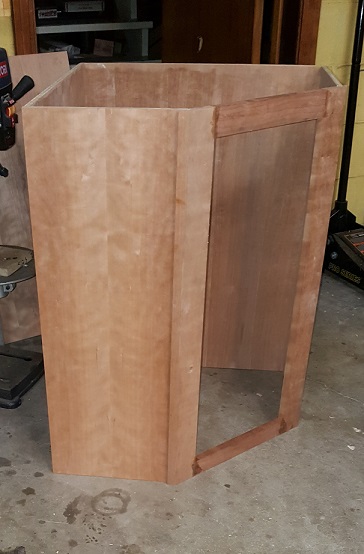
I planed the plywood for my last (plywood) cabinet today. It was quick and far more enjoyable than the process that I've used for all of the others (progressive sanding). The plywood is rotary sawn stuff. I think it probably takes me more time to sand, but I never timed it. If I hadn't been chasing this efficiency, I'd never have found a good way to plane plywood. You can scrape it instead, of course, but it takes about the same amount of time and is more dusty. I made a mistake sanding the rest of it, but it's too late - the rest of the cabinets are already done and finished.


Efficient would be buying all of this stuff, but enjoyable is being able to do parts of it with minimal time where you're either holding something vibrating or not doing work (e.g, solving tearout issues, etc). That means lowering risk.

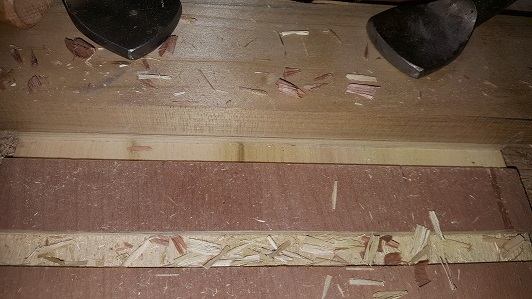
After buying a nice plunge router and routing every groove in all of these cabinets, I reset a dado plane today to 0.48 inches. I wish I'd have never used power tools for any part of this other than cutting the panels out. I'm headed back to the shop now to pin the sides all in a row and cut the last dados.


Everyone has to choose what's enjoyable to them. Trying to work entirely by hand with single iron planes (which I thought was the solution 7 or 8 years ago) made for a lot less enjoyment, unexpected tearout, no feeling of progress with certain parts of the process and overshot marks. The double iron is a great way to work slow.

Re: LV replacement cap irons......

#54

Re: Sandpaper

Charlie

Doesn't matter all that much, if at all:

http://www.finewoodworking.com/2006/09/01/sand-scrape-or-plane (requires membership)

We all railed and screamed about this on Knots, but in the end were just making a bunch of useless noise.

Re: LV replacement cap irons......

#55

Re: Sandpaper

Warren in Lancaster, PA

I don't know if you read this forum's discussion in 2006, Charlie, but in the Fine Woodworking article comparing sanding and planing, for every finish compared, the guy fellow prepared one planed sample and one sanded sample. Then he applied a thin coat of finish and sanded the sealer coat. Every single sample was sanded at this stage. So he was comparing sanded samples with sanded samples and not surprisingly could not see a difference.

When I pointed this out on this forum, some acquaintance of the author berated me for being hard on the author, a young guy without much experience.

If you can't see a difference, it might have something to do with planing skill, or finishing skill, or discernment.

Re: LV replacement cap irons......

#56

Re: Sandpaper

Charlie

OK, show me the difference.

Re: LV replacement cap irons......

#57

Re: Sandpaper

david weaver

Hey Charlie, you often ask people to do things for you. Why don't you do your best job at planing, apply finish (something rubbed and not sanded heavily) and show us the difference.

Then if you can't seem to show it, other people will see if they can show a difference (I will, but I'm not going to do anything until you try first, since you're always ready to offer someone else's time, but you disappear when you have to show something of your own).

I'm sure you can spare the time, it's not tax season yet. How about you refer to something you did rather than something fine woodworking, or tage frid or someone else did. There's no great legitimacy to the writers in the magazines. You want to know how I know that? I have received requests to write articles for them.

Re: LV replacement cap irons......

#58

Re: Sandpaper

Charlie

Warren, a light leveling of a film finish with a fine abrasive is far from being tantamount to finish sanding the raw wood.

Re: LV replacement cap irons......

#59

Re: Sandpaper

Charlie

There is no difference David. There just isn't. Hell, I wanted there to be a difference. My wife, who has art degrees, finally poked a hole in that balloon for me. She has an extremely discerning eye and simply cannot see a difference, and when I'm honest with myself I cannot either, even under good light and a bit of magnification. No way in Hades with a piece sitting in a room.

The FW article and test was valid. All Tuckman (who is a psychologist with a Ph.D. -- not a dummy!) did was level the film finish with fine abrasives. He did not sand through the finish back to bare wood. What he did was not tantamount to prepping bare wood with sandpaper as a last step, not even close.

Re: LV replacement cap irons......

#60

Re: Sandpaper

Charlie

Not being able to get a gorgeous finish off scrapers and sandpaper, if not paper alone, would be news to this guy, a far better furnituremaker and artist than I'll ever be:

http://dannykamerath.com/vessels/#/sculptural-bowls/

Re: LV replacement cap irons......

#61

Re: Sandpaper

TM Stock

I'm looking...and not seeing the difference under any finish that forms a film. Agree on unfilled stuff like oil or wiping varnish.

Maybe y'all can hazard a guess at which one did not see sandpaper until the grain was fully sealed.


Re: LV replacement cap irons......

#62

Re: Sandpaper

Warren in Lancaster, PA

Todd, thank you for posting pictures, but it is hard to judge by a photograph. Also I don't know enough about your finishing to know why you would want to sand after a seal coat. I can't remember doing that in 40 years myself.

Re: LV replacement cap irons......

#63

Re: Sandpaper

Brian Holcombe

Charlie it’s most obvious with fine softwoods in my opinion. The better the job you do with both the less obvious the differences are but there is a practical difference in that planed surfaces absorb less finish and are generally more water repellant. The whole of Japanese traditional architecture relies upon this, the wooden structures are simply planed to a finish and left that way. They age better than sanded and film finished structures.

Re: LV replacement cap irons......

#64

Re: Sandpaper

TM Stock

All are epoxy pore fill (clear pore filler - long path lengths and high index of refraction), lacquer-based sealer, and lacquer top coats. 3.5 mil final thickness, which will thin to under 2.5 mil in a decade or so. I'd prefer to work in varnish, but few customers ask for it, despite how much better it is re: longevity versus nitrocellulose. Standards for instrument finishes are a constant topic of complaint for those transitioning to the craft from other woodworking fields - I knew few cabinetmakers that would job out a finish, while it's pretty common for instrument builders to do so.

I agree re: photos - my limited skills as a photographer don't do any of these instruments justice. At some point, I'll have a completed instrument in the shop long enough after completion for pro shots before it ships.

Re: LV replacement cap irons......

#65

Re: Sandpaper

Patrick Chase

I see Warren has already replied, and I expect he'll have said the same thing I'm about to, but...

That FWW comparison is misleading in the sense that it only applies to the sorts of film finishes that you're going to sand out anyway, and in fact the author did sand the "planed" and "scraped" pieces very early in the process (earlier than you would if you were trying your best to preserve surface quality). The comparison was basically "sanded vs sanded vs sanded", and unsurprisingly they all looked the same.

Garbage in, garbage out as they say.

Re: LV replacement cap irons......

#66

Re: Sandpaper

david weaver

Charlie, I haven't found much in your advice with buying or using planes vs. Warren's. I just don't think you're very good with a plane, but I also recognize that there is no well defined argument in dealing with you, so if I am to follow up the board at the top of this forum switching with planing and sanding to the opposite sides, and the planed side looks better, I expect that you'll shift the argument and maybe link the work of someone else, but not yours. I'm just not interested.

Perhaps I'll be wrong with the cherry board above, and when I flip flop planing and sanding the side that stands out will still stand out. I'm willing to wait and see.

Certainly, the fact that sanding consumes something and takes twice or three times as long is not particularly interesting. Might be different if I had 300 doors and a 75 horsepower three belt sander that finished at a high grit. I don't. I worked in that environment summers in college and found it not very stimulating. Definitely no planes in the building.

Re: LV replacement cap irons......

#67

Re: Sandpaper

Patrick Chase

If you want to see the difference then try using a low- or non-building finish for starters.

That was basically the original sin of the FWW article, in that it assumed a finishing process that first obliterated and then obscured surface structure. Contrary to what you say, sanding immediately after a thin base coat like that does disturb the wood's surface structure. The sandpaper and the surface both have texture that's on the same order as the film thickness, which means that there is interaction even if you don't see large-scale "cut through". 220# sandpaper has ~3 mil abrasive particles, whereas the thickness of that sealant layer is <1 mil after drying. Try it and look in the microscope (as I have) and it will be obvious enough. That's OK, though, because he then applied a building film finish that masked the resulting destruction.

You absolutely can produce "first rate" output with sandpaper, but only if your objective is to create pieces with finishes that don't show off the underlying surface. If you're trying for the Japanese "high-sheen unfinished" look that Brian describes then you'll be out of luck. Ditto for truly high-quality oil finishes and (IMO) some lower-build films.

Re: LV replacement cap irons......

#68

Re: Latest Development

david weaver

I am partial to the vintage sets, partly because I'm cheap, but also because I've become a bit of a crack addict for the mathieson/ward cap iron style.

However, those are very good looking sets. I always figured that if someone made those production and took the time to market them and sell and service customers, they'd have to be about $100, and that's around where they are. Certainly they eliminate some of the cross-ups that can happen with vintage sets, too, especially if you're expecting to buy one or 3 instead of 50.

Re: LV replacement cap irons......

#69

very interesting article *LINK*

Ron Harper

I would really be challenged to argue with this m


http://www.planemaker.com/articles_single_v_double.html

Re: LV replacement cap irons......

#70

Re: very interesting article

David weaver

I wouldn't. It wouldn't take me long to finish a volume of wood against a much fitter man with a single iron and do it much faster.

Larry makes all kinds of incorrect suppositions about double iron aspects and limitations, but it took me little time to study older planes and find put they were false.

I believed Larry at first because he talked a lot, but volume doesn't guarantee accuracy. Larry also believed it wasn't practical to expect someone to be able to set a cap iron at the close distances required, but it took me less than a week to do it. He simply isn't accurate because he probably never dimensions a significant volume of wood by hand, and he also had a main customer that doesn't allow double iron use in their museum.

Re: LV replacement cap irons......

#71

Re: very interesting article

Ron Harper

He sells a huge amout of planes to repeat customers

Re: LV replacement cap irons......

#72

Re: very interesting article

david weaver

Indeed, he does. In a non-competitive market to beginners (mostly) and museum workers who are hamstrung by curators who won't allow them to use double iron planes.

He does make nice planes. They're just dominated (game theory term) by double iron planes, and his thoughts/conclusions about the double iron plane are wrong.

If he tried to stick to his guns 200 years ago (when experienced users would've been his customers) , he'd go broke.

Here's things that he's incorrect about:

* double iron planes can be made sloppily (any can, but the early ones that eliminated his types were definitely not, and even into the early 1900s in england, they were not)

* the double iron is there to eliminate chatter for the most part. Very unlikely, though it's a nice side benefit - the double irons would've remained loose and less expensive to produce than slotted irons and caps with brass bosses and expensive screws if it wasn't important for the cap to be close to the edge (to break chips). The slot and screw was added because it makes a close stable set that lasts through plane depth adjustments.

* You can't use the full width of the iron, because a shaving trap is created between the top of the cap iron and the wedge fingers (it's not if the wedge fingers are sprung against the side and don't terminate well past the end of the cap iron hump (there's no reason for them to). Every plane I've made has been tested to take full width shavings without issue. It's quite possible that larry wasn't able to make one that didn't clog, but this point has been true on my planes and any reasonably well made plane with a well fitted wedge.

* There are no single iron planes around now from the late 18th and early 19th century because people favored them and used them up (I don't even know what to say to that one - wouldn't there be expended planes and spare irons around in droves? Nobody seems to throw away the spent double iron planes)

* People would've just used a thicker iron, but they were too difficult to sharpen. the soft part of the iron is easily cut with a coarse sandstone. It would've been no big deal for a shop craftsman to sharpen a thicker iron. The bit would've been no thicker, and that is the part that's really difficult to sharpen if it's too thick. Thick enough to eliminate chatter would've been 3/16th or so instead of 1/8th.

* You can't reliably set the double iron at a distance where it's effective. That's not true at all.

What is true is that double iron planes cost a great deal more than single iron planes, but they were bought by men who weren't made of money, almost without exception. It's very unlikely that this decision has to do with anything other than economics. A craftsman could do more work with a double iron plane, and in more woods. The extra cost must've been worth it, or the craftsmen would've just asked for a thicker single iron plane and spent their money on a grinding wheel or corundum.

We can see it very easily now - 100 board feet of lumber with each type of plane is enough to see the difference many times over. Few do that now, especially not for a living. The market is made of beginners, and beginners like easy. If they buy a plane and don't use it much, they're usually not upset.

I noticed in Larry's (excellent) moulding plane video that he has to skew his high angle smoother in wood that i have no trouble planing through with any double iron plane. There's no great pressure on him to do any blank sizing productively because he does his rough work with machines, and it appears that the final planes are sanded. This type of work is very easy to do with a standard stanley plane.

I understand that Larry was a carpenter before an arm issue sidelined him. I don't think he has a lot of experience cabinetmaking from rough wood with hand tools or he'd have come to a different conclusion very quickly.

This discussion could lead to all kinds of additional questions. Why don't I make planes for pay if I think the design is so great? Why have most of the follow-on makers copied Larry? Why doesn't CW allow single iron planes? Why aren't there double irons in specialty planes?

There are answers for all of those questions, but it's hardly worth the trouble to type them out, and I don't have interest in convincing people that they shouldn't buy single iron planes. People should buy whatever they like, but they shouldn't conted buying what they like is a substitute for what happened with professional users 200 years ago.

(Larry hates bevel up planes, too, and has all kinds of suppositions about why they are unproductive, but I'm pretty sure LV sells far more of those than Larry sells of his planes).
Re: LV replacement cap irons......

#73

Re: very interesting article

david weaver

Ron, have you been cross with me before? I know there are a couple of folks on here who don't favor me too much, but I'm OK with that. I just can't remember who they are. Larry's cross with me quite often!! Fortunately, George isn't. I adore George. value his advice above almost all others (I don't ask him too much about the Internal Revenue Code), and really enjoy talking to him.

Re: LV replacement cap irons......

#74

Re: Breaker, breaker, on mine, clear the pine

TomD

Let's not pick on the stragglers, David. That article, if I am not mistaken, was written (possibly revised since?) before the whole Super Surfacer thing came to light. He is talking about the lay of the land before the good work was done on breakers, and some of what he says is dead on. I think the audience at the time were mostly concerned with why these old tools were being sold without breakers, not with the yet to be discover passions of Japanese academics. What he was saying was perfectly in line with the year 2000ish ethos where millions of dollars were spoiled on bevel up planes, and I went to a Japanese plane making seminar and we were told not to bother with the breakers. Personally I had adapted a bevel down LV plane to take a breakerless iron, and had been leaving the subs out of my Jap. planes for 20 years. That was then.

Now Larry didn't take the Enlightenment all that well as I recall. But I think some of that could be attributed to the overselling it was presented with, which in turn was understandable given that the main exponents seemed to lack background on some of the issues they dragged in. Some of the critics also, it turned out...

It is really a lot simpler than most people let on. North of 90 percent of planes don't need breakers, and where breakers aren't needed they are a pain and hold you back. Many plane types have never been made with breakers. Today's hobby woodworker is pretty limited in the kinds of planing they do, so there is a great chance they will fall either entirely into, or outside of the realm of breakers or single blades. Until pretty recently, a lot of woodworkers kept a block plane in an apron pocket, and that was pretty much it, if they got that far at all.

My dad was brought up as the son of Joiner who ran a yard out back of the house. He watched with fascination how the workmen worked , and became a woodworker in his own domestic life, and built a lot of our furniture. I would say he never actually learned how to sharpen. In the 50s (?) he played chess with the then Irish champion, who was blind, so they played without a board, so it wasn't a mental deficit. The point being that it is difficult to know what information will actually help people get along in their work. Are we helping people with breaker talk, people who can't maybe sharpen? Did LV get it right with the bevel ups? I have no idea where the average consumer is on this stuff.

Re: LV replacement cap irons......

#75

Re: Breaker, breaker, on mine, clear the pine

david weaver

I like the way you put that, Larry didn't take the enlightenment that well. I think he's dug his trench deep enough that battle flexibility is gone. He'll have to stand there even if it's overrun.

The most confusing thing to me in all of this (having learned to use the cap well, and on the reasonably curly wood I often come up to, it's very useful - square an edge and no follow-up work, etc) is that the economic part of this whole argument was glossed over. That is the strongest conviction of all of this.

(we didn't have to wait for the videos to learn about it. I'd be beating the drum either way - I'd have just needed to make more youtube videos to show the details. Mark H put it perfectly, you get a huge pile of wood and you'll be looking for a better way. I just got 500 feet of cherry yesterday, am completely done with power tools and can't wait to start working it. It was hit or miss when I was using single iron planes, and I often had enough of working it by hand).

Curious what the 90% of planes are that don't work better with a cap iron, just as curious as I am regarding why Larry believes the single iron wooden plane to be so good and the bevel up iron plane to be so bad. I think the latter, he probably doesn't have experience with (just like the double iron) nor the ability to make, and he probably gets a lot of questions from buyers about whether they should buy a BU plane for figured woods or one of his steep smoothers. The reality is, the BU planes are more capable in figured woods than anything except a double iron plane, and the hang ups (long wear bevel on the face) are theoretical things that don't materialize in use.

👍 This page answered my questions

Your vote helps other woodworkers quickly find the answers and techniques that actually work in the shop.