WoodCentral Forums

Est. 1998 — 27 years of woodworking knowledge

Cap iron setback and shaving thickness

Posts

Re: Cap iron setback and shaving thickness

#126

Re: No tear stained defense needed..

Charlie

... and FWIW the leading edge of my cap iron is sharp enough to cut. I am no cap iron expert, but keeping it polished naturally keeps it a little bit sharp at its edge. Not sure how you would avoid it, or why you would want to.

Re: Cap iron setback and shaving thickness

#127

Cap iron sharpening

Patrick Chase

I think that Warren's point is that if your cap iron is set a reasonable distance from the edge, then you don't need to sharpen it very often to keep in in good condition. You certainly don't need to sharpen it "every time" you sharpen the iron.

In particular the cap-iron's edge sees no wear at all in normal use. Its face (where the shaving is "turned") can develop a concave "wear trench" over time, but you can go MANY iron sharpenings before you need to do anything about that.

Re: Cap iron setback and shaving thickness

#128

Re: Cap iron sharpening

Charlie

I usually run mine across my fine stone every other honing or so to keep it bright and clean. It produces a wire edge which I wipe off. It's an area that wants to rust anyway in my humid shop. It adds 30 seconds to a honing, if that.

Keeping the 'hump' clean and smooth will naturally produce a burr on the leading edge. Once removed, a sharp(ish) edge results. It certainly doesn't hurt anything, and might even be helpful at a very close setting when the need arises for one.

Re: Cap iron setback and shaving thickness

#129

Re: No tear stained defense needed..

david weaver

"""As a formula, or mnemonic device, his litany was that the mouth opening

(Jeff's aperture--another of those Latinate terms) should be no wider

than the shaving you want to produce, and the distance from the edge of

the cap iron to the cutting edge should be no more than the thickness of

the shaving you want to produce.""

I'll have to read this later, but all I can say is GAHHHH.

I'm sure there's some good stuff in it, but I wrote an article in 2012 at the time that I did (Through Bill, I told PWW at the time that I wasn't that sure what I'd come up with would stand the test of time, and a magazine article is a good way to get preliminary information put into permanent status) because people were throwing around numbers in the thousandths like this (shaving thickness equal to projection, etc) and talking about how they'd like to pair it with a closed mouth (extremely problematic).

Until patrick goaded me into it, I never measured a projection set - I think it's a waste of time. You can tell what the plane is doing by the shaving and the surface, and make adjustments as necessary and then do what "looks right" once you develop the sense. That is how we do pretty much everything that I can think of that is other than a straight line or parallel surface to a specific measurement. Measuring an edge or set is just a good way to ruin an edge or do something dumb because it "matches the instructions".

I get why Warren has always said this is a "subtle thing" instead of giving paint by numbers. It's subtle, but it's simple, and it is one of the ultimate examples of repetition providing improvement, even if you're not trying for improvement.

It also allows something else listed in that conversation, which is concern for surface uniformity rather than absolute sharpness. The washita is a fabulous stone to pair with the cap iron. You can eventually get almost as good as a finish stone with it, but the edge is extremely uniform and stays that way until the plane will no longer stay in the cut.

Re: Cap iron setback and shaving thickness

#130

Re: No tear stained defense needed..

david weaver

Thank you, Warren. I may have spoken too soon.

In terms of wear on a cap iron, I have two that have been used a reasonable amount with oxpho blue on the cap. One because the cap was ugly and oxpho blue made it less visibly ugly, and the other to see the cap against the back of the iron.

Oxpho's etch is extremely shallow - it can easily be worn off with use (hand touching, rubbing against wood), but enough of it still remains on those caps that they need not be refreshed even with that. It's sort of a canary for wear.

On the reasonability side otherwise, I've used my favorite stanley a lot over the last several years, and I don't really see evidence that the cap has changed at all on the leading edge.

These little details are what I'd like to see someone talk about, and I'm sure just about every competent cabinetmaker or apprentice 175 years ago would've been fully involved with these kinds of thoughts, but there's certainly a lack of it now.

Re: Cap iron setback and shaving thickness

#131

Re: Cap iron sharpening

david weaver

I haven't ever given any cap iron (other than a couple I tested 5 -6 years ago with various angles) any treatment after initial setup, and none (including the one of the whole bunch that I've used A LOT) show any visible sign of wear.

Re: Cap iron setback and shaving thickness

#132

Re: Cap iron sharpening

Charlie

You must be working some very clean wood my friend. I haven't had a shop space yet that didn't produce some smeg and rust on the hump of a cap iron where the shavings rub. I use pine as a secondary wood and it leaves its traces.

Re: Cap iron setback and shaving thickness

#133

Re: No tear stained defense needed..

Charlie

It's amazing how shavings produce almost visible to the eye wear (dulling) on the cutting iron, but virtually none on the much softer piece of metal less than a half a millimeter from the cutting edge.

I think Lucy's got some 'splainin to do....

Re: Cap iron setback and shaving thickness

#134

Re: Worn Through

david weaver

(I'm practicing using titles that are representative rather than making a long list of posts with a title that bears little resemblance to anything other than the first post.)

My wooden planes generally remove the first layer of crap with new lumber. Sometimes the lumber is dirty, but usually not so bad. Those are large shavings, and if the edge is bad enough, I just strike a line and cut it off. On the face, the jack plane takes off the junk. so far, I haven't noticed anything on it (the sole is very slick looking with some big scratches from various untoward things, like staples or accidentally running the plane across something, etc).

So, anything after that is working fairly clean wood.

However - point of the title - the very first #8 that I ever bought was sold to me by an unscrupulous seller. It had a diagonal groove down the center - to the left on the rear and to the right on the front - you know what I mean. The cap iron was split in two at the center. It must've been used to take the edge off of dirty wood, one after the other, and the seller neglected to mention that the cap was worn through in the center. Maybe it was stuck in some kind of fixture, I don't know.

So, if the wood is bad enough, I guess you can mess up the front of the cap (but that should be long gone before you get to your "fine" planes. Aside from that, if I have the cap set close and take a healthy swipe of filthy wood off (something I don't have that much of, but from time to time, you still get), I don't think much dirt contacts the cap iron - the underside of the dirty wood does.

Thanks, by the way, for the earnest participation in this discussion.

And, remember the picture of the wood with a bit of tearout that you rode me about in the article? You were certain that I must've seen it at some point, and that i allowed it as a "piece of wood that wasn't ready for finish". You're in the place to actually ask a question about that piece of wood. I'm still patting myself on the back for not making a big deal about it, because I tend to go all or none on most things, and on the human side of things, I actually recognized that folks were making an effort on their time and dime to edit an article that I put together.
Re: Cap iron setback and shaving thickness

#135

Re: No tear stained defense needed..

david weaver

Do you have a picture of the wear? Warren has stated no visible wear over a very long period of time, and I haven't seen any on my stanley 4.

I actually have the metallurgical scope now - we can see what a 4 that's (smooth) planed approximately 250 board feet looks like (that's smoothed from the try plane - what's that equivalent to in planer ripples? I don't know). I'm interested in it, because it appears more to have been burnished.

And it's genuinely curious to me, too. I sent Brian Holcombe a try plane with a later English iron that you can almost roll a burr on, but it will cut and cut with a very visible edge, yet the cap on that type of plane (that's doing heavier work) still has not shown any sign of needing a touch up.

I'll issue this challenge - you do more planing than me, I'd suspect. Don't hone your cap iron for a full year, and see what it looks like. If it gets unusable at some point, show us a picture of it.

WRT to the stanley that I mentioned above, it is set about as far from the edge as the pictures on here (about 6 thousandths) and I always use it the same way. One set of heavy shavings, one set of light ones. a "set" is whatever it takes to get a uniform finish across a board surface after the try plane, and then the second set at a lighter shaving is whatever it takes to do the same thing with a lighter shaving - with the latter, the cap iron is doing nothing. But I never set it off out of the way on a smoother, there's no point. Same as it's exceedingly rare that I set it that close on the try plane. It's probably more like 1 1/2 hundredths. If wood is problematic, increasing the shaving thickness a little bit actually improves the surface. I'm guessing in the 1 1/2, because a heavy cherry shaving is a hundredth, and in ash, it was about 60-70% of that.

Re: Cap iron setback and shaving thickness

#136

Re: No tear stained defense needed..

Charlie

No, I don't have pictures of any cap irons. I run them on a stone to keep them clean and bright. I'm not about to make that a separate process from honing the iron. All gets done at the same time. Bip, bam, done.

Re: Cap iron setback and shaving thickness

#137

Re: No tear stained defense needed..

david weaver

You could skip the bip bam, though. I promise that unless you're planing a tile setter's rub stone, you won't have a problem.

Re: Cap iron setback and shaving thickness

#138

Re: Worn Through

Charlie

My cap irons never fail to get dulled when planing anything. This is at a minimum. If planing resinous wood, they get sticky. Shavings stick to the sticky. Sticky stuff needs to come off. I do it at a honing stone usually lubricated with lamp oil or maybe kerosene (during the heating season), occasionally whatever oil I'm running in my old Jeep at the time. Doesn't seem to matter much. I clean the stones a few times a year so no big deal.

Hope all remains well. Cheers.

Re: Cap iron setback and shaving thickness

#139

Re: No tear stained defense needed..

Charlie

I roll the cap iron like the so-called "Grimsdale Method." It produces a burr, which I flex a little bit and then wipe off on on the end grain of my pine vise linings. I've nicked myself on the cap iron. It's sharp enough to cut, but I'm not trying to produce a sharp leading edge as much as I am trying to keep it bright and smooth. The sharpness is an afterthought. Even working them on a wire brush attachment to a grinder will produce a burr. The burr has to come off. What's left behind is a sharp, but not durable, edge.

Re: Cap iron setback and shaving thickness

#140

Set-back distance and measurebation

Patrick Chase

I want to be very clear that I spent more than a year using cap irons day in and day out without measuring setback, even though I had the ability to do so all along.

Basically I didn't want to worry about the numbers until I'd found a setup that worked. Even then I only did measurements to answer the specific question of whether it made sense to have the cap iron edge below the sole (i.e. setback less than cut_depth*sqrt(2) assuming common pitch).

Having now done the measurements, I agree with David: Blackburn's recommended configuration of cut_depth == set_back isn't particularly workable. Every time I've tried that configuration I've seen degraded (fuzzy) surface quality and greatly increased planing forces. I'm therefore not surprised that Warren observed "crushing" and low surface quality at the 2011 talk.

Let's give Blackburn credit though: He was a lot "more right" than most people at the time. He was off by about 50% in terms of ideal setback for difficult wood, while most were off by an order of magnitude at the time.

Re: Cap iron setback and shaving thickness

#141

Re: Set-back distance and measurebation

david weaver

It's easy to give out measurement suggestions like that without actually knowing what you're doing if you don't measure, too. And it's not an easy thing to measure without a microscope or high resolution camera.

Re: Cap iron setback and shaving thickness

#142

Re:cap iron sharpness and maintenance

steve voigt

Some thoughts on maintaining the cap iron (not directed to anyone in particular):

I use my main three bench planes daily, and has probably been a couple years since I did anything to the cap irons. Once they've been prepared properly, they should stay that way for a long time.

However, it depends on the type of cap iron, and on how they're prepared. Early on, I would prep my cap irons so that they were truly sharp, and the fragile edge would need occasional maintenance. Later, I found that a very slight dulling of the edge, just as part of the process of removing the burr, made maintenance unnecessary. It's important not to overdo this--you don't want a really blunt edge. I do this dulling by stropping (on leather) the crap out of the cap iron edge, in exactly the way that you're not supposed to strop a cutting tool--using lots of pressure and overshooting the angle on both sides.

It's interesting that Holzapffel (1850-ish) and Denning (1880-ish) refer to the cap iron as "moderately sharp" or "the dull iron." I think the above is what they were getting at.

This depends on the type of cap iron, though. A vintage woodie cap iron puts a lot of pressure on the tip, and I think an OEM Stanley does too. So there's no need for tricks like raising a burr with a burnisher. But a so-called "improved" modern cap iron hardly puts any pressure on the tip, so I can see why the burr would be necessary. But that traps you in an unending maintenance cycle. Some improvement.

Regarding resin: When I plane hardwoods, and I plane them almost every day, I don't get any resin build-up. The tip of the cap iron gets tarnished and discolored, but I don't care. When I am planing SYP for any length of time, the resin does build up, but a rag and some mineral spirits or acetone removes the resin easily; there is no need for honing.

Re: Cap iron setback and shaving thickness

#143

swingley thread

steve voigt

Yes, that swingley thread is certainly worth a read. It definitely supports the claim that Graham Blackburn knew what he was doing with the cap iron. It also shows how unwilling people were to hear that message. Virtually everyone else in the thread who engages the topic comes back with "Nah, fine mouths, steep angles, thin shavings, cap irons are for stiffening, yada yada yada."

Re: Cap iron setback and shaving thickness

#144

Re: Cap iron sharpening *LINK*

Patrick Chase

Kato and Kawai measured cap iron "breaking face" wear. Steve Elliott presented a translated and summarized version of their results in Figure 5 of the linked document. C_0 is probably the most relevant parameter.

Note that they were using a motorized setup that may have imposed higher loads than typically seen in hand planing.

Even assuming that K&K's results apply directly to hand planing, you shouldn't need to grind or hone the cap iron with anything like the frequency that Blackburn reportedly claimed.


http://planetuning.infillplane.com/html/review_of_cap_iron_study.html

Re: Cap iron setback and shaving thickness

#145

Blackburn

Warren in Lancaster, PA

I went to the lecture; I thought he was in the dark. I neglected to say that in addition to claiming that the cap iron should be set at the thickness of the shaving, he claimed that the mouth ought to be the thickness of the shaving as well. Try making a diagram. Even without the cap iron, (which would be below the surface), this is an clumsy situation at best.

The main problem, however was that he failed to grasp two very important points:

1) that the cap iron distance depended on the nature of the timber, and 2) that the object was to prepare a fine surface.

The double iron yields a finer surface than scraping or sanding in very little time. He had no idea.

I did see Andrew Hunter using a double iron Japanese plane at Williamsburg in January 2011. I would say his plane outperformed all that were for sale at WIA.

Re: Cap iron setback and shaving thickness

#146

Pictures

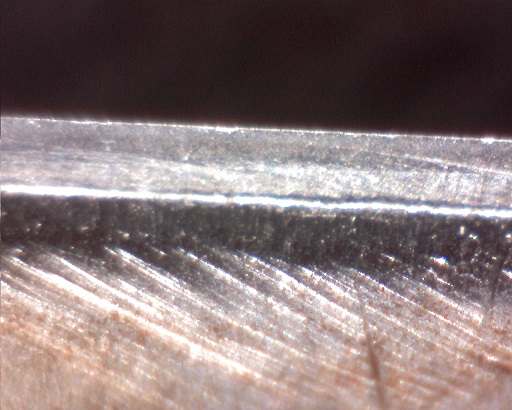
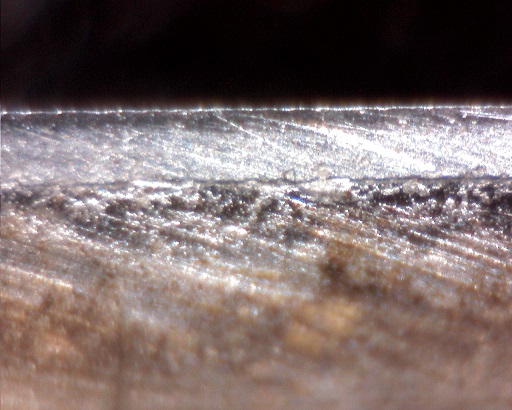
david weaver

From my 1970s stanley 4 - my favorite, but also the only stanley I've ever had where the iron was a bit soft even for my taste.

Center of the cap iron (the iron is of my own make - as in, just cut 3/32nd O1, file to fit, weed torch, quench and temper).


Neither sharpened nor reset, just pulled from my smoother. I did check this under the big scope - it's probably 5-6 thousandths. I can get a picture of the back of the iron with the big scope, but it won't focus well on the cap unless I put it up on something and do some strange setup - not worth it. So these are the cheap scope pictures (I think everyone with a computer should have one of these, they're $11 and they'll tell you everything you ever need to know except for the finest quality straight razor sharpening).

The left:


The right:


I don't remember what I was doing with this or why the camber is so gradual. It would normally have a couple of thousandths, but it's almost straight.

I also don't remember how I fitted the cap iron because I've been using it for a while. Probably washita and then removal of the very tough washita burr with dursol on leather. Nothing since.

I don't really understand the "cap iron gets dull" thing. Following Steve's post, it's not supposed to cut anything, it's supposed to redirect. It should be a little dull.

There's very little here to suggest degredation. The bright line at the edge may just be mostly burnishing from working the burr, off. I don't know. The fit is tight all the way along.

The tiny brown splotches might be pitch. I looked more closely at them, and they're not rust.

Re: Cap iron setback and shaving thickness

#147

Re: Blackburn

Patrick Chase

Warren, I think this is a case where some balance and benefit of the doubt would be helpful.

Blackburn didn't have anything like your understanding of the topic. Nobody else did back then that I know of, and very few (if any) do today. I certainly don't.

He certainly was on the right path, though. He unquestionably overshot the optimum and thereby lost out on creating truly finish-ready surfaces, but at least he wasn't part of the baying "high-angle pack"

Re: Cap iron setback and shaving thickness

#148

Cap iron sharpness

Patrick Chase

The edge of the cap iron should rest dead flat against the back of the main iron.

The wood tends to deflect away from the main iron as it's cut, such that for the most point it never even touches the edge of the cap iron. You can see this clearly in the K&K video and also the earlier German one that's made the rounds. That's why there's no ill effect from blunting the edge of the cap iron a tiny bit as David, Steve, and others have pointed out.

When properly set cap irons do wear it usually happens a small distance "up" the face from the edge, where the shaving impacts the cap iron.

Re: Cap iron setback and shaving thickness

#149

Andrew Hunter

Warren in Lancaster, PA

I edited my post to add that Andrew Hunter certainly knew what he was doing when he demonstrated a double iron Japanese plane at Williamsburg, January, 2011. I did not see anything at WIA that year that was in the same range of quality.

Re: Cap iron setback and shaving thickness

#150

Simple concept, easy 'splanation

Patrick Chase

The iron *cuts* the wood, with all of the resulting forces and wear concentrated at its (hopefully) very fine edge.

The cap iron *deflects* the wood, using a much larger flat region a bit behind its edge. The forces are both lower (due to the fundamental difference between cutting and deflecting) and distributed across a much larger area. The result is vastly slower wear.

This should not be a difficult concept to understand.

👍 This page answered my questions

Your vote helps other woodworkers quickly find the answers and techniques that actually work in the shop.