Re: "Planecraft"
Charlie Stanford
All the very close cap iron setting 'stuff' was indeed in Planecraft all along. But so were scraping and sanding. No need to throw any babies out with bathwater. Don't deplete your arsenal unnecessarily.
Est. 1998 — 27 years of woodworking knowledge
Re: "Planecraft"
Charlie Stanford
All the very close cap iron setting 'stuff' was indeed in Planecraft all along. But so were scraping and sanding. No need to throw any babies out with bathwater. Don't deplete your arsenal unnecessarily.
Re: "Planecraft"
david weaver
Not sure that anyone has advocated that. I make more planes than anything else (surprise) and I've never made a moulding plane without sanding (and scraping) or a bench plane without scraping the handles (no sanding on those).
I like what hasluck has to say about sanding, though (or whoever wrote the bit in his book on that).
Re: "Planecraft"
Warren in Lancaster, PA
The big difference between the Planecraft era and what we are doing today is the scraping and sanding. The use of the double iron is an art. If you are planing well, both scraping and sanding will degrade the surface.
Re: "Planecraft"
Charlie
What's your strategy for hand wrought mouldings?
Re: "Planecraft"
Warren in Lancaster, PA
Mouldings look best when they are made with moulding planes and not scraped or sanded. Crisp and clean. I generally use near perfect timber for mouldings. I take care to orient the stock in a favorable direction (usually on two adjacent planes, top and side). I also sometimes plane the stock on a taper to change the orientation 5 degrees or so to get an even more favorable situation. And if there are problems I sharpen the iron and take thin shavings at the end.
I have 45, 50, 55, and 60 degree moulding planes. I like 60 degrees the least. There are tradeoffs here because the lower angle mouldings look slightly better and and higher angles are slightly less prone to tearing.
Re: "Planecraft"
Charlie
But 60* is really scraping as much as anything.
Re: "Planecraft"
Warren in Lancaster, PA
I did say that I liked a 60 degree moulding plane the least. Even so I think you get a much more uniform surface with a 60 degree plane than going back with a little curved scraper (or sandpaper) and trying to doctor a torn surface.
Re: "Planecraft"
Charlie
I assume the difference under a finish between the essentially scraped mouldings and the planed straight parts is essentially immaterial. It seems to be to me, but my vision deteriorates with each passing year.
Re: "Planecraft"
Patrick Chase
I think I've said this before, but a properly "hooked" scraper has remarkably similar cutting mechanics to a double iron.
The tip of the hook forms a relatively low-angle cutting edge, then the face of the scraper acts to drive the chip back into the workpiece and prevent tearout.
I've never been able to get the hooks of my scrapers sharp enough to equal the surface quality from a well-tuned plane, though. As Warren says everything you do after planing is a compromise in that respect.
Re: "Planecraft"
Patrick Chase
60 deg is very much cutting, not scraping.
IMO there's no comparison between a moulding cut with a high-angle moulding plane and one cut with a scratch stock (which is truly scraping). The plane wins hands-down.
Hooked scrapers are actually cutting tools and are a different matter, but those aren't generally used for mouldings.
Re: "Planecraft"
Charlie
I'm sure makers of high-pitched bench planes would agree with you Patrick.
Re: "Planecraft"
Patrick Chase
It's not clear to me what you're trying to imply. I would hope they agree, as it's a simple statement of incontrovertible fact.
If you plane a board with a well-tuned 60 deg plane (I have 62 deg frogs for a couple of my bench planes) you'll see that it produces full-length continuous shavings. The resulting surface is smooth, though not "glassy" as from a common-pitch plane. If you examine the surface under a microscope, as I have, you'll see that its structure has been cleanly cut for the most part (though again with more disruption than from a lower-angle plane).
Now plane the same board with an unhooked scraper of the sort that would be used for mouldings, in a scratch stock or similar. The shavings are "powdery" and much less cohesive/continuous. The surface quality is noticeably more "dull" and "fuzzy" at the macro level, and exhibits much greater structural disruption under the scope. It's not as bad as a sanded surface, but it's clearly the result of very different cutting mechanics than the plane.
If you honestly think that scraping and planing with a 60 deg plane are equivalent, then you've either never *really* looked at the results, or you don't know how to tune/use a plane.
Re: "Planecraft"
david weaver
I don't think I have a scraper plane at this point (sometimes it's hard to remember what you've sold, but the last thing I had of that type was a LN 212 or whatever the little bronze one is called).
If you follow the method that charlesworth espouses and use a truly smooth burnisher (polish it yourself if you have to) so that the hook is continuous and perfect, then you can get a surface on hard maple and harder that looks very similar to a planed surface. Softer? Not so much.
You can roll the burr to be quite large if your process is good (charlesworth suggests an angled fixture to get this kind of precision, and it definitely gets you there faster, but you can do it without once you have touch).
What I recall of the large scraper plane is that the shaving is an awful lot like a little bit too closely set cap iron. It's shorter, straight and wavy. That is, if you're taking a healthy shaving for a given burr.
Like the single iron plane, it suffers in terms of economy of effort when compared to the double iron plane. Does it matter if you have a lunch box planer? Probably not. Does it matter if you have six panels of curly maple that have been set aside for a day when the weather changes before you do final surfacing. It matters a TON. That particular activity convinced me to pitch high angle planes and sell the large scraper plane that I had (the small one is useful for japanese planes, but you can make something really simple and cheap to do that job, too, or (look away, brian) use a hand held burred heavy scraper to scrape the hollow slightly less neatly).
In deference to Charlie's comment that I don't build much furniture, I still have those six panels (as well as the rails), waiting to be built into a curly maple and cherry blanket chest that was in FWW at one time. In this case, procrastination has paid off, as the original design had through tenons, and I'd never let such a thing show these days - I am no Brian Holcombe, that's for sure. I also laid the finish on thick and rubbed it out in those days - something that needs to be removed from those panels.
Anyway, that's the last thing I scraped in earnest, and I bought the small LN scraper plane to do it after, I believe it was Wiley, commented that it followed the contours of a surface much better.
The 63 degree plane that mujingfang makes proved to be worthless (it was either slow or impossible to push with little in between, and the surface on soft curly maple would've needed sanding to be finalized). The Large scraper plane proved to be worthless and endless frustration (same thing - big footprint that needs a surface to be dead flat, and little ability to remove any significant amount of material) - the small LN scraper followed the undulations much better. A simple stanley planes it with ease. A costly lesson overall. A pro would've done all of the work that I did on the same day they ran the panels through a drum sander, but I didn't have that option.
Deference from Charlie now back to Warren - history wins again.
Re: "Planecraft"
TomD
"The big difference between the Planecraft era and what we are doing today is the scraping and sanding. The use of the double iron is an art. If you are planing well, both scraping and sanding will degrade the surface."
It was ever thus, nothing new.
It also depends a lot on what you are doing and what is at stake. I don't do marketry. I do do planing. I wonder if I would try to plane marketry if I did it. I do plane guitar parts all the time. I am still going to have to sand plenty. Once you break that shinny surface somewhere, it is all going to have to be made uniform.
Re: "Planecraft"
Charlie
I get along OK.
Re: "Planecraft"
Brian Holcombe
I probably should not admit this publicly but I've tuned the sole of my radius and
Spoon planes with a rasp, so a card scraper on a hira-Kanna no longer bothers me at all. 
My apologies
Patrick Chase
That was a cheap (and obviously bogus) shot in my previous post, sorry about that.
Is it possible that you're talking about hooked scrapers while I'm thinking in terms of unhooked scratch stocks? The subthread started out with Warren's moulding planes, so I assumed we were confined to the latter.
As David says, well-tuned hooked scrapers can get into the ballpark with planes, which is unsurprising since they actually cut at acute angles like a plane.
Re: Burr and Hardness
david weaver
I think that the burrs on the A2 irons are about 52 hardness. For some reason, they last longer than saw temper burrs that I've used, and the difference is more than planes - but I'm not about to spend much time thinking about why that is.
I was just surprised by the surface quality on maple, and how thick of a shaving you can take. And then on top of that, how long the burr lasted compared to the hand scrapers I've used.
Re: Burr and Hardness
Patrick Chase
Which A2 irons? The one in the LN 212?
As I've mentioned a couple times, high[er] alloy steels like A2 can have good wear resistance even at lower hardness because of the presence of super-hard carbides along the edge. One grossly simplified mental model that might help is to think of those carbides as being like the carbide teeth on a circular saw blade.
The catch is that the edge has to degrade a bit before those carbides are exposed enough to "shoulder the load" and prevent further edge wear, hence the old jibe about "holding a crappy edge forever".
One other thing to note here is that edge angle is the single most important determinant of whether carbides will chip out or stay in place and act to prevent wear. The more obtuse the edge the better supported the carbides along the tip will be. That's why higher-alloy steels tend to have higher "critical angles" (minimum edge angle to avoid pathological chipping) than lower-alloy steels. This is also why those Blue Spruce A2 *paring* chisels are insane IMO :-).
Scapers, even hooked/burred ones, are a pretty friendly application for a carbide-rich steel for that reason.
Re: Burr and Hardness
david weaver
You're probably right about the carbides. IIRC, the LN irons are definitely harder, too, and the care in rolling a huge smooth burr is also helpful for continuous cutting.
All in all, nice kit (all of them - between me and the Englishman who got me into woodworking, we've pretty much tried everything - both scrub planes, bevel up planes, bench planes, three of the scrapers, etc). The Englishman still has his stuff. I have two boggs shaves, a custom plane and a bronze 4 and that's about it. The rest is gone.
While it's novel to perfect that stuff on the scraper and really get a long wearing burr, it's sort of like heading to a four cylinder turbocharged drag race with a repowered but otherwise stock crown victoria when you compare the scrapers to a simple cheap double iron plane. You can make the crown vic fast for a crown vic, but you can't hang with a guy in an old civic that's had all of the guts removed because his car is superior for the purpose.
Re: "Planecraft"
TM Stock
First woodworking book I owned. Dad had a battered old copy with missing coverboard...when I moved out at 18, I did not have access to his library, so picked up the Woodcraft reprint a few years later.
Re: Correction
TM Stock
I have no doubt you'll pick the plane thing up by and by even without my tuition - have faith, as it is a relatively simple tool. On the subject of crafting a properly snarky reply, it's apparent from your last effort that I can probably be of somewhat greater assistance ;-)
Re: Correction *LINK*
Warren in Lancaster, PA
Todd Stock wrote:
When I checked out of WoodCentral around 2007, this knowledge was something I took for granted...certainly common knowledge in the 1970's for anyone working with hand planes, which is when I must have absorbed it from the boat carpenters on the Eastport side of Spa Creek. Not sure how something becomes arcana so quickly.
Here is a thread in which you participated, February 2005, six weeks before I joined this forum. Not a mention of the double iron.
http://www.woodcentral.com/woodworking/forum/archives_handtools.pl/bid/3105/md/read/id/57881/sbj/i-also-believe-that-labu-is-superior-to/
Re: The most likely
david weaver
...repeating myself, but Steve and I had this conversation at least once (and so did Chris Griggs and I, Chris was my guinea pig for explanations before writing anything about the cap iron).
The thing that drove me to the cap iron (seeing these very old conversations about "this new thing is superior" is humorous - and so are some of the old dynamics - some frustrated users from those threads are gone) is likelihood. My day job involves a lot of it.
There are things that are unlikely:
* that someone who knows how to use a double iron well will talk about much else for anything other than curved surfaces
* that double iron planes showed up for a higher cost and people with little income purchased them for any reason other than economic gain
* that someone who claims to have known all about the double iron really did, but never said anything until after the fact
I could probably make a list of ten points.
I don't doubt that a lot of people heard of it being a method of controlling tearout (but most people seem to forget that they did until someone else reminds them), but I doubt many people were using it capably (because doing so pretty much wipes out other things. For example, charlie often talks about scraping and sanding being easier and customers don't care. I scrape flat surfaces from time to time, but I always end up with more marking from a scraper with a sheer finish than I do with a plane).
I have my doubts about the OP here, either. A gutter plane with a cap iron isn't going to be the same as a smoother used for closer work.
Re: Cap iron setback and shaving thickness
Bridger
Warren-
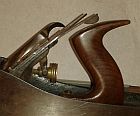
Any tips on how to radius the chipbreaker to follow the camber of the edge while maintaining clearance? It seems to me like the trick of resting the top of the chipbreaker on the bench while honing the bevel of it would produce gaps at the corners.
Thanks
Bridger