Home Articles Forums Gallery Marketplace Videos

WoodCentral Forums

Knowledge You Can Build On — Est. 1998

What makes the "handtool" look?

Posts

Re: What makes the "handtool" look?

#51

printing..

david weaver

..it's only a matter of time before someone develops printers that can print materials rather than just shapes. Whether it's 50 years or what, who knows? It only needs to be perfected once and then it can be copied everywhere (and there's no requirement that copied wood has to be made of wood or cellulose, it could be any material that looks and feels the same).

Cost will always be a factor, though.

If someone develops a machine that can print what looks like hand work 10 years from now, I'll still do hand work. It feels good. Of course, I wish I could do it better like everyone who is mediocre wishes, but it still feels good nonetheless!

Re: What makes the "handtool" look?

#52

Re: I'm back to what is the objective

david weaver

I'm not going to speak for Brian, but I will say from my perspective that it is possible to do a lot of things with machines that can be done by hand. But when the rubber hits the road, human nature has people cutting corners and adapting designs to machines. Even nice ones. Warren has mentioned one reason - cost to do things that are simple by hand vs. what they are with machines. Human nature itself and economy of effort (some would call it laziness) will leave people saying, even if it's an effort issue more than cost, "well, it doesn't have to look *exactly* the same".

And I'm not entirely hand tool like warren. I have a bunch of small power tools, just no big stationary ones. Your question about the strips, I probably would've done those with a machine, too, unless I was looking to make the project more interactive . It wouldn't be that hard to make them, but it might be difficult to make 20 of them as fast as you could with power tools.

Re: What makes the "handtool" look?

#53

Re: Caring WRT Handwork

david weaver

Brian, your perspective is good because you are dealing with a small segment of the market that actually cares.

A lot of these discussions come up, and if the general sentiment is that most people don't care how something is made, then it's extrapolated that nobody does and nobody can tell the difference.

I don't make anything for anyone, so I don't have access to customers, but I'm sure that as you get above folks who are comparing your works to something in a discount furniture outlet, there will be many who want something hand made. Same as people buying the finest silver from Tiffany's - if you gave them the option of something machine made vs. hand made, they would probably want hand made.

I was talking to George last night, and he mentioned that he was making tooling for a silversmith, who as he put it, made a bowl (hand hammered) that was hammered and finished so perfectly that he thought he could put it on his lathe and it would run practically true. A lot of people wouldn't buy a silver bowl in the first place, some would want the bowl to not be much more than the cost of silver (and prefer something made on machines in a method that was intended to suit the littlest labor possible), but the highest level of client will want the bowl to be hand hammered with the greatest skill possible because that is the top of the art.

If I could afford that kind of stuff, that's what I'd want, too.

Another

Re: What makes the "handtool" look?

#54

Not what I see

Kees

Those are very crisp lines! It's easier to see in this picture. (All these are on the wkfinetools website).


img

Re: What makes the "handtool" look?

#55

Re: I'm back to what is the objective

Kees

Yes it is about design. I am not quite sure yet what I want. Therefore this discussion. I am very interested though in this "handtool" look.

Re: What makes the "handtool" look?

#56

Re: comment

david weaver

Nothing stands out about the saws in the seaton chest?

They are just more finely made and with better lines than any saws I've ever seen with the possible exception of a couple of handles that George has made when he wasn't stuck copying someone else's designs.

More pictures of the handles are here.

http://contrib2.wkfinetools.com/hendricksJ/seatonCh/seatonCh-05.asp

It helps to make a few of these handles and attempt to make something to this standard to realize how good they are.

Maybe someone else could clarify if these were presentation tools, or if, in fact, they are just a set that didn't get used, and the maker made all of them to this extremely high standard.

Re: What makes the "handtool" look?

#57

Saw handles

Derek Cohen (in Perth, Australia)

The Kenyon Seaton saw handles are sublime.

David, I've made handles with crisp edges ( posted this earlier) ....


... and handles with rounded sides ..


The crisp edges take a LOT more care in the making. I cannot say that the rounded ones are more comfortable.

As to which is the better design, it is all in what pleases you.

Regards from Perth

Derek

Re: What makes the "handtool" look?

#58

Re: comment on comment

david weaver

Those saws are over 200 years old. Maybe I'm misinterpreting something, but those saws are not worked on any belt sander. They may have been planed by hand.

There is an extreme level of craftsmanship involved in them, though, because even if they are cleaned up by re-smoothing the flat, the curves done by hand have to be perfect or the once-perfect curves are no longer perfect after planing the flat cleanly. There's no guarantee that the seaton chest saws ever had such a second step done, though.

Wenzloff's saw handles are nice, especially given the price. But they are not anywhere near the same standard as the originals. I don't think anyone would make handles to that standard.

I talked to George briefly when he showed his groves saws and asked him how long it took to make a handle. He said about 5 hours (what he makes in 5 hours, most of us couldn't make in 10). I think he thought it might be novel to make a few more saws because of the reception he got to the two groves-looking saws that he made, and when I asked him what he'd expect for them, he said $500 without the filed spine, but he doesn't have a brake to fold backs now that he's retired (you can see the carefully flat-filed facets on these saws despite the fact that they are folded backs, and not slotted).


I'm not by any means demeaning mike's saws. I've made three (maybe it's four) from his kits, and his saws themselves are exceptionally nice for the price. Nobody is going to make a saw to George's standard or the kenyon standard for $200.

Re: What makes the "handtool" look?

#59

Re: I'm back to what is the objective

Warren in Lancaster, PA

You act like the design is everything. The execution is very important; the execution can even help flaws in the design.

Years ago people were getting computers to play Bach. Today you can take samplings of noise from a 1690 cello, played by a real person, and plug the samplings, corrected for pitch, into a program to play a flawless Bourree. Guess what? It stinks. The nuance that a real musician is able to add, and the warmth and charm he is able to impart, completely overwhelm any flaws.

Today a woodworker might spend 15 minutes sanding out a small defect to make it perfect, but then neglect to spend 5 seconds adjusting a curve that makes the whole thing look awkward. He doesn't even know it is his responsibility to make the design come alive.

Re: What makes the "handtool" look?

#60

Re: Saw handles

david weaver

Exactly - certainly there is preference, and some folks like the rounded look (I know I'm more stiff than most about preferring the handles with crisp lines). The handles with crisp lines, though, are more difficult to make well, as you say.

They are inspiring to try, though, and your top handle is a good one.

Re: What makes the "handtool" look?

#61

Adam's goal, as expressed to me

Chuck Nickerson

a few years ago, was to match the work of an adequate 18th century joiner in both quality and speed.

The goal of matching their speed put limits on the quality of his work.

In examining actual 18th century work he found the quality of 18th century work was at least in the ballpark of what he could do.

Everyone gets to choose their goal, but given his goal he uncovered a lot of stuff.

Re: What makes the "handtool" look?

#62

Re: Where is Adam Cherubini ?

William Duffield

He's back, and living in Bucks County, PA.

Watch the Forum of the Society of American Period Furniture Makers for an impending announcement of his appearance at an upcoming Del-Val Chapter event. I'll make a formal announcement when the notice is officially published.

Re: What makes the "handtool" look?

#63

Where was "why bother"?

John in NM

I don't recall seeing that sentiment, but then I'm at work sorting photos on another machine so I'm not reading closely.

There are lots of reasons to bother, IMHO, but one has to be sure to recognize that the reasons are the result of value judgements that vary from person to person - which is why I asked why does it matter? Answering that question should tell a person whether its worth bothering.

Re: What makes the "handtool" look?

#64

Re: comment (touchy feely alert)

Wiley Horne--So. Calif.

"And you want something to look like it was just tossed off spontaneously, not labored over."

The truth of Warren’s words struck me, as it did Kees. I attempted once an adaptation of the Greene & Greene Gamble House chiffonier. I tried hard to emulate the carved pulls, which were done by European craftsmen, who had been brought over and were living in the Pasadena arroyo beside the Rose Bowl. The European carvers’ work had flair, that tossed off look that Warren speaks of. I found I could look right at detailed photos of what they had done, and no matter how much I focused, mine at their best looked machined and rounded over—not imperfect, too exactly alike. The harder I worked, the effect stayed the same.

There is a description of this enigma in the book ‘The Unknown Craftsman’ by Soetsu Yanagi. He discusses it at length in the chapter ‘Hakeme’, which refers to Korean tea bowls. An item in universal use by all families and made quickly with no thought of art. The artisans laid on a white slip with brushes made of whatever lay to hand—hair, hemp fibre, rice straw ends, grasses, cotton rags……;They laid this slip on fast, which resulted in brush strokes showing. ‘Hakeme’ means brushstroke.

Japanese aesthetes found ineffable beauty in this Korean folk craft. It’s now in museums. Their artists and zen masters tried to reproduce it. They couldn’t get it right. No amount of artifice or intellectual effort could reproduce what the Koreans laid on with no conscious thought of beauty at all.

Yang reaches a conclusion…that the beauty of this sort of folk craft arises from ‘seeking freedom in the work’. The very opposite of bearing down, gritting the teeth, trying ever more diligently to eliminate error. You can’t get there by successive approximation.

Yanagi concludes that the natural effect begins with freedom in the mind, which after much, much repetition achieves a meld with the tool and the material. He ends by saying that ‘the brush and clay do not allow of dilettantism’, but rather that this sort of ‘freedom comes from infinite repetition of a technique’.

I think of this when I think of those European carvers making the cut they’ve made thousands of times effortlessly. A stab cut which I find most difficult. Their result is a lightness, a flair, where each little lobe of the pulls is, on inspection, unique and ever so slightly different from the others. The carver wasn’t thinking, ‘I’ll make you this way, and I’ll make you that way…etc. Surely they just did the work for the pay they got, while thinking of other things far away.

Wiley

Re: What makes the "handtool" look?

#65

Re: I'm back to what is the objective

Brian Holcombe

A great deal of it can be mechanized, I really have little qualms with this so long as quality is maintained. After all, I think modern life would be nearly impossible without machines and the benefit of that in good cases is that you can get quality products that are reasonably priced.

Consider the CH24 chair, truly a masterpiece of industrialized fine woodworking. Wegner worked out the prototype painstakingly, having designed and built it by hand many times until he felt it was ready to be produced, then worked with the shop until the shop was capable of producing top quality work quickly and effectively. The chair features a steam bent back rail, curved lamination support for the back, perfectly straight grained lumber, cut tenons and a hand woven seat...for $550.

I think in scenarios like this where the details are so thoroughly thought-of and a master cabinetmaker with training in architecture was employed to put it together, then it becomes a huge benefit and allows many many people who would otherwise not be capable of doing to enjoy good design and quality make.

I like handwork for different purpose, I find it both practical and awe inspiring. I'm able to produce what I consider to be high quality furniture in a limited space. To do the same thing with machines would require me to practically rent a warehouse space and buy some top quality european tools along with probably CNC equipment and even then I would still be using hand tools. They have not really been eliminated from top work, even in production scenarios.

CNC is really only so accurate and it does not leave a quality surface finish aside from the fact that it would be without tearout. So the parts must be further refined from that point and shops are typically employing skilled labor for that aspect of the work.

Re: What makes the "handtool" look?

#66

Re: Caring WRT Handwork

Brian Holcombe

I agree and the silver is an excellent comparison and the market is similar, there are customers who are buying basically machine made pieces at prices not far removed from their weight value and then there are people specifically looking for makers who specialized in what is called 'Hand Hammered' or otherwise goes by 'Hand Wrought' and they're made by few specialized makers who cater specifically to those seeking hand wrought.

My absolute favorite is from a small Chicago maker, Arts and Crafts period; LeBolt Sterling. Lebolt would commonly mark their work 'Hand Beaten'.

There are a good number of people looking for quality, not specifically hand work, but the two generally go hand in hand. I'm sure there are also people looking specifically for hand work, I would not be surprised. As an example, I know from my conversations with other makers that one in particular had a client requesting hand planed beams in their timber work.

Re: What makes the "handtool" look?

#67

ditto for turning

Bill Tindall, E.Tn.

I took a class with Alan Batty, a person that had worked in the British Trades all his previous life making "parts" on a lathe. One morning before class I took him a bun foot I had turned. It was good but something about it was not as good as the bun feet I had seen on old furniture. Alan chucked it in the lathe. One end had been sawed off its support and its center lost. No matter, Alan spun it up, bashed it a few times, while spinning!, and it miraculously centered itself. To this day I regret not asking-"how did you do that?!".

Alan took no more than 1/32 from part of the large diameter circumference, and adjusted one side of the cove, again by no more than 1/32, and it just popped. I have saved it for inspiration, and a reminder that I will never turn enough to get "perfect" at making turned objects.

Only a turner would notice the differences, so lack of perfection does not need to be an obstacle to making stuff that most everyone will admire. I am sure that Curtis Buchannan would be embarrassed by the spindles in his early chairs, from 30,000 spindle hindsight. Never-the-less, I'll bet their owners cherish them.

Which brings me back to the point, if you want hand tool work to be significant then the design needs to include some element where hand tool work matters- for example turning, carving & shaping, and inlay.

This is not to say that attractive design has to include hand tool work.

Re: What makes the "handtool" look?

#68

Re: I'm wondering ...

AZ in Colorado Springs

... whether or not you question might be about appearing "homemade" instead of hand made.

I remember helping someone who was making a rather elaborate shadow box as a table. Cherry, I think, for the sides, a glass top, felt for the inside bottom where the doodads were going to be. Then, for the legs his plan was to use 2x2s. Straight (well, as straight as they come at the BORG), plain ol' pine, lumber. I asked if he was planning to keep it in the basement, and then we had a discussion about design and tapering the legs and using a complementary species. I never did see how the project turned out.

Re: What makes the "handtool" look?

#69

What doesn't result in a hand tool look

Bill Tindall, E.Tn.


Operations where it doesn't matter. I am fitting the glass retainers in the display cabinet. All the fitting is with hand tools. So what. It doesn't contribute anything to desirable appearance. Maybe the arc does. It was cut on a band saw. Would a coping saw have resulted in a more desirable arc?

My conclusion is the look you desire has most to do with design. Where design calls for carving, shaping, turning, these operations must be done by hand tools for most attractive results.

As an aside, the curved retainer is a 3 piece bent lamination. I was relieved that the installation escutcheon pins will pull the gaps largely together when they are set. What's left is good enough.

Re: What makes the "handtool" look?

#70

Re: What doesn't result in a hand tool look

Kees

Well, yes if you want to make the handtool look obvious, you need to add some typical design elements that are best done by hand and try to put a bit of "schwung" into it.

Then there are of course the hidden clues, like the rough backboards, the gaping shoulderlines on the inside, the secondairy wood like pine, all those things you see in antique cabinets.

And then there are the subtle clues like Brian described, the wood choice, how the wood is used, the panel thickness etc.

Re: What makes the "handtool" look?

#71

Re: What doesn't result in a hand tool look

Derek Cohen (in Perth, Australia)

Well, yes if you want to make the handtool look obvious, you need to add some typical design elements that are best done by hand and try to put a bit of "schwung" into it.

Then there are of course the hidden clues, like the rough backboards, the gaping shoulderlines on the inside, the secondairy wood like pine, all those things you see in antique cabinets.

And then there are the subtle clues like Brian described, the wood choice, how the wood is used, the panel thickness etc.

Kees, this is what I have difficulty accepting. Or perhaps I am misunderstanding your argument.

I do understand that furniture in the past (to which we are referring) was built without the need to thickness all board to the same dimensions, such as when making panels. I know and accept this because I have done so enough times in the past to be familiar with the process (in the days pre-thicknesser/planer). The different board thicknesses do not show on the outside.

The inside of this table ..


... is referenced by the outer edges. Inside is a multitude of thicknesses ...


I also understand that one will take less care with other areas that are not seen. Even on drawers that are carefully made and have the most precious dovetails at the front, sizing and gaps on the rear dovetails may be ignored of lesser concern ...


But .. but ... but ... what has this to do with a "hand tool look"?

I think that we need to stop talking about a "hand tool look" and instead ascribe the warmth you are seeking to be a function of design and construction rather than construction alone. The signs of building quickly/efficiently by hand that are evident on the inside of a carcase are not welcome on the outside - there they are simply "sloppy" to me.

A piece that is well made using hand tools imparts a subtle variation in line, and this is charming, and for myself it is a desirable feature, however the warmth you speak of I believe comes from the design, per se. Take that dining table of yours: Your table is very angular, all straight lines. What could you do to soften this? Would it change if you planed the top with a hand plane?

I'm going to continue this conversation in a post of its own since I wish to illustrate this argument with an actual build. I am finishing off design preparations for the next piece, and I hope to post this soon.

Regards from Perth

Derek

Re: What makes the "handtool" look?

#72

Re: What doesn't result in a hand tool look

Kees

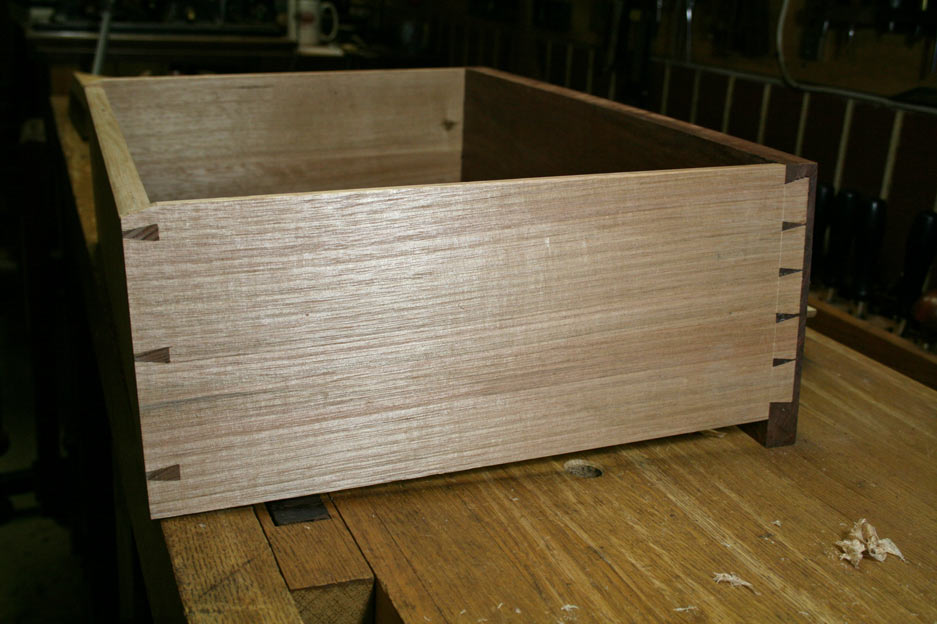
That depends if the sides of the planks are visible or not. For example on a tray, with dovetailed corners, the sides are very visible. Small variations in thickness would be a subtle clue. On most closed cabinets you wouldn't see it, but on a bookshelf?

I look forward to your build, always a pleasure to read and watch.

Re: What makes the "handtool" look?

#73

Affectation Vs. Artifact

Todd Stock

How does one sort through those choices and determine which are affectation and which are artifact? Are we consciously engaging in what smells a lot like virtue signaling, or do we put the labor hours in and let the result speak for itself, sans obvious symbology?

In my little area of craft, the standard of fit and finish is ridiculously high - essentially perfection in appearance and function if the maker wants to be able to sell at a reasonable price. Despite that standard - which would seem to reward eradication of both obvious and less-than-conscious signaling of 'handmade' - there exist a sufficient number of customers in the market that appear adept at identifying the project which required more hours and a greater level of commitment on the part of the maker. Which begs the question as to whether we are better off doing the very best work we can and trusting to the astute to reward our efforts, or adjust our design and execution to garner a larger audience through more obvious signaling of the great virtue of our work?

Re: What makes the "handtool" look?

#75

Virtue?

Bill Tindall, E.Tn.

The concept of virtue in building something escapes me. I build because I need a place to store my socks, or my granddaughter needs a place to store her socks.