This is a line of thought often
Chuck Nickerson
discussed and documented by Adam Cherubini and Joshua Klein, among others.
With luck, in 2018 I'll start planning my handtool-only projects (one out of six) to reflect these realities.
Knowledge You Can Build On — Est. 1998
This is a line of thought often
Chuck Nickerson
discussed and documented by Adam Cherubini and Joshua Klein, among others.
With luck, in 2018 I'll start planning my handtool-only projects (one out of six) to reflect these realities.
You guys are way too negative
Kees
about the taste of the average public. 
Luckily I only need to please my self and my wife.
Where is Adam Cherubini ?
Bill Tindall, E.Tn.
I used to enjoy his contributions here on WoodCentral.
Re: Where is Adam Cherubini ?
TomD
Yeah I was thinking of Adam in this context, because he went through a silly phase of thinking that the real authentic work was some kind of forced rustic. That we should do the hand tool equivalent of dragging our knuckles on the ground. He went off to greater things in the UK where he would had a chance to see a wider range of furniture from rustic to royal.
Re: What makes the "handtool" look? Mistakes?
TomD
Until quite recently, all work was done with hand tools and therefore the built environment look was a hand tool look. Machines have taken over most tasks, so the built environment is now mostly machine made, but still largely based on forms from a hand built time. It is dead simple to find masses of furniture styles that were conceived in a hand tool time, and are not made by machines today. The only thing is that they tend not to be the current taste in furnishings. Further, often the kind of people who like the hand tool thing, have even simpler tastes than the norm. Also, machines drove an oversimplification in style, both through their capabilities, but also by driving various ideas of perfection into the culture. These ideas show up in stuff like ideas about dwellings being "machines to live in". And the idea that machines should be ugly an utilitarian, which took about 100 years to filter into society.
Some options
1) Rustic. things like Windsor chairs where handwork is a product of the efficient building style. I would say I have never used a perfected machine made chair that didn't fall apart. One does stop looking after a while. I bought several Windsors for 25 bucks that are machine made and overly heavy, and very durable. And I was given a beautiful windsor, that fell apart. But only hand made chairs seem to survive.
2) The ornate. Highly carved pieces are impossible to produce with today's technology. There isn't a sufficient market to make the very best furniture by machine. Furniture is mostly a subtractive technology. Complex products like paintings, can be "printed" with modern machines, but carving is tough.
3) Find a vernacular for simplified forms that reveal that they are made by hand. I don't know of anyone that successfully does this, but the components can be assembled, and one could try and Haiku the parts into a whole. Faceted rounds and rippling flats.
At the end of the day, tools are a means to an end. Some end users seem to like the idea that things were hand made, though one wonders if that isn't dying off to some extent, and what it really means when almost anything can be called hand made, even CNC  .
Re: we do it for ourselves - Nietzsche nailed it
TomD
Yeah, virtue would be a tough one. Skill is even getting to be a stretch. There are so many jigs, involved in hand tool work, that a lot of it is pretty deskilled. Which creates a further problem: What is a hand tool. (Back to risk, which is silly in it's own way). A spear plane vs a hand plane, which is a hand tool? Is the Jointmaster a hand tool? And if it isn't why is a plane. What about LV's dovetailing jig? Not just to argue over definitions, but if one comes up with stuff that is hand toolie to make, someone will figure out how to do it with certainty by machine. And revolution of interest in hand tools over the last decade or so is basically a convergence of people getting bored with machines after 50 years, and media that is sophisticated enough that you can learn to use hand tools in ways that are largely deskilled. Which contrary to what people think, was the original idea.
Hand work was a way of making a living, and meeting basic human needs. God died (technically different thing from whether he exists), and so modern life is fundamentally awash, and without purpose. And the same thing happened to hand work, at roughly the same time, and machines took over. Getting value into an area where it never existed is going to be a toughie. Even funnier is seeing people trying to get ultimate value out of these tasks "fly fishing is my religion" kind of antics.
Re: comment
Warren in Lancaster, PA
I have known people whose work came up for sale 20 years later where the auction house thought something was 250 years old and it was not. or was shown in prestigious publications as 18th century. These were not Sapfm people. It makes a nice story, but nobody is happy when this happens.
Generally reproductions have different flaws than 18th century work, like doughy carvings, bland turnings and mouldings, crappy 21st century curves and on and on. The style, the charm, the liveliness are very important indicators of age. And you want something to look like it was just tossed off spontaneously, not labored over., Style and refinement were much more important in the 18th century; guys were not walking around in baggy tee shirts and shorts. Looking at high quality work and doing hand work and repetitive work help refine one's eye.
My experience after 40 years in the business is that people are interested in quality and price. They don't care what was done by hand. If the piece needs a lot of hand work it becomes very expensive for a power tool guy to make. His machines, 3/4 of his shop, and his investment in machine tool skills sit idle whenever he does hand work and in a lot of cases he is not all that fluid with hand work either.
Re: What makes the "handtool" look?
Don Stephan
What about a very small scratch bead, say 3/16" diameter, that shows imperfection. Perhaps a spot of torn grain, a flat spot, et cetera. Not sure router bits make smaller beads, with a narrow fillet on each side?
Perhaps...
John in NM
Could be that we are realistic - I'm not reading all that closely, but I do see a trend of "why does it matter?"
Well built is well built and has little to do with what tools were used - you can build great stuff with chisels, handsaws, and hand planes - or you can use a CNC router. If the furniture is well made and aesthetically pleasing, why would it matter to the end user how it was made?
Re: comment
Kees
The style, the charm, the liveliness are very important indicators of age. And you want something to look like it was just tossed off spontaneously, not labored over.,
This is important. When looking at the Kenyon saws from the Seaton chest, like I posted earlier, I think this very obvious. These are the nicest looking sawhandles I have ever seen. This the level of work I aspire to (but probably never reach). Clearly the result of a terrific craftsman with decades of experience.
In freehand, unjigged work, the strength of handtool design speaks the most.
Thanks gentleman
Kees
The discussion has been extremely helpfull, thanks.
Of course there was the argument about "why bother, nobody cares anyway". That was to expected and all part of the fun. But there have also been many great ideas. From stock selection, use of appropriate joinery to ornamental handwork to textured surfaces (not neccessarily rough, but handtool textured). And to the way to improve the handtool look, the "schwung" you need to put in your work.
Re: comment
Derek Cohen (in Perth, Australia)
In freehand, unjigged work, the strength of handtool design speaks the most.
Kees, when looking at the handles of these saws, ignoring the fact that we know that they were built in 1796, how do you determine that the quality of the work was due to the use of hand tools, per se, or that of an individual workman, who may have used a variety of methods?
Regards from Perth
Derek (playing devil's advocate)
Re: Perhaps...
TomD
Nothing other than fashion, price, and prestige maters to the end user, mostly. And one runs into people who sorta get it, but they are like US hockey fans who needed the fluro bouncing ball to follow the puck.
Where hand tools mater is in opening up the range of possibilities since the alternatives are very limited. Even blended woodworking is limited, assuming sufficient skill (rare), because people have a hard time turning off the little voice in their head that tell them that it isn't worth it. The problem is that since machines are 99% of the market, people don't care, and in fact identify superior craftsmanship still found in the third world with cheap goods, as an example. There isn't demand for what isn't there. It's like a war: the people that died don't write history.
Re: comment
TomD
It isn't your question Derek, but you can identify tools that are used by people working in a time when hand tools were all they had. They are either so primitive they show that the person didn't have cheap alternatives flooding the market, or actually are comfortable to use. Modern tool makers rarely make the mistake of making tools that are comfortable to use. It would be like pearls to swine. And this applies to a lot of extreme price tools also.
Re: comment
Kees
Mostly intuitively. I find it hard to put in words why it looks handmade. The roundovers run from wide to narrow in one nice sweep. The sides of the horns are incredibly narrow. It certainly looks very bold.
In contrast, that dovetail sawhandle from Gramercy that I posted, has been made on a CNC mill for the large part. Only a few small triangular nicks are filed by hand. That handle is a very good aproximation of handtool work, but it still looks mechanical and those filed nicks look like an afterthought.
But of course all this may be because I know how and when they were produced and I may easilly be fooled one way or another.
Re: What makes the "handtool" look?
TomD
"But what I am looking for is a more "human" touch. And I think most people recognise that imediately. Handtools are then just a means to an end.
No round over router bits, but carefull chamfers flowing in and out of the wood."
The funny thing is that the California round-over school of thinking was in part to make furniture touchable. The stuff that shows a human touch is often a lot less comfortable to be around. It doesn't have to be if we are talking clover leaf or pie crust edges. When my kids were young (I won't bore with pictures) I put a Becel Margarine container on their heads to function as a helmet, so they wouldn't be gored while crawling around the furniture. Character building.
Re: comment
TomD
"This is important. When looking at the Kenyon saws from the Seaton chest, like I posted earlier, I think this very obvious. These are the nicest looking sawhandles I have ever seen. This the level of work I aspire to (but probably never reach). Clearly the result of a terrific craftsman with decades of experience."
The pictured saws? They don't really stand out to me. One probably had to be there. If you didn't know where they came from would they impress?
What I find interesting though is the uncomfortable ornamentation. That speaks volumes. It has a granularity and pride one rarely sees today. The old school guys were showoffs. It isn't just how good a particular tool case was, it is that it was at all. Bill would remind us that the time taken was all time being taken away from making furniture for the kids. And many of us have wondered how they kept to just the tools so carefully enclosed in these cases. That speaks volumes also.
Re: comment
Derek Cohen (in Perth, Australia)
Hi Kees
Still with my devils hat on ...
Do you know for a fact that the Gramercy handles are made on a CNC machine? (I do not know, but have a vague memory of Joel mentioning to me at one time that production stalled as their handle maker was incapacitated - I could be quite wrong). The point I want to make is that some saws may have simple features because they are intended to create a particular style. In which case, the Gramercy may not be a good example.
I understand what you are saying, nevertheless, and I agree with your sentiments.
Here are two saws made by George Wilson. I think they are inspirational (they inspired me with a handle, below) ...

He made these for himself, and I very much doubt that he used machines (although he is comfortable doing so).
By contrast, George also made this saw, and I think that it was for Colonial Williamsburg ...

It is quite plain, and easily could have been made with a CNC machine.
Another example? At the top is the LN dovetail saw, and below it is the IT dovetail saw, which was the forerunner of the LN. There are notable differences in details when viewed close up (by someone looking for them). But I imagine both were made by hand ... ?
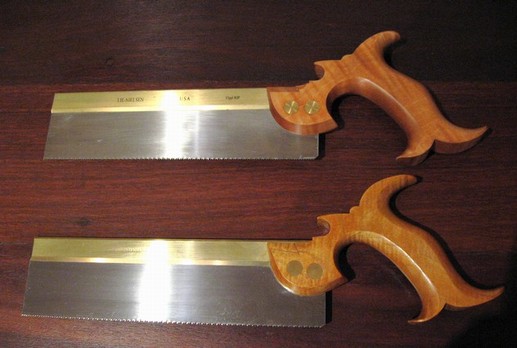
Here is a handle of mine. Can you tell what tools I used?

Regards from Perth
Derek
Re: comment
Kees
CNC is really confusing the market. They seem to be able to do things with 5-axis CNC that is going to be harder and harder to distinguish from hand tool work, if they are so inclined.
I read a blog from Joel once where he was explaining how they were making the handles.
And the handles you made certainly weren't created on a regular router table. There is one thing that is almost impossible on a router. The handle of the saw on your miter box shows it clearly, the inside rounding goes from nearly non existent to full round size in one nice swoop. And then all the tight, sharp corners in hard to reach areas. I'm not a router expert at all, but that looks quite impossible.
Disagree
Bill Tindall, E.Tn.
Your claim certainly applies to a saw from Home Depot. However, compare a LV shoulder plane to its vintage cousin, or the LV spoke shaves with their comfy handles, customized plane handles, etc. If you close your eyes to get by the jarring visual difference even the LV saws are a delight to hold. There are all sorts of modern chisels that have exceptional fit and finish.
Re: comment on comment
John Schtroumpf
1) Notice how the handles are smoothed over where they can be pressed against a narrow belt sander.
2) Notice how the round overs are crisper where the handles can't be pressed against a narrow belt sander.
3) See how these same traits are on the Wenzloff Early Kenyon Saws: http://www.wenzloffandsons.com/component/virtuemart/early-saws/early-kenyon-saws.html
My conclusion is that those saws were worked with machines

I'm back to what is the objective
Bill Tindall, E.Tn.
I think you are confusing design for how it's made. And maybe you want to believe that only something made with hand tools can achieve the kind of design you envision as best. Or maybe you believe that hand tool made is more desirable and are looking for confirmation in an attractive design that reveals hand tool made.
Again, there are some things where hand tool made is the only way to achieve the most refined result. These are the operations to advertise hand tool made, if that is the objective- turning, carving, inlay. The rest of the design features may be achieved how ever it suits the maker.
Caring WRT Handwork
Brian Holcombe
There are many knowledgable customers out there who do care about what they're buying and how it is made. They are interested to learn about the important aspects of the product they're buying.
It's the maker's job to explain why these details are important and why they're skill involved to make them. I typically show my clients in person how a hand plane can be used to finish a surface, for instance. Others I've cut sample joinery for them while they witness the process.
Look toward Nakashima or Maloof and you see the efforts these guys made in explaining the process to their clients. That showmanship and willingness to provide insight into what they consider important as craftsmen rewarded them with clientele that considered their work very highly.
The world will only understand that talent and skill are involved if you take the time to show that talent and skill are involved.
Re: comment
david weaver
I don't think the LN handles are made by hand. At one point, they charged about $100 for their dovetail saw, and then not long after, it was something like $125. Not sure what it is now.
I'm sure they are tooled up to make it. Their handle has a low radius and a lot of flat cross section on the sides, which is the kind of thing you'd see on a disston handle (who was probably the first to seriously mechanize saw handle making).
Amish
david weaver
The amish i ohio and PA (and I guess the mennonites, too) often take a basic design and round off all of the corners and soften the edges. If you ask them why, they will either say that it makes the furniture more comfortable or that they don't want kids running their eyes into corners of tables, etc.
I don't have much thought about the furniture makers who intentionally heavily round off absolutely everything, though. Transition lines in work generally aren't uncomfortable when the angle is very obtuse, and our eyes spend time looking for that kind of stuff, anyway - lines that define where things start and stop.
Same as the saw handles. There was a restorer who rounded off every single transition on saw handles they got under the guise that they (the transition lines) made the saw handles uncomfortable. I've never noticed them on an older saw handle, especially on one like the seaton handles -to suggest that they make a handle uncomfortable (given that they were on all of the old hand-made handles that would've been made any way a maker wanted to make them) sounds like a made-up reason to round off everything and sand the crap out of it just because it's easier.


