As the caption sais, it interests me to know how to enhance the design of a piece so it is obviously made with hand tools. What makes it look like it didn't roll out of a machine shop?
For example, in blacksmiths work it is pretty obvious. A forged piece looks quite different from a milled piece or a piece welded up from standard metal ware. For example, it is difficult on the anvil to create truelly parallel surfaces, but making them tapered is easy. So you often find tapers everywhere. (To be sure I can't really see if it was made under a triphammer or under the hammer). On a mill each taper asks for special rigging and lots of milling time so stuff tends to be more parallel.
But how do you recognise hand tools in woodwork? Let me give two examples.
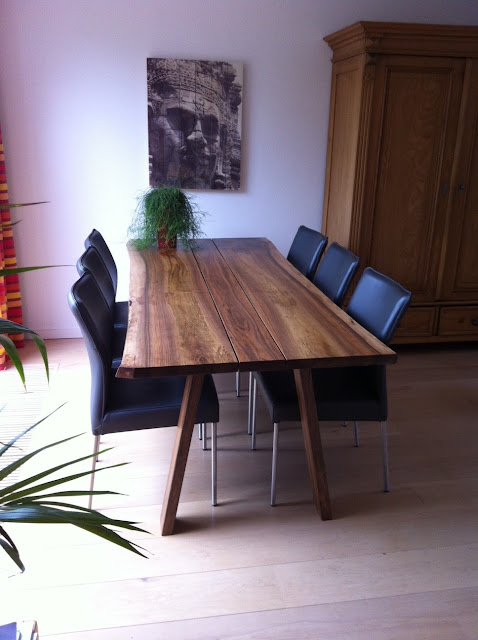
My dining room table. Made with handtools only. Lots of work. I like it, but to be honest it does show a machinists mind. You could make this on machines and it would look completely the same. Only the life edge asks for some spokeshaves probably. This life edge BTW started my interest in more freehand shaping.
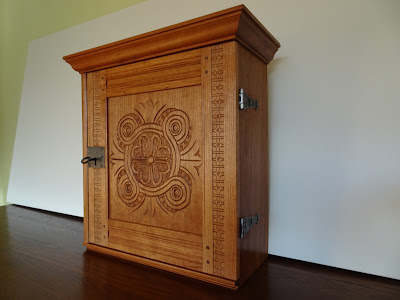
Here is a small cabinet I made. Mostly handtools, I did use the planer from time to time. This kind of work reminds much more of handtools. Of course the carving is obviously handtool work. The dovetails were far from regular, but they are mostly out of sight. The drawers inside are very primitive. The door panel is pretty roughly beveled on the inside.
Is it just the antique look of the cabinet versus the modern look of the table that makes most of the difference. One associates antique with handtools and modern with machines? Or is there a lot more?
What is the objective for revealing a piece was made with hand tools, entirely or partially? And related to that question whose eye needs to detect the way a piece was made?
To give someone that is not a woodworker a clue would involve leaving some obvious "defects" that would indicate hand shaping. Then again, here in the US flooring is sold with grooves machine milled into it that can be seen from 10 meters. It is called "hand scraped". When I hand scraped my floor I did it to achieve a result better than machine sanding!
I was at a craft show this weekend and a woodworker was asked if his dovetails were hand made. The person asking said he was a woodworker....of some sort. They were obviously(to me) not hand made. The furniture maker replied that if they were hand made there would be a scribe line on the drawer side. Well, as we know, that depends. From this experience we can see that advertising hand tool made from appearance is fraught with difficulty. Only a brass plate hand nailed with a cut nail to the side of the piece will ensure recognition.
Other than making it sloppy, can anyone ensure that a M&T joint will be revealed as hand made?
It seems to me that the only valid situation to flaunt "hand tool made" is where hand made is clearly superior in appearance. Inlay, complex shaping, turnings and carving done by hand is clearly more attractive even to a less than expert witness. Reserve the hand tool recognition for these operations. M&T joints, panel joints, etc.- who cares?
Personally, I don't go out of my way to tell anyone how a piece is made unless they ask. Most don't care. It is the appearance that counts.
I build windsor chairs. In my case hand tool use is obvious at first glance. However for case furniture,if done well it won't necessarily show. You have to look under the drawer,or inside the case for hand tool evidence. Dovetails are usually a dead giveaway. Machine cut dovetails are fairly obvious. Plane marks on undersides of tops or inside walls of dressers and such pieces. I don't think you'd want it to be obvious.---Jack
I think it would take a seasoned hand tool user to know in most cases.
I try not to make it obvious, though sometimes I'm tempted.
In many circumstances where a piece is typically made by machines, it's going to go unnoticed. Most slab tables are the product of a giant belt sander, so not many will recognize them as being a product of handwork unless you intentionally leave tool marks.
I've seen it done successfully and enjoy it when it is done well. I do so occasionally by texturing with spoon bottom planes, gouges or otherwise.
I am searching for a more human, natural or organic look. At the moment I am into this 17th century stuff which usually is far from perfect. I've always been more a fan of the prosaic. The upper floors in a well preserved mansion can be kind of boring while the kitchen downstairs is full of life.
The legs of my table are simple slabs. They look too skinny from this end while they look nice and meaty from the side. What if I had used stock twice as thick and had made them tapering, narrow at the top and wider at the bottom? Maybe even with a bit of a sweep towards the bottom?
Most people won't recognise if something is handmade but they do see if it is different.
And the handmade nature of M&T in very old stuff is often very obvious with tight shoulders on the outside but gaping on the inside and marking gauge lines all
The notion of furniture being "hand made" is only important to woodworkers, not the spouses of woodworkers, and clearly not the friends of woodworkers. Not one of my friends asks how I built something, and my wife never requests that I build something specifically with hand tools!
The difference between a piece that is made and finished with machines may or may not be different to a piece made by hand tools. There are hand tool users that will build furniture in a way that replicates machines, and there are machine users that are sensitive to the methods used by hand tool users of the past.
I think what you are asking is how to "soften" the work that you do - hard surfaces tend to look like they were completed on a jointer/planer. Hard edges can similarly look clinical.
My comment on previous occasions that this topic has arisen has been that, in part, this is a function of design and not tools and, in part, that the mere use of hand tools will leave a few irregularities, even when you strive for "perfect" work. I strive to do the best I can, and do not attempt to leave traces of tools used. Some do this, but I cannot identify with them.
At the end, I am not focussed on stating that the piece I built was "hand made" (because everything I build is, but no one is interested in that). Instead, I am focussed on stating that the piece is something I built, and if someone is interested I will describe the tools and methods used.
Indeed, no one will recognise that it is made with handtools. They are usually astonished that I made it myself! And then assume that I have a shop full of intricate machinery.
But what I am looking for is a more "human" touch. And I think most people recognise that imediately. Handtools are then just a means to an end.
No round over router bits, but carefull chamfers flowing in and out of the wood.
Another example, made with the simple scratch stock. Nothing special, just more "human". Or soft touch, if you want to call it like that.
I admire your work a lot and was looking forward to a reaction from you Brian. Handtool work has a strong tradition in Japanse woodworking, and if I am not too wrong then I think you take a lot of inspiration from Japan.
Is there anything in the shape of these items that draws from handtool use, other then surface textures?
But what I am looking for is a more "human" touch. And I think most people recognise that imediately. Handtools are then just a means to an end.
No round over router bits, but carefull chamfers flowing in and out of the wood.
Kees, you are preaching to the converted. Only those woodworkers who care about these things will know the difference. This forum is about these differences.
I have seen too many examples on the forums around the WWW to recognise that the level of proficiency, aesthetics and skill vary so widely. I see furniture and tools displayed with such pride ... yet only a mother could love it. The type of detail that you hold up as important is only recognised by those with some experience.
Every year I enter a piece of furniture in the local woodshow competition. No one asks whether the joinery was made with a mortice chisel or a Domino. There are no extra points for handwork. There are no extra points for hand planing the finish. Does anyone ask a carver whether their winning carving was made with chisel or grinder? (And, having said this, it irks me that the very irregularities I mention that are a function of hand tool work are marked down in these competitions!).
So you and I can tell the difference between a routered edge and a rasped and scraped one. Like you, I prefer the slight irregularities of the latter. If the irregularities are important to you, then use handtools that will naturally (not deliberately) create them. Do them for yourself. Others are less likely to notice or care how you did it.
The question was probably too subtle. I should have asked for a comparison with this saw. I think, believe, everybody immediately sees the difference, also when they don't know how they were made. And I think, believe, most people would choose the Kenyon saw immediately and intuitively.
Some people have what ever it takes to design something and no matter how it is made it achieves the look you want to achieve. I don't have this design creativity. So I copy stuff, more of less. Over time I have gotten somewhat better at design. But I still need to see some piece of furniture to get inspiration. Now days I am able to modify something I see and have it wind up looking acceptable. But I never start "from scratch".
I have a "file of inspiration". I have all the Fine Woodworking design books. I clip pictures out of magazines. I take pictures of things I like. Then when I need to make a chest of drawers I go to the file for inspiration.
If you can't invent the Maloof rocking chair then copy one after someone else invents it and be satisfied.
A trend I am not fond of is slabs of wood and live edges. Personally I don't see much design skill being employed when someone incorporates a shape already in the wood into a simple piece of furniture. But here I know that I am in a modern minority. I'm not that impressed by much modern art of any kind either.
Thank you! I think hand toolers just design things with an entirely different mindset. One of my fellow Japanese tool nuts is also primarily a hand tool user and when I look at his work its apparent to me some of the things he's done.
It's mainly subtle things that I don't believe would be very obvious at all to someone unfamiliar with using hand tools. I've noticed that hand toolers are very particular about wood grain, especially those that work with them for a living. When you have time constraints on your work, either imposed upon you or self imposed because you want to earn more you tend to be extremely careful at the point where choice has a great impact on your work. Choosing wood that is very straight grained is a priority. Figure is generally acceptable but knots are avoided.
The design begins to be effected by planing around planed surfaces, I've moved away from things that are aggravating to plane, such as book matched panels. Someone who sands to a finish is not even going to blink at a book matched panel but I avoid them because of the center being exact opposite grain on both sides of a line. I can plane it, I have, but it adds significant time so I tend to work around sequence matched panels.
The same goes for glue ups, I keep them to a bare minimum and typically I'm working them to make entirely certain that the grain direction is the same on all parts. I've not seen many machine toolers who would consider this, they're sanding to a finish and typically do not bother. There are notable exceptions and those are always the case when a person who uses machines will plane to a finish (with either super surfacer or hand planes) and must consider grain direction.
I plan chamfers into my design, this is something that is very common in traditional Japanese work, shoji for instance, where even the tenon shoulders are made to accommodate a heavy chamfer. Japanese carpenters plan chamfers into their joinery and it is very common to see joints intersecting in a way where they can completely avoid stopped chamfers. Stopped chamfers cannot be cut by a plane and they take longer, they also do not look as nice.
This carries forward into frame and panel design, typically I make the stiles thicker than I do the rails so that the joint can feature a small continuous chamfer.
I've not seen that consideration in machine tool work since the edge is typically just broken with a ROS after construction and in fact it would be significantly harder to finish a frame an panel door that has a stepped feature in it if one were finishing by way of sanding. By contrast if you are planing your parts to finish as you make them, than it is much easier to have a stepped frame and panel because you can take a few plane swipes over a finished stile without running over the rail cross grain.
Someone who works stock by hand does not often plan around hard numbers, so when I thickness a panel I'm often working with the numbers a bit differently than someone who is planning around a given dimension. I couldn't care what the dimension is, unless it begins to look incorrect. For instance, a slab top, if you measure mine they're all weird numbers, I don't look at a ruler when planning them, I joint one side, then set my gauge to the lowest point and plane it. At that point is done, I'm not taking off another 1/16" on a surface like that to meet a number. I do this on almost everything, I plan on proportion more than real numbers.
This, and more considerations all begin to add up to work which looks slightly different than work where someone is making with primarily machines. You can see it in my work if you go back earlier enough, especially my cabinet work, as I began to use a majority of hand tools my work changed a lot, but to the passer-by there is little difference.
This cabinet was done partially by hand and with machine tool thinking:
All of the shelves fit into stopped dados, the sides are all flush and the joints create stopped chamfers. Further more the design is made so that it can be done mainly with a router. The hand tool effort is limited to the visible aspects, like the corner joinery. The panels are also flush and feature grain and layout which requires sanding to finish.
No consideration for grain direction and planing, and the corners are left with hard edges.
This cabinet is entirely made by hand and planned accordingly.
One of my fellow Japanese tool nuts is also primarily a hand tool user and when I look at his work its apparent to me some of the things he's done.
It should say:
One of my fellow Japanese tool nuts is also primarily a hand tool user and when I look at his work its apparent to me some of the things he's done That are very similar to considerations I have also made. When I see it in the work of others it stands out to me more so than in my own work because I can step out of my thought process.
The saws are the perfect example. The first ones have humanity, and curves that look natural.
Furniture ends up being the same way. When it's done by hand, it ultimately ends up being less angular. Even simple case work where there are stopped dadoes, hand cut mouldings, beads, tongue and groove - the ultimate product is more human and less mechanical. It doesn't have to have errors to look more human, either.
Except George can design. But he recognizes bad design quickly because of that, and his suggestion is the same - if you can't design, you should copy pleasing design.
The other thing that isn't often said about design is that it requires a trained eye. I you take a silversmith and you ask them to design furniture, it will end up taking on a bunch of characteristics of silver pieces.
Tools that I have made is not a dead copy of anything necessarily, but I readily take proportions and elements off of good copies.
Funny you mention this aspect. I went through quite some head scratching when designing my kitchen. Chamfering the inside edges of rails and styles asks for some planning. Here is what I would call, the IKEA solution (nothing bad about IKEA, it's just an easy and cheap method that doesn't look so hot).
And this is a more traditional aproach with unequal shoulders. The outside shoulder is different from the inside to accomodate the chamfer.
This method was very time consuming. I think there are special routerbits for work like this so it isn't handtool specific. When working with moulded edges there are similar solutions.
Otherwise, thanks for your explanations. Lots to think about.
On hand work: don't expect the vast majority to notice, and intentionally leaving a bunch of tool tracks and other 'artifacts of the handmade process' seems like a a rationale for doing less than your best work or dull tools unless you are working in a vernacular style that calls for that sort of approach.
To expand on Derek's notion of who we aim to please with our work, I'll posit three groups exist for consideration: the sleepers, the woken, and the makers.
The vast majority of those that see our work will fall into the first category, and not because they are insensitive or crude or refuse to wash their hands before dinner, but because sleepers simply lack the interest in or - in some cases - the knowledge to move beyond the symbolic content of an object. While sleepers may have a significant degree of interaction with an object, that interaction is on the level of 'My feet hurt...I need to sit down...I see a chair which signals that it is reasonably comfortable...that feels better...ohhh...cute blond." Sleepers are evidence of the accuracy of G.K. Chesterton's observation that, "“There are no uninteresting things, only uninterested people.”
The woken have sufficient interest to move beyond the symbolic content of a thing, and possess a level of knowledge that permits an appreciation for the attributes of that object. The woken will have a deeper level of interaction with the objects we craft - they move past the initial signaling (e.g., I am a chair) to see some of the design and construction language, but may still substitute symbols (e.g., dovetail = handmade) for more accurate assessments as to the nature of a thing.
Makers often know too much and - we fear - enjoy too little. A single botched design or construction element can destroy our appreciation of a piece, despite how we might respond when asked for our opinion of the work As both creators of things and knowledgable critics, we are the inveterate checkers of angles, arrises, flats, and joinery, and cannot help but judge things done well or done otherwise.
To build on Derek's ideas, if we are pros, we build for the woken - other makers are competition or sources for technique, rather than our primary focus. If we are amateurs, we build primarily for other makers, with a few of the woken in the mix to ensure we can get a sandwich made once in a while.
I'll use two examples to further illustrate:
- While Derek's kitchen project - no matter how well designed and executed - might elicit little in the way of a response from sleepers ("Did you guys do your kitchen? Cool), the woken of his inner circle have a keen appreciation for his work ("Wow, Derek...this is so modern and clean! "), but I suspect the reason for threads on both WC and SMC is the importance that Derek places on the assessment of his work by other makers, and especially the group that recognizes the level of craftsmanship necessary to pull this off using his preferences in materials, tools, and techniques. It's not that Derek does not value the praise received from his friends and family - I am certain he does - but the interaction and critique of other makers of his efforts appears to be a major source of creative energy and inspiration in his pursuit of craft.
- I'm an amateur as far as cabinetmaking goes, as it's the hobby part of my woodworking, but as a pro luthier, my focus is on the woken...or at least the tiny percentage of them that will pop for $5K and up for an instrument. While I participate on various instrument building fora, I seldom seek feedback or critique where I have an established, proven model...new builds and gallery shots are posted on sites that reach the woken...posting them to instrument hobby sites are not cost or time-effective. And as an additional data point, the most recent effort that I am aware of to create a 'pro only' luthier's site crashed and burned within a few months.
I have thought along these same lines. I build traditional looking stuff. But I have wondered if my details are different from something similar built in 1720. For example, by machine it is trivial to make a bunch of small parts, like the strips I made to hold the glass into the display case. If I had to saw and dimension these by hand I would have found another way to do it. I counted up once and on a chest of drawers I had over 100 parts. I'll bet I would have used less dimensioning by hand only.
As far as grain, presuming very old American antiques were done by hand dimensioning and finishing grain does not seem to be important. Cost of lumber does seem to be important. And I see tear-out around grain reversals in old hand made furniture. This "defect" was not important to clients, apparently.
I have often thought that it will be easy on a 2075 version of Antiques Road Show to distinguish something made in 1720 and a SAPFM member reproduction made in 2012. The 2012 piece will be obviously more perfect.
I can usually spot hand tool work, but then I'm aware of the distinctions. My wife is usually surprised at my extreme distaste for factory furniture, not seeing what I see. To me the finishes are obviously different, and the details of construction scream "factory" to me.
Now with high end custom furniture I often can't tell machine from hand work. At the level where aesthetics are chosen over quick construction, it becomes difficult to spot machine work - Just look at any of Bill Tindall's stuff in the gallery section here.
On a similar note, I once had a part I'd made with me at the day job (a telescope) and a grad student there who was in to CNC machines could not believe I'd made the part without a computer
I think we only make hand made work for ourselves. Except perhaps Brian.
When we've asked Warren about this before, he's said flatly that clients bring him work because he's cheaper using hand tools for certain things than a shop using power tools due to tooling time and overhead. I doubt most of his customers care, either.
I was in a shop over the weekend in the strip district in Pittsburgh, a guy is making a go at having a shop where he makes the stuff and his wife sells it. It's not cheap real estate to sell from the strip, so there was a fair bit of stuff like $150 cutting boards, etc.
I have made basic cases for around the house, and have a couple of dressers to make. They will be of the same style as my other case work - plain, but not mechanical looking - nothing that ensures that they look hand tool made will show on the final cases. The dovetails and half blinds are hidden by mouldings (though they are imperfect enough in proportion that you can easily tell I didn't lay them out with a dovetail marker or pre-measure to get them all equally size - I personally think they look better that way - nicely proportioned but not perfectly identical, but they are covered nonetheless):
Back to that shop - I don't know what you call a chest of drawers where the legs go half height (half a chest of drawers with legs?), but there was one in that shop made of walnut. My wife is WELL aware that I use a lot of hand tools and work by hand, but she much prefers that power toolish stuff. So I guess I'll be using hand tools to make a chest of drawers with legs like that, and out of walnut, because the version in the store was $4200 (figure it was about 42 inches wide by about 2 feet tall for the case part with four legs and a top. The top was just 8/4-looking around the edge (can't remember, it may have been 8/4 solid) and no effort was made to keep sap wood out of the piece. The pulls were rounded over spalted maple. Not a part on it required any hand intervention except the pulls, but they were plain looking with no interesting curves. That is a style that people will buy these days. It looks like it's full of afterthoughts to me - the top is made with all chamfers so that it can be cut out on a tablesaw, and every edge on the piece was heavily eased. Nowhere for the eye to follow a curve and then stop.
So, even my wife doesn't care about the hand tools, I know my parents don't when they visit ("eww...tedious"). I do hand tools for me for the same reason I dimension by hand fairly often - it feels good and it's satisfying. Just like making planes. It would take a lot of effort for me to make similar planes and incorporate much power tool stuff. I could make planes that were more power tool based and sell them, I'm sure of that, and probably do OK. I wouldn't like the end product or the process as much.
When my wife's friends come over and ask about stuff in the house, I don't say anything about things being made by hand (as in with hand tools). I don't usually even say I made something unless they ask where they could get one.
Very long winded, but I don't want to convey the idea in any of these threads that I think anyone else - especially in person - thinks that it's virtuous that I have made some pieces entirely without electricity, plywood, fasteners, etc.
I forgot about some of the through tenons that you've shown where you did very tasteful gouge work on the ends of the pieces. Looks like hand hammered metal but in wood form.
Of course, a lot of clients would have no clue that you did that by hand, but I'm sure they'd like the look.
That kind of tasteful well-executed element is a far cry from some of the directions these discussions go, where it's assumed that we would leave garish marks on purpose like some "hand scraped" floors are made these days.
Thanks David! Much appreciated and that is one aspect that I had in mind.
I also like the textures left by the yariganna and chouna or spoon bottom plane (shi-ho-sori ganna) when done in a subtle fashion. For instance, in timber work it's somewhat common to make the decking (probably a better term for this) on a walkway and leave the adze marks. They're usually done so accurately that most people do not recognize that they're actually hand work, same goes for peeled post beams and so forth.
Some of this is very difficult to work into furniture, but I see it on rare occasion. For instance an outdoor table recently where the stretcher was made from a round section that had been finished with a yariganna. Those kind of finishes do look right at home in a garden setting.
I used the spoon bottom plane to finish a chair seat, I like it and it received great feedback from my client who mentioned having preference for it over a smoother finish.