New WoodChat!
Home Articles Forums Gallery Marketplace Videos

WoodCentral Forums

Knowledge You Can Build On — Est. 1998

Identify and use hundreds of woods

Cast Iron

Posts

Cast Iron

#1

Cast Iron

Hank Knight

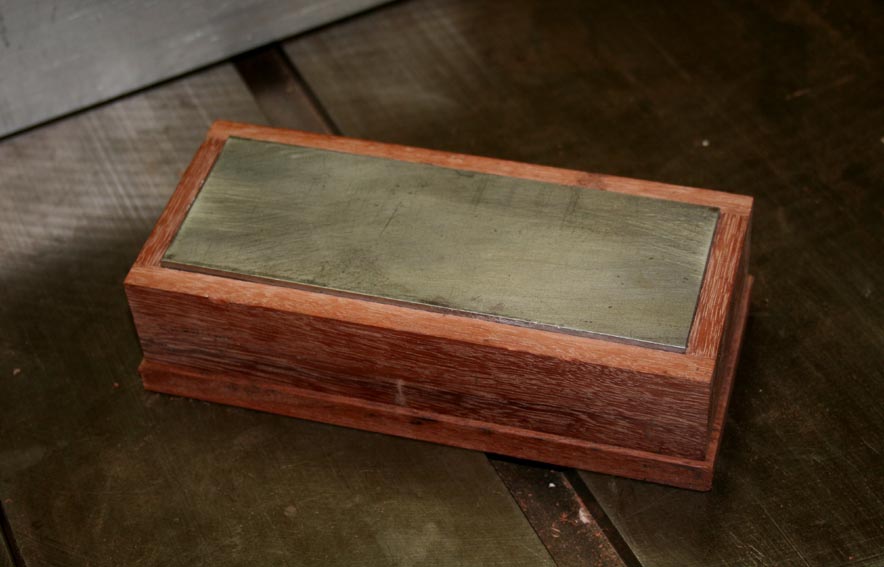
As a follow up to the long thread below about sharpening A2, I spent some time today looking for cast iron plate. Anybody got suggestions about where to find cast iron sharpening plates? I have bought a bunch of stuff from MSC Industrial Supply over the years and have always been happy with their merchnadise. They have cast iron "flat stock" in suitable sizes, but it's expensive. It might not be too expensive if it is useable as a sharpening substrate for diamonds as it comes from MSC. If it requires blanchard grinding and/or lapping to get it flat enough, the cost of having that done pushes it out of my price range. Anybody have experience with cast iron flat stock? How flat is it? Is it suitable as-is for a sharpening plate?
Re: Cast Iron

#2

Re: Cast Iron

Michael Brady

Lee Valley has this one, which I own. I use the plain side mostly. It's a good size, but not overly heavy, so that you can move it fairly easily from place to place:

http://www.leevalley.com/US/wood/page.aspx?p=59752&cat=1,43072,59752

Re: Cast Iron

#3

Re: Cast Iron

TomD

I haven't found the cast plates are better than leather. They would be maybe if you were doing all your sharpening on diamond, but for doing the final sharpening polish, I don't find them superior. I don't really like doing all my sharpening on diamond either, or loose anything, IN fact, one of the nice things about strops, probably why they exist, is that they don't behave as though they are loos, they behave like a unity.

Apparently both Derek and I have recommended plane soles as an option bodies alone can be found for a few bucks. I have all kinds of surface plates in cast, and so forth, in many sizes, so I have plenty of the best cast ever, to use for laps, I just don't really prefer it.

I love that LV lap, looks awesome. They should send me one as the upgrade from the plate I have been using so faithfully for the last 35 years. But I would not prefer it for diamonds. Though diamond past is not terribly expensive, the grooves are to swallow abrasive. And it does look beautiful, but isn't going to look that great after it has been in use even briefly.

I should say that lapping with SC has it's place, and I do like that tool, if I was still in that stage.

Re: Cast Iron

#5

Re: Cast Iron

Frank D. in Montreal

I bought an old table saw top for $20 and cut it up with a reciprocating saw (had enough for about 12 fairly large plates). Most of the older tops are smooth ground, and mine was flat enough to use with just a quick polishing to take off any dings (rubbing them together with carborundum or diamond, like flattening water stones).

Re: Cast Iron

#6

Re: Cast Iron

John in NM

Unfortunately, it is expensive stuff, probably due to lack of demand. The nature of the material doesn't really lend itself to being useful as bar stock.

The stock McMaster-Carr sells would need to be machined flat - I haven't looked at MSC's but it's probably the same.

One would think there would be enough of a niche in sharpening for an outfit that already does a lot of casting - like say, one of the plane companies that start with "L" - to produce a run of iron plates and supply a kit of diamond to go with them.... :D

Re: Cast Iron

#7

Yes to the table saw top

Bill Houghton, Sebastopol, CA

I could have picked up more than I need in a summer of yard sales.

Re: Cast Iron

#8

You would think

Bill Tindall, E.Tn.

I don't understand why LV chose a steel plate instead of cast iron. Bar stock of the right size is readily available. It is cheap to shave off 1/2" thick sections and grind them flat. Anyone wanting to make 20 can make them as cheaply as any good stone. The problem is if you only need one.

Re: Cast Iron

#9

Grooves....

Brian Roberts

What is the purpose of grooves in a lapping plate?

Especially a plate used for hand lapping.

My experience has been that the grooves are simply a place for abrasive to fall into ...which removes said abrasive from any further "work".

The reason for my question.......I just finished turning some scrap cast pieces into a pair of lapping plates. Finished size is 1.85" x 6" x 21.5". Yes they are heavy...but no reason to machine them any thinner.

I ground both faces and the CMM says they are flat to within .0003 all directions....which is plenty accurate for lapping stones, plane soles, and other misc, tools.

So......any reason to groove one side.......opinions?

Re: Cast Iron

#10

Lee Valley...

Brian Roberts

Says their steel plate is "precision-ground to a flatness tolerance of 0.005" over the entire surface".

Sorry...but that is NOT precision ground......5 thousands....?

Re: Cast Iron

#11

mine aren't

Bill Tindall, E.Tn.

And I have seen no reason to add grooves, whatever they are for.

Re: Cast Iron

#12

Re: Grooves....

roger lance

Could the grooves on the LV plates be residual marks from their flatting process??

Re: Cast Iron

#13

Re: Lee Valley...

John in NM

The definition of precision has much more to do with being accurate to a certain tolerance (specified in this case as 0.005") than with how small that tolerance is. A piece of steel could be claimed to be precision ground to 0.1" over its surface and as long as that accuracy was maintained, it would be a true statement.

The example is hyperbolic of course - no one would claim that 0.1" tolerance is precision work - but that is more because it is not even remotely difficult to hit that tolerance than it is an incorrect use of the word "precision" in and of itself.

Re: Cast Iron

#14

Re: Grooves....

John in NM

The grooves are there to break the suction between two large surfaces rubbing together with a lube between (I believe those plates are intended for lapping plane soles or sharpening stones). The idea is that the suction effect can contribute to rounding the edges of a large piece when hand lapping - but I've no idea whether that idea is accurate or not.

Re: Cast Iron

#15

Not sure what....

Brian Roberts

your point is.

I said what I meant....but to rephrase it.....a lapping plate that is up to .005 out of flat is worthless.....to me.

Re: Cast Iron

#16

Is it iron or steel?

Wiley Horne--So. Calif.

Hi Bill and all,

Bill, I remember the steel one from some time back. But the one Michael Brady is pointing us to is advertised as being iron, if I'm reading it correctly:

http://www.leevalley.com/US/wood/page.aspx?p=59752&cat=1,43072,59752

So is this the original steel plate with different verbiage? Or is it iron? Perhaps someone knows....

Wiley

Re: Cast Iron

#18

What I mean is this...

John in NM

Put simply, "precision-ground to a flatness tolerance of 0.005" over the entire surface." means nothing more than what it says, and if it is indeed within that tolerance then "precision-ground" is not an unreasonable descriptive term to use.

I suspect you meant instead that you are unimpressed with this degree of precision, preferring a tighter tolerance. Nothing wrong with that at all, but it has nothing to do with their choosing the term "precision ground" to describe their product.

Re: Cast Iron

#19

Re: Is it iron or steel?

John in NM

They have both. The one without the grooves is steel (and it doesn't have those grooves talked about below).

Re: Cast Iron

#20

Re: Grooves....

John in NM

On the steel one, yes, those very light grooves are the remains of the Blanchard grinding process.


On the iron one, the grooves are intentionally cut into the plate.


Re: Cast Iron

#21

John...

Brian Roberts

I knew you were quibbling over semantics.

I am quite aware of what manufacturers do to promote their products......commonly referred to as "advertising fluff".

I don't need anyone to interpret Lee Valleys copy for me...nor do I need anyone to interpret what I meant.

I knew what I meant.....every other reader knew what I meant....and you knew what I meant.

Re: Cast Iron

#22

John....

Brian Roberts

take a breath.....

The OP (me) referred to grooves in a lapping plate.....not scratches.

Re: Cast Iron

#23

Re: Lee Valley...

JDK

This is precisely correct.

"Precision ground to a tolerance of .005 inches" means that the company used equipment calibrated to produce that tolerance over the surface of the plate, i.e., x inches plus or minus .005.

It has nothing to do with the degree of tolerance. Only that the degree of tolerance is within the calibrated capabilities of the machine doing the grinding.

Re: Cast Iron

#24

Grooves prevent stiction

Steve Elliott

Allowing air into the area between two nearly-flat surfaces prevents atmospheric pressure from overwhelming the pressure applied by hand. When the non-bevel side of a blade is being flattened stiction only becomes a problem when the surface of the blade is flat enough that the perimeter is in contact with the stone and the edges are sealed by water or oil. Any slight hollow in the stone will cause a vacuum to develop between the blade surface and the stone. A porous stone will help prevent this, as will grooves in the stone (or lapping plate). Japanese blades with a hollow in the back will have much less stiction because the hollow leaves a pocket of air under the blade. This air will be able to expand so the amount of added pressure is only the difference between the slight vacuum created and atmospheric pressure.

Re: Cast Iron

#25

Semantics...

John in NM

Sure, if you like.... the other way of spinning it is that words have meaning and correctly using them is and should remain important. Try thinking of precise writing as an analogy to precise grinding :D

And yes, I am picking on you somewhat. It is irrational and rather childish of me to indulge in doing so, but there you go, we all have our faults. I often resist such urges, but usually don't bother when people are denigrating - unreasonably in my view - the products of vendors I like.

I'll knock it off though - I apologize for the nit picking ;)