Finishing the tool chest I started
Chuck Nickerson
in a class taught by Chris S. in early August.
With any luck, the first coat of paint goes on Wednesday eve.
Knowledge You Can Build On — Est. 1998
Finishing the tool chest I started
Chuck Nickerson
in a class taught by Chris S. in early August.
With any luck, the first coat of paint goes on Wednesday eve.
Re: The impracticality of the suggestion
William Duffield
"To the man whose only tool is a hammer, everything looks like a nail." 
…which just means you tend to use the tools which are familiar to perform the tasks with which you are familiar.
I think it's more than just studying history. It's preserving traditions, and emulating beauty without reinventing it. Some people, like you, have an eye for what is beautiful and elegant without being overly ornate, and some people have to have a precise model to follow, and some people throw up their hands in frustration and proclaim there to be nothing more beautiful than Shaker.
If you are trying to make reproduction furniture, especially if you want to copy a form published in the likes of Chippendale or Sheraton, or if you need to repair or restore old furniture or architectural details, and you want your new molding to match the old, the impracticality of grinding a custom molder head, to be used in a machine that will take up a substantial amount of floor space in the shop for a year or two, is intimidating to me. The expense of a competent CNC machine, and the expertise needed to program it, much less maintain it, is likewise impractical to me. Similar considerations apply to a shaper, or molder-shaper and custom knives, which would also sit idle in my shop, as I already have all the power tools I need to do all the other operations.
The same set of moulding planes can reproduce or create or match an almost infinite number of different profiles, while you may never use the custom molder cutter on another job, unless you are a millwork shop.
I have many router bits designed to make moldings of many different profiles. However, until I started to study in detail the architectural moldings on and in the houses around me, and antique furniture and the drawings of the classic orders shown in Palladio and Chippendale, I didn't realize they are all more or less worthless, except to fool the untrained soccer mom.
There are power tool alternatives that are readily accessible to the small shop operator, especially someone with a little tool making expertise. Warning - this picture may be disturbing to some…

…and even more so when I tell you it came with my radial arm saw. I have, with trepidation, used such a tool in a table saw, but my SawStop is not stupid enough to let me even turn it on with this IED mounted, so if I ever wanted to use it again, I'd have to mount it on the RAS 
But that's not really the point of showing this one, except it reminds me of a similar tool that was used by a professional cabinetmaker that I met several years ago. He had a machinist make him a similar head that held only one cutter. It was machined in such a way that the weight of a typical cutter balanced it sufficiently to run at table saw speed. When he needed to make a custom profile, he only needed to grind one cutter to match, not three identical cutters. For short runs, HSS cutters were not necessary. For longer runs, of course, O1 was easily ground and hardened and tempered, and it got the job done with a minimum of fuss and minimum of delays.
With a dado stack on your table saw, a #66 beader, gooseneck scraper, a small block plane and maybe three or four round planes, a really good set of reproduction moldings can be produced in the small mixed hand and power tool shop, following the basic technique outlined in the sources I provided. If you don't want the hassle, expense and time needed to secure a pair of snipes bill planes (and I assure you it can be a hassle), you might consider getting a pair of table saw blades reground to cut a sharp bevel on only one side. I've seen people do this to cut dovetails, so a bit more radical bevel should suffice for defining the details of moldings that require them.
The most important concepts to be gained from the references are the procedures to follow to lay out the molding, and the planning to perform the steps in the proper order so that the early procedures remove as much waste as possible, and as accurately as possible, and guide the more subtle curves that complete the molding.
The hollows and rounds just make it a bit quicker to achieve the final surface, and using a rabbet plane to define the major transitions is just a safer method, but sometimes slower than using a dado stack, because you can sneak up on the final size without the fear of going too far and having to start over. If your rabbet plane is out to lunch, use a shoulder plane instead.
Another strategy, which is important when doing the bulk of the molding on a table saw, and in many cases, especially with small moldings, is also useful with hand tools (and maybe even obviating a sticking board), is to work the molding on a wide board, and rip it off after you have completed it.
Re: "What Have You Been Working On?"
William Duffield
Well, it's not fine furniture, or even a woodworking tool, with minimal hand tool content, but it is woodworking, and I needed to get it done before I went on to more interesting things. My Father-in-Law is in assisted living at a continuing care retirement community, and needs a motorized wheel chair and walkers to get around. Lately, he has been having more and more trouble attaching and detaching his walker from his chair with velcro and bungee cords, so I designed and built a rack. His particular model of wheel chair is not particularly amenable to the attachment of a rack. Most of the wheel chairs and carts in his community have racks, but I haven't found one of the same design. I'm better at designing in wood than in metal, especially when any necessary fitting has to be done in the hallway outside his apartment. It's an hour and a half drive up there (and an hour and a half back), and I couldn't just haul the wheel chair and walker back to my shop, so it took several trips to measure and fit it all together.
The challenge is to fit it to this:

Wheel and actuator on the left, lower frame member in the middle, and battery rack and a corner of the battery on the right.
Here's the solution. He's got the raciest walker in the place.

I installed it yesterday. Everything fit perfectly. Two 7/8" beech dowels are inserted into the lower frame, and glued into the cross member (poplar). Two machine bolts go through the lower block and into existing holes in the battery rack. The biggest trick was getting the dowel spacing correct, so the cross member was made in two pieces with a half lap joint that is adjustable on floating tenons. After I fit them with a dead blow mallet and marked them, I took the pieces back to the shop and glued them together.
The upright and hooks are rock maple. All joinery is loose tenons, with liquid hide glue. All edges and corners must be rounded off, because his skin is fragile and he bruises easily. Finish is shellac (Zinsser blond, cut about half and half with Behcol. What I was most pleased with was the performance of brush I used to apply it, a Robert Simmons Saphire S52 1" oval wash. This was the first chance I have had to use it since it was recommended to me at a finishing seminar I attended in May.
Dad was pleased with the new setup.
That was helpful
Bill Tindall
It would also be helpful if someday someone will provide a photo essay of a piece of molding they are making. Now, where can I find out what a Snipe bill is or a #66?
What is good
Bill Tindall
There is no greater good than learning new skills to make something. I rank it even ahead of actually making something and far ahead of being entertained by watching someone make something, which trumps criticizing someone learning or making.
Personally, I discovered that I was missing the "carving gene" so I have taken that activity off the list of things to learn.
Re: more help
William Duffield
A #66 is the metallic equivalent of your scratch stock. For big bucks, Lie-Nielsen makes on in bronze.
Here's a description of the Stanley original:
http://www.supertool.com/StanleyBG/stan9.htm#num66
and Lie-Nielsen's knock-off:
http://www.lie-nielsen.com/catalog.php?sku=66
Snipes bill planes are described here:
http://msbickford.com/msbickfordsnipesbills.html
http://musingsfrombigpink.blogspot.com/2010/12/snipes-bill-planes-introduction.html
and here for a video demo:
http://musingsfrombigpink.blogspot.com/2011/01/snipes-bills-and-beads.html
If you search the blog, you should also be able to find examples of molding patterns where a side bead is useful (for a cove next to an astragal, for example). While not as rare as hens' or snipes' teeth, these are not done very often.
To get a TS blade to do this exactly would require a pretty radical grind, and it wouldn't stay sharp for long. The people who teach the use of these things strongly recommend removing as much wood as possible with rabbet planes and only finish up with the specialty planes, because the rabbet planes are so much easier to sharpen.
Re: Oops! wrong pic! Trying again!
William Duffield
Here's the correct second picture, of the completed gizmo.


Re: "What Have You Been Working On?"
Jack Guzman from Maine
A client asked me to copy a chair she had. She wanted it as close as I could get to the original's current condition. The original has a final finish of shellac so after three coats of milk paint and rubbing out I coated it with shellac. It is alot shinier but it will wear to appear similar,I hope.---Jack
glad you posted the corrected pic
Bruce, a MN Galoot
I was beginning to think it was one of those games where you're supposed to pick out the differences between original and second pic and I couldn't find any 
Dang! you do nice work, Jack!
Bruce, a MN Galoot
Which one is the original? Very, very nice.
Did you take a class or pick it up from Curt Buchanan's videos?
Dang! only $500
Bill Tindall
That meets my criteria for impractical. It would appear that making molding the Period Correct way is a very rich persons activity.
........but, I did enjoy reading about it so I thank you for the effort to provide the information.
Thanks
Jack Guzman from Maine
I got started by reading Michael Dunbar's book but the first chair I made,I followed Jim Rendi's step by step instructions in his book. Curtis Buchanan's videos answered alot of my questions and showed me ways to perform the various functions. I'm still studying. I just got a new book by Drew Langsner that shows other ways to build these chairs.
I really wanted to take classes but can't manage it so I decided to teach myself. I think it's working.---Jack
Re: glad you posted the corrected pic
William Duffield
What happened is I got interrupted while composing the text that goes along with the pictures, and the WoodCentral WebBBS software timed out one of the pictures and tossed it out, and all I got was one of those little blue question marks. While I was relocating the picture on my machine, the other picture timed out. Somewhere, I got confused about which pic I was trying to reupload.
Re: A simple outdoor table in English oak
Sgian Dubh
Last week, and the week before, in between my main teaching job, I got on with making a simple design for a new table to go on a south facing patio, meaning it's as sunny a spot as you'll get here in relatively damp old UK. Air dried English oak, draw bored M&Ts of various sorts, and a bit of boiled linseed oil to give an attractive honey colour to the wood for the photographs. This is a no maintenance finish where the honey colour will largely be replaced by the natural silvery grey of weathering over the next year or two. Slainte.
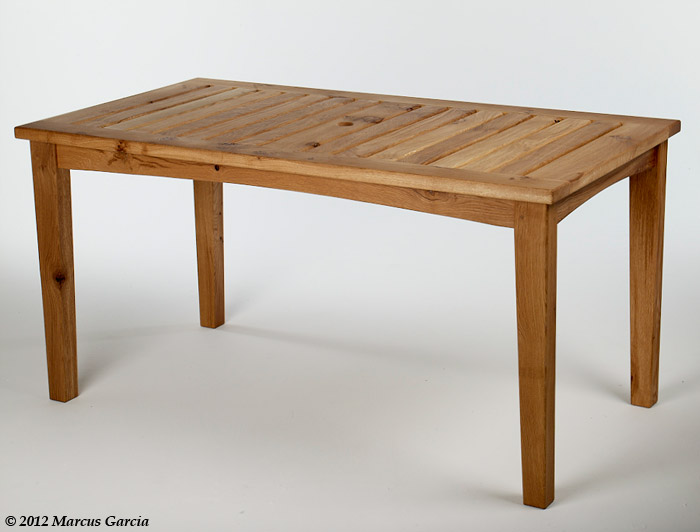
More images and a bit of text here: http://www.richardjonesfurniture.com/Tables-Chairs/oak-al-fresco/oak-al-fresco.html
top question
Bill Tindall
What a pleasing design.
How is the top assembled to withstand the elements? I have been wanting to make something similar with slates for top but didn't know what sort of joinery would hold up.
PS
Bill Tindall
This may indeed be an example of where a silk purse has been created from a sow's ear! I'll bet that oak didn't look nearly as good in the lumber pile.
Re: Dang! only $500
William Duffield
…and a six month lead time, or thereabouts. Old Street's versions are even more, and their lead time is more like three years, so you've got lots of time to save up . If you don't have a set of hollows and rounds, it gets a lot more expensive in a hurry, and the lead time goes up again. I bought my antique English hollows and rounds several years ago, which was good, as they have gone up in price a lot lately. I was lucky. Mine are in really good working shape. You can find a lot of lemons out there in the antique tool market, that can take a lot of fettling before they will perform, and you won't know until you've actually tried to use them how much time, blood, sweat and tears has adversely affected them. (Ref. comment by Roger Myers on Snipe Hunt thread.)
To a certain extent, it depends on where you are starting from, as well as your method. A Williams and Hussy molding machine and a few custom, or even standard, cutters aren't cheap either. Nor, I suspect, is a CNC machine with the necessary bits (end mills, or ones and zeros?) to make your desired mouldings.
In any case, you have to decide whether any tooling or skills acquired are worth the time, money, and space in your shop, and whether you can also use them to help you make other stuff that you want to make. It's very personal.
Re: A simple outdoor table in English oak
Robin Corell in Atascadero CA
Nice. Those curves in the aprons give the simple design just the right amount of elegance and ballance the tapered legs perfectly.
Robin
Very Rich
Warren in Lancaster, PA
That meets my criteria for impractical. It would appear that making molding the Period Correct way is a very rich persons activity.
I have spent $300 on planes to make mouldings, grooves, dados and rabbets over the last 35 years. Making custom mouldings is a part of my business; an awful lot of antiques have my mouldings on them. I have done every one I have been asked to do.
So how much has a frugal amateur spent over the same period in order to make mouldings, grooves, dados and rabbets. Routers? router bits? shapers? shaper cutters, dado heads, sanders and maybe some items I am not familiar with?
The impracticality of old tools when you need them
Bill Tindall
I used to have this same argument with Tod regarding chisels. By the way, what happened to Tod? I don't deny that if you live some place where antique tools are available that one might be able to accumulate what one needed in a few years. But even then the collecting and hording of useful old tools has removed most from the market place.
If I am making a chest of drawers today I need the means of making moldings and drawers today. The chisels to make the drawers can be readily bought new. Ditto for router bits for many molding patterns, especially the smaller patterns. And it is quite practical to scrape a profile if it can be roughed out approximately by some means.
People have developed techniques for roughing out coves of any shape using the table saw. CMT even sells a cutter to aid in this common task, I recently learned. What I am looking for are techniques that others have developed for roughing out other molding patterns , to be refined to final shape by scraping. An example could be the pointy saw blade William describes, which the saw shop Misenheimer could readily make, or might be filed from an old steel blade.
Re: Very Rich
david weaver
I think a frugal amateur could make those planes for about $300. At least these days, there's a source for beech (and he lives pretty close to me). He's going to retire at some point, though.
If an amateur doesn't want to make planes, well, that's their business. A good pair of working H&Rs can be made in 5 hours by hand, add a couple if you want the cosmetics to be perfect. I don't see that as too big of a deal, I'd rather be sitting at the bench making planes than leafing through router bit catalogs or tooling deciding what compromises I can tolerate.
That said, I've seen plenty of H&R sets. I don't think anyone can know what they should get for one until they've fettled a couple of old ones, but trying to tie the hobby with fine and thoughtful work isn't for someone who can't spend a few hours learning how the planes work.
Re: Thanks
Hank Knight
I think it's working too. Nice job!
Re: A simple outdoor table in English oak
William Duffield
Very nice table.
If I were buying the table, I think I would like a can of your oil finish to go with it, so hopefully I could slow down the fade to silver grey, at least for a while.
I also like the subtly tapered legs. But then I went to your website and found another, very similar, table with untapered legs. Oops, the figure is the same as the first table. The taper is only an artifact of the camera lens.
Re: "What Have You Been Working On?"
Andy Lincoln,in Dearborn MI
Jack,
I am going to assume that the chair on the right is the new one.
It is very well done.Your chairs are exceptionally well done.
Someday I'd love to attempt a chair but i know my skills,attention span,
and patience are not where they would need to be.
Excellent job.If the chair finish needs to be roughed up a little,I have a skill set
for that.
Re: Very Rich
TomD
I have never paid more than 20-30 bucks for a molding plane that works. There are names, and set completions that the collectors want, and other planes that survived through to today that work great. It is like everything else, one probably uses a couple of the planes a whole lot and the rest hardly at all so a full set is not need.
I find it hard to believe your area does not have second hand planes. Myself, I have come to the conclusion that I would be better off making them since the blades are easy enough for me to make. There are excellent shortcuts like sawn planes, where the whole plane can be made in 30 minutes, blades extra. Molding planes are actually faster to make because crosspins can be left out, and normally only one cheek is glued. Tapered blades are an important part of some designs, but not the world over. Anyone who eschews the details can easily get by with flat stock, and this reduces making the blades to a very short process.
While molding planes are pretty efficient, they chose to use them in old shops, they may not be justified by your production, though if not you one would wonder who. People just like planing, particularly the easy fun stuff, and that is part of the appeal here also.


