WoodCentral Forums

Est. 1998 — 27 years of woodworking knowledge

Observations: Veritas Low Angle Smoother Plane

Posts

Observations: Veritas Low Angle Smoother Plane

#1

Observations: Veritas Low Angle Smoother Plane

Bruce McCrory

A few days ago, I was crying about hand plane problems. In desperation I drove 15 miles to Seattle and bought the only other brand of smoother I knew was in this fair community of umpteen million souls.

A Wood River #4. I complained about it too. And, took it back, to Seattle, where it came from.

A couple days ago, eastern Canada shipped me a Veritas LA smoother. I optioned the short list of two other blades for this ... "oddball". I had good, rave reviews for Canadian made goods. (I guess better-built Stanleys come from the UK.)

Fine Woodworking Mag., and someone we have on this list from Dorothy's vacation land (I won't point fingers) reviewed this bad boy, and had nice things to say. [This is purely humor! Mr. OZ is one of my favorite mentors. He just doesn't know.]

I just wish my Bailey #6-c, with all its mass, could do everything. Including what the Stanleys, Wood Rivers, and Veritas tools sporting the racing number "Four" can't do. That is, every one of them can't shave wood without having the blade sliding all over the place.

Next. Build quality. I have as much, and more, vitriol spilling over about East Asian manufacturing quality as anyone else. I must say, however, the Wood River #4 smoother was excellent. The blade didn't even need honing. There was a very slight angle in the frog machining. The horizontal blade adjuster was off by about 3 degrees. Lots of delicious mass in this guy. It almost plowed through obstructions as well as my Bailey.

The Veritas LA Smoother is in another class. Where Wood River is a clone of, and what the Stanley #4 should be, Veritas is an all together different design.

Build quality of the LA is close to "gilded". There are few moving parts, or any parts. Design is its glowing point which covers for a lot of missing substance.

Rather than a wad of iron gum, the Veritas has these cool threaded inserts that creep into and pinch the blade sidewalls. They are so neat that I am including them in my #220 fix-up. (220 is another block plane that I really believe Stanley marketed for children; read: toy.) The blade and everthing else still have wiggle room to roam.

It is light. I don't just push the LA. I have to really bare down. And. Push. Amazing, what the lack of substance (a little over a pound lighter) can do to comfort. The Veritas is much like a handled block plane with less mass per square inch of sole area.

I need new Titanium shoulders. My endurance suffers with more to push around. When I ask for more mass, it is for a credible improvement in production.

The factory blade (25?, 30? angle) needs a second bevel honed in. I screwed some scrap into my $20 bench and beavered/fluffed/wacked/hacked at [shot] some cedar edges for glue joints today.

After a couple 16oz lead fishing weights get melted onto the sole, and into various other voids--and a sharp blade--the V-LA should march through most anything. At least, that is what I am counting on...

PS. The Veritas is costly, too. $40 more than Wood River, and twice as much by weight.

Oh, the optional channeled blade is overkill for the LA. It's like mounting a 3/4" blade onto a 12-inch band saw. Who is kidding whom?

PPS. It can be a "go-to" tool, with some minor tweaks, besides the additional pound of add-ons. ["Go-to" is a hint.]

There. I think this is an honest review. Only a little reading between the lines is needed. Oh...

Bye.
Re: Observations: Veritas Low Angle Smoother Plane

#2

Re: Observations: Veritas Low Angle Smoother Plane

Kees

I read a lot about weight in your review. It seems like you haven''t recognised yet that weight isn''t a desirable feature in a plane. Weight just wears you down.

I propose that the heavy weights are taken away from you for a while and replaced with some wooden planes, the ones our ancestors used to create the most extraordinary furniture ever made in history. That'll teach you a lesson or two.

Re: Observations: Veritas Low Angle Smoother Plane

#3

Re: Observations: Veritas Low Angle Smoother Plane

Bill Tindall

You seem to be searching for a tool to compensate for your lack of experience. Been there and done that myself. (still inexperienced but I have come to realize my planing limitations are not a result of the tool I am using) I know of professional cabinet shops using old Stanley #4 planes to make furniture as complex and as good as can be made. A recent Society for American Period Furniture Makes Cartouche Award winner exclusively uses the Veritas plane you just bought. I expect that even the WoodRiver would do acceptably in experienced hands. The practical functional difference among these planes is minimal.

Join a club and find a mentor.

Re: Observations: Veritas Low Angle Smoother Plane

#4

Re: Observations: Veritas Low Angle Smoother Plane

George Allchin in Lowell, Mich.

I too have the plane in question.

It is a well made, well thought out plane, and is a copy of something Stanley developed long ago. If I have a challenge in the grain area, I grab it or one of my low angle Stanley block planes. My real preference is the low angle block that I put a CPMM4 blade in. The blade is like the Everready bunny!

More experience is needed.

Work safe

George

Re: Observations: Veritas Low Angle Smoother Plane

#5

Observations on Observations on ...

Derek Cohen (in Perth, Australia)

Hi Bruce

As you point out, the finish of the LAS is excellent and it has helpful features, such as the set screws you mentioned (and, like you, I have incorporated these on the planes I have built, both wooden and metal).

The mass issue is complicated. I like more mass in a plane I use on hardwoods because extra downforce is often needed to stop it literally bouncing on the hard surface. But I am talking really hard wood here. Otherwise a sharp blade in a lighter plane works well as it permits the plane to skim off the peaks. You would be surprised how effective the even lighter Small BU Smoother is. At the other end of the spectrum, a heavy (eat-your-wheaties-at-breakfast) Marcou literally does the work for you.

All this aside, there is a difference in feel when using a BU smoother (such as the LAS) alongside a BD smoother (such as a WoodRiver or LN #4). And this is pertnent when comparing two planes such as these.

The BU's low centre of gravity along with the upright handle places the direction of effort low down and at the handle, itself. In this guise these planes ask you to push them forward under their own momentum. The BD plane, on the other hand, with a high centre of gravity and a handle that leans further forward, places the direction of effort more over the mouth. This may create a sense of higher mass (as the BD plane requires more effort to push the plane forward on high cutting angles). Further, it is easier to exert more downforce with the BD plane. But ... change the handle on the Veritas and the dynamics of the plane change.

The more upright handles of the Veritas BU planes (LAS and BUS, but not the new SBUS, which is different) better suit higher benches. With my recent change to a lower bench, I replaced the handles on my BU planes with Stanley types. It is easier now to exert more downforce without apparent effort ...


Handles are wood and we are woodworkers. The LAS is an excellent plane, and I changed out the handle some years ago (not as low as the Stanley type, but lower than the Veritas) ..


You do not say what woods you tried the LAS on, or which cutting angles you used. Enquiring minds would want to know. One of the advantages of the BU planes is the wide range of cutting angles. These cannot be matched by a WoodRiver (with its common angle setting), but the high angle LNs are another matter when planing interlocked grain. A few months ago (when testing the chip breaker effect), it became evident that one can certainly improve planing on difficult rain with the chip breaker on a close set. Nevertheless, this was further improved with a higher bed angle (I was using a LN #3 with a 55 degree frog). In other words, high cutting angles work. Hence any input you can offer here would be relevant.

Regards from Perth

Derek

Re: Observations: Veritas Low Angle Smoother Plane

#6

I may misread, but if

Joe shelton

You're shooting with this plane, I think you're using the Small Low angle smoother. I prefer the small LA to the LA smoother, though both are commendable tools.

Joe

Re: Observations: Veritas Low Angle Smoother Plane

#7

Re: channeled blade?

William Duffield

When you drove to Seattle, did you try out the plane in the store before you bought it? Was there someone in the store who was willing and able to show you what you needed to know about the plane? If so, I can't imagine your needing to return it.

Anywhere you can buy a Veritas or Lie-Nielsen in person, they will have someone who can show you how to set up, tune and use any plane you may be considering. There are lots of opportunities, but you'd have to wait until about this time next month and go all the way to Port Townsend to try out a Lie-Nielsen. And you might want to take a ferry, very relaxing, beautiful scenery, to Victoria to try out a variety of Veritas planes. L-V's website doesn't seem to be updated right now with show schedules in the U.S. beyond the end of this month.

When you say "channeled blade", do you mean the toothed blade? If so, the toothed blade has nothing to do with rapid or gross stock removal, at least not in my hands. Its use is for preparing surfaces for gluing veneer with hot hide glue. It is reputed to also be used for preparation of stock with radical grain reversals, such as burl, if you cannot plane it with a properly setup iron without getting radical tearout. I at least partially agree with you on this one, though, because I prefer a scraper plane configuration for toothed blades, over of a low angle or even a Bailey pattern. I might suggest you try a L-N #85 if you can't find an antique wooden scraper plane.

A 3/4" blade on most 10" bandsaws, including my Delta, is well beyond overkill: It is totally dysfunctional. The spring and frame are not strong enough to properly tension it, the bearings are not robust enough, and most importantly, the 3/4" wide tires leave no room for tracking adjustment. You would immediately take the set out of the blade and destroy the rims of the wheels.

The Wood River #4 is not a clone of the Stanley #4, and does not in the least resemble any Stanley plane that anyone currently working for the garage door opener and hinge company has ever ever had a hand in manufacturing. You might argue that it is a clone of the 1930's era #604, but I would argue that it is a clone of the Lie-Nielsen #4, and I think you would lose that argument.

Re: Observations: Veritas Low Angle Smoother Plane

#8

Re: Observations: Veritas Low Angle Smoother Plane

Bruce McCrory

Thanks to all for your comments. I will try to elaborate, with less tongue-in-cheek.

My Stanley #4 is the standard, plastic-handled, pre-China model (stamped "Made in USA") where the only things machined were the blade and screws. The frog and base use paint to level casting roughness. Cheap American garbage! No more about this paper weight.

I mentioned Wood River/Woodcraft's #4 smoother because it is a very well made tool--and I used it. It is made in China. In a different thread someone badmouthed the Wood River, out of habit I trust. I grew up hearing the same "cheap Jap' junk" platitudes. No more about Wood River.

Oh, dear... Veritas/Lee Valley have a growing identification problem on their hands. LAS, SBU, SLA ... QVC... ? (I have not a few water plans with that TV version of 'walmart' abbreviation for quick-coupling valves--qcv's.) I purchased a "Low-angle Smooth Plane", and it will be abbreviated as "LAS" (LAS) and, LAS. Further clarification, I have only used the included blade-iron so far, without final honing.

The tool (LAS) is in its pristine, as sold, low angle mode.

I plan to keep, and use, the LAS. Its selling points fit my design/function demands. "If one tool can perform the task of several with ease, have it; not those others."

The sample wood I tried the LAS on was Western Red Cedar; and it is a project. Derek may have never worked this west coast, USA species. I've not used the following, but I think Port Orford and Alaskan yellow cedars are supposed to be very similar. California Redwood is slightly tougher but almost synonymous in use with WRC. You can build a house from WRC, using a pocket knife. I was insulting the LAS in how it handled one of our softest, easiest-worked native species.

Using the LAS to shoot was easier than I expected. A sharper blade will improve the pleasure, I am sure.

I do have a love affair with mass; and as Derek put it, where that mass is centered. I suppose, weight is not my real rant. I am very fond of my Millers-Falls #57 LA block plane with a jury-rigged knuckle-buster cap-iron. I doubt it exceeds 2 pounds. No more about block planes.

So, how the tool balances is probably a better way to say my say. Kees and hi, David!, weight is a factor--to confuse this paragraph. I love using japanese pull saws, but pulling on a plane on a shooting board to get shavings from endgrain is no picnic for me. And, just think about the 12-inch half-log Forest Service picnic table you carved your initials into, or used to beaver through firewood using the Cub Scout hatchet that cleaved rocks in the river a couple hours earlier. An excellent comparison is shaving endgrain of a stick 19" from the bench clamp holding the stick; or, planing the stick at 2" from the clamp.

At commercial sawhorse height (28 - 29 inches) the standard Veritas tote is a wrist killer. I knew Mr. Cohen had modified his fat, vertical totes to a more Stanley-similar thinner angle, and I intend to do the same; sooner than I want... And, not just for the relationship to working height. Many arthritic people have trouble gripping fat things. If I could, I would rip-out modern steering wheels from cars and use the skinny ones from the 1960s.

Some people have mentioned doing training classes. Those probably will help. However, I can't discount my physical adaptations. My dominant arm has been so mangled over the years, besides the dry sockets-and-balls arthritis, that my tool handling motions are unique. A therapist would probably advise I buy a table planer, jointer, and sander with the money I have spent on hand tools. My other arm sounds like a bad CV joint on a car.

Second, I am very distrusting of store offered classes. Especially, when the teacher has his/her/their name stamped on the products they want us to use. This bias must also apply to the publications we read. Rockler owns Woodworker's Journal. There is a paucity of non-Rockler products and review recommendations in that magazine. Even though Fine Woodworking claims otherwise, their favored tools fall into an advertisers' list.

Lie-Nielson is smart, if they don't own any periodicals. I hope to try a Lie-Nielson tool some day. Port Townsend, or Portland, may be the only places for the opportunity. Around here they are strictly mail-order.

Anyway, I march to a sometimes different tune. People may wonder why I whine about personal handicaps. As a professional in the design industry, I know that design for physical disability is always better for everyone.

Summary. These observations are based on initial reactions. The Veritas Low-angle Smooth Plane is an adequate handplane tool. Further testing is needed before I can rave. But as with most test drives, we look specifically for deal killers in cars we are not otherwise enamored of.

Done.

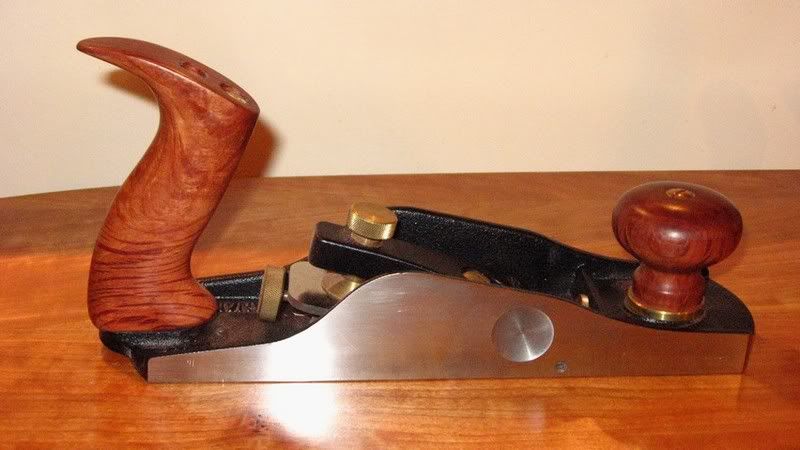
PS. Now, I am going to look deeper into Mr. Cohen's observations of my observations. He shows my plane--the one by itself, on Blackwood (Euc. spp.) I think.

Re: Observations: Veritas Low Angle Smoother Plane

#9

Re: Observations: Veritas Low Angle Smoother Plane

Kees

The shooting board is where weight seems an advantage. I prefer my nr 6 over the nr 5 on the shooting board. At the other hand, when I was planing the ends of a big 8 cm thick ash table, the nr 6 was too heavy to hold up on the air. I was getting stellar performance from the nr 5 with its cambered blade and easilly removed the saw marks.

My infill plane (heavy!) does indeed seem to work easier on hard wood, untill my elbows start to complain. Lately I am on a wooden plane trip and I can now work Jatoba very well with the small wooden smoother. With woodies it is easy to bring your own wheight over the plane. Somehow I feel that I can regulate the depth of cut, just leaning a bit more or less on the plane. Marvelous feature.

For me, sharp is way more important the wheight. When you have problems with your body I would certainly look into that direction too. A lighter plane is not so taxing on creaky joints.

Re: Observations: Veritas Low Angle Smoother Plane

#10

Re: Lee Valley seminars

TomD

LV took an interesting approach to the whole seminar thing, they let the customers give them. Once when I was preparing for a seminar I asked them if I should bring my LV tools, since I have enough tools in various languages to give an LV seminar, etc... They recoiled in horror. The absolutely did not want me to bring the LV tools in particular. I guess it might have been different if they were the only ones I had. Customers can detect the pitch at 100 yds.

Re: Observations: Veritas Low Angle Smoother Plane

#11

Re: Lee Valley seminars

Bruce McCrory

Sweet!

I have a hunch that Lie-Nielson may be the same way.

BTW, my first experience with "sweet" as an explicative was right after an Alaskan flight I was on landed. You could not feel the touchdown. This sexy voice came over the cabin speakers "S u wheat! That landing curtesy of your Captain, Ms. X?." I think sweet is an appropriate reply to your account.

Re: Observations: Veritas Low Angle Smoother Plane

#12

Re: Lee Valley seminars

TomD

I had a college who used to pass comment on women followed with the remark that at his age they were all pretty. Having been in on one bad landing I can say that any one you can walk away from is "sweet". :)

👍 This page answered my questions

Your vote helps other woodworkers quickly find the answers and techniques that actually work in the shop.