CPM 3V vs. CPM M4 ?
TomD
Anyone look into this? 3v is tougher, which really isn't a big deal to me, and M4 is still in the range of say A2. But M4 is up to 3 x better wearing than 3v. Just wondered whether anyone had looked at it...
Est. 1998 — 27 years of woodworking knowledge
CPM 3V vs. CPM M4 ?
TomD
Anyone look into this? 3v is tougher, which really isn't a big deal to me, and M4 is still in the range of say A2. But M4 is up to 3 x better wearing than 3v. Just wondered whether anyone had looked at it...
Re: CPM 3V vs. CPM M4 ?
Phil Smith
M4 is my go to blade for no 4 1/2 and 5 planes.
I`m just happy...
Bob Hackett
to see folks looking at these things.
I have never understood why WWers seemed to settle for whatever steel fell into their hands.I always felt that was like planning your next project based on the wood available at the local lumber yard.
I think you`ll find similar doors of creativity and opportunity will open up for you once you learn to understand the different metals in the same ways you have come to understand the different qualities in wood.
Re: CPM 3V vs. CPM M4 ?
David Weaver
I don't have either of those, but if I were choosing based on specs, I would have M4 plane irons and 3v chisels.
I'd save one hard high carbon steel iron for a single pass with a smoother after using any of them, unless I'm missing something.
Unless the piece is getting a significant amount of finish (like a lacquer or something), then I don't think you'd be able to tell.
I just like the way wood looks off of a pass of high carbon steel, but I don't like how high carbon steel wears for pretty much everything else other than a final smoothing pass.
Maybe I'm making too broad of an assumption that a lot of people on here are still doing a significant amount of dimensioning and sizing by hand.

Metals
Ellis Walentine
Bob, I'd have to admit to using my planes and chisels without thinking of the steel involved, and I'm pretty sure the vast majority of woodworkers are in the same boat. If this should change, I'd need to know A) why I should prefer one steel over another for a given application or tool and B) where to get the ideal steel for each type of tool. Is this a big opportunity being missed by the toolmakers, or are the differences too slight to matter to the average woodworker? And, are they significant enough to matter to the discriminating woodworker? I've noticed the difference in sharpness and edge retention between O-1 and A-2 steel, and I've used various Japanese and American laminated irons and chisels, but I'm all for learning some of the subtler joys that we seem to be talking about here. What am I missing?
I'm sure I could piece most of this picture together by digging into the archives, but I'd be happy to read a succinct discussion of it anywhere.
Anyone?
Ellis
Re: Metals
David Weaver
I can't answer for Bob, but I can answer from my point of view.
The promise in the new steels for me is especially in everything right up to final smoothing. When I face a rough board, I don't like to have to stop in the middle to sharpen because an iron starts cutting. I just don't - i lose my place a little bit in what i'm doing unless I chalk the board where I stopped cutting (short term memory isn't so good, I guess).
Same thing goes for either trying or rough smoothing, whatever is appropriate after the first step - I like to be able to do it all in one shot and get the board in question level and ready for final smoothing (or stop there if it's going to assembly) all in one shot.
With high carbon steel, I have to stop fairly often and sharpen. On my coarse planes, I sharpen on a 1000 grit belt and a green loaded belt, so it's quick, cool on the edge, and it will sharpen anything - makes really no difference what kind of metal i'm using. Not counting the time spent taking the plane apart and putting it back together, less than a minute of time.
So far, I haven't used anything tougher than M2, but I have never had to pause and wonder whether or not the plane is getting too dull to use in the middle of a board.
I think it hasn't come on faster for several reasons:
1) the myth that A2 is a "tough steel", and that beyond that you can't sharpen
2) the persistance that once you decide something is hard to sharpen, you're done with it (when usually it's just an adjustment in method
3) the cost of materials more expensive than M2, A2, O1. M2 isn't ideal for plane blades, but it's pretty good - for anything that isn't final smoothing, it'll outlast all of the older steels by a LOT and it retains its hardness really well, so you can be pretty brief sharpening it on a belt
I would suspect if a toolmaker offered M2 10 years ago, people would complain up and down the street that it was impossible to sharpen and couldn't take a good edge. People thought kings were fast cutting stones then, and that A2 couldn't take a good edge.
As oil stones exit and more and more low slough sharpening methods become more widely accepted, I think new woodworkers will start paying for metals that hold an edge better - especially if there is little difference in surface quality and more and more woodworkers go back to working entirely by hand.
Just my opinion.
Re: Metals
TomD
Ellis, I think it is like most of those "why can't a women be more like a man statements". Meaning the asker is dead wrong but perplexed that everyone else isn't the same as them. Of course people are selecting steels as they would be selecting wood. For instance there is little reason to believe when someone selects cherry, or walnut they are doing it because it is the single most beautiful, or practical wood for their purpose. There are selecting it primarily because it is locally available, relative to rosewood, and cheap. Likewise I can get a blade as good as anyone in the West has had, for any purpose, out of my workshop in 45 minutes with O1, and I can resupply locally. Living in Canada is a bit like living in the US in 1950, except you can see the future. I just found a source for CPM 3V, and apparently they will heat treat it. Worth a try.
Re: CPM 3V vs. CPM M4 ?
TomD
Why would you choose 3V for chisels? The impact on M4 is still way off the map, and it holds an edge 3 times longer. I was just wondering whether anyone has tried M4 for real, and what they think, it sounds a better choice among the CPMs and makes 3V sound like the ideal steel for a crowbar. But having never heard of it for woodworking tools I wondered.
Properly used chisels are can be less stressed that plane blades. I always cut with them, never pry, and a plane blade is normally used in a semi scraping action with a significant relief angle at the edge.
Re: CPM 3V vs. CPM M4 ?
David Weaver
Well, i can't really answer that other than that I've heard 3v works well in chisels and isn't too bad to sharpen. If M4 works better, then I wouldn't be opposed to that, either.
Also, I don't mind sharpening chisels - they're not in anything, there's nothing to take apart and put together and they're easy to grind. it's not nearly as much of a nuisance to keep them in shape in the middle of work as it is to get 90% done jacking a rough board and have the jack plane get so dull that it behaves like it's refusing to cut.
That's really about the only reason - just becuase people have attested to the ability of 3v to work in chisels, and I haven't yet heard about m4 chisels. That said, when the dust settles, for chisels, I'd take whatever holds a good edge at a lower angle. My experience with m2 is that it likes 30 degrees+. That's not acceptable in a chisel - to me at least. 25 is more comfortable to use all-around, and to the extent you can get away with less, even better.
Any ideas on that? I know there's no reason to believe m4 and m2 behave remotely similar just because they both start with M.
Wait...
wilbur
"I have never understood why WWers seemed to settle for whatever steel fell into their hands. I always felt that was like planning your next project based on the wood available at the local lumber yard."
You mean that you aren't supposed to plan your next project based on what's available at the lumber yard? 
Re: CPM 3V vs. CPM M4 ?
TomD
No, but it's a good point.
Re: Metals
Larry Williams
Ellis,
I'm not sure what everyone else is experiencing. I do know what I experienced.
Back when I was working construction six days a week, I was in pretty good physical shape. They call it manual labor for a reason. We also did our own cabinets and other wood work. We always started with rough stock and did stock preparation by machine except that the biggest jointer we had was 8".
Sometimes we might have needed something wider, maybe 12" to 16" wide and 8' or 10' long. Those times flattening the first face was done by hand. We'd start with a fore plane and then true that face with a trying plane. Bill and I would alternate but we'd both use the same two planes. I don't remember ever having to stop and sharpen but, if we did, I'm sure it was a very welcome two minute break. We just had old water hardening steel irons or, later, O-1 irons.
Even times when I was working alone and pacing myself I stopped to rest a lot more often than I sharpened. Sharpening wouldn't have been anything other than a welcome break. The edges had more staying power and stamina than me.
These days I do a lot of metal working and even machining of wood in the shop. I maintain a lot of different high speed steel and carbide metal working tooling. I also grind custom HSS cutters for machining wood. We have some pretty good equipment to do this but it's slow and a PIA. I can't imagine putting a HSS iron in a plane, I think I'd rather take a beating than deal with that.
Re: Metals
Bob Hackett
The first time you hit old hardware during a remodel job or boat work makes that small amount of extra work shaping that HSS worth while. For me it was not a whole lot more work and the time I saved by not having to regrind and hone chipped edges more than made up for it.
When you cross crafts a lot it`s also nice to be able to put a small bevel on both wood and aluminum or bronze with the same block plane.Saves you from climbing down off the boat,making the round trip hike down the pier and then climbing back up onto the boat. 
I absolutely love the old industrial planer blade turned into an iron for my scrub plane,so does everyone else who has had to use it for any length of time.My brother really appreciated that we didn`t have to stop and sharpen once while we were planing a rather considerable crown from the main floor beam of my mother`s house when reworking her floor.We had to plane the entire length of the living room and it had some remnants of hardware and residual rust in it.
Some folks forget that there are more applications for hand tools than fine cabinet work.
I don`t think anyone here has ever demanded that everyone surrender their laminated irons and oil stones.What the folks who offer alternatives are saying is that there is different stuff out there that folks ought to take a look at because it might make a few things easier for some people.
If you want to ride a horse into town and talk to people on a crank style phone then more power to you.I`ll still say hello when we meet and let you use my cell phone to call a tow truck to pull you out of the ditch.All I ask in return is that you don`t look down your nose at me because I choose to keep up with recent technological developments.
Re: Metals
David Weaver
Different perspectives, I guess, Larry. I might have a different opinion of it if I were working all day, but like most hobbyists, i can quit when I run out of interest.
I usually get an hour or an hour and a half in the shop at a time during the week - after my daughter goes to sleep at night. I don't like to stop.
If I really get too tired in that hour and a half, I will pick up a plane that gets pulled rather than stop. You can go indefinitely that way. I haven't used a power planer or jointer in a year.
I haven't felt for a long time like it was very hard to sharpen high speed steel, and it only got easier when I realized that something with a cord makes it even easier to finish the edge. I will, though, admit that if you don't have something designed for HSS (or diamonds - diamonds are what I used), a new HSS iron that isn't flat can be a lot of work to prepare, and people who would flatten an iron back with finger pressure probably won't like it much.
My HSS irons are from china. The feel an awful lot like M2 in terms of how gummy they are and how long they last. They are not dead flat when they arrive. The first one, I tried to lap years ago on a clay matrix waterstone - it was a bear. The last one, i flattened on a diamond hone - about 15 minutes of total time to bring the back of the iron to a 1 micron polish (with an iron holder). If I only ever did that first one, I would think they were awful.
Now i would only think they were awful if I didn't have something that sharpened them easily, and plenty of things do.
Re: CPM 3V vs. CPM M4 ?
Derek Cohen (in Perth, Australia)
Why would you choose 3V for chisels?
Hi Tom
You may recall that I posted a couple of chisels here some weeks ago (which were built to test these steels) ..
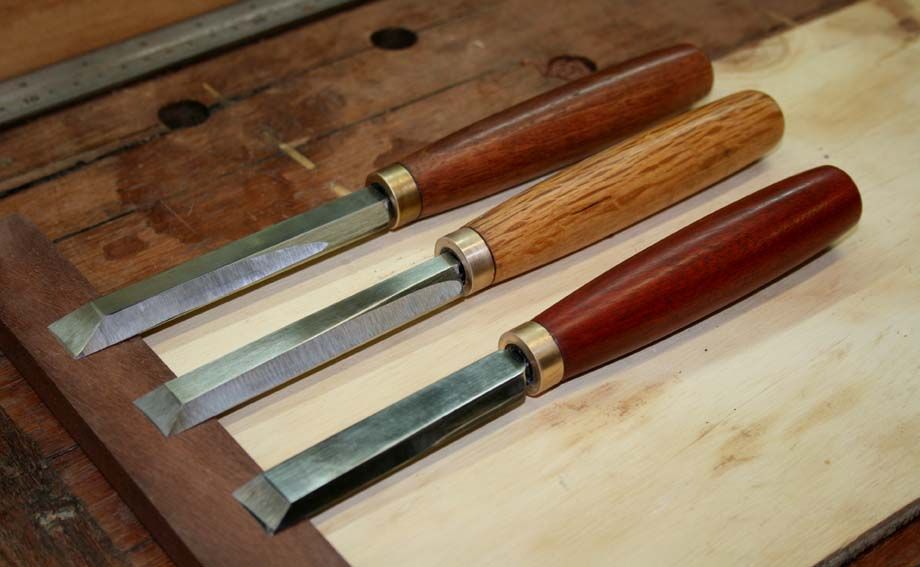
The top one is 3V, the middle M4, and the lower one is 10V.
The 3V is ground and honed at 25 degrees, while the other two are 30 degrees. These are the optimal angles for these steels, according to the advice I was given.
Theoretically, this should indicate that the 3V is preferred for paring while the others are better suited to chopping. I wonder if this turns out in practice?
Regards from Perth
Derek
must consider the whole process
Bill Tindall
What is considered best must account for how the metal will be used as well as how it will be maintained. Indeed, abrasion resistant steels demands something better than 19th century abrasives. When I have occasion to sharpen an old Stanley plane iron I am astonished at how easily it abrades, no doubt to be compatible with the "rocks" of its day. On the other hand, any steel abrades easily with diamond abrasive.
Is it worth switching out an ""old" iron for a "better" steel including upgrading one's sharpening equipment? I suspect doubtful in most cases. However, if one is starting from scratch, then alternatives to traditional materials should be considered. "Pioneers" serve a useful purpose investigating alternatives and reporting their properties for consideration.
Personally I don't do enough planing for the metal to have much effect on my satisfaction. Chisels are another case. I like the benefits of the modern steels.
Tow truck? Who needs a tow truck? *LINK*
Bill Houghton, Sebastopol, CA
I am not, here, expressing an opinion on the question of O-1 vs. newer steels and their tradeoffs.
I just couldn't resist Bob's setup.
http://www.youtube.com/watch?v=idiw3rDU954&feature=related
to repeat a chisel dulling discussion
Bill Tindall
Chisels don't get dull by the same mechanism as plane irons as revealed by microscopy. The edge fails(gets dull) by deforming or chipping on a micro scale) The best metal is the metal that compromises these two mechanisms at the bevel angle and mode of use. 3V is exceptional in not chipping. M2 is poor in this property. M4 can be hardened more than 3V to resist deformation but maybe at the expense of chipping (I haven't tried M4. I got weary of metal work and returned to woodwork) In the end what is best will depend on bevel angle, HEAT TREATMENT DETAILS, and how the chisel is used. (Without revealing the details of heat treatment comparisons are meaningless.) What someone says is best may not apply to other's situation for the reasons enumerated.
Re: Tow truck? Who needs a tow truck?
Bob Hackett
I think if you lift one of those horses hooves and look at the shoe you may find that the caulks that allow them to work on ice are made from wear resistant steel.
You forget Bill,I am also a blacksmith. 
Re: to repeat a chisel dulling discussion
TomD
I do my own tool making and heat treating so I get the 101 stuff. I just wonder about M4, seems like an obvious upgrade, so why stop at 3V. It is the single longest wearing cold use HSS in the CPM range, and has the best toughness of any HSS they make. They all have very fine carbides. It doesn't sound as though there would be problems, but it might be a nightmare for some non-obvious reason. What with the diamonds etc... It just sounds like an obvious candidate.
Re: CPM 3V vs. CPM M4 ?
TomD
Thanks Derek, that's a real answer. I am skeptical about the grind angle though. I would wonder where such a recommended angle would come from since they don't really make it for such uses. I would have a hard time believing the steel would blow up on you if you simply ground it to 25 degrees. Never found a steel that couldn't take that. These steels are designed for cutting other steels, while the cutter is red hot, with an intermittent cut. There is just nothing in woodworking short of dropping it edge down on a stone floor that would be equivalent to that kind of use.
Did you have any difficulty with M4 otherwise, cost, sharpening, sourcing?
Oh, see? I handed you a straight line back
Bill Houghton, Sebastopol, CA
Re: CPM 3V vs. CPM M4 ?
David Weaver
I think M4 would be my choice for a chisel if I had to drop them and then put them back in service.
I dropped three japanese dovetail chisels out of a tool roll - business end first into a concrete floor. It wasn't that great of an experience.
Re: CPM 3V vs. CPM M4 ?
John Payne
Tom
3V and M4 are definitely being tested against each other in chisels and plane blades. I'm the one that sent Derek the chisels and plane blade. He will be getting several other steels to try down the road. In some of the tests done so far, M4 has been much more wear resistant than 3V, but the edge shows chipping very quickly. This may be because it came back from heat treating at the high end of it's range. I think with a couple points lower in hardness it will do better, we will be testing that. The guy testing it was planing MDF and in comparison, after a several passes O1, D2, and 3V showed visible wear, M4 showed none.
If you have questions, let me know.
John
As my dentist once said...
Larry Williams
"...If you want to ride a horse into town and talk to people on a crank style phone then more power to you.I`ll still say hello when we meet and let you use my cell phone to call a tow truck to pull you out of the ditch.All I ask in return is that you don`t look down your nose at me because I choose to keep up with recent technological developments."
As my dentist once said, "Okay, we have a pretty good idea where that nerve is."
As I said, Bob, we do use high speed steel in our shop and some times for wood. We have it in both our planer and jointer but I don't find it all resistant to embedded metals. Those HSS knives last well because of the heat resistance of HSS but an embedded nail tears them up in a heart-beat. When I machine steel using HSS tooling, I use a much different cutting geometry than I do for wood. These different shaped cutting edges aren't interchangeable and I'm sure an attempt to interchange them would lead to immediate problems.
I just don't see any gain here in using HSS or even powder technology steels in hand tools. I suppose if my point of reference was the chrome vanadium steel Marples used in their Blue Chip chisels or Record put in their planes, I could see a need for improvement. I thought everyone knew chrome vanadium makes for lousy cutting edges though.
I believe there is a problem in promoting these steels the way I see it being done. As simple as basic sharpening is, for some reason there's a significant percentage of hand tool woodworkers out there who haven't figured it out. I think holding out a difficult to sharpen, magic-bullet steel with "long lasting edges" as a solution to a lack of basic sharpening skills just leads to failure.
How can anyone decide their cutting edges aren't durable enough if they can't create a good edge in the first place? When I see those promoting magic-bullet exotic steels emphasize learning basic sharpening skills before exploring blind alleys, I'll be less critical of this nonsense.