Part 6 - Drying
by Bill Tindall
Drying Basics

What happens to lumber after the green chain (see previous section—Inspection & Grading) has changed markedly in the past twenty years. In the past there were numerous small mills in my area and they supplied lumber to the area furniture factories, flooring factories, kitchen cabinet factories, and other high volume end users of hardwood lumber. The lumber was seldom end trimmed or even graded at the mill. The lumber was sent by truck to these nearby factories where it was graded, stacked with sticks between the layers to enable air circulation, and piled outdoors in stacks as high as a fork lift would reach—about 20'.
It was not uncommon to see hundreds of thousands of bd ft drying by these factories. When the lumber had air dried to around 30% MC (moisture content) it was moved to steam heated kilns and dried to about 7% MC. The factories used their wood waste to make the steam. Most of these furniture factories have closed, so today these local markets are gone, as well as the small mills that supplied them.
Today, huge and highly automated lumber operations sawing as much as 100,000 bd ft of lumber per day dominate hardwood lumber production. It is common for these large mills to have drying facilities integrated into their operations. They've found it useful to produce attractive bundles of lumber for sale often for the export market. From 50 to 70% of the hardwood lumber produced in recent years was exported.
Nowadays, what happens to lumber after it comes off the green chain varies widely among mills, depending on the market for their lumber. In what follows I will describe some typical operations found in my area.
Before the lumber leaves the green chain the lumber will almost always be double end trimmed to a length, about 2" longer than nominal foot increments. This operation makes the bundles more tidy at the expense of about 4" of end trimmings going to waste. I prefer untrimmed lumber for my use and get this extra 4" for free. The ends may be sealed but often they are not. The lumber will be assembled into packs of about 1000 bd ft according to species, length, and grade. The lumber packs may be dipped in a chemical bath to prevent the growth of mold and fungus, but more often it is not dipped. If the lumber is to be sold green then the packs are banded, loaded onto trucks, and sent to the domestic customer or shipping point for export.
Stickering Piles
I am going to dwell more than usual on this topic because it is important to anyone drying their own lumber. In the past, lumber was usually dried by the end-use customer but now it is common for the saw mill to integrate drying into their operation. Once the lumber comes off the green chain it must begin the drying process immediately unless it was dipped in the chemical bath. Otherwise, susceptible species like maple and other light colored woods can begin to develop mold which will stain the lumber grey or black within a day or two in hot weather.
Getting the surface dry is sufficient to prevent mold growth but if the moisture content of the interior is not brought down fast enough, enzymes within the wood make chemicals that darken the lumber when it dries. This defect is called chemical stain and it can be confused with mold stain. Sticker stain is one or the other of these stains that occurs under the sticks used for stacking lumber. It is usually the result of having used sticks that are not dry.
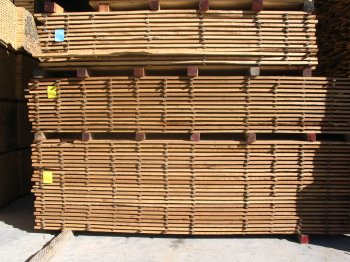
The first step in the drying process is to get sticks between the layers of lumber so that air can freely circulate between the layers. This picture shows some stacks that just came out of the kiln with the sticks still in place. The important points of preparing these stacks are illustrated in this picture. The objective of the sticks is to enable air circulation between the layers while adequately supporting the lumber so that it stays flat during drying.
In this case the sticks are 8' long and ¾" thick, although I have seen these sticks up to 1" thick (thicker sticks enable better air circulation but the kiln will hold less lumber). The bottom packs are cherry and the sticks are 12" apart which is closer than I have seen in most cases. This operation, Mountain City Hardwood, told me they stick cherry and maple every 12" and other species at 2'. It is common to see stick separation of 18" at other operations.

Some mills use kiln dried sticks made from domestic species but this mill uses foreign woods that don't pick up moisture as readily as domestic species. At this mill grooves are milled into the sticks to promote air circulation and hence, more rapid drying under the stick. These are grooves in a 4x4 used to support the stacks.
It is essential that the sticks be aligned one above the other to properly support the layers. These piles are assembled by automated stackers and they are perfect. When these stacks were in the kiln the 4x4's which enable the fork lift tines to go between stacks would have been aligned exactly under the sticks. Note that the bottom layer has already begun to sag because it is not supported under each rank of sticks by a 4x4. Any warps and wiggles before drying will be flattened by the moist hot environment of the kiln provided the lumber is properly supported in the kiln. But, any bows set in the hot lumber when it leaves the kiln will be there forever.
Logs are cut in even foot increments so most lumber will be even foot increments. However, as a result of trimming some odd length lumber is produced. Lumber stacks are assembled from just one even length of lumber plus the odd length 1' shorter. These odd lengths present a problem for supporting the layers. This problem is usually dealt with by alternating the end alignment of these odd length pieces when the stack is assembled. Note in the top pack of 12' long poplar the sticks are spaced every 2' except at the ends of the pile where they are spaced one foot. This extra stick one foot from the ends support the ends of the 11' long pieces in the interior of this pack. The odd lengths should be in the interior because they are supported better there.
Predryer
After stacking (or stickering as it is often called) the stack may be placed outside with a cover over it for air drying. Air drying is cheap and it is what was usually done some years ago. But the drying rate is subject to the weather. Too slow drying and the lumber may stain and too fast drying and the lumber may check. In any case the wetting, drying, and sun will turn the lumber grey. While this discoloration is of no practical consequence, nowadays it is important for lumber packs to be attractive even to the point of painting the ends of lumber stacks and putting company logos on the sides. Therefore, it is common for large mills to use predryers.

The function of the predryer is to do what outdoor drying once did, but in a controlled way. By carefully controlling the initial drying rate, most drying defects are avoided and the lumber stays bright and attractive. Predryers come in many variations of sophistication. This predryer is a pole building with fans to move the air through the stacks and side vents which are opened or closed to control humidity, which in conjunction with the fans, determines drying rate. Predryers can hold as much as a million bd ft of lumber.
Kiln
The predryer can do its job with out heating the air, but getting lumber to a marketable moisture content of 7% requires heating the air well above ambient conditions. While the predryer can be a relatively crude affair, kilns are, by comparison, sophisticated buildings and greatly more expensive to build and operate.

This picture shows kilns of 200,000 bd ft capacity. Every kiln I have ever seen looks just like these—they vary only in width. They are always silver—I suppose to reflect heat back into the interior. In the front they will have large sliding doors to accommodate fork lifts full of lumber stacks. These kilns are heated by steam generated by burning wood waste from the saw mill. Operating costs for these kilns many be only a few dollars per 1000 bd ft of lumber dried. Smaller kilns often are heated and dehumidified with a heat pump arrangement. Needless to say, an all electrical energy source results in higher operating costs.
To avoid drying defects water removal must be uniform within the stacks and the rate of removal matched to the species and thickness of lumber that is drying. These criteria are accomplished by fans and baffles that direct air though the stacks. There is a hurricane of air moving inside an operating kiln and a constant hum of the fans. By controlling the temperature and humidity of this air the drying rate is controlled so that moisture gradients which would induce stress in the lumber are minimized.
While it is common for the kiln to be charged with air dried or predryer dried lumber this particular kiln dries lumber right from the saw. It takes about a month to dry green 4/4 oak in this kiln while 4/4 poplar can be dried in a week. Kiln drying times are shorter if the lumber is predried because it starts out drier to begin with. It is common practice to dry to a moisture content of 5% and then steam the lumber back to the industry standard of 7%. The post drying steaming relaxes any drying stress induced in the initial drying process.
Comments (0)
No comments yet. Be the first!
Leave a Comment