Part 4 - The Saw Mill
by Bill Tindall
In the old days the saw mill was set up near where the logs were harvested. There was no automation in these simple mills—logs and lumber were moved by man power and a portable engine powered the saws. They were only able to saw a few thousand feet of lumber in a day. Now the mills are more complex, automated, and they are permanently located at sites which are conveniently accessible to wide spread logging operations. The smallest mill in our area saws 100,000 bd ft per week while the largest saws 100,000 bd ft in a day—that is about 30 tractor trailer loads of logs per day.
All of these mills use the same steps to convert logs to lumber. Logs are debarked, then brought to the saw or saws, and sawn into boards. Boards with bark on the edges are ripped to remove the bark. All the boards are then graded and defects are trimmed away to improve grade. Finally, the lumber is sorted and bundled by species, grade, thickness, and length, ready for shipment . The mills mainly vary in the amount of automation employed to move lumber around, the automation to determine how to saw a log for best yield, and the details of the saw or saws.
It is difficult to get good pictures of a mill in operation, so most of the pictures will be of the mill at rest for they will best show the equipment. The mill pictures were taken at two of the smallest mills in the area because they are closer and I can wander around them at will.
Debarker
The bark of the log accumulates all sorts of saw-dulling grit during the process of skidding the logs out of the woods and while on the log yard. This grit would dull the saw prematurely and result in lost production. Furthermore, the slabs and cut-offs are chipped for making paper. No bark can be tolerated in these chips. Therefore, mills remove bark with a debarker, a machine that comes in several varieties. Logs are loaded onto a live skid way with a forklift or log grabber such as was shown at the log yard (previous section). The live skid way is a series of parallel chains like on a bicycle which rotate over sprockets and move logs or lumber forward upon command of the operator. We will see an example later in the mill and during grading.

The operator sits in the green house on the right and the debarking head is on the left. The wires overhead power the debarker motor. A log is brought forward by the moving chains and dumped onto the cogged wheels, half of which are seen in front of the small log which has just been debarked. These cogged wheels capture the log on each side and upon command of the operator they rotate the log under the debarking head. The head is moved across the log on the track in the foreground.

Mill Front End

Here we see an overview of the front end of a typical mill. The yellow booth is where the sawyer sits. A joy stick with buttons controls various hydraulic devices and motors which move the debarked logs along the skid way, lift the log onto the saw carriage, rotate the log on the carriage, set the dogs, position the log to saw a set width of board, advance the log through the saw, and control where the board or slab goes when it falls from the saw.
It should be apparent that this is the most highly skilled job at a mill. A 19 year old wisp of a sawyer occupies this booth and he runs everything on this end of the mill. In the old days without automation three very strong men would be needed here.
The circular saw is shown in left center with the end of a log behind it ready to go through the saw. The saw is driven by belts from the blue electric motor, probably around 100 HP. The green conveyor can be swung with the red hydraulic cylinders to direct the slabs seen on the belt to the chipper, finished boards to the green chain, or cants to a gang saw. More on these parts later.
The Skid Way and Log Carriage
The next two pictures were taken at a different small mill. The lighting in this mill is better for showing the log carriage. This mill does not debark logs, which is very uncommon, but the skid way and log carriage functions are typical, although the carriage is less automated than most (it is a small mill). Logs are carried to and dumped onto the live skid way in front of the main saw called the head saw (see below). The picture below shows some walnut logs on the skid way chains. The crescent shaped pieces of metal in the foreground hoist the log onto the saw carriage with a hydraulic cylinder.

In the old days the skid way was just a sloped ramp. The sawyer and a helper rolled the logs up the skid way and onto the saw carriage with cant hooks. It takes great strength to roll large logs. One day while I was at a mill someone bet the sawyer that he could not pick up a hickory railroad tie he had just sawed. The sawyer hoisted it to his shoulder with ease and then danced a jig for good measure.

This picture shows the log carriage. The carriage is the heart of the mill and it performs several functions. It holds the log securely during sawing. It travels on a track to move the log across the saw and it advances the log perpendicular to the saw in increments determined by the sawyer to produce boards of specified thickness. The log lays on the horizontal metal piece just above the carriage wheels. It is supported in back by the vertical head blocks and held on the carriage by the dogs, the downward pointed things on each head block. One can sometimes see dog dents in the edges of hardwood lumber. They will be serious dents about 1" wide in the edge of a board.
The log is positioned relative to the saw by moving the head blocks forward or back. To saw the log the carriage is pulled toward the saw with a cable, which can be seen under the carriage. The large dial at the top of the picture tells the sawyer how thick the board will be.
The big orange thing is one variety of log turner. It has a chain with some teeth and on command rotates these teeth to position a log. A hydraulic cylinder pushes the device forward to the log on the carriage. The teeth engage the log and rotate it. Hardwood logs are typically sawn to yield the most high grade lumber. To do this the log is frequently turned to find the clearest log face from which to remove a board.
It takes a great deal of skill to set up the carriage. If it is not aligned perfectly the mill will cut boards that are not of uniform thickness. If the lumber is not uniform it will be down-graded by the lumber inspector.
The Head Saw
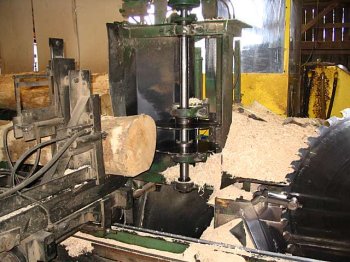
The first saw a log encounters in a typical hardwood mill (the head saw) is a circular saw, seen here. The job of this saw is to make at least two parallel flat sides on the log and in most cases this saw also removes as many high grade boards as the log will yield. In smaller mills this is the only saw that makes boards from the log. In larger mills this saw saws the log down to a cant—a portion of the log with at least two parallel faces—and the cant is sent to a band saw or a gang saw (more on this operation later) which more rapidly converts the cant to boards (usually lower grade boards).
The circle saws are fast and accurate and most importantly, it will be the only area in the mill where the log can be turned to search for the clearest log faces to produce the highest grade of board. This saw typically cuts a ¼" kerf. The teeth, called “bits,” are removable/replaceable and held in the saw plate with rings. The sawyer sharpens these bits on the saw with a file, and then swages the end of the bit to widen it to provide set for the saw. If a nail is hit and it ruins a “bit” (tooth), or a few bits, new ones can be quickly installed. If a fence insulator or a bolt is hit and the saw plate is damaged, it must be taken to a saw shop to have it re-hammered back into shape.
The first boards removed from the log will have rough edges where the bark was attached. There are various strategies for removing this rough edge. This mill has two small horizontal saws perfectly aligned with the main saw to cut a strip from the top and bottom of a board as it passes the main saw. A laser beam shows the sawyer where these saws will cut and he moves these saws up and down to just remove the rough edge from the board being made by the head saw.
An alternative device to do this task is an edger. It is a sturdy rip saw with two vertical blades which can be adjusted to rip a board of specified width by removing a strip from one or both sides of the board. Rollers grab the board and feed it in a straight line through the edger. Sophisticated edgers have lasers, scanners, and computers to calculate the best value and rip the board accordingly.
Various other parts of the mill can be seen in this picture. Sawdust falls out the metal chutes under the saws into the pit where it is scooped up and carried away with the dust chain to a storage area. It will be sold for mulch, cattle bedding, or fuel for the local paper mill. You can see the small oak log secured on the carriage and behind it, logs on the skid way. The sawyer has a bird’s eye view of the saws from inside the yellow booth. The window protects him from flying debris.
The advantage of the head saw and carriage is that the sawyer can turn the log to find the clearest faces from which to saw boards. This process is relatively slow, but it pays off in yield from the log so long as the log has clear faces to saw from. In high volume mills once the high grade boards are removed by the head saw the cant will be passed to a faster sawing operation to saw the lower grade lumber. A gang saw is a common machine for converting cants to boards. A gang saw is similar to an edger but with multiple blades spaced a board width apart. It converts the cant into boards in one pass through the machine.
Sawing Strategy
Our retail customers would be astonished that we didn’t have 6" or some other standard width boards of their choosing. In a softwood mill the objective is to make boards of such a specified width. After all, the end use of much softwood is dimensional lumber for construction. In a hardwood mill the objective is to get the highest value boards from the log, with little regard for width. Clear boards from the outside of the log can bring ten times what the pallet lumber from the heart brings.
The clearest lumber in a log will be located on the outer portions of the log. This is the wood which grew after the limbs died and fell off the young tree. The overall strategy for sawing hardwood lumber is to remove as many high grade boards from the outside of the log as possible in the shortest amount of time, while concentrating defects—knots, rot, pitch, etc.—in the remaining interior portion of the log. Turning the log enables the sawyer to find clear faces to saw but it takes time away from sawing. The sawyer is always budgeting his time between trying to get the highest grade lumber from the log vs getting the log sawn and moving on to the next log.
This strategy of frequent turning of the log on the carriage will result in boards narrower than if the log was just sawed through in one position on the carriage. Through sawing would yield wider lumber that could be book matched. While through sawing might be more desirable for our needs it would yield less high grade lumber overall from the log. But, commercial mills saw lumber to meet the needs of furniture factories, not us.

The following sequence illustrates an example of the sawing strategy which would be used on an ideal log with no defects in its outer portion. The sequence of turning and sawing which would be done on logs with defects on their outer portions will vary somewhat from this ideal example.
At right is a view of the end of a typical log to be sawn. Note the blue arrow pointing to a ripple in the grain in the pith. We'll use that as a reference to follow the orientation of the log in the following sequence. If it isn't otherwise obvious, the green line in some pictures represents the cut made by the saw blade.
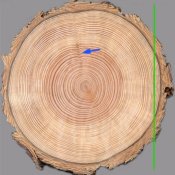


Sawing starts by removing a slab plus two or three boards from one side of the log.
Next the log is rotated 180° (note the blue arrow)…


…and a slab plus two or three boards are removed from that face.
The log is then rotated 90° (note the blue arrow)…

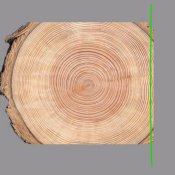

…and a slab removed. Having removed just the right number of boards from the log in the first two positions (not perfectly illustrated in these pics), followed by rotating the log 90°, subsequent cuts from the remaining cant will not have a bark edge. These boards will not require a trip to the edger and that saves labor. The sawyer typically stops cutting from this face 3" away from the pith.
The log is now rotated 180° (note the blue arrow)…


…and boards removed from the last face, again continuing until the sawyer reaches the 3" from the pith point.
Not shown in the preceding series of pictures, but continuing, the sawyer rotates the log through 90° once more and takes one more plank off, then rotates the log a final time through 180° and cuts off one last board leaving a boxed heart or cant 6" square (last picture, above right). This heart wood (center) of the tree is low grade material for a variety of reasons. It contains the pith, cracks, and many knots from early in the tree’s life. The boxed heart goes for pallet material and other low grade wood needs.
In the above illustration the sawyer didn’t encounter any defects until the log was sawed down to a 6" cant. In a more realistic case a knot or some defect that would cause the lumber to be downgraded would be encountered in an early cut. In this case the log might be turned earlier in the process and/or more frequently. Log scanners coupled to sophisticated computer algorithms are replacing the judgment of the sawyer in some mills.
To meet the specifications for the top grade of lumber, FAS (firsts & seconds), the boards must be at least 6" in width. Notice therefore how cutting the log in this sequence ensures none of the potentially high grade boards from the outside of the log fall below the critical 6" width. Depending on market factors this 6" goal is not always important. Keep in mind that this discussion was for an ideal log. The details of sawing an actual log will vary somewhat depending on its shape and the defects encountered in sawing it.
Comments (0)
No comments yet. Be the first!
Leave a Comment