Part 3 - Logging
by Bill Tindall
Harvesting timber begins with the contract between the owner of the timber and the saw mill, or an independent logger supplying logs to saw mills. Skid roads are graded into the forest and a place is cleared and leveled for loading the log trucks. This work is typically done with a small bulldozer. Then logging can begin, an activity that occurs all year in my area.
Sloppy loggers can make a mess of a woods leaving skid roads to erode and remaining trees damaged by skidding and felling. But, even under the best of circumstances a logged woods is not a pretty sight. The contract may specify stabilizing the abandoned skid roads, replanting trees or any number of factors that lessen the impact of the logging operation on the forest.
When I was a kid I carried water and supplies to a pair of French Canadian loggers in the Adirondacks. They skidded logs with a single horse that only understood French. The horse was guided through the forest with oral commands, the French equivalent of the English commands “gee” and “haw,” horse talk for right and left. It was fun to watch but way slow by modern standards. Later in the last century logs were skidded with a small bull dozer and winch which was still slow by modern standards.

Now logs are skidded with the nimble device shown in the picture at left. One or more logs are hooked with a cable off the back of the skidder. A winch pulls the logs to the skidder, lifts the log end up off the ground and away it goes to the loading area. The blade on the front is handy for pushing brush out of the way, or bunching up logs. With the aid of the skidder and truck with a log loader shown in the picture below it is practical for a single person to do logging.

The small boundaries of timber located on private land in our area are most often logged by a lone logger. This person will cut some trees, remove the limbs and then skid these trees to a loading area. Here they are cut to length for optimum yield (8-16’), loaded onto the log truck and hauled to a local collection point or directly to the mill. One load of about 2000 to 3000 bd.ft. of logs is a typical days work. It is a hard, dangerous way to make a living.

I often hear people fret over the “wasted” logs left in the loading area when the logger moves out. If these logs could be sold at the mill they would have been hauled away. These remains are unmarketable for a variety of reasons—rotten centers, severe crooks, foreign material (nails and the like), etc.

Logs typically come into the yard on trucks like what is shown in the picture at right. These are boom trucks and they have the advantage that the logger can load the truck by himself with the mounted crane. This truck was unloading 3200 bd ft of very nice 16’ poplar logs. The logger is up there sitting in the chair of the boom because he had to climb up there and get the boom out of the way of the unloading crane.

Once on the ground the logs are spread out for inspection and grading (picture at left). The length of the logs is measured with a tape measure fastened to the graders belt, the log grade is determined from the diameter of the log and what ever defects are showing (crook, knots, or rot), the log is scaled (scaling is the term for measuring the bd ft in the log), and this information along with species and the logger’s identification is recorded on the end of the log with crayon.
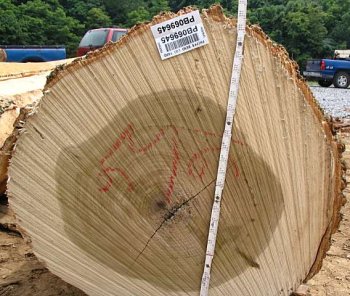
These crayon marks are shown on the end of the log in the picture. While we can’t make out what the marks mean, the log yard people can. Next, someone comes along with a bar tag and portable computer and enters the bar code and log information into a data base for inventory and payment of the logger.

The rule shown is used to determine the bd ft in the log. A close up of the rule is shown in this picture. Just to the left of the first ruler joint one can see the numbers 16,14 and 12 (these numbers correspond to log lengths) and three rows of numbers down the length of the ruler for each of these long lengths.
The opposite side of the ruler has the scales for other common log lengths. The end of the rule is placed at the bark/wood interface and the bd ft in the log is read from the value on the rule that aligns with the bark-wood interface across the diameter of the log. In this case if the log was 16’ long the top scale would be used and this log would contain 49 bd ft of lumber, according to the Doyle scale. Logs are always scaled from their small end.
Hardwood is typically scaled with the Doyle Scale. The formula for the Doyle Scale is
Bd ft = (D - 4)2 x L / 16
In words, subtract 4 from the log diameter (inside bark), square this result and multiply by the log length in feet divided by 16. The Doyle scale substantially underestimates the yield from small logs. This issue was discussed in more detail in Part 2 on selling timber.
The owner of the logs will be paid by the size and grade of the log. As an example the current price paid for a clear, large red oak log is about $0.50 per bdft, while a small red oak log, or one with several knots, would sell for only $0.20 per bdft. There is a considerable difference in the amount paid for the various species and this amount varies weekly according to demand. Currently, as of June 2007, the best cherry logs bring $1.50 per bd ft while hickory logs only bring $0.30 per bd ft. As an example of how demand can rapidly change pricing, prime red oak logs brought $1.00 per bd ft last year.
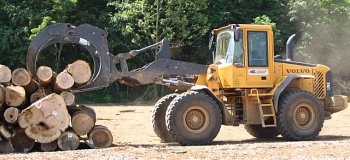
Logs are sorted, moved around the yard and piled with the machine shown in this picture. The big log in the picture is a red oak. Some inventory tags can be seen on the log ends.
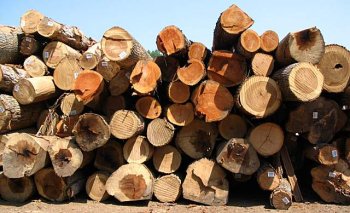
Here we see a portion of a log pile. This pile is unusual in that it has not yet been sorted by species. Log piles at the mill are always sorted by species because only one species at a time is sawed. The logs with the red ends are cherry and most of the other logs are poplar. This picture illustrates a trend in hardwood lumber quality. With the development of highly mechanized mills, as well as other market factors, it is now practical to saw logs as small as 10", the size of the smaller logs shown in this picture.
This fact has an impact not only on the quality of lumber being sold today, but on future supply. If trees as small as 10" are harvested today, it is going to be longer for the forest to grow back large trees. Twenty years ago it was common to get oak and poplar boards 12" and wider in typical wholesale packs of hardwood lumber. Not any more. Wide lumber is going to become even more uncommon in the future. If you have an opportunity to buy exceptional quality hardwood make the investment if you can afford to. I can only see the trend in quality going down and price going up.
Many of the best logs that would have been sawed in times past are now sold as veneer logs. Veneer logs are worth at least 50% more than the best saw logs and the sky is the limit for the very best veneer logs. These are the logs that yielded the most desirable lumber (wide and clear and/or figured) when they were sawed.
Finally, the logs are loaded on a tractor trailer for hauling to the saw mill (right). Between 3,000 to 6,000 feet of logs can be hauled depending on the size of the logs.. Because these tractor trailers can haul more logs than the boom trucks it is more efficient to use them for the 75 mile trip from this log yard to the saw mill.

Comments (0)
No comments yet. Be the first!
Leave a Comment