Part 2 - Selling Your Timber
by Bill Tindall
If you own a woodlot, someday someone is going to knock on your door and ask to buy your timber. If you decide you’d like to sell your wood, you owe it to yourself to plan the harvest for maximum revenues and the optimal health of your forest.
Generally speaking, there are three ways to harvest your timber:
- Clear cutting: removes all the saw logs as well as everything else that can be chipped to make paper. In my area, it takes two generations, or about fifty years after clear-cutting, before another crop of timber can be harvested. It requires much of this time span for the thicket of new sprouts to thin out and eventually start growing the surviving trees at a normal rate.
- Loggers choice: leaves the decision of what to harvest up to the logger. Left to their own interests, loggers will remove anything that they can make money on and leave the rest—trees smaller than 12" diameter and larger trees with no value—either because they are defective or because there is no market for the species ( beech, for example). Walnut and cherry trees greater than 10" may be removed. It will be a generation before the woods can be harvested again.
- Selective logging: removes the trees someone has decided should be removed. If this person is your local forester, both mature and worthless trees are removed, leaving behind young trees to fill the gaps left behind. This forest can be logged again in half a generation.
Logging for maximum return
Before you can start your planning process, you will need to gather some information. For the example discussed here, I’m using information that is current for my region, eastern Tennessee. The details will change with time and place but the conclusions will not. Think of your trees as your employees, and see how they can work for you.
As will be discussed (in Part 3, Logging), the board-footage yield of hardwood logs is measured with the Doyle scale:
Bd ft = (D - 4)2 x L / 16
where D = log diameter inside the bark, and L equals the log length.
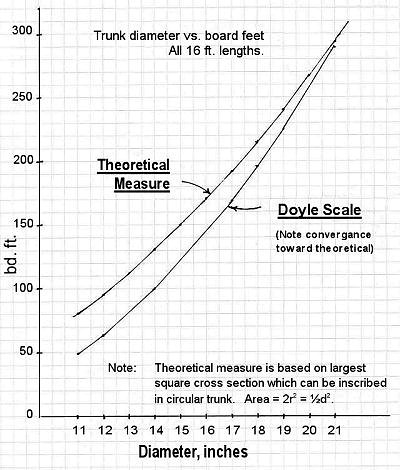
This measuring system substantially underestimates the volume and yield from small logs, accurately determines the yield from large logs, and overestimates the yield from very large logs. As your trees grow, the measured board footage in the logs from your trees will increase two ways—first, the trees add volume by growth; second, the scale used to calculate the yield grows them an additional amount because the difference between what the tree will scale using the Doyle scale and the actual volume of the tree converge as the log diameter gets larger, as can be seen in the chart at left.
Let us suppose you have eight trees that at harvest yield one 16’ log from each tree. Four of the trees have limbs on two sides of the trunk. They will grade “S” or select. The other four are limbless and “clear” for the full length of the 16’ log. They will grade “P1,” prime. If you harvest these trees today, they will bring, delivered to the log yard, the prices shown in Table 1 below. The landowner usually gets about half this amount and the logger the other half.
Let’s see what happens if these trees grow for another eight years. Let’s assume that the two limbs on the 17" diameter tree (#2 in Table 1) didn’t die and heal over so they will still show as defects in the harvested log. But, the limbs on the smaller trees (#4, #6 and #8 in Table 1) died, fell off, and healed over, which will normally be the case for young rapidly growing trees. The “+” cloumn in Table 1 is my estimate of how much these trees will grow in eight years. These are not unreasonable growth estimates for poplar—or even oak in good growth conditions—in the southern Appalachian valleys.
We see from Table 1 that in eight years the value of these trees went up nearly threefold, not counting whatever price increases there might be for poplar after eight years! The value received for the smaller trees went up even more. This illustration shows why I tell people that their trees are worth more than money in the bank, presuming they stay healthy.
Let us examine why the value went up this astounding amount. The trees grew larger adding board footage to the measured logs. The grade of the smaller trees improved because the limbs fell off and the limb scars healed over to produce clear, higher grade logs. Finally because of the way logs are measured the logs grew twice—once in the earth, and again because of the Doyle scale used to measure them.
Lessons learned from this exercise
- Let small trees (trees #3 to #8 in Table 1) grow to improve their volume and grade.
- Large trees with defects (tree #2) don’t add much value with time. Harvest them and make room for better trees.
- Large, good trees (tree #1) add value with time but not as much as small trees. Harvest them if you need the money or if they risk becoming damaged with age.
So, which method should you opt for: clear cutting, logger’s choice, or selective harvest?
Most everyone chooses option #2 (logger’s choice) in my neck of the woods—a poor choice by my estimation. This choice takes many trees at the peak of their productive growth and leaves trash trees that should be replaced by healthy and vigorously growing trees. It is the equivalent of letting a competitor skim off your most valuable staff.
Your trees are your employees. Make them work for you or get rid of them and hire some new ones. If the woods has lots of damaged and/or low grade trees then clear cut it if you can stand to look at it afterwards. Otherwise hire a forester, or get one for free from the state, to evaluate your timber and select trees to harvest.
Table 1
Comparison of Tree Value Today vs Eight Years From Now
| Log # | Diameter/
Grade |
Doyle
Measure (bd ft) |
Price/
1000 bd ft |
Total
Selling Price |
8-year
Diameter Increase |
Grade | Doyle
Measure (bd ft) |
Price/
1000 bd ft |
Total
Selling Price |
|---|---|---|---|---|---|---|---|---|---|
| 1 | 17"/P1 | 169 | $375 | $63 | +3" | P2 | 256 | $375 | $96 |
| 2 | 17"/S | 169 | 150 | 25 | +3 | S | 256 | 150 | 38 |
| 3 | 14"/P1 | 100 | 325 | 33 | +4 | P2 | 196 | 375 | 74 |
| 4 | 14"/S | 100 | 150 | 15 | +4 | P2 | 196 | 375 | 74 |
| 5 | 12"/P | 64 | 325 | 21 | +5 | P2 | 169 | 375 | 63 |
| 6 | 12"/S | 64 | 15 | 10 | +5 | P2 | 169 | 375 | 63 |
| 7 | 11"/5 | 49 | 125 | 6 | +5 | P1 | 144 | 325 | 47 |
| 8 | 11"/S | 49 | 0 | 0 | +5 | P1 | 144 | 325 | 47 |
| Totals | - | - | - | $73 | - | - | - | - | $502 |
NOTES
Log grades
- P2 : clear, over 17" diameter
- P1 : clear, 12 to 16" diameter
- S : clear two sides, over 12" diameter
- Grade 5 : 10" to 11" diameter
Prices
Typical for yellow poplar logs as of June 2007. No price increase was assumed in eight years—a most conservative assumption.
Eight-year increase: I assumed that the 17" select tree had large limbs on two sides today and that it would not lose these limbs and heal over in eight years. I assumed that in eight years the smaller trees would lose the limbs they had today and they would heal over and present a clear log in eight years. The growth in eight years would be typical for trees of these sizes in Eastern Tennessee valleys.
Comments (0)
No comments yet. Be the first!
Leave a Comment