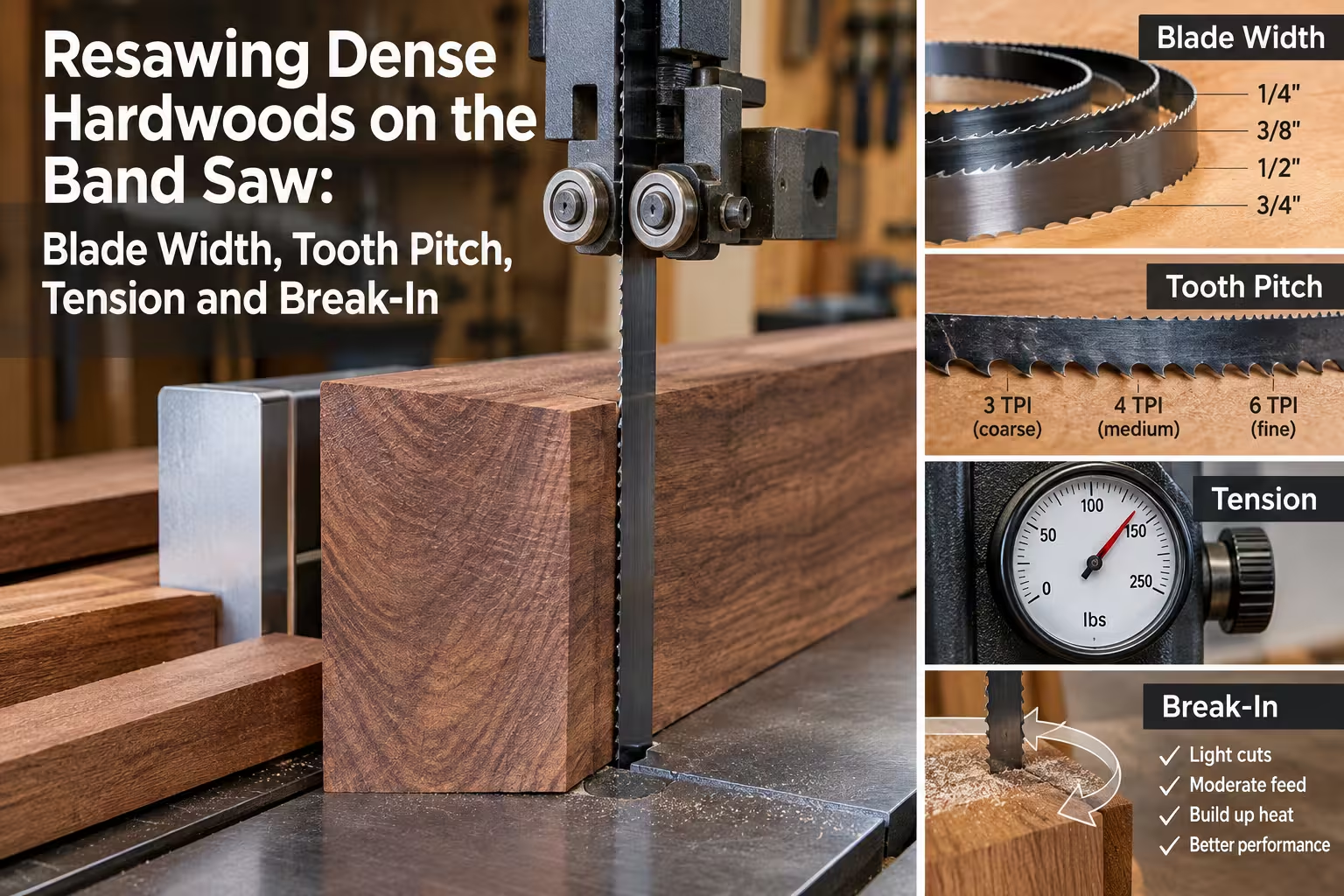
Resawing is where a band saw earns its floor space. Stand a thick board on edge, split it into a book-matched pair or a stack of thin drawer sides, and you get two or three boards out of one. In dry poplar the job almost runs itself. In padauk, jatoba, hard maple or white oak, the cut wanders, the blade runs hot, the faces come off washboarded, and sooner or later somebody blames the blade.
Most of the time the blade isn’t the real problem. A clean resaw in dense stock comes from a few things working together: the right width and thickness for your saw, a coarse enough tooth, proper tension, a gentle break-in, and a saw set up to cut straight.
Start with what your saw can handle
Check your owner’s manual for blade length, the range of widths the saw accepts, and the recommended band thickness. These are set by the machine, not by the job.
Thickness is tied to wheel diameter. Every trip around the wheels flexes the band, and a thick band on small wheels fatigues and cracks. A conservative old rule puts band thickness at about 1/1000 of the wheel diameter. In practice, .025″ (0.64 mm) is the standard for a 14″ saw, and .032″ (0.8 mm) suits wheels of 16″–18″ and up. A heavier band on a 14″ saw may feel stiffer at first, but it will usually crack long before it gets dull.
Blade width: as wide as your saw can tension
For resawing, width is your friend. A wide blade has more beam strength, so it resists bowing in a tall cut. On a typical 14″ saw that means 3/4″ to 1″ (19–25 mm), as far as the saw and its tension spring allow. Many 14″ saws, especially with a riser block, can’t properly tension a 1″ carbon blade, and a well-tensioned 3/4″ blade will outcut a slack 1″ blade every time. On a 16″–18″ saw, 1″ or wider is normal. Keep that blade for resawing and swap to a narrow one for curves.
Tooth pitch: coarse teeth and deep gullets
Each tooth carries its sawdust out of the cut in the gullet, the hollow in front of it. In a 6″ or 8″ (150–200 mm) tall cut every tooth takes a long bite, and if the gullet can’t hold that dust, it packs in, rubs the kerf walls, heats the band and pushes it off line.
That’s why resaw blades are coarse: 2–3 TPI (teeth per inch). A hook-tooth blade, with its positive rake and big rounded gullets, is the classic choice. A variable-pitch blade, such as 2/3 TPI, cuts a little smoother and quieter because the uneven spacing damps vibration.
You may have heard that at least three teeth should be in the cut. That rule matters for thin stock, where a coarse tooth grabs and tears fibers. In a tall resaw cut you’ll have a dozen or more teeth in the wood even at 3 TPI, so the limit is gullet capacity, not tooth count. A 6 TPI blade that works fine in 1″ stock will clog and burn in 6″ maple.
Tension: start from the numbers, finish with the manual
Too little tension and the blade bows, flutters and leaves a barrel-shaped face. Too much and the band fatigues, the weld takes a beating, and the saw’s frame, spring and bearings work harder than they were designed to.
As a starting point, carbon-steel blades run at about 15,000–20,000 psi (roughly 100–140 N/mm²). Bi-metal and carbide-tipped blades are designed to run higher, often 25,000–30,000 psi or more, but only if your saw can deliver it. The scale on many hobby saws is a reference mark, not a gauge, and the saw’s manual and the blade maker’s recommendation come first. Don’t crank on extra tension to cure drift; it only hides the real cause.
Release the tension at the end of the day. A band left tensioned for days stays under constant stress, flattens the tires, and is a common reason a blade breaks the next morning.
Break-in: the first minutes decide blade life
A new blade’s teeth are at their sharpest and most fragile. Shove a dense board into them right away and the tips can chip; from then on the blade cuts worse, you push harder, and wear speeds up.
- Mount the blade with the teeth pointing down toward the table, tension it and track it.
- Run the saw empty for two or three minutes and watch the tracking.
- Make the first cuts at roughly half your normal feed, in clean, medium-density stock with no grit, bark or hidden nails.
- Recheck tension after the first 10–15 minutes of cutting. A new band settles and stretches slightly.
- Bring the feed up gradually while listening to the cut and watching the dust.
Drift: fix the cause, then set the fence
Drift is the blade cutting at an angle to the fence instead of parallel to it. Common causes:
- uneven set, often after hitting a staple or nail, so one side cuts more aggressively;
- low tension, or a dull blade being forced;
- tracking: on wide blades, try running the gullets near the crown of the upper tire;
- guides set too loose, too tight, or set only below the table;
- feeding faster than the gullets can clear.
Fix those first, then deal with what’s left. Joint a scrap board, draw a line parallel to the edge, and cut freehand along it for about a foot. Stop with the board in the blade, mark its angle on the table, and set the fence to that angle. A tall fence or a single-point fence helps on wide boards. Keep the upper guide just above the work, feed steadily, and let the blade do the cutting.
Why blades break
The usual causes are fatigue from a band too thick for the wheels, overtension, a blade left tensioned between sessions, heavy feed pressure, and a dull blade that you keep pushing. A blade riding hard on the rear thrust bearing is being overloaded too. Cracks at the bottom of the gullets mean fatigue; a clean break at the weld in the first minutes usually means a shock load or overtension.
Resin and gum in dense hardwoods
Oily padauk, gummy jatoba and cherry, hard maple that scorches easily, and dense oak that packs fine dust into the gullets all leave buildup on the band. A gummed-up blade behaves like a dull one: more feed pressure, dark streaks on the band, a scorched smell, then drift.
Clean it before it gets there. With the saw stopped and unplugged, release the tension, scrub the teeth and both faces with a brass brush and a blade-and-bit cleaner, and lift stubborn deposits with a wooden scraper, never a steel one. Wipe the tires too, since resin on the rubber reduces grip. Store spare blades coiled into three loops, dry and lightly oiled, tagged with length, width and TPI.
Troubleshooting checklist
| Symptom | Likely cause | What to do |
|---|---|---|
| Cut wanders to one side | Uneven set, poor tracking, fence not at the drift angle | Check the set, re-track, set the fence to the drift angle |
| Blade bows, barrel-shaped face | Low tension, pitch too fine, feed too fast | Raise tension within the manual’s limits, use 2–3 TPI, slow down |
| Washboard on the sawn face | Uneven feed, loose guides, blade flutter | Feed steadily, close up the guides, recheck tension |
| Smoke, burning, hot blade | Gum buildup, dull teeth, packed gullets | Clean blade and tires, sharpen or replace |
| Fine dust instead of chips | Pitch too fine or a dull blade | Coarser blade, check sharpness |
| Cracks at the gullets | Band too thick for the wheels, overtension, left tensioned | Match thickness to wheels, release tension after work |
| Weld breaks in the first minutes | Shock load, overtension, no break-in | Ease into the cut, correct tension, break in |
| Blade jumps off the wheels | Low tension, poor tracking, resin on the tires | Clean the tires, re-track, retension |
One last habit: change one thing at a time. If you swap the blade, the tension and the guide settings all at once, you’ll never know which one fixed the cut.
About the author: Andrei Kamyshenko works at Stankotorg LLC in Moscow, which has supplied band saw machines and blades to woodworking and metalworking shops since 2008. He writes practical notes on blade selection, setup and troubleshooting for small shops and furniture makers. Band saw blades for wood (Russian-language site): stankotorg.ru/treesaw.htm
Aligning a bandsaw from our archive:
https://www.woodcentral.com/articles/articles_535.php