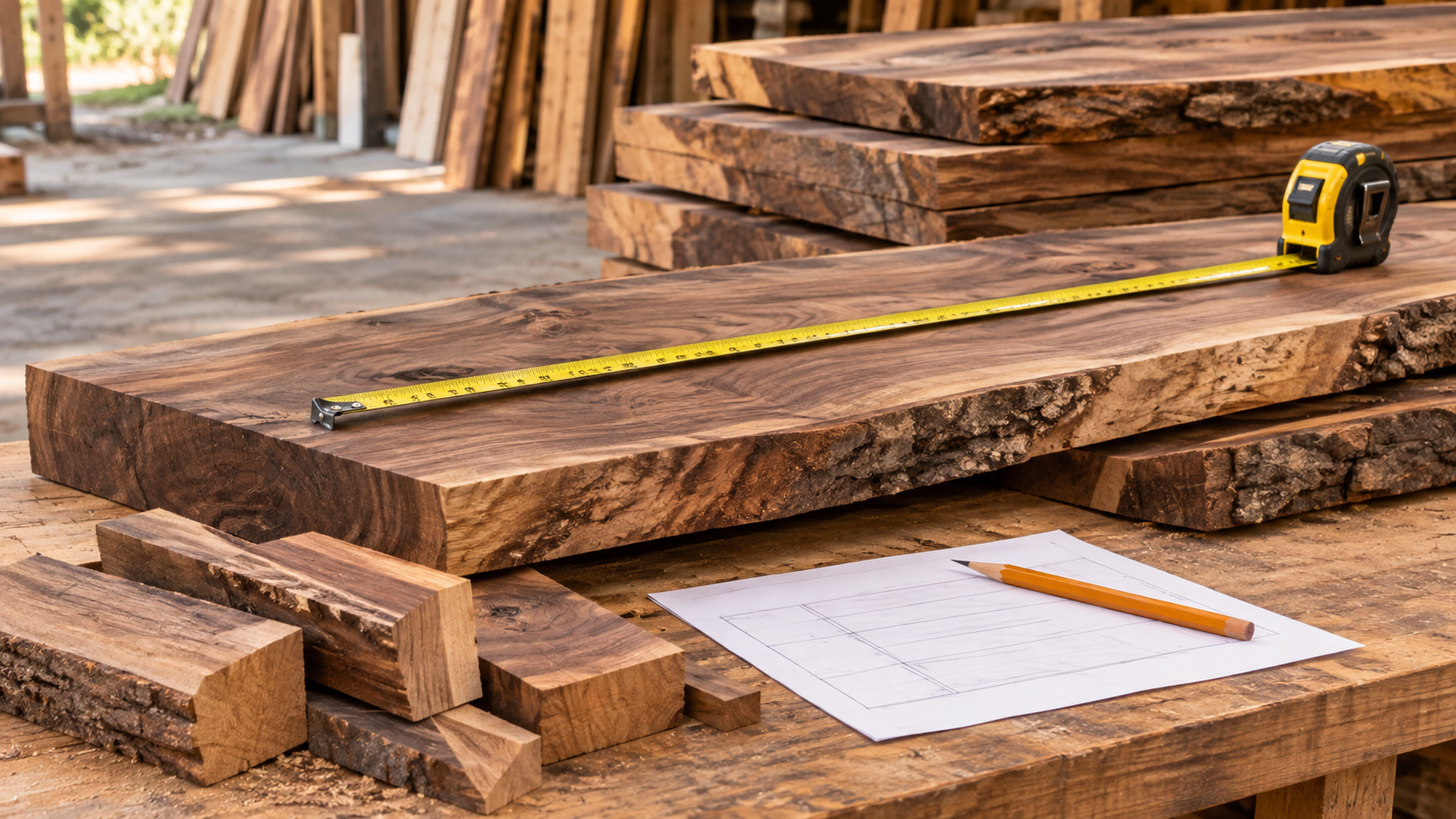
The first trip to a hardwood dealer can be confusing. The boards are rough, the edges are crooked, the price sign says “per board foot”, and the person at the counter adds up your pile faster than you can follow. Many people new to it either buy far too little and have to make a second trip, or buy far too much because they’re afraid of running short.
This article covers how board feet work, how to turn a project cut list into a buying list, how much extra to allow, and how to compare a dealer’s price with the dressed lumber sold at home centres.
What a board foot actually is
A board foot is a volume: 144 cubic inches, or a board 1 inch thick, 12 inches wide and 12 inches long. Two formulas give the same answer:
- Board feet = thickness (in) × width (in) × length (ft) ÷ 12
- Board feet = thickness (in) × width (in) × length (in) ÷ 144
So a board 1 in thick, 8 in wide and 8 ft long is 1 × 8 × 8 ÷ 12 = 5.33 board feet. A board 2 in thick, 6 in wide and 6 ft long is 2 × 6 × 6 ÷ 12 = 6 board feet.
Quarters, rough thickness and what you actually get
Hardwood is sold by rough thickness in “quarters” of an inch: 4/4 is 1 in, 5/4 is 1¼ in, 6/4 is 1½ in, 8/4 is 2 in. You pay for the rough thickness, not the thickness you end up with. A 4/4 board that’s been flattened and planed usually ends up around ¾ to 13/16 in thick. If the board is cupped or twisted it can be thinner. That’s why projects that call for a full 1 in of finished stock need 5/4 lumber, not 4/4.
Width and length work the same way. Rough boards come in random widths and lengths. Dealers usually measure the width at the narrowest sound point and round to the nearest inch. Length is usually counted in whole feet. Ask how your yard tallies, because small differences in rounding add up over a big order.
If the yard offers S2S (surfaced two sides) or SLR1E (straight-line ripped one edge), you’ll usually still pay for the rough board feet, but the stock is easier to read for defects and quicker to mill at home. For someone without a jointer and planer, that small upcharge is often worth it.
From cut list to buying list
Start from the finished parts list, then turn each part into a “rough blank”:
- Add thickness. Finished ¾ in parts come from 4/4. Finished 1½ in legs need 8/4 (or two pieces of 4/4 glued up).
- Add width. Allow about ½ to 1 in over the finished width for jointing edges and ripping.
- Add length. Allow 1 to 2 in over the finished length. Rough boards often have end checks (cracks) that need to be trimmed off, so leave extra for that too.
- Total the board feet of the blanks.
- Add a waste allowance. For most furniture projects, 20 to 40% on top of the blank total is realistic. Stay toward 20% for paint-grade parts or simple shapes. Go toward 40% if you’re matching grain across a tabletop, avoiding sapwood, or buying lower grades with more knots.
Worked example: a small walnut side table
Finished parts: a top 16 × 20 in, four legs 1½ in square and 24 in long, four aprons ¾ × 3½ × 13 in, and a lower shelf 12 × 16 in.
| Part | Stock | Rough blank (T × W × L) | Qty | Board feet |
|---|---|---|---|---|
| Top (glued up) | 4/4 | 1 × 17 in × 22 in | 1 | 2.60 |
| Legs | 8/4 | 2 × 2 in × 26 in | 4 | 2.89 |
| Aprons | 4/4 | 1 × 4 in × 15 in | 4 | 1.67 |
| Shelf | 4/4 | 1 × 13 in × 18 in | 1 | 1.63 |
| Blank total | 8.79 |
Adding 30% for defects, grain matching and milling gives about 11.4 board feet, so plan on buying around 12. Split by thickness, that is roughly 8 board feet of 4/4 and 4 board feet of 8/4. At an example price of $12 per board foot, the lumber comes to about $144. Your local price will differ, so plug in your own.
Grouping by thickness matters. Only part of the walnut is 8/4, and you don’t want to make 2 in legs out of a board you planned for tabletop stock.
Comparing dealer prices with home-centre lumber
Home centres sell dressed (S4S) hardwood by the piece, not by the board foot. To compare fairly, convert the piece price into a price per board foot. Use the nominal thickness the board was sold as, the same way a dealer would count it.
Example: a 1 × 6 × 6 ft S4S board (actually about ¾ × 5½ in) at $40. Its nominal board feet are 1 × 6 × 6 ÷ 12 = 3, so you’re paying about $13.33 per board foot. That’s for stock that’s already thin and narrow, and you can’t choose your own grain. Set that against the dealer’s rough price plus your own milling time and waste. For a single shelf, the S4S board can be the sensible choice. For a full piece of furniture, rough lumber from a dealer is usually cheaper and gives you more control.
Also watch out for “lineal foot” pricing on mouldings and some softwood. That’s a price per foot of length, not per board foot, and the two aren’t comparable without doing the conversion.
Picking boards at the yard
- Check the ends. End checks often run a few inches into the board. Trim them off in your head before you count the length as usable.
- Sight down the edge. Bow, crook and twist all cost you thickness and width when you flatten the board. A slightly twisted 4/4 board may only give ⅝ in finished.
- Look at sapwood. Walnut and cherry sapwood is much lighter than the heartwood. Decide before you go whether you’ll use it or cut it away, because that changes your waste allowance.
- Bring your cut list and a tape. Lay out the main parts on each board with chalk while you’re still at the rack. It’s the easiest way to catch “this board won’t give me a 17 in panel” before you pay.
- Ask about shorts and offcuts. Many yards sell short pieces at a discount. They’re ideal for legs, drawer fronts and small boxes.
A quick summary
- Convert every part into a rough blank (extra thickness, width and length).
- Total the board feet per thickness, then add 20 to 40% for waste.
- Convert any piece-priced lumber into a price per board foot before comparing.
- Choose boards against your cut list, not just by grade stamp or price.
Done this way, the counter tally stops being a mystery and the second trip to the yard becomes rare.
Author bio: Muhammad Asad runs CalcQuarry, a set of free construction and woodworking calculators that show their formulas and worked examples. He writes about estimating materials so that projects start with the right amount of stock. Readers can total a cut list with the board foot calculator.


