I think it’s safe to say that table saws are involved in more injuries than any other woodworking tool. I can count myself in that group, having a bit less bone in my left thumb. I try to minimize the risks by keeping the saw (left tilt 3hp JET) tuned, the table clean and clear of obstructions, the guard, splitter, and fence properly aligned, and my head focused on what I’m doing.
A couple days ago I was presented with a very dangerous situation. I wanted to cut a piece of 4/4 walnut 6x24 in half longwise. Wood was clear and straight-grained; a cut I’ve made hundreds of times over the years. Started the cut and about 2" into it the sound of the saw changed and the wood started to get harder to push. Continued for another 1.5" and that saw was seriously bogging down. Have to stop, right? But how? I don’t dare let loose of the board to reach for the kill-switch as the piece could well launch way faster than my 77 year-old legs could get me out of the way.
My shop-made safety device saved the day and me. With the saw stopped, I moved the fence and tried to pull the board back but found it had gripped both the saw and the splitter so hard that I had to actually pull hard enough that the blade raised a bit before I was able to lever the piece free of both.
Holy s..., Batman!
Since the top of the saw was clear, I dove under it seeking anything like a slice of wood that might have been binding the blade out of alignment; all clear and clean. My investigation turned to the piece of wood. Took it to the band saw and completed the rip without an issue. Inspected the cut faces and found . . . .
Nothing. A second rip on the band saw was business as usual, but I did find the kerf closing a bit. I concluded that I had hold of some serious compression wood that, despite the ts splitter, was able to stall a 3hp saw with a clean and sharp full-kerf blade.
Ok, now your wondering “How the hell did he get that binding saw blade stopped.”
When I first got my big saw, I fashioned a way to kill the power hands-free. I kick it.
Pictured is my safety savior. A simple board hinged to the main fence rail and aligned to allow a 1 finger push of “on” button, but the stop is hidden. All that’s required is a quick leg kick and the chunk of closed-cell foam on the back pushes the red button. Push the workpiece through the saw and you need not take your eyes or hands off the cut pieces to stop the saw after the cut’s completed
Saw makers have been putting paddle switches on power tools for a number of years, but the ones I’ve seen are not what I’d rate as “kick-stop”; more like making a hand push easier to use.
My kick-stop, without a doubt, saved me from a likely serious injury this week so I decided to share here. All you need is a hinge, a piece of scrap wood, and a chunk of thick weather stripping to make your table saw a whole lot safer to use.
Carpet is optional.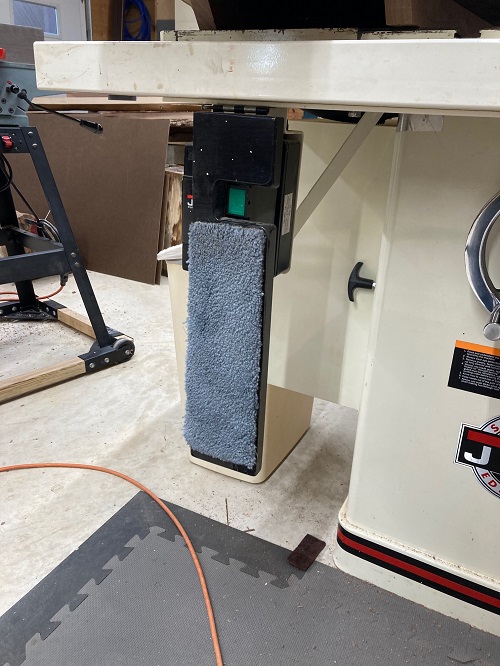
Table Saw Safety
Posts
Re: Table Saw Safety
#2I agree with you, Mark,........having a way of turning off the saw with your knee is a very valuable device to have.......years ago, I made one for my Unisaw......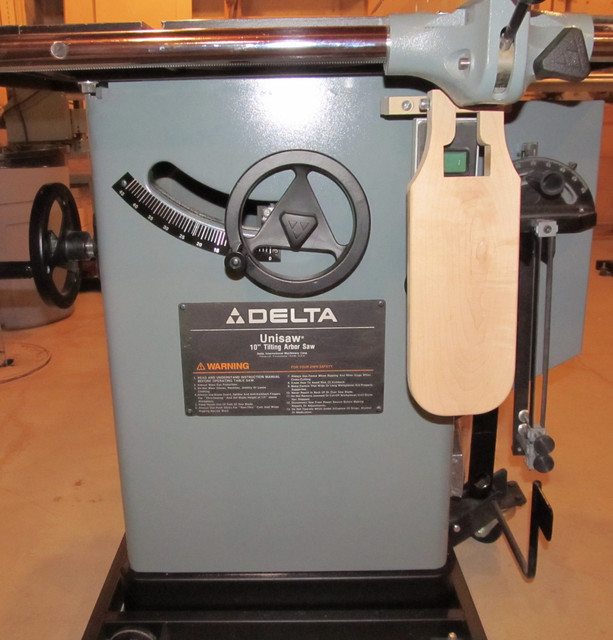
Re: Table Saw Safety
#3

@Mark Mandell
I have a similar paddle on the switch of my Shop Foz 10" cabinet saw. It's saved me several times over the years.
Re: Table Saw Safety
#4I just had the same issue last week with a piece of walnut. I have a 3hp Delta left tilt saw. While I was cutting the 5/4 walnut I noticed the sound of the blade slowing down, then a bright red ring start to form around it. It was really cool to look at, but I figured out pretty quick it was not a good thing.
I hit the stop button with my knee watch the saw blade stop and smoke rise. I pulled the board off, along with the zero clearance insert, when I noticed a bit of left over saw dust smoldering in the cabinet. I put it out, and cleaned it out to make sure I didn't miss any.
I tossed the blade figuring it got too hot.
After replacing the blade I made the cut from the opposite direction without issue.
Re: Table Saw Safety
#5Never had those issues when cutting on my bandsaw.
Re: Table Saw Safety
#6A bandsaw would be the preferred tool for this task.......
Re: Table Saw Safety
#7

Time for me to get a making. My off switch is small and back against the saw cabinet, making it difficult to reach.
Re: Table Saw Safety
#8I guess all the Saw Stop users could just run their hands into the blade.
I had a situation a little bit like the one Mark described, about 30 years ago, and it ended up in a kickback injury. Not long afterwards I got rid of the saw, a fantastic General 3HP. In the real world, 3HP saws are something you buy for employees.
I have two table saws, an Inca, and a Beaver. The latter finally got killed in a flood, but last summer I brought it back for the third time, with a Leeson 1/2HP motor. It is amazing how little you can get away with in horsepower. I break down big pieces of wood like the one in the story, on one of my 5 bandsaws.


