>>>� Thoughts on a finish?� I would expect the point end over time would pick up oil and dirt from the hair.� A slick finish might make them come out too easily.� Thin coat of mineral oil, wiped dry?
I generally stick to a coat or two of “danish” oil. � On many species the oil soaks in and shows off the figure; the poly seals the wood. � I don’t buff so the stick doesn’t get too slick. � The shaft sometimes gets some texturing and the shaft design works to keep them in place. � The decorative turned/carved end can have a different finish.
Oh, I don’t think I used any finish on the two made from ebony. � I Just sand those to at least 800 then I may buff a bit then use 0000 steel wool to cut back any shine. � Or just leave them alone. �
Sometimes I apply a bit of Renaissance wax; sometimes not. � Depends.
Another thing about hair sticks is probably obvious: those I know who use them sometimes seem to wear them for show as well as function. � Might be good to keep that in mind when designing the decorative end!
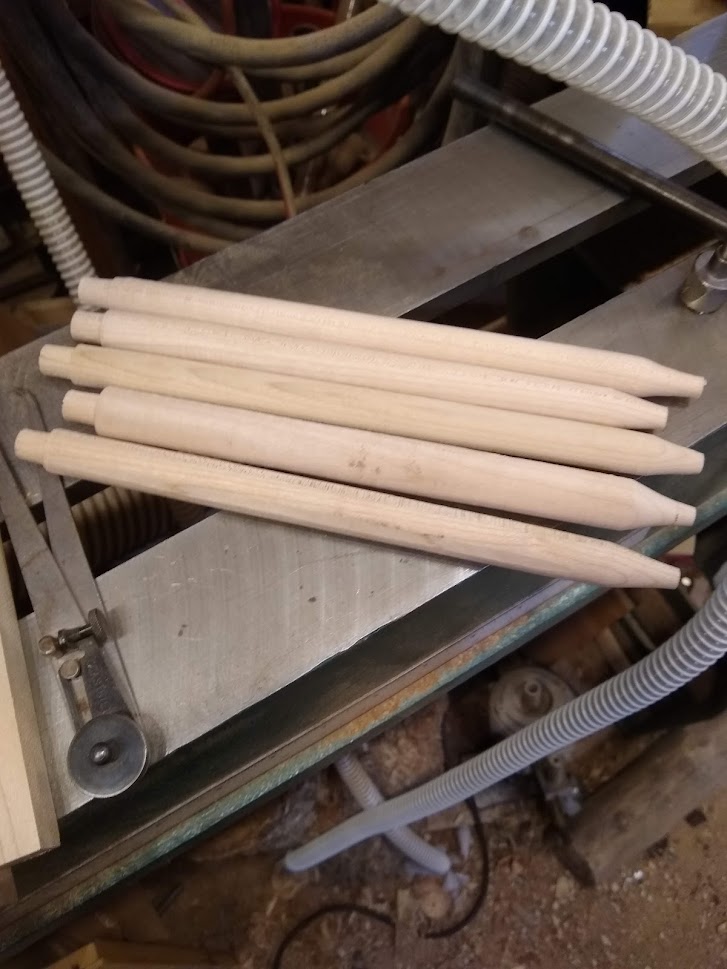
Just so you know there is still some minor raging at times. I often get requests. (I don't make them to sell but when someone twists my arm it'll cost them about $100.) They are still popular gifts, for the right person of course!� I made two for a gift last week
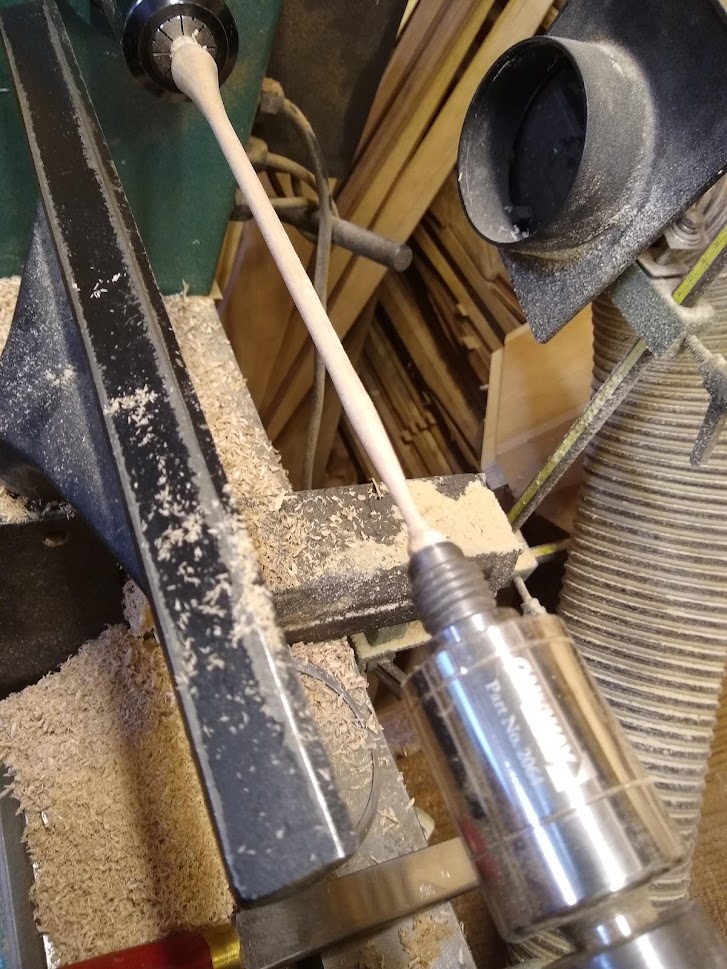
>>>I met a turner making them in a set-up outside a book store (buy a book, then a wand to go with it). Working on a JET Mini he used a pair of collet chucks.� Starting with 3/4" round blanks, he had a collet chuck screwed on the headstock spindle and then a draw bar MT version in the tail stock to put some "pull" on the workpiece to negate the flex in the wood shaft.� Seemed a pretty cool system and he was obviously going flat out hi-speed work, as his customers could stand and both watch and choose details as he went.
Anyone here used this kind of rig?
I haven't tried that but several of us discussed it and I knew a guy who experimented with it. One possible problem: if a spindle is thin enough just starting and stopping the lathe can twist the wood in two, I guess unless the tailstock holding device has low mass (and bearings with low friction.)
I personally don't see the need for the tension. I've made many 100s of wands and the method I use always works fine.
This is interesting but I don't quite understand it: "he had a collet chuck screwed on the headstock spindle and then a draw bar MT version in the tail stock to put some "pull" on the workpiece". I only checked one of my lathes and the tailstock doesn't have a large enough hole all the way through for a drawbar. The drawbar needed with all the #2MT collets I have here is 3/8".
And any thing mounted in the tailstock will need bearings - was it some kind of modified live center? And Morse tapers are notoriously poor at holding under tension.
Do you remember any thing else about his method, have a photo?
John, thanks again for the ideas & suggestions for the hair sticks. I happen to have a Beall collet chuck & find it works well(lots of length available).MT 2 collets are not in the budget for now. I have the Nova revolving center, but found that the MT1(or smaller) in the Oneway center allows even more clearance at the tail end. Also, you don't really need anything more precise than a cone that will fit into the hole and you can use nearly zero tension. � First piece of wood on the lathe in about 5 months. Not looking graceful yet, but the weather is getting warmer here so I'll get in some more practice soon.
>>>John, thanks again for the ideas & suggestions for the hair sticks. I happen to have a Beall collet chuck & find it works well(lots of length available).MT 2 collets are not in the budget for now.
Leo, excellent! What ever works for holding - with thin spindles the better holding at the headstock end the easier to turn. I've never bought one of the collet chucks.
BTW, when I started doing demos on wands and thin spindles I wrote a handout document on techniques.� The doc needs updating but if you would like a copy let me know.
As mentioned earlier, since these are relatively short I use pin jaws on a chuck to grip the square stock. With chuck jaws I find it easy to turn even something 8" long with tailstock support until nearly finished, then form the point and remove the tailstock to complete the end. The jaws will easily support 8" without tailstock support when using the "left hand" steady method with the skew and spindle gouge.
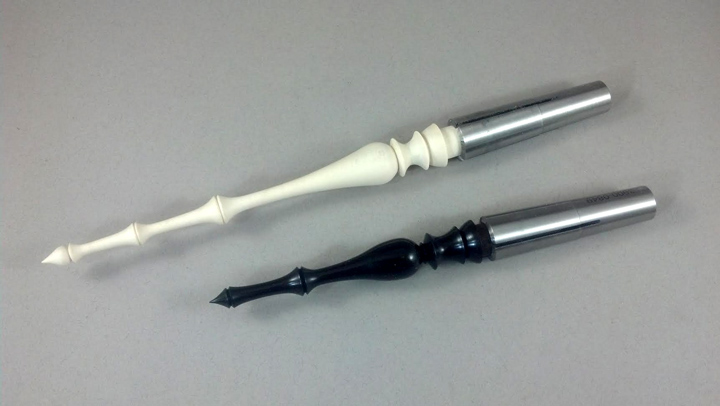
I have used MT collets with a drawbar for some things - I bought a set from 1/8" to 1/2" but I also found them at Little Machine Shop and bought several 1/2" for $10 each. These collets take a 3/8" drawbar, easy to make with some allthread.� I turned these finials with the collets, unsupported by the tailstock except during initial shaping. Holly and Ebony. The only "problem" with the 2MT collets is the tenon needs to be made fairly precise since compared to the ER collets they don't have much gripping range. These finials could easily have been held with chuck jaws instead.
(I think I may have posted this picture before, if so, sorry.)
One advantage with any type of collet is the piece can be removed and remounted without losing registration. (As long as the wood doesn't move/warp in the mean time!)
But for longer thin spindles I prefer the #2MT on the headstock end since it does hold well and I'm used to it, having made 100s (and I can make the taper very quickly now!) These do need tailstock support until parted off, or the piece can be held with a drawbar threaded into the wood. For wands I simply support with a Steb revolving center in the tailstock until I saw off and smooth both ends by hand. (I never make wands with sharp pointed ends.) I think the little #2mt taper has several advantages for wands.