WoodCentral Forums

Est. 1998 — 27 years of woodworking knowledge

Shop Heating: Insulation (Long, but worth it!

Posts

Shop Heating: Insulation (Long, but worth it!

#1

Brad Vietje

Shop Heating:  Insulation (Long, but worth it! 

Brad Vietje

Just so I don't completely hijack John's shop heating thread, I figured I start a different one on insulation. I would caution anyone in John's situation to consider insulation options just as thoroughly as your heating and/or cooling options.

What do I know?: Some of you know that I design and install solar and renewable energy equipment, but in truth, the most important work I do is to help people explore options to be more efficient, more comfortable, and to save money, regardless of whether they ever use any solar products. I've worked for the past 7 years on an engineering and design team to help our clients create Zero Energy Buildings, and in the end, insulation and air sealing is far more important than the energy source. On this theme, if you're building a new structure, and you can find a way to spend 10% more -- putting it into the thermal performance of the building -- it will save you 70% on heating and cooling for life. Swapping an older heat plant for a high-efficiency unit will usually save you only 10-15% of that.

Here's the deal -- you only have access to really tear into those walls once, and getting the insulation right will not only keep you warmer in winter, but also cooler in summer, and can save -- or cost -- you money for as long as you own the building. To retrofit a shop after all that equipment and storage is in place it is just too difficult, so most people don't do it. It's usually a lot easier to swap heating systems than the insulation and wall/ceiling/roof structure, but no where near as effective. Getting the insulation right is a much better investment, in other words.

I work in northern New England, so while I know quite a bit about our local needs, I may know nothing about your local conditions. However, physics is still physics, and aside from differences in vapor barriers and such, we're still trying to resist the movement of heat from place to place. Below are some of my thoughts, and I realize that YMMV, and there is of course, no requirement to agree with me -- I'm just trying to save you some $$$ ;)

Brad's Insulation Rule of Thumb #1: More is better. Properly installed insulation*** resists the movement of energy from warmer places to cooler places. Insulation helps keep you warm in winter and cool in summer.

Brad's Insulation R.O.T. #2: Building codes are very low standards. If your local code requires X, think about 2X or 3X.

Brad's Insulation R.O.T. #3: All the insulation in the world will do you no good if air (or, Heaven forbid, water) can move through the structure. Insulation w/out proper air sealing is wasted money.

Brad's Insulation R.O.T. #4: *** Insulation is rarely installed properly! Many, many contractors do such a lousy job of installing insulation that they should be fined, and put out of business, though that almost never happens. This includes fiberglass, cellulose, foam, you name it. If you hire someone, hire someone good. If you do the work, be sure to do it right.

Brad's Insulation R.O.T. #5: Fiberglass is not insulation. Good rodent bedding, and a great place to find snake skins, thousands of ladybugs, mouse turds, and other dead things, but really poor insulation. Why? Because air moves through it, lowering it's effectiveness (a lot). Better horizontal than vertical, and only when backed. If you have any choice in the matter, use something else. Applies to both batts and blown pink crap. Trust me - use something else.

Best insulation? Difficult question, since they have different properties. Thoughts:

Spray Foam: (closed cell Isocyanurate foam)

Plus: Highest R-value per inch (R 6-7 per inch), adds structural integrity and great moisture barrier. Good sound attenuation (keeps noise out).

Minus: often the most expensive option, and stops moisture dead in its tracks -- which can cause huge problems if that's not a good place for moisture, or has not been carefully thought out.

Other: sometimes the only way to get desired level of performance out of a fixed wall thickness. Made from petroleum. MUST be treated with fire retardant if exposed, and creates highly toxic fumes in a fire. R-value will go down as it cures, or out-gasses (and you don't want to breathe what it releases).

Open Cell Foam: can absorb and trap water, shrinks and settles over time: not recommended.

Dense-Pack Cellulose:

Plus: 1/3 to 1/2 the cost of spray foam for a given R-value; environmentally friendly and relatively non-toxic -- made from ground up recycled newspaper; highly fire retardant, since air can't move through it; treated with Borate to keep bugs and mice out. R value of 3.8 per inch when properly installed. Excellent sound attenuation. Very good air sealing if installed at high density & pressure (5.5#/sq. in.)

Minus: requires thicker walls to reach higher R-values; can be very messy & dusty to install. Requires screws and often temporary strapping to keep drywall or other sheet products in place during install (5.5 #/in = almost 800 #/ft sq, and a tremendous force over a 4' x 8' sheet!

'Nuther option is Damp-Spray Cellulose, which performs just like dense pack cellulose after it dries out fully (usually 1-6 weeks); can be spray-applied to open bays between framing; good air sealing when properly installed. A LOT of fun to install with the right equipment!

Lofted (Loose) Cellulose:

Plus: Good for attics if no access is needed; best if attic can be stuffed full; inexpensive; can be owner-installed; about R 3 per inch, but only when used above a solid surface or membrane, or installed at minimum depth of 12" to reduce air movement (not an issue for dense-pack cellulose)

Minus: very messy and dusty; poor choice where attic access is required. Not good for walls -- settles unacceptably and does not stop air flow (see fiberglass).

Sheet Foam Products:

Plus: Great for retrofit work; fairly rigid & strong; needs to be sealed between sheets; easy for homeowner work; easy to transport, cut, etc... R-value varies from iso-cyanurate foam (R 6.7/ inch +/-) to styrofoam and polystyrene products (R 5.5/"). Foil-faced iso-cyanurate foam should be used when insulation will face an air space.

Minus: foam is made from oil, and tends to end up floating in the ocean; not biodegradeable; needs to be taped and sealed for best effect.

Fiberglass: only mentioned here out of spite. In a wall cavity, warm air migrates up the warm, inner side, while cold air moves down the cooler, outer wall, creating a heat pump circulation that helps move hot to cold. Fair when used flat in an attic as long as foil or paper backed. Almost never installed correctly, as every interface, pipe, wire, switch, or receptacle box needs to be carefully sealed. "R-19" fiberglass in a wall cavity tends to actually perform at about R-11. Poor choice.

What to do? Depends on budget and other factors. In my location, what I would do is rip out whatever is there, use Larsen truss system* to build out the walls to be 10 - 12" thick (extending window & door framing to accommodate), and have the walls stuffed with dense-pack cellulose. 10" = a true R-38 if properly installed, and 12" = R 45. For roof/ceiling, it depends on the structure and the roof composition, but getting at least R-50 up there is a good idea -- and I mean true R-50 performance, not 2 layers of fiberglass batts. I'd also consult a local builder or even better - a trained Igloo or NuWool cellulose installer to get advice on moisture management for your local

climate.

* Larsen trusses are built with 2x3's attached to the current framing with 3" wide tabs of 1/2" plywood -- a very inexpensive way to build a thick, high-performance wall with almost no thermal bridging.

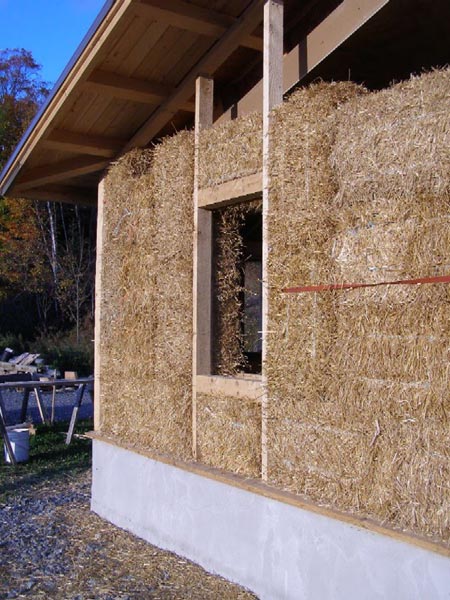
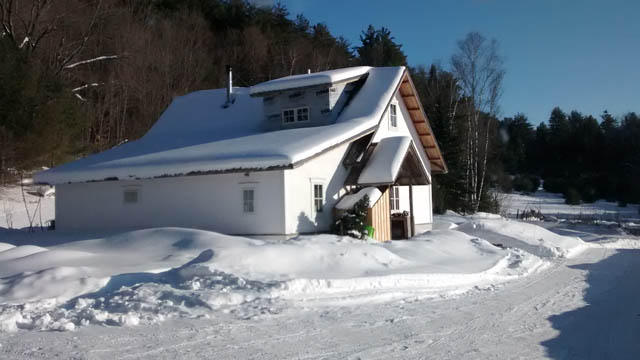
Here's MY house last Friday afternoon at 2 degrees F: Straw bale walls are about 17" thick, 17.5" of dense pack cellulose in roof structure -- note NO icicles 8) 8000+ heating degree days, but only 2 cords of wood to heat -- the little wood box outside the door provides 2 months of heat when stuffed full of dry wood. No cooling needed.

Waay too much info, but hopefully helpful....

Safe spinning,

Brad Vietje

Newbury, VT

Re: Shop Heating: Insulation (Long, but worth it!

#2

Re: Shop Heating:  Insulation (Long, but worth it!

Mike Potts

Brad a lot of good info. I wish you'd have posted it a month ago. I just got finished putting a sun room addition on the house, I went fiberglass, probability would have consider something different, with this info.

keep it safe

Mike

Re: Shop Heating: Insulation (Long, but worth it!

#3

Good info

John Lucas

I think I broke your first 4 rules when I had my current shop insulated. Hey it's better than none but still probably why I freeze in there.

Re: Shop Heating: Insulation (Long, but worth it!

#4

Re: Good info

Barry L Elder

I thought I remembered you showing us the straw bale walls you put in your house a while back, I'm glad my info locker still works, and it's great seeing what you built! :D

Re: Shop Heating: Insulation (Long, but worth it!

#5

Re: Good info

Gary clarke

Brad, what type of garage doors would you use for a garage shop?

Re: Shop Heating: Insulation (Long, but worth it!

#6

Re: Shop Heating:  Insulation - nifty!

Rum

Nice rundown!

The moisture control part scares me a little - mostly because I don't understand it as well as I'd like. It seems coooommmmplllicated! :\

Is your place structural straw or post and beam infill?

Re: Shop Heating: Insulation (Long, but worth it!

#7

Aage Rendalen

Long is good: thanks


Re: Shop Heating: Insulation (Long, but worth it!

#8

Brad Vietje

Re: Shop Heating:  Insulation - nifty!

Brad Vietje

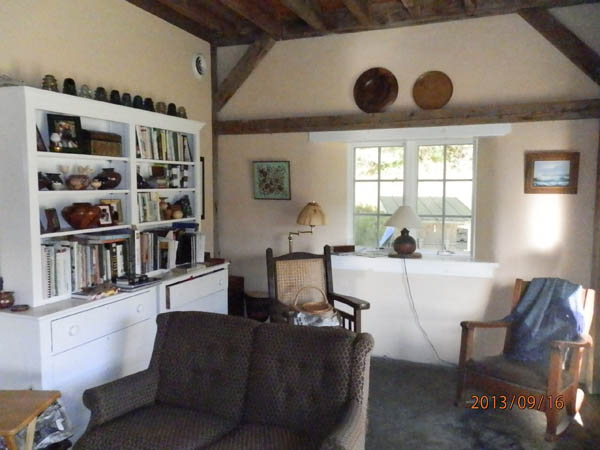
Our frame is a recycled post & beam from a house originally built in 1850. The bale walls are actually a "wrap" around the outside of the frame, which is entirely within the living space, so there are fewer leaky junctions than an infill wall. We paid a lot of attention to sealing around every opening and interface.

Windows are framed to the outside, leaving very deep window boxes:


East Wall before plaster:


And after plaster and paint:


Straw bale homes are not for everyone, and frankly, you can get slightly better performance with fewer construction issues, and probably save money going with a 12" thick Larsen truss wall with dense pack cellulose, but its just more fun to tell people about straw bale construction.

Safe spinning,

Brad Vietje

Newbury, VT

Re: Shop Heating: Insulation (Long, but worth it!

#9

Brad Vietje

Re: Good info

Brad Vietje

Gary, great question, but I would not know. They do make insulated garage doors, but I have not studied them. I think the issue is they tend to leak or have cold drafts wherever they have hinges to fold or bend. If a garage door was only used occasionally to move equipment or big logs, maybe the whole opening could be insulated with foil-faced foam sheets or some sort of blue-board contraption (?) Might be tough to make it look nice, but you could stay warm.

I had a heated office out in an unheated garage in a former house, and I built a 2-panel hinged door to seal and cover a 6' wide opening in the wall with 2 layers of 2" blue board inside the two panels. It was only slightly clunky to open & fold, but you'd need two of these arranged like french doors for a 12' wide garage door opening, which might be pretty clunky and unmanageable.

Safe spinning,

Brad Vietje,

Newbury, VT

Re: Shop Heating: Insulation (Long, but worth it!

#10

Re: Shop Heating: straw bales - thanks!

Rum

Nice redo of an old building.

Straw has a certain appeal outside of strictly a practical basis though :D

Re: Shop Heating: Insulation (Long, but worth it!

#11

Bill Blasic

Re: Shop Heating: straw bales - thanks!

Bill Blasic

When I built my shop 24' X 36" I used Fiberglass. R-19 walls and R-38 Ceiling and there is a 16' insulated garage door. I have the same oil fired furnace in the shop as I have in the house. It is set at 50° from 8 AM to 10 PM and then goes to 45° for the night. The night before we got down to -20° so I went down to the shop at 4 AM and the temperature was 49° as I expected as that is the lowest that I have seen. I suspect that the floor area (cement) year round is somewhere in the 55° area as in summer the shop is relatively cool. I think this year I might sell my 89 Eldorado as I'm tired of parking it in my shop every winter. That way I can get rid of the garage door. I guess I can't complain too much about the fiberglass but if I did it over I would go with foam even though more expensive.

Re: Shop Heating: Insulation (Long, but worth it!

#12

Brad Vietje

Re: Shop Heating: straw bales - thanks!

Brad Vietje

Bill, you raise a good point that I often encounter. Even poor insulation is better than none, and I hear all the time from people that their drafty old houses are warm & toasty all winter long -- they just use between 3 - 10 times more fuel than they would if their insulation performed better.

Now that people are getting cold and lots of snow, look at the roofs and eaves of the houses you pass by. Melting snow in the roof and huge icicles are a bad thing, and usually a sign of ice damming, which can cause serious structural damage. My brother's house is a great example -- he had a new roof put on about 10 years ago, and the contractor only installed a single 2" layer of sheet foam (polystyrene, or "Styrofoam") between the knotty pine cathedral ceilings and the roof decking. Two days after a 20" snow storm, he has only about 6" of snow on the roof (looks like someone got up there and shoveled it off), massive icicles reaching all the way to the ground, and 8" thick ice dams all the way around the edge of the roof. All because his heat goes through the roof and melts the snow, which runs downhill until it gets to the cold eaves (or pools up when it reaches the ice dams), and freezes.

Just the weight of all that ice can damage a building, but ice dams on a shingle roof are really bad, because water starts running up-hill, up and under the shingles, and soaking the plywood decking and running down inside the wall cavities. Now all the windows, doors, and siding are shot, and the whole place really should be torn down :\

Safe spinning,

Brad Vietje

Newbury, VT
Re: Shop Heating: Insulation (Long, but worth it!

#13

Chuck Jones - West TN

Re: Shop Heating:  Insulation (Long, but worth it!

Chuck Jones - West TN

Brad,

Probably 80% of what I know about heat, cooling, and insulation I've learned from your thread. So I'm certainly not qualified to disagree. But I am surprised and curious that fiberglass gets such a bad rap. Fiberglass is by a long shot the most used product for wall insulation in this part of the country. You clearly said local variations have a lot to do with it and most any time (except this week) this locale could be said to have a mild climate. Pretty much the same as where John Lucas lives, maybe a little warmer. A heck of a lot warmer than your area, I know because we've lived in the NE.

I have been very pleased with the performance of the insulation in my shop and for whatever it might add to the discussion here is my situation.

The original building is 32' x 48' (~1500 sqft) with a 10' x 12' "insulated" garage door at each end. I recently added a 32' x 24' (~750 sqft) extension on to the back with a 10' x 12' and a 6' x 7' insulated roll-up door.

I normally heat or cool only the original building, but both are constructed and insulated the same way.

From the outside-in the walls are sheet metal cladding, "bubble wrap", 5.5" of fiber glass insulation with paper backing, and 3/8" beaded plywood interior wall covering.

The ceiling is 12' high covered with sheet metal. I have about 15" of blown in cellulose in the attic.

My only source of heat is a medium sized wood burning stove.

For a week or more we have seen single digit nights with below freezing highs. Last night's low was about 14. I let the fire go out yesterday morning. No heat until mid morning today. When I went to the shop this morning it was 51 degrees, about the lowest I've ever seen it.

Not advocating, selling, or debating, just pointing out what works well for me.

My son is reworking his shop right now so we are very interested in this subject and watching and reading everything we see. I find it a very complicated subject and one I have not spent much time thinking about.

Your insights are most appreciated. Thanks for taking the time and sharing.

Re: Shop Heating: Insulation (Long, but worth it!

#14

Re: Shop Heating:  Insulation (Long, but worth it!

Dick Strauss

I've enjoyed reading about your straw bale home when you originally posted.

I've done a bit of research after your previous comments and have come to conclude that cellulose is better once it gets cold (like it is now -10 to -15 in the mornings).

I would like your opinion on my situation if you wouldn't mind. Our climate in Northwest Ohio is simialr to yours except it is not quite as cold in the Winter and more humid in the Summer (I used to live in Middlesex, VT). We have done extensive air sealing around the foundation to our cape code (1.5 story) home that was insulated with fiber rolls in the walls and rolled/blown in fiber in the upper and lower attics. We plan to add at least 8" of cellulose to help with both Winter and Summer temps on the horizontal surfaces of the attics over the top of the rolls+loose fill fiberglass. Is 8" of loose fill cellulose over fiber going to prevent most of the the air movement?

On the 1/2 story upstairs, the walls have fiber rolls (probably about R15-R19 because it fluffs beyond the studs) installed vertically between the studs for insulation with a 6 mil poly barrier on the inside surface. I have considered adding fiber rolls installed horizontally by stacking them behind vertical 2x4s. I have also considered adding foam sheets to help add insulation and prevent air movement. One other idea that came to mind was to add Tyvek/Typar house wrap over the rolls of fiberglass to allow the moisture to pass (should any get into the insulation which is unlikely) while cutting down on the flow of air through the fiber. Would damp spray cellulose be a better solution for the 1/2 wall than my various ideas? If so, do you have any idea what it costs in your area?

How do we as homeowners make sure that we get a quality insulation job other than by reputation? How do we make sure that we are getting 8" finished and not 8" of fluff that settles to 4-5"? You never know where folks might cut corners...

Thanks in advance,

Dick

Re: Shop Heating: Insulation (Long, but worth it!

Edited #15

The main message is that air sealing is more important than the heating system itself for comfort and energy savings.

Key takeaways from the post

  • Invest in insulation first. The author argues that spending more on the building envelope can dramatically reduce heating and cooling costs over the life of the building. 

  • Air sealing is critical. Even high-R-value insulation performs poorly if air can leak through walls, ceilings, doors, or gaps. 

  • Building code minimums are often not enough. The recommendation is to exceed minimum insulation requirements where practical. 

  • Installation quality matters. Poorly installed insulation can significantly reduce real-world performance.


Edited 2026-06-11 08:01:43 - OK to provide takeaways, but you tried to sneak in a business link when that had nothing to do with your post. Trying to link farm the web doesn't really work anymore and can actually hurt a business. The search engines will penalize for such behavior, so any money spent to services that try to do that is not only money wasted, it can actually hurt you. I will leave your post but remove the unnecessary reference in case you are actually involved in this subject and not just a paid service where someone in an underdeveloped country is being paid pennies a day to spam the web with links.

👍 This page answered my questions

Your vote helps other woodworkers quickly find the answers and techniques that actually work in the shop.