Thanks, Jamie
Mark Mandell - Gone Round In New Jersey
"Mom's Watermelon Oil & Paraffin" just didn't seem to fit.

Est. 1998 — 27 years of woodworking knowledge
Thanks, Jamie
Mark Mandell - Gone Round In New Jersey
"Mom's Watermelon Oil & Paraffin" just didn't seem to fit.
Re: Thanks, Jamie
Wally Dickerman in Arizona
Sounds like it might work.....if I could just find some watermelon oil.....
For That
Mark Mandell - Gone Round In New Jersey
you'll have to talk to Mom.

Re: final finishing question
Barry Rockwell
Gary, IMHO, I too have evolved to finishing most pieces with WOP, and think buying the entire Beall Buffing System would be a waste of time and money. I use 3-6 coats of WOP,after sanding to 400 or 600, letting each coat cure for 24hours, then buff with white diamond. If you buff with the red stuff you have just reverted to about 240 grit. I can get as high polish as I want with white diamond. If I don't want gloss, I cut back a little with imitation 000 steel wool from Norton (Home Depot). I have a couple of 8" buffing wheels and a few bowl buffs in 4" and 2" sizes. I either use them with white diamond or nothing for buffing. By the way, between light coats of WOP I "de-nib" the piece with either 600 or 800, not to "scuff sand" but just to get the dust particles off. After the final coat of WOP, I let it cure for 48 hours, "de-nib", and buff with white diamond. On salad bowls I usually leave the inside with a satin or knocked back finish, and polish the outside. Just my $0.02 worth.
Not a Fan
Mark Mandell - Gone Round In New Jersey
of machine buffing. I can get a mirror finish without the paraphernalia using a good quality finish, some fine wool, some rubbing compound, and some elbox grease. 
If I want to really push, a shellac sealer, and a couple coats of waterborne lacquer will get me all the shine I want. 
Some pieces will take a high shine (design-wise) but others "want" less gloss to hold the light on the form. 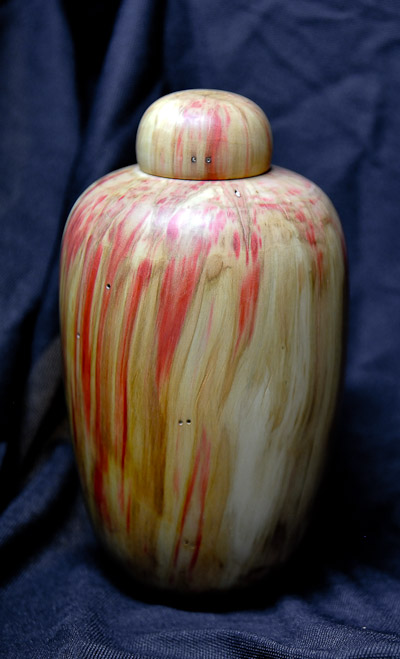

Point is, shiny is always shiny, but not always better
Yes, indeed,
GaryG in MD
Thanks for clarifying, Wally. I understand.
If I don't mind yellowing, then I prefer an oil finish. It's great for cherry, walnut, oak, dogwood, beech, maybe birch, fruit woods, etc. I think I would still do those off the lathe because my lathe doesn't go super slowly and because I like to really to soak that "first coat" into the end grain for about 15 minutes. Bush Oil has a lot more (say 4x) solids than Watco Danish, so it builds a lot more quickly -- depends on what I'm trying to accomplish. I keep them in squeeze bottles and just keep squirting the stuff on till it stops going dull. Then I wipe it off and let it cure for a day or two (not as hot and dry here as where you are!) A second coat will then often be enough to provide the desired sheen when buffed out (which I've been doing by hand, and that's the problem). If I keep the piece on a glue block or leave the tenon on, I could put it back on the lathe for the hand buffing up to, say, 4000 with Abralon (which is the level of silky shine I prefer), but I'm concerned about getting circumferential swirls that way. Do you not have trouble with that? I always polish with the grain, just as I sand that way.
For woods like maple, box elder, ash, some birch, sycamore, tuliptree (poplar), etc., that I don't want to yellow, or pieces with sapwood that I don't want to yellow, I have been experimenting with things like spray acrylic and water-based poly, without great success. The latter is particularly nasty and frustrating in terms of bubbles and "brush" marks, and I'm going to stop using it. I called my local Ace Hdwr, and they DO have Deft, so I'm going to go up tomorrow and get some. I'll try your approach with great expectations.
Even if oil goes over Deft, I can't imagine why anyone would want to do that! The whole point of an oil finish is that it soaks in and pops the grain. I can't see any reason for putting a yellowing finish over nice clear lacquer.
Thanks again Wally. I appreciate your time. I've learned a lot and enjoyed our conversation. ...GG
Mark,
GaryG in MD
Thanks for your thoughts. I can't say I disagree, because that's the way I've been doing things (by hand). But I'm tired of that final rub-out by hand. Seems like that's what the Beall is for. Some agree, some don't.
When I first started turning, I met Don Riggs at a meeting of the Capital Area Woodturners in the Virginia suburbs of DC. He made a big impression on me for many reasons. One was his gorgeous finishes that he did (and does, now south of Roanoke) with the Beall system. I'm frankly not sure why I didn't get one sooner. I guess I enjoyed the personal/tactile aspects of the hand rub. Well, I'm tired of it.
But I have to admit that Barry Rockwell just set me back a bit with his info about the red rouge being a very low grit. I expect to hand sand my finishes at 800 before buffing, so that would be a big step in the wrong direction. I assumed it would be a very high grit. Ass-u-me is a bad thing. But I'm guessing I can find an appropriate polishing agent to charge the wheels with to give me what I want. I know the white diamond is not a good thing to use on dark, open-grained woods!! But there are plenty of polishes on the market now.
The Beall is very affordable, so I'm going to have to get one to play with, but my main concern is that I don't want to be slinging my completed pieces onto my concrete patio! Don says there's a "learning curve". That's what I'm afraid of.
I'm going to start a new thread about the magazine article!! It's nice to see your beautifully finished Jupiter bowl highlighted in that magazine article, but there is a magnificent unidentified NE bowl on the same page, and I know that bowl very well. Look up the chain to see my new thread.
...GG
Barry,
GaryG in MD
Wow. Loads of good info here! But not all good news...
I get your point. I really don't need three wheels. I wouldn't use the carnauba wheel anyway because if I'm using wax, I use Ren. wax, and that goes on and off easily by hand.
I had no idea the red stuff was so gritty! I made a big mistake ass-u-me-ing that it was a very fine polish. My bad. But there are plenty of products on the market that I'll be able to use instead. I tend to shy away from the white diamond for a lot of applications where it might get stuck in the pores of an open-grained darker wood.
The good thing about the three wheels is that you can mount them between the headstock and tailstock and not need a draw bar to hold a drill chuck in the headstock. It's a "minor" problem, but something that would take time and money to solve because my drill chuck is not threaded. But I will have to figure out something else for holding the ball and small disc buffs. I think I have some alligator jaws that may work. I'm very glad you made me start thinking about this.
Thanks for jumping in. ...GG
Good point!!!
GaryG in MD
David,
You just hit the nail on the head! I figure I'll still probably do small stuff by hand. My whole point for getting a buffer is to do the larger stuff. And your point is right on! I clearly would not be able to do larger stuff with the other two wheels getting in the way. Very good info. I'll now punt and figure out a chuck to hold single wheels. Thanks for saving me from learning the hard way. That's the reason I asked in the first place!! ...GG
Have you tried walnut oil?
DKWalser
Of the true hardening oil finishes, linseed, tung (real tung oil, not the stuff that calls itself tung oil without containing a drop of the real thing), and walnut, I find walnut oil to be the least yellowing. It leaves maple and other pale woods looking natural in color -- a shade or two darker, but not changing the hue.
I find that I use it more and more as a sanding lubricant. By the time I've sanded through all the grits, I have a nice deep, satin finish. It's quick, eliminates the dust, and produces a beautiful and durable finish. If you want a glossy finish, you can buff it out with hard wax topcoat (carnauba or microcrystalline). Or, you can add a topcoat of shellac.
Just another option for you to try.
More great info...
GaryG in MD
David,
The simple answer is "no", I've never tried it.
Why?
I don't know. I guess nobody ever told me what you just told me!
I'm going to get some immediately!!
Thanks for the excellent tip.
I can't wait to try it.
What's a good source? ...GG
Re: More great info...
DKWalser
Gary - There are lots of sources for walnut oil. You can even use the walnut oil carried in most supermarkets for use in salads and cooking. I've used two different brands of walnut oil marketed for finishing wooden items, Mahoney's Utility Finish and Doctor's Woodshop's Walnut Oil Finish. There are other brands, I've just not used them. Our local Woodcraft carries both. I buy whichever is cheapest. Both Mike Mahoney and Doctor's Woodshop also sell their products online.
In my own situation, since I've already paid for shipping, I usually add a bottle to my Craft Supplies USA order (if I'm running low). Or, if I'm between between orders from CSUSA, I'll pick up a bottle at the local Woodcraft. YMMV.
HTH and good luck!
Gary,
Mark Mandell - Gone Round In New Jersey
a cautionary note - machine buffing is faster, yes, but the ability to ruin a piece is increased many-fold. Aside from the ability to launch the piece, the buffs create heat and it's easy to "burn" your finish, literally melting the film which then crazes. If you've used an oil finish (which doesn't "burn in" to the prior layer), it's very easy to wind up with witness lines all over your piece after you cut through the top layer of finish. Oil finishes should be allowed to fully cure (as opposed to just "dry") before you start your polishing. Very light pressure with the buff barely touching the surface is a key skill to develop.
You'll also be using a really good breathing mask as the process creates extremely fine dust composed of fabric lint, buffing compound, and finish; a rather toxic mix to be breathing.
Re: Duh . . . ?
Bill Boehme
Minwax without papers?
No Papers?!!
Mark Mandell - Gone Round In New Jersey
We don need no steeking papers, man.
I'm with Mark on not machine buffing
Bill Boehme
I have had a set of buffing wheels for many years, but no longer use them because of the reasons that Mark gave. The buffing wheels can't level a finish and under very close examination of the finish, you can always find streaks left by the buffer no matter how gently the buffing is done. Manually leveling and polishing the finish is a lot more work and takes a long time, but the results are significantly better.
Another Opinion......
Wally Dickerman in Arizona
I've used the Beall system for years. I can't say that I've ever found lines or marks on the finish after using it. It possibly depends on the finish used and how well cured it is. Also, the amount of tripoli applied to the wheel has an effect on the results. I apply a small amount. I always wait at least a week after the final coat of finish before buffing.
Someone claimed that buffing with Tripoli leaves a finsh like 220 grit sp. I can't agree with that either. 220 grit leaves sanding marks. Tripoli doesn't. Just my opinion.
I agree that a light touch when using buffing wheels is a must. When buffing a finish like lacquer it's easy to go clear through the finish when using a heavy hand.
Re: Another Opinion......
Bill Boehme
Wally, I agree with everything that you say, but it is just my experience that when I scrutinize the finish that I have been able to get under full bright sunlight that I can see "directional" gloss (something not quite the same as looking at light reflecting off glass).
Regarding often heard comments about not liking a plastic look, I also do not like that sort of look, but I do not equate that to a well done high gloss. To me, a poorly done high gloss finish has a plastic look. Things like orange peel that has been polished without first leveling the surface looks plastic to me.
I was "gifted" a set of Beall wheels.......
JamieDonaldson
...years ago, and they are still as new in the box. I do most of my final satin or semi-gloss buffing with the gold Scotchbrite pads used in the auto finishing business, spun with a standard angled drill also used for power sanding. I fasten them to a velcro pad and stick them on just like a sanding disc. Reall levels the final wax without cutting through my usual lacquer finishes.
Since no one else has mentioned it..
mjonesrdg
I used the Bealle 3 wheel system for years and experienced just about every sort of mistake that has been mentioned above. I got the Don Pencil long adapter, wheel, and PL compound and I haven't used the tripoli/white diamond since.
The adapter gets the work piece out away from the headstock adequately for larger bowls and such, the wheel is the same as Bealle's wax wheel (all cotton) and the compound is dramatically superior for final buffing of finishes.
Any tiny buff lines left in a finish usually mean that my wheel needs to be raked clean, and the carnauba wax application will typically eliminate those.
I understand that some folks have had trouble ordering from Don Pencil. I don't know if this is a temporary situation or not, but I think it would be a shame to lose this resource as I haven't found any adapters or compound to equal his.
Very good caveats, thanks.
Thanks, Bill. Understood.
Jamie,
GaryG in MD
That's a good tip. I've seen "gold" rated at 1200 grit -- don't know which scale.
But that makes sense.
What forms does it come in that you can connect to your drill mandrel?
What's your source? ...GG
good thoughts, thanks.
Re: Since no one else has mentioned it..
Bill Boehme
I visited Don Pencil's web site a couple weeks ago and it was a mess. However, when I checked it out today it seems to be in much better shape. Maybe he is updating it.