WoodCentral Forums

Est. 1998 — 27 years of woodworking knowledge

David Weaver Chisels

Posts

David Weaver Chisels

#1

David Weaver Chisels

Hi all,


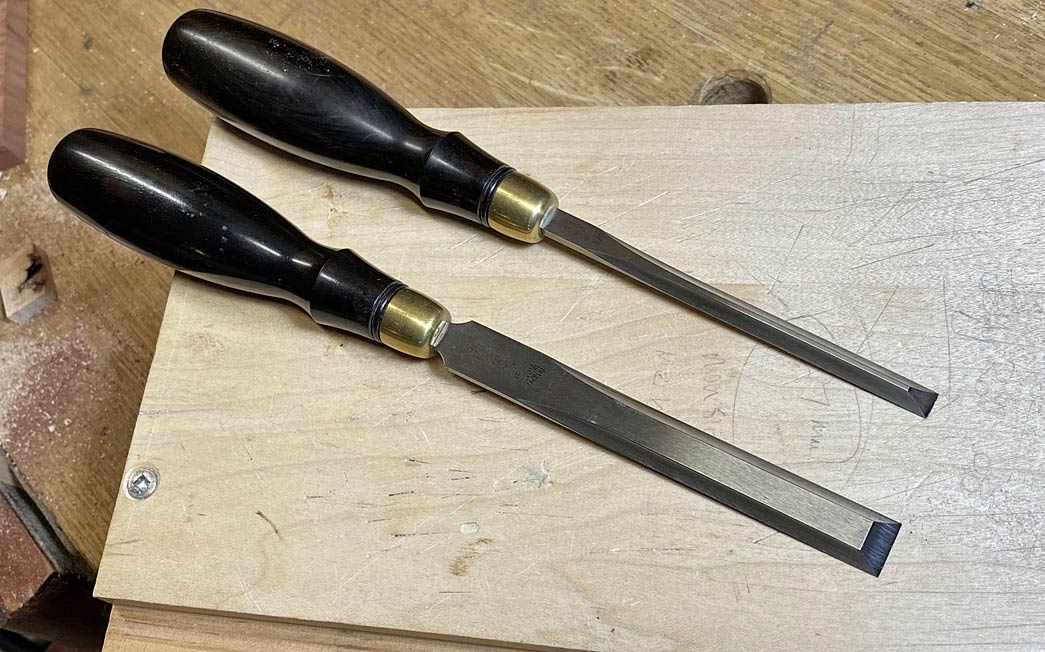
Our good friend David Weaver has been very kind! Yesterday, I received the third paring chisel to complete the set of 1/4, 3/8, 3/4”. They’re 14-15” total length; steel, 26c3 which is very high carbon with a teeny of chromium to aid through-hardening and toughness; lands tiny; handles are old cocobolo. Bolsters and everything hand-forged, hand-tempered, hand-made. The steel is like Japanese white steel; takes a wonderfully keen edge.


A few photos:


W


Wiley


Re: David Weaver Chisels

#2

Re: David Weaver Chisels

Beautiful chisels, Wiley!!� You are a lucky man!


Re: David Weaver Chisels

#3

Re: David Weaver Chisels

David does very fine work!  You’re lucky to have them!


Re: David Weaver Chisels

#4

Re: David Weaver Chisels

Yea!  We all get to see some of David's wonderful workmanship.  It would be a real joy in my 84th year to purchase just one of his beautiful chisels..  Philip


Re: David Weaver Chisels

#5

Re: David Weaver Chisels

He makes a nice chisel.


Re: David Weaver Chisels

#6

Re: David Weaver Chisels

Wiley, David did a fabulous job: thin, consistent grinding and polishing, look balanced and comfortable. And you did an excellent job of photographing them (no mean feat). 


Tell us about the one you have used - feel in the hand, edge holding, flex ...


Regards from Perth


Derek


Re: David Weaver Chisels

#7

Treasures

Hi Wiley, 


Those are wonderful looking treasures. I hope they work half as nice as they look! 


Re: David Weaver Chisels

#8

Lost track of David

Those are gorgeous paring tools.


I followed his blog and Youtube for some time but misplaced the links. He opened my eyes to the intricacies of blacksmithing and tool making without all the voodoo and extreme nuances one finds in the the craft coverage. I'm pretty sure I can go out, lop a few bricks off my house trim and try to burn down the house--he made the craft so simple.


Re: David Weaver Chisels

#9

Re: David Weaver Chisels

Hi Derek and all,


You’re so right on David’s skilled work, and I’d like to say a few words to reinforce your point. � I was looking back at Smith’s Key (c. 1816) and Edward Preston’s 1909 catalog, to find the DNA of these chisels. � David’s bolsters are the older version as shown in Smith, while his blade length—9” to the bolster—is exactly as advertised in Preston. � What jumped out though, is that in both Smith and Preston, the bevel-edged chisels were approx. 60% more expensive, for both firmer and paring chisels. This speaks both to the work of grinding the bevels, as well as to the notorious difficulty of managing warp as the thin, high-carbon (unalloyed) chisel is plunged into and out of the quench.�


David has worked out a multi-step quench process—plus pressing between aluminum plates in between coolants— to control warp. �


You asked about the feel of the tool in use. � To date, I have only done some light paring with the 3/4 and 1/4 when replacing my ca. 1900 Sargent front door mortise lock. � In that case, and I’ll compare with Japanese chisels, the long straight reach of the English chisel easily allowed accurate paring 6” into the door. � For me, it is the long straight length that distinguishes these paring chisels. �


Visually compare David’s chisel with another real favorite, a 1/2” Funatsu (Funahiro brand) 14” long paring chisel. � One sees the longer registration and sight-line of the English chisel:


In side view, the differences in sight-line jump out. � The Funahiro is cranked a bit to provide hand relief—this also aids the sight-line. � But David’s chisel gives such a sense of plumb when paring dovetail sockets or a deep mortise:


This sense of plumb given by the English type really distinguishes it, in my opinion.


David will certainly appreciate your kind words, as do I and my iPhone camera😀.


Wiley


Re: David Weaver Chisels

#10

Re: David Weaver Chisels

It is nice to see a chisel with a real bolster, real tang, tapered blade, and more carbon than chromium in the steel. 


Eleven years ago I was asked on this forum what chisels I would recommend, and I said 19th century English chisels. The response I got was that it was inappropriate to discuss such chisels because they would probably never be made again. David's chisels are certainly a long step in the right direction. 


Re: David Weaver Chisels

#11

Re: David Weaver Chisels

Wiley,


� they are wonderful looking chisels, David is quite the artisan. 


regards,


Paul Dzioba


Re: David Weaver Chisels

#13

Rafael from PA

Re: David Weaver Chisels

David has certainly refined the process to a very refined finish. His hardening method is very accessible to the bobbyist. If you have the desire to cut, grind and file O1 bar stock, then plane irons, chisels, knives, etc. are just around the corner.

I've a small set he made from vintage files with apple handles. They're earlier versions of his efforts, but they don't disappoint.


He commented that 26c3 steel better matched the performance of his Ward & Payne reference chisels. I want to get some of that stock and make my own chisels.


Re: David Weaver Chisels

#14

Not mentioned....the handle and heat treat

In my hands what makes David's chisels special is that they are harder than all but Japanese chisels and they have a handle that is the most comfortable of any chisel handle I have used.  We probably will never see a commercial chisel heat treated to this high hardness and in this style.  Careless owners would break them doing things with a paring chisel that a paring chisel is not designed for.  


Chisel handles don't get much mention when chisels are discussed.  But it is the handle that connects the chisel to the user.  While the eye may note the details Wiley enumerated it will be the hand that discovers the best feature of these chisels.   Commercial chisels could easily be made with handles like these.  


Re: David Weaver Chisels

#15

Re: Not mentioned....the handle and heat treat

We have certainly discussed handles on this forum before. I was not the only one who suggested that the handles on the Lee Valley chisels were way too fat. And I have mentioned numerous times that traditional handle material was beech and ash and that Roubo mentions hornbeam also.


It is a pretty easy thing to temper a chisel so that it is harder, but most chisels from before 1840 (when there were more serious hand tool workers) were tempered softer than David's chisels. I use these chisels and prefer them. When I had some chisels hardened and less tempered, I had chisels that were more work to sharpen, but did not last any longer in use. 


Re: David Weaver Chisels

#16

what is not straightforward

What is not straightforward is achieving high hardness while preserving toughness.  David has this tradeoff optimized the best I have seen in his chisels as judged by regularly using them to make stuff.   


While some choose to, now days it is not necessary to be concerned with ease of sharpening.  Modern abrasives easily sharpen anything. 


How we choose to work and what is judged important will lead to different chisel (and knife) choices.  David's chisels are my go to chisels, not from how they look, but how they perform.  


Re: David Weaver Chisels

#17

Re: Not mentioned....the handle and heat treat

Chisel handles are personal. There is no single style which is "perfect". Of course, the ones I like are perfect :)


The handles of Veritas and Blue Spruce are wonderful in my hand.


Veritas ...


Blue Spruce ..


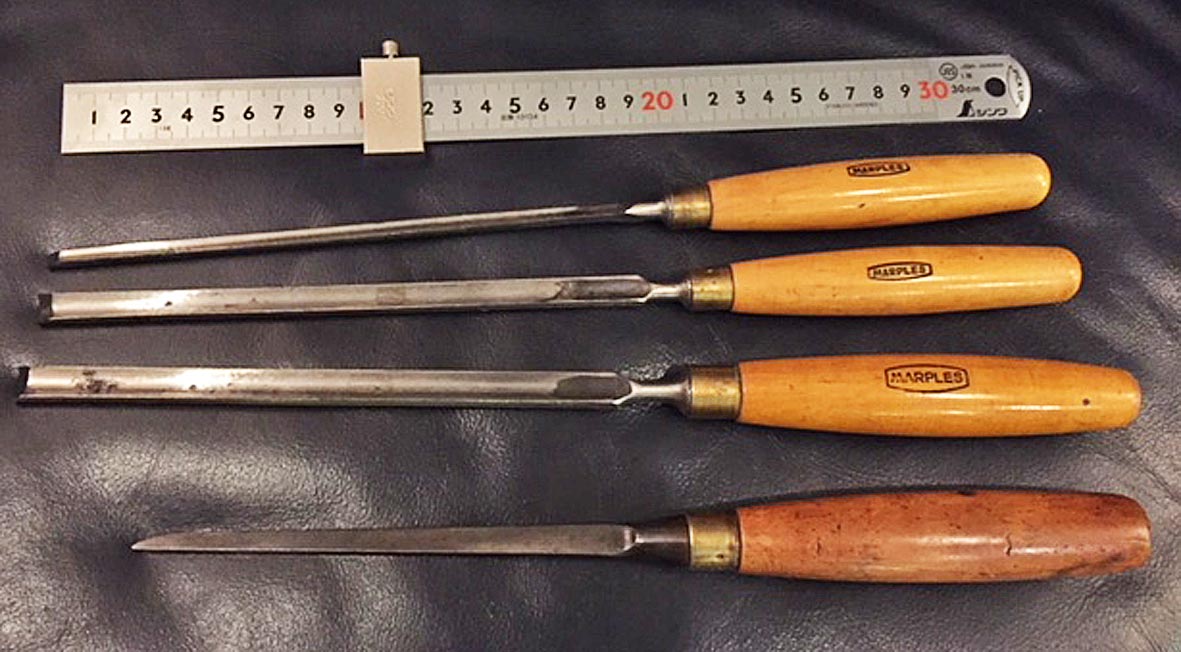
Another I like, which is different from these - but very similar to the shape used by David - is the Marples, especially those in Boxwood.


Regards from Perth


Derek


Re: David Weaver Chisels

#18

Re: Not mentioned....the handle and heat treat

boxwood-handled.....and made after 1840.....


Re: David Weaver Chisels

#19

Some thoughts on vintage steel from David

who wrote....."I have a feeling that most older chisels were in the .9-1% carbon range,  and the alloy was only enough to improve the iron carbides and add some toughness to the matrix,  as I've never had a vintage tool that resisted sharpening stones. The idea about carbon content is based on having looked for carbides in worn edges on chisels and plane irons from ward.  There is little to nothing visible whereas 1.25% carbon steel makes a dense pattern of iron carbides in a worn matrix.  The odd thing is that they do nothing for wear resistance,  and even the small amount of chromium in 52100 increases wear resistance measurably and you can feel it on the stones, too."


It would be a dandy project to get some of these old tools and analyze their composition. It is trivial to do if you have the gear. I known where some is located....call Chuck Kettler....


Re: David Weaver Chisels

#20

Re: Some thoughts on vintage steel from David

There's an interesting couple of lines in the Bernard Jones edited Complete Woodworker when discussing what to use as a burnisher for scrapers -- "use the back of a chisel that's found to be too hard for its intended use."  To me, this means a couple of things.  One, obviously, is that a chisel can be too hard, and two, it apparently wasn't uncommon to end up with one in your kit of tools if they bothered to even mention it.  It couldn't have been a rare circumstance to end up with one.  


A lesson in there somewhere?  Probably a few...


Re: David Weaver Chisels

#21

Re: David Weaver Chisels

As you have both, there is no downside. 


The advantage to bent, which is also on Japanese hooped chisels, is that they usually cut flush better, and the force on the handle is less likely to cause a chisel to dive.  I find that a nice feature particularly on hooped chisels.  Paring chisels are so long they are easy to control.  As with all nuances it does not much matter, one can get the hang of anything.


Re: David Weaver Chisels

#22

Re: David Weaver Chisels


Re: David Weaver Chisels

#23

Reality with the steel

I don't post on here, and that's not going to change. but I figured I would address the comments about hardness as there's some reality that would be more helpful than the guesses posted about hard tempered steel or scraping. 


I don't temper these chisels hard. the steel itself has high hardness out of the quench. When you temper it, it retains a lot of that. At 64 hardness, it has higher toughness than anything offered commercially aside maybe from some high speed steels, but that's based on my results - as provided by Larrin Thomas (actual testing of hardness and toughness, not supposition).


https://i2.wp.com/knifesteelnerds.com/wp-content/uploads/2019/08/26c3-toughness-fits.jpg?w=753&ssl=1


I averaged toughness results just under 12 ft-lbs at an average hardness of 63.8. Same guy testing as the one who made the chart above, same testing equipment, same steel. Individually heat treating samples (not as a batch), I had hardness disparity in total of about 0.6 c scale points, nothing outside of 0.3 points from the mean. O1 samples were closer together in general (3 of 4 within 0.1 point on the c scale - by eye - separately cycled and quenched). O1 is more hardenable and was designed to be to through hardening, so the fact that it's easier to get less variance isn't a surprise. The idea that you can't judge the color of steel by eye in a constant light environment and harden it accurately is a myth, though - the results are not just out of the quench, but also include any variance that may have occurred when tempering - all were tempered in a toaster oven in a metal stack at the same time. You can literally do it just sitting on a floor with very little equipment.


I only got superior (to commercial) results with 26c3 - 1095 and O1 samples have about the same balance of hardness and toughness as commercial results. The reason for that is probably due to the high carbon content - excess carbon doesn't do good things in a long duration soak - it lowers the toughness of the steel. Attempts at soaking steel and eye temperature are probably possible with experimentation, but pointless and unlikely to be as consistent and the method that I use. 


26c3 is available at retail, isn't horribly expensive, and doesn't need to be heat treated in a vacuum or soaked to get good results. that means anyone else could do this with propane, good indirect light - a garage during daytime away from direct outdoor light is good - and a toaster oven with a stack of metal to stabilize overall average temperature will be as accurate as most high cost tempering solutions (more accurate than a kitchen oven rack by a long shot). 


For these to be chippy like V11 is at the top of its range or like hock O1 is until some of the edge wears off, it would have to be at the upper range of japanese chisel hardness  - 65/66. I don't make chisels at that hardness level - they don't fare as well in work. 


Is there a practical reason for a garage maker to use something more common or hire out heat treatment just to make a chisel less good? I don't know what it would be. 26c3 isn't for a beginner, but it's by no means that difficult to deal with once you understand that you give the steel what it wants and don't try to be a cowboy over-forging it (and overheating or decarbing it) or getting too cute with temperatures and underhardening it. It is noticeably better than O1, and much better than V11 or A2 (it lasts longer in use, takes an edge easier, doesn't hold a wire edge and grinds twice as fast and much cooler). If someone wants to buy those, they can just go get them on the commercial market. let's be realistic - very few of the chisels that are sold in the $80+ range are going to get used by anyone who can discern the difference, anyway. I've seen machined A2 chisels being sold on etsy for as much as $125-$150 each and the reviews just gush over them. It's not really the era of discerning workers, but just like you can make furniture nicer than you have to without too much extra effort, you can do it with tools. It only becomes prissy nonsense when the making is fiddly, the results absurdly expensive (or components) and there is a long laundry list of things you can't do with the tools. you can mallet half blinds with these parers indefinitely and the cost of materials in total is probably about $25-$30 per chisel with parers, including the belts and old cocobolo. 


----------


old tools 


Very old tools were softer most likely for industrial reasons and to be usable with sandstone grinding wheels and slates/sandstones that were common when they were made. English tool hardness ticked up mid 1800s when the washita appeared. There are probably a dozen other reasons that older steel would be tempered softer in chisels, but not in files or razors - from adjusting straightness in manufacture to controlling grain size to dealing with steels 1% or below that laminate more easily to wrought iron. When I see the video that CW posted of making laminated chisels, there's definitely far more hammering to shape than I'm doing - workability at high heat matters more, and I'm using friable alumina specialty belts to grind - that's what's available now inexpensively, so those kinds of limitations don't exist. Workability with these, and sharpening/grinding, is about the same as Iles O1. 


For wood - these chisels will probably outperform everything commercially available made of solid steel and they'd be less good if commercially heat treated. High speed steel still trims metal better (i have no idea why, but it does), but it grinds and hones slower - and isn't better working in wood unless you're cutting through nails or staples. 


Re: David Weaver Chisels

#24

Re: Reality with the steel

David,


nice to see you post here. Those are wonderful chisels you are making.�


regards,


Paul Dzioba


Re: David Weaver Chisels

#25

Re: Reality with the steel

Thanks for the nice comment, Paul. I'd love to make more and spread them around as they should in use be at least equal to or better than the looks, but with kids, the time just isn't there to do it and make other things at the same time. 


👍 This page answered my questions

Your vote helps other woodworkers quickly find the answers and techniques that actually work in the shop.