WoodCentral Forums

Est. 1998 — 27 years of woodworking knowledge

Saw drift, what to do?

Posts

Saw drift, what to do?

#1

Saw drift, what to do?

Scott in Douglassville PA

Hi all -

I bought and fettled a Richardson Bros 10" backsaw years ago:


(pre-fettling)

Made a new handle (I'm going back to the original, which needs work but fits my hand better), jointed, filed and sharpened. It was my first time attempting to sharpen, and seemed like it went well (I think it was about 15 tpi), but the saw drifts:


I'm trying to get this saw to where it can actually be used at this point, and I'm not sure what to do. There's a little bit of wiggle in the plate heel-to-toe, but really no more than my 8" Richardson Bros backsaw that Bob Rozaieski worked on for me, which cuts beautifully.

Thoughts on anything to save this saw?

Thanks,

Scott

Re: Saw drift, what to do?

#2

Re: Saw drift, what to do?

Warren in Lancaster, PA

Often when a saw drifts people will say the set is not even, but much more likely is that the teeth are longer on one side. Do a very light jointing, just enough to see on the teeth and see if that supports the notion that the teeth are longer on the left side.

A light stoning on one side will alter the cutting a bit, but it looks like you have bigger problems than that.

Re: Saw drift, what to do?

#3

agree

Bill Tindall, E.Tn.

On other kinds of saws longer teeth on one side results in the result illustrated. Been there and done that.

Jointing will reveal if unbalanced teeth are the problem. As bad as it looks just looking down the toothed side of the blade may be all that is necessary.

Simple fix if long teeth. Joint just shy of the short teeth and resharpen the jointed teeth worked for me.

Re: Saw drift, what to do?

#4

Re: Saw drift, what to do?

Jack Dover

In addition to checking a set, please double check that the plate is straight. It might be bent in ways that make you wonder what it went through. If the plate is not straight no amount of fiddling with set or teeth would fix the tracking.

Re: Saw drift, what to do?

#5

Re: Saw drift, what to do?

Derek Cohen (in Perth, Australia)

Scott, there are a bunch of things wrong with the saw.

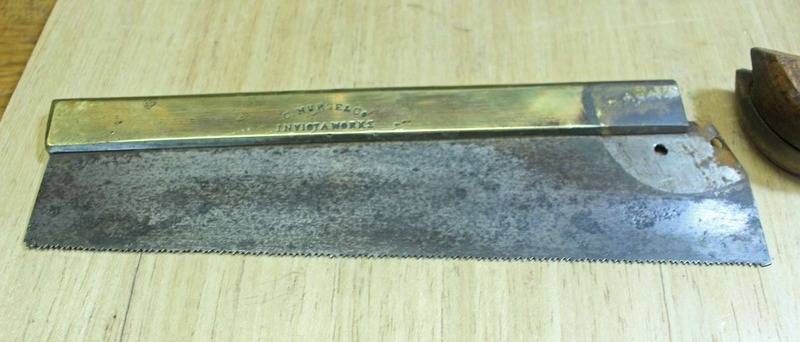
Firstly, that tapered plate looks too tapered, which means that the rear of the plate had dropped out of the brass reinforcing. Here is an example …


You can see how much the taper was reduced when it was reset (post restoration) …


Secondly, the teeth look like they’ve been sharpened by someone with either little care or little experience. The heights and spacings are all over the shop. I imagine that the set is similar.

Thirdly, the kerf cut by the saw begins fairly straight and then curves to the left after a third of the way. That is not just about the saw plate - I think that this is also about your body compensating for the misshapen teeth and applying more force. Does the saw tend to bind as you cut more deeply? That would be too little set, and forcing the saw to cut would produce this effect.

My advice is to pull the saw apart, clean it up, re-install the plate, remove all the set (lightly tap the teeth with a steel hammer on a flat cast iron top), joint the saw, and then refile, sharpen and set the teeth.

Regards from Perth

Derek

Re: Saw drift, what to do?

#6

Re: Well...

Scott in Douglassville PA

Derek, the pic I posted was as-received. Not what I'd call a whole lot better, but after trying to reset the spine a bit, cleaning the plate, and filing the teeth (ignore the handle):


I'm sure my filing is NOT up to snuff, but it's not that bad. But I think you're right overall, and I defer to your judgment.

I think what I'll do is gently joint the teeth, to see if there's an issue with the teeth being out of balance right-to-left. If that's not the issue, or if that doesn't reveal something even I can decipher, I'll do what you suggest - remove the set, joint the teeth, and refile.

As far as removing and resetting the back, well, Bob Rozaieski did that with my 8" Richardson: https://www.youtube.com/watch?v=Tk4yroAcMyA (that's my saw in the video). I tried, at length, to remove the spine on this saw and couldn't do it. I got it mostly set kinda straighter, but not removed and reset.

Scott

Re: Saw drift, what to do?

#7

Re: Well...

Derek Cohen (in Perth, Australia)

Scott, your filing is MUCH better than the original. Plus the back now looks close to correct.

Is this the saw that produced the results above? If so, check the set first. That may be all that is needed. You can get away with too little set (in hard wood) for the first 1/2". Then the plate begins to jam in the kerf, and to compensate you apply too much force.

The aim is find the best compromise for the set: too much and the cut is rough; too little and the saw does not cut smoothly. Many "dull" saws just have too little set.

Regards from Perth

Derek

Re: Saw drift, what to do?

#8

Re: Okay, on closer inspection...

Scott in Douglassville PA

...there are a number of, consistently spaced (like every other) teeth that are taller than those next to them. My vision isn't quite good enough to discern whether they're consistently one side or t'other, but it's definitely there. I'll try to get some photos this afternoon. I'm guessing my touch on filing (attack?) was inconsistent when I was filing.

I'm thinking:

- Tap the set out of the teeth, as that's likely inconsistent, too;

- Joint the tops of the teeth to where they're all at a consistent starting point;

- Refile the teeth;

- Reset.

Let me know if you think that's appropriate, all to be confirmed after some pictures.

Thanks guys.

Scott

Re: Saw drift, what to do?

#9

Re: Photos seem to indicate...

Scott in Douglassville PA

...my first attempt at filing was, um, poor.


Toothline, while better than what I received, is still all cattywhompus. No bueno. Will try again. I'm looking forward to using this saw (finally), needs to be workable.

As an aside, I found a type study for Richardson backsaws. These are from somewhere in the 1870s. That's crazy to me.

Scott

Re: Saw drift, what to do?

#10

re: Saw teeth need jointing... *LINK*

John Aniano in central NJ

Hi Scott,

First, I love Richardson Bros. saws! My favorite! Classy handles, often of birch in their earliest saws. Please, please, share any info on a type study for these! I have many, ok, maybe too many Richardsons and I've basically got them grouped from the very earliest to last period, but I've not known of a type study. Please share.

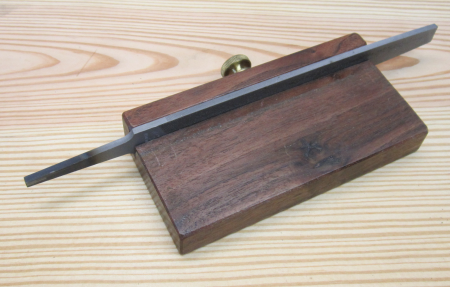
Second, you need to joint those teeth! Get a block of hardwood around 4" or 5" long x about 1-1/2" wide by 1-1/4" thick and cut a 90 degree slot in it to hold a flat, single cut file. I've got mine set up to hold the file with a brass screw. Below is a link for a typical wooden file holder for this purpose.

Then joint the teeth holding the wood block against the side of the blade with the file cutting the very tops of the teeth.

Then, you have to sharpen/shape those teeth that are too shallow after the jointing step. I use a black Sharpie marker to mark the jointed flat tooth tops and use this to show when the tops are filed to the proper depth. The black mark just disappears when at the proper depth. All the teeth should be at the same height when done.

Lastly, follow this link: http://www.woodcentral.com/store.php and find the Charles L. Johnson book on saw maintenance and consider getting a copy and support WoodCentral! It's a good book for learning how to sharpen a saw.

Have a great holiday!

John


Simple wood jig for jointing saw teeth

Re: Saw drift, what to do?

#11

Re: re: Saw teeth need jointing...

Scott in Douglassville PA

Thanks John!

First, the type study is in an old newsletter from the MWTCA [https://mwtca.org/wp-content/uploads/2019/09/Issue-146-March-2012.pdf]. It starts on page 12. The watermark is a complication but this is the only thing I've found about identifying Richardson Bros saws. I have it bookmarked, downloaded and printed. I'm a fan of these saws, too. Here's my 8" that Bob R. retoothed for me:


I just looked at what sundries I have for sharpening. Apparently have a Veritas jointer (https://www.leevalley.com/en-us/shop/tools/sharpening/jigs-mounts-and-rests/32631-veritas-jointer-edger?item=05M0701) and a Veritas saw file holder [https://www.leevalley.com/en-us/shop/tools/hand-tools/files-and-rasps/files/70465-veritas-saw-file-holder]. The file I have seems good, and was only used once on this saw, so I think I'm going to try using it again. I watched some videos about retoothing, wondering if I should try to file in smaller teeth (I *think* I filed this to 15 ppi, but I need to count), but I think I'm just going to use what's there.

I'm looking for designs on homebrew saw vises. Last time I just clamped the plate between two pieces of poplar in my vise. In the mean time, though, I'm studying youtube videos, trying to get reacquainted with the process. I'm sure I'll be posting more about this later, it'll be a couple weeks before I can actually dedicate some time to this.

Thanks for the help, I'm looking forward to having this saw rehabbed!

Scott

[As an aside, I no longer recall how to post links here. Used to be able to use [url] as I recall, and there used to be a field next to the image one below the edit field, IIRC. No longer there. Help!]

Re: Saw drift, what to do?

#12

Home brewed saw vise.......

roger lance

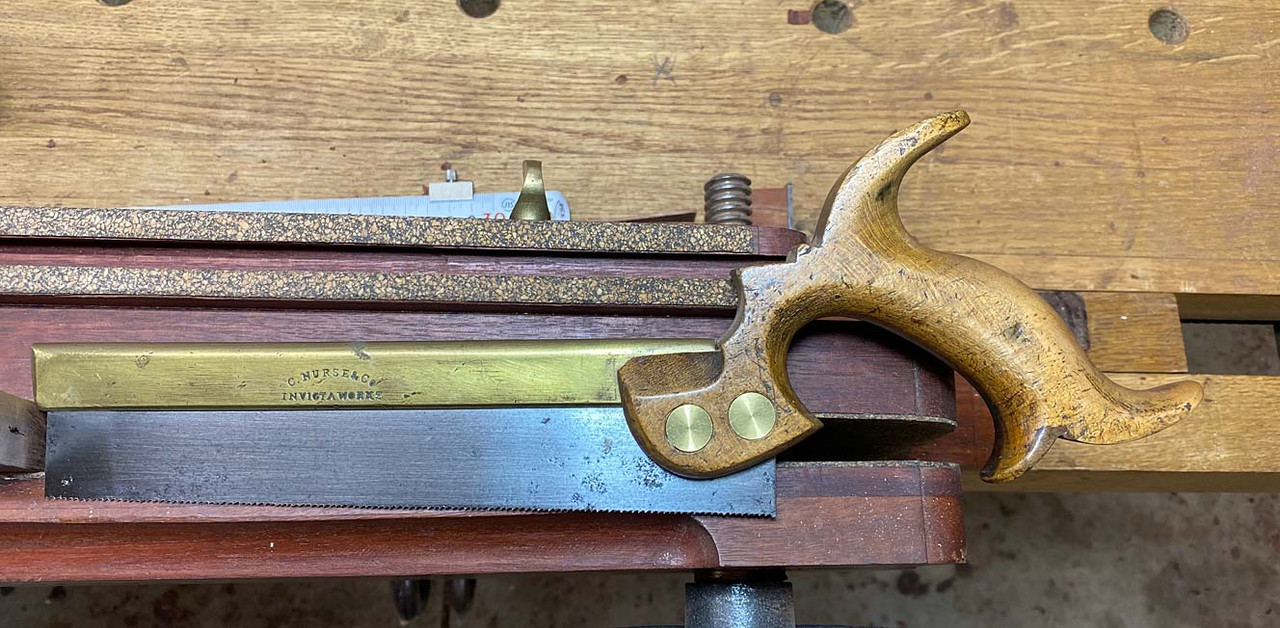
Scott......if you have a Record type bench vise, this simple shop made saw vise works well.....the two halves sit on the guide rods of the vise.....


Re: Saw drift, what to do?

#13

Re: Nice!

Scott in Douglassville PA

That's really cool, Roger. I'd found the below on eBay and was thinking of copying the design for use with my leg vise, but your design looks like it might have better holding in a bench vise.


[Photos belong to 42kustom-2 on eBay]

👍 This page answered my questions

Your vote helps other woodworkers quickly find the answers and techniques that actually work in the shop.