WoodCentral Forums

Est. 1998 — 27 years of woodworking knowledge

Handsaws in the shop

Posts

Handsaws in the shop

#1

Handsaws in the shop

john jesseph

Howdy,

Back again, thought I’d rehash another dead horse topic from my angle. I’ve accumulated a pile of saws over the years, and have enjoyed using them for certain tasks. I’m curious what people would consider a minimum kit, regarding preferences for length and ppi.

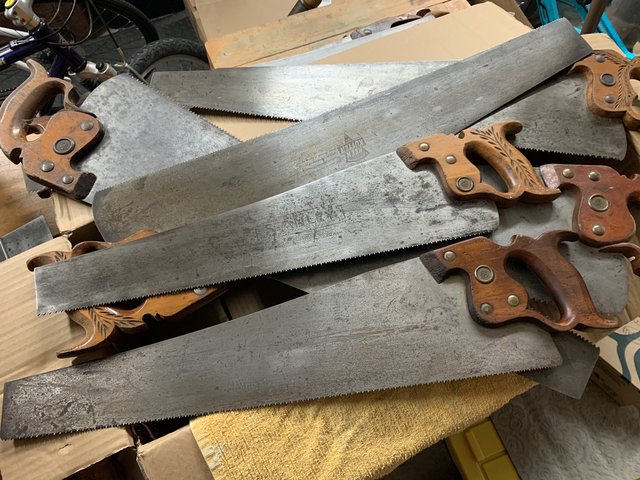
Added twist, I’ll post pictures of what I have- I’m trying to decide what to keep and what to move along to new stewardship.

I’m ready to cut back to a short crosscut, a couple full length cross cuts, and a big rip. Hard to want to get rid of any, since they really aren’t being made like this anymore.

Re: Handsaws in the shop

#2

Re: Handsaws in the shop

Bruce McCrory

My guess is, which ones feel the most comfortable and usable to you? Keep them. Enjoy them. Send the others to new homes. You have saved them from the torch and acrylic hacks; that alone is worth super kudoes.

Re: Handsaws in the shop

#3

Re: Handsaws in the shop

Jack Dover

I guess it depends on your methods of work?

In my shop saws roughly divided into three categories: rough material breakdown, medium to fine work (panels, occasional short stock processing, small resawing, etc) and fine work (joinery and trimming).

Handsaws fall into first two, and if you're not using power tools for breaking down lumber than coarse (~5 tpi) rip and cross cut are necessary, maybe keep ones with the longest stroke you can do (this depends on your height)

Same for medium work, something around 8 to 11 tpi, except minimal weight would be the priority. Since this type of sawing happens mostly in awkward positions and confined spaces, I'd pick a saw that's not too long (~18-20") and light, that gives the cleanest cut. People say that rip saws can crosscut too, which is true to an extent, but I would still have both a rip and a cross cut.

This would be my minimal set. I have more though, for the same reasons as you do. I have a good set of frame saws, my hand saws barely get any work, but I still keep them.

Re: Handsaws in the shop

#4

Re: Handsaws in the shop

Bill Tindall, E.Tn.

This question can not be answered reliably unless you reveal what sawing you do with these kinds of saws. But then, it would seem that it would become apparent what saws were needed by what saws were used.

I use a wood frame firewood cross cut for breaking down rough lumber into manageable pieces. Works for me, but probably everyone else would say get rid of it. Hence my quest for group advice would be flawed.

Re: Handsaws in the shop

#5

for me

David Weaver

* 2 rip saws, one aggressive and one less so (a minimalist would be fine with 1, you can orient the saw more relaxed in a rip with nasty wood or thinner wood)

* 2 crosscut saws (one that can be used for finish cuts and one more like 8 point intentionally filed aggressive)

* 2 backsaws, both rip - one with bigger teeth a little relaxed and then one small with a shorter spine for dovetails

* 1 flush cut saw (not absolutely needed, but a big time saver)

* 1 fast/aggressive turning saw and a coping saw for finer work

I think I have about 6 saws set rip and sharp (not just a little sharp, but economy of effort sharp), four backsaws set up and usable (more than that in total) . And two crosscut saws that I use regularly as well as a gaggle of specialty saws infrequently used.

If it doesn't stretch the bank, for instance, it's nice to have a saw with some set to rip wet softwoods, then something like 6, 5 and 4 point saws for ripping or resawing (something like a short piece of purpleheart to be resawed is going to be a bugger with a saw set to dig in just right on cherry).

my head swims not with ideas to saw joinery faster, but to rip and break down lumber and resaw more easily, so the comments above about rip saws and a crosscut saw that is aggressive and may be a bit hard on the back side of the cut isnt' going to resonate with someone who roughs boards to length with a cordless circular saw.

for the joinery saws, if something is so big that it needs an atypical joinery saw, it can be sawn with the hand saws, anyway (large tenons ,etc).

Re: Handsaws in the shop

#6

Re: Handsaws in the shop

Warren in Lancaster, PA

5 1/2 point rip saw

9 point crosscut saw, little set.

8 point crosscut saw set for green timber

Dovetail saw

Carcass saw

Sash saw

Tenon saw

The Seaton chest has the same kit, but with only one crosscut saw. I assembled my kit before the Seaton book was written. These are the only back saws and hand saws I have owned.

I think for a professional it is important to have a limited number; too great a variety takes away from fluency with the tools.

Nicholson (1812) adds a very coarse rip saw and a "panel saw" which is a 26 inch 7 point saw for thin wood.

Re: Handsaws in the shop

#7

Re: Handsaws in the shop

William Duffield

Hand saw vs. panel saw: Panel saws are shorter so they can be kept in a tool box. If you hang yours on a wall or in a saw till and don't take it out of the shop, there's no reason your cross cut hand saw needs to be any shorter than your rip handsaw. When used on a saw bench, a longer saw cuts more efficiently. In fact, the crosscut can be longer, since your rip saw is used more vertically, and will therefore strike the ground sooner when used at your saw bench.

Re: Handsaws in the shop

#8

I think...just my preference..

David Weaver

..that having a second coarse rip saw for resawing is nice.

A lot of times, it doesn't really save much time, but is a nice thing to have if you encounter something like a cheap 16/4 slab and want to break it down.

I have only ever browsed parts of nicholson, so I don't know the context there. I doubt they would've wasted time on something like that, or if they did, maybe they had cheap labor.

I have far more saws than the list above, but even my list is an indulgence vs. need. There's nothing wrong with the other saws, I just don't remember how they're sharpened.

Re: Handsaws in the shop

#9

Re: I think...just my preference..

Warren in Lancaster, PA

I use a veneer saw for resawing. Nicholson does not mention a veneer saw, but veneer saw webs (blades) were listed in Sheffield list in the 19th century and a veneer saw is pictured in Roubo in 1769.

Here are the four saws without backs in Nicholson:

Rip saw: 8 teeth in 3 inches, 28 inches long

Half ripper; 3 teeth in an inch, 28 inches

Hand saw: 15 teeth in four inches, 26 inches

Panel saw: 6 teeth in an inch, 26 inches long.

I think in general workers used saws with larger teeth than today.

Re: Handsaws in the shop

#10

Panel Saws

john jesseph

I appreciate everyone’s discussion!

Here’s an example of two saws I don’t need, but like: Stanley 780 crosscut, 20 in., and Disston D8 22 in.

Fun saws, don’t need them at all. No idea who really made the Stanley.

I’ll follow up in the morning tomorrow, thanks!


img

Re: Handsaws in the shop

#11

If Richardson Bros. then as many as possible...


Re: Handsaws in the shop

#12

Re: Handsaws in the shop

Oskar

The saws I use the most.

Japanese pruning saw with big teeth, for crosscutting and harvesting green wood. (e.g for carving and to be riven into parts for staked furniture)

Large (as fast as possible) rip and crosscut saws for rough dimensioning.

Frame saw for resawing boards

fine rip and crosscut saws for joinery.

azebiki for female part of sliding dovetails.

abutment saw for planemaking

a turning saw made from a gramercy tools kit.

a couple of very small keyhole saws, made from jigsaw blades, for making very narrow hidden tang mortises. e.g for knife handles

Re: Handsaws in the shop

#13

I would like to learn more

Bill Tindall, E.Tn.

a couple of very small keyhole saws, made from jigsaw blades, for making very narrow hidden tang mortises. e.g for knife handles

Re: Handsaws in the shop

#14

Re: I would like to learn more

Oskar

Hi Bill,

here's one of them. I ground the jigsaw blade down to this pointy profile and put a handle on it. First I drill out a couple of holes or three, then saw out the wood in between. It saws on the pull, which clears the mortise when it is blind. For through mortises (think knifes that are peened at the end) a push saw would work as well. I use the saw in conjunction with these two small chisels, reground from Pfeil luthiers knifes. They are something like 2 x 4 mm in cross section and are mainly used to keep the edges of the mortise clean, where the wood should be snug to the blade.

Hope this helps?


Re: Handsaws in the shop

#15

Re: I would like to learn more

John Jardin

nice

Re: Handsaws in the shop

#16

clarification

Bill Tindall, E.Tn.

for making very narrow hidden tang mortises. e.g for knife handles

I didn't make my question clear. I was curious about the mortise part. I have a need to handle a knife Mr. Weaver made for me. I would not have imagined that it was possible to mortise the hole in the end of a block of wood as thin and long as a knife blade tang by any means. And even with your brief description I don't think I could do it and keep the mortise straight. Some time when you are mortising a handle for a knife I would like to see pictures of the process.

Re: Handsaws in the shop

#17

Re: clarification

Oskar

Hi Bill,

ok, I see. I have a knife or two to make in the near future and I will try to remember to document the process and share here. I have done many such knifes since I was young, and it is very possible, but sometimes a tedious work. The scandinavian tradition of making hunting, fishing and carving knives rest a lot on hidden tang and rat tang construction, and every scandinavian reseller of knifemaking supplies carry needle rasps, saws of the kind i posted and long, thin drill bits.

I´m sure there are descriptions online but I never looked. Will post pictures when I get to the making. Must decide on a wood blank first.

What are the dimensions of your tang? is it through or shorter than the handle?

Re: Handsaws in the shop

#18

Re: Handsaws, and other saws...

john jesseph

“I’m curious what people would consider a minimum kit...”

When I wrote this post originally, I was only thinking of handsaws. Backsaws were not on my mind. Not to mention frame saws, Japanese saws, or other specialty saws. Certainly those are all worthy considerations, and I’m glad they are being brought up.

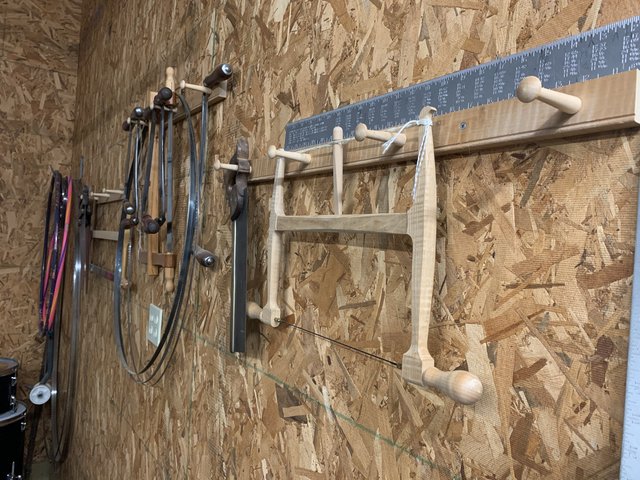
When I first began woodworking, I learned most of my information from a combination of Roy and Norm on PBS, VHS cassettes and books from the library, and dial-up modem OldTools listserv. I checked a book out from the library that contained information about frame saws, by Tage Frid. I bought a couple of them, and still have them as you can see in the picture below. Also seen are bandsaw blades and half a dozen drawknives.

This pic shows where my handsaws were hanging, two to three deep on each peg. In the foreground is a small frame saw made of curly hickory, made from the Grammercy parts. I may remake it, since I over thinned the arms.

More stuff to discuss later...


img

Re: Handsaws in the shop

#19

Re: clarification

Bill Tindall, E.Tn.

is it through or shorter than the handle?

Could be either. Result does not have to win a beauty contest.

I hear what you say of the process, I understand the steps, yet my brain says, impossible.

Re: Handsaws in the shop

#20

I've only had one...

David Weaver

But it was a very elegantly ground good saw. As good as anything I've had and some non-disston saws come up short of the bar that disston double taper ground saws established.

Re: Handsaws in the shop

#21

Coarser teeth..

David Weaver

I don't know why they'd use coarser teeth, but I have gravitated to coarser teeth the more I work with and the nastier some of it gets (e.g, resawing gombeira billets, or katalox).

Since they were likely working with a lot of fruitwoods like beech in planes at the time, or with woods like mahogany for cabinetry, it's easy to adjust orientation a little bit to increase sawing speed without blowing out the backside of a cut as much as one would on woods that splinter a lot more easily on the back side of the cut.

Whatever it as, I'm sure they knew what they were doing and there was an economic/efficiency reason for it, and to discount their knowledge and assume "we're modern and we know better" would be a recipe for coming to the wrong conclusion.

(I say that noting that you are the last person who would attempt to do that - bt others may be inclined to assume that they were just crude back then).

What I've used of good rosewood ,fruitwoods and mahogany (wood that takes nice detail) is like being on a different planet vs. a lot of what we work with now.

Re: Handsaws in the shop

#22

Re: Handsaws in the shop

Derek Cohen (in Perth, Australia)

John, the majority of my ripping is completed on a machine, either a table saw ir a bandsaw. Crosscuts on large panels are treated the same way. However, there are times when rough sawn boards are easier to use a panel saw, which I do ...
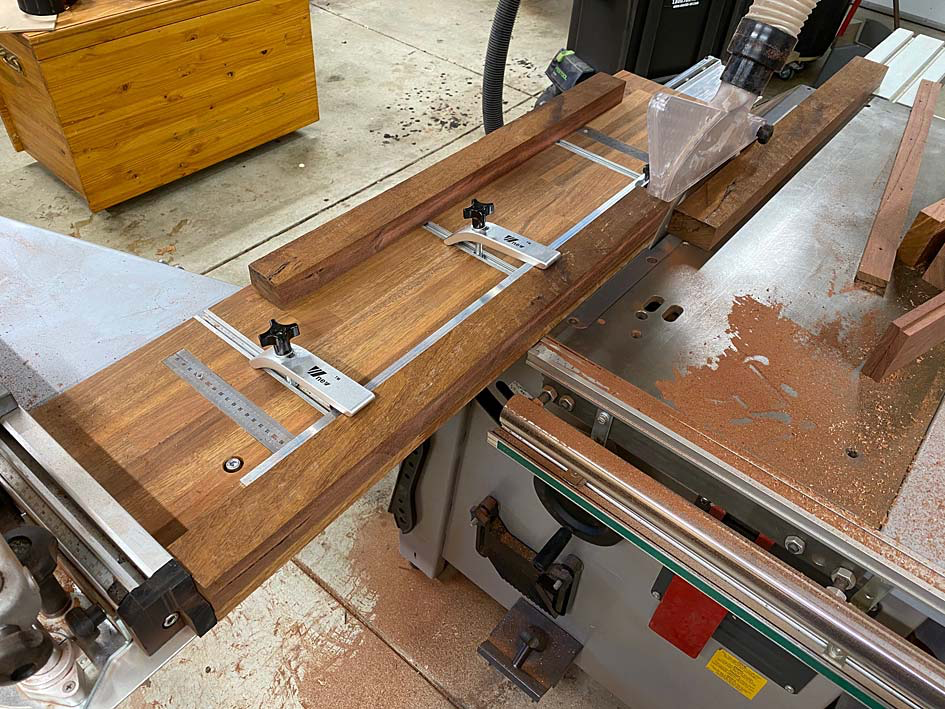

A comment in a recent FWW mag caught my eye, as it falls in line with my view point that Phil Lowe "exemplified a North Bennett Street catch-phrase that embraced 'using hand tools in concert with machinery'". This is a hand tool forum, but few here use hand tools only.

I use hand saws exclusively for joinery. Dovetail saws are probably the ones to immediately spring to mind. I have a few, of different tooth size and rake since these serve better to work the range of woods I build with. The two main teeth size would be 15 tpi for around 3/4” and 20 tpi for 1/4” thick material. My favourites are an original Independence Tools saw, the original LN that is based on this, the Grammercy, and a 20tpi from Mike Wenzloff. I must admit that I love dovetail saws and have a bunch. Here is a Nurse I completely restored and refiled 16 tpi ...
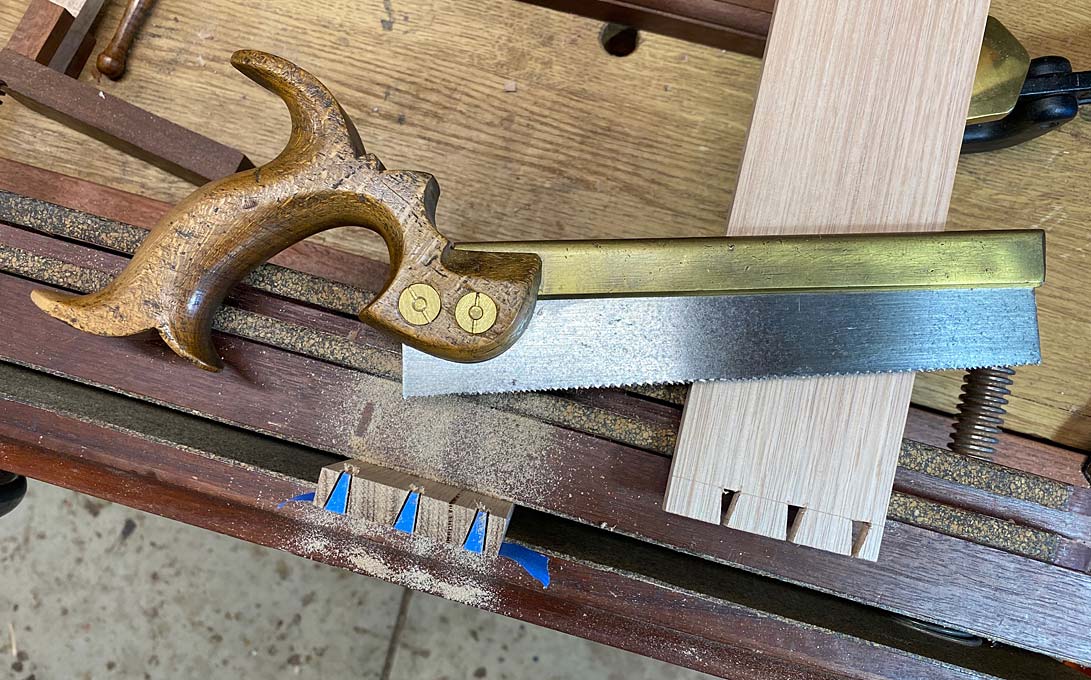

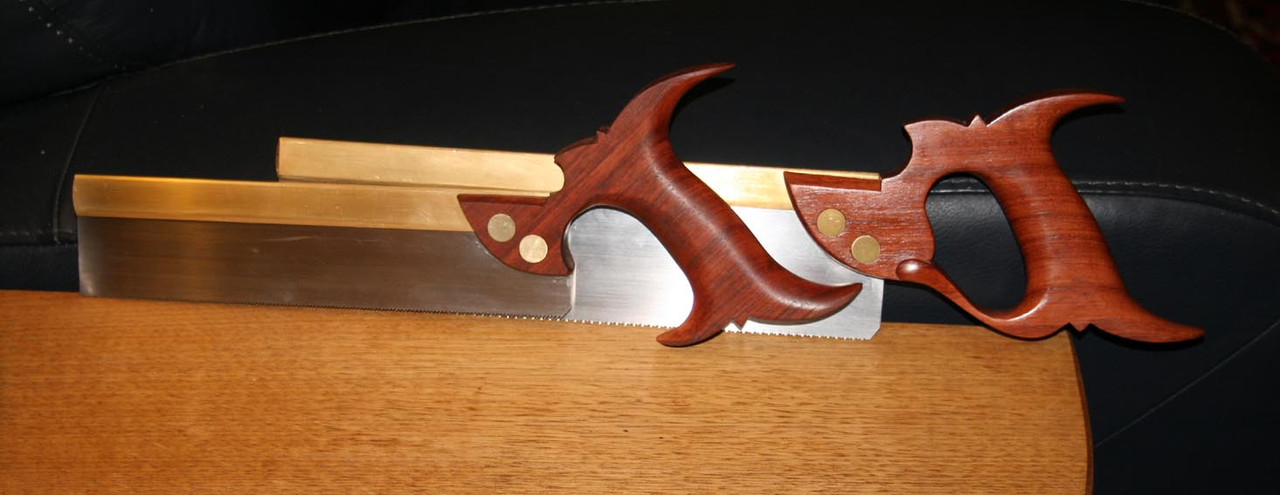
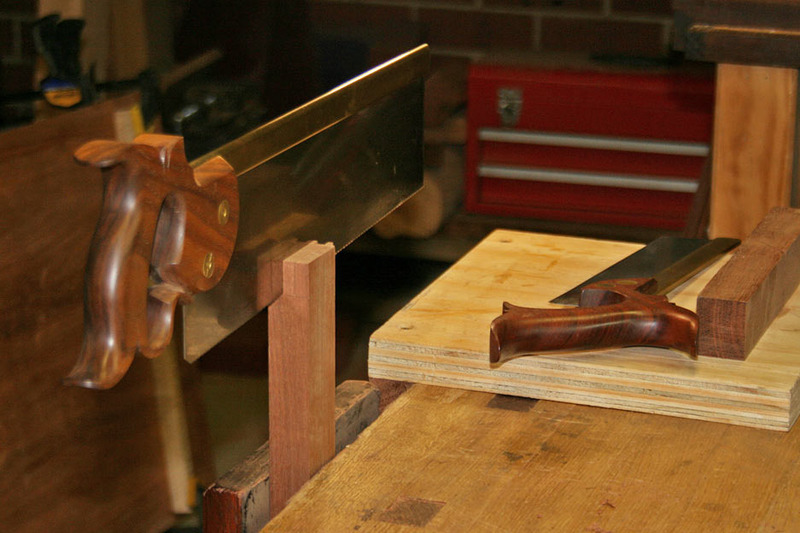
There are three crosscut saws: a dozuki for thin material (such as drawer sides), a small (10”) joinery backsaw (14 tpi) and a larger (11”) carcase saw (13tpi). These are great for shoulders of tenons and other similar cuts.

These are two I made ...

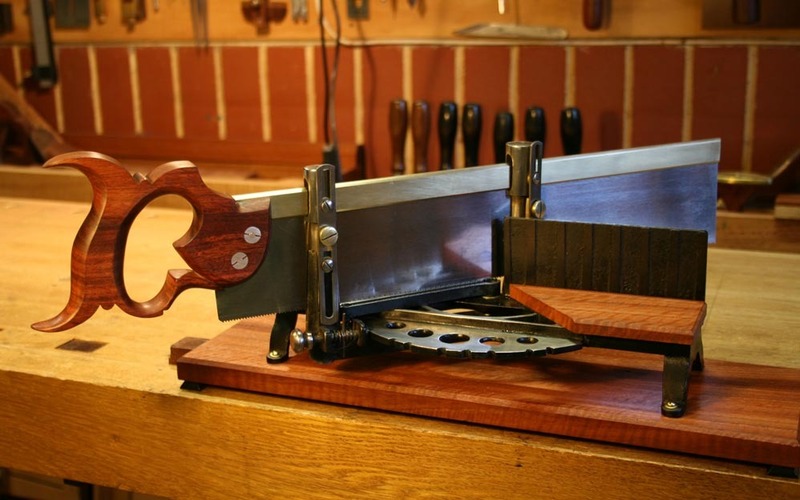
Another saw I made, also for crosscutting moldings, but in reality little used, is this small 14” inch mitrebox saw ...

Tenon saws - I have a couple I restored and sharpened, one monster 16” 11tpi from Mike Wenzloff, but the one I use mostly is the 14” 12 tpi Grammercy ...

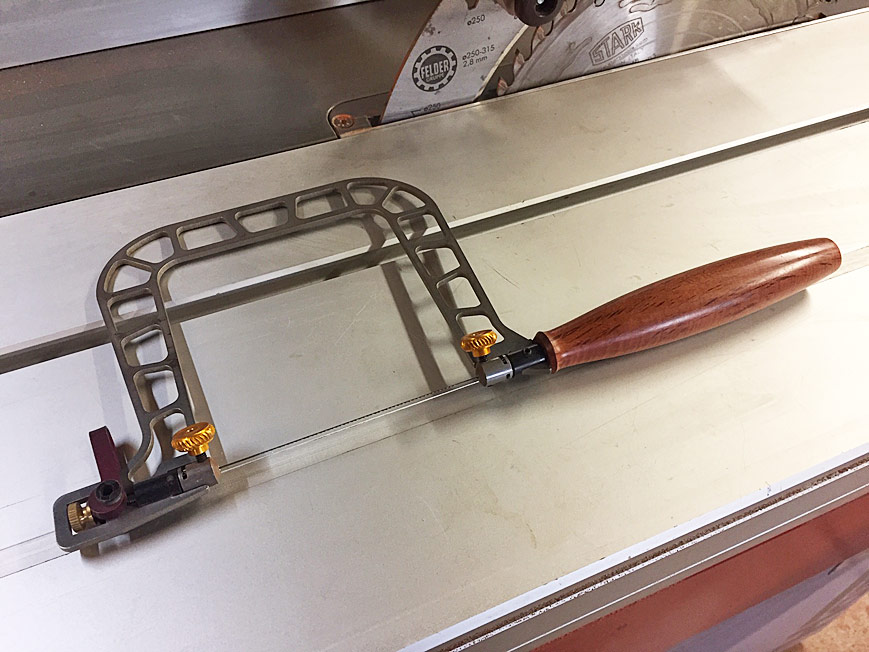
There are other saws which get frequent use. A (re-handled) Knew Concepts fretsaw for dovetails and similar ...

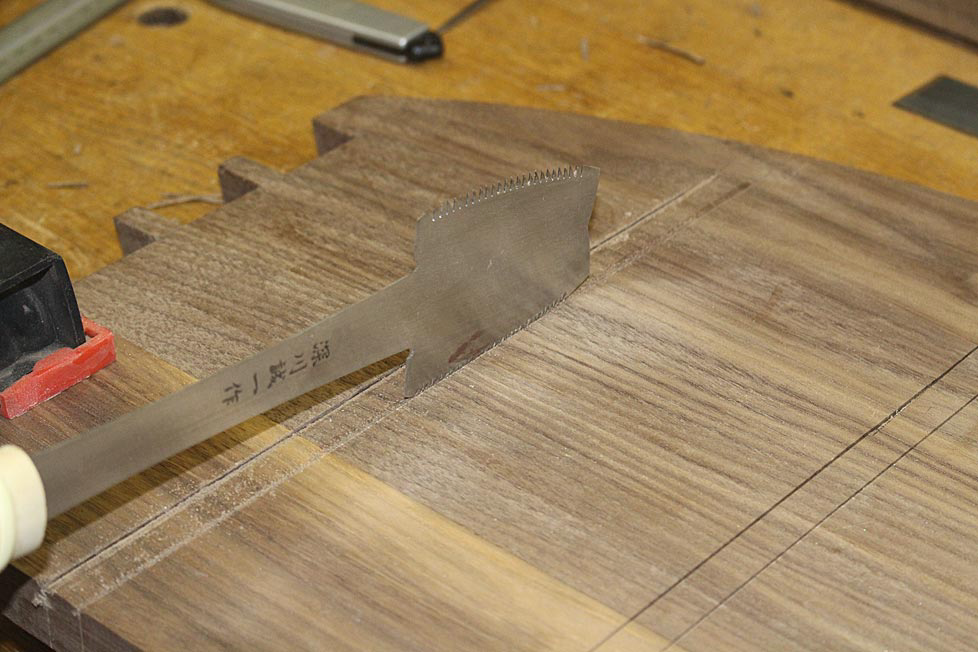
And an azebiki for sliding dovetails and dados ...

It is not essential to own all of these, but the specialist saws do make it easier (and fun :) )

Regards from Perth

Derek

Re: Handsaws in the shop

#23

Morticing a Japanese chisel handle

Derek Cohen (in Perth, Australia)

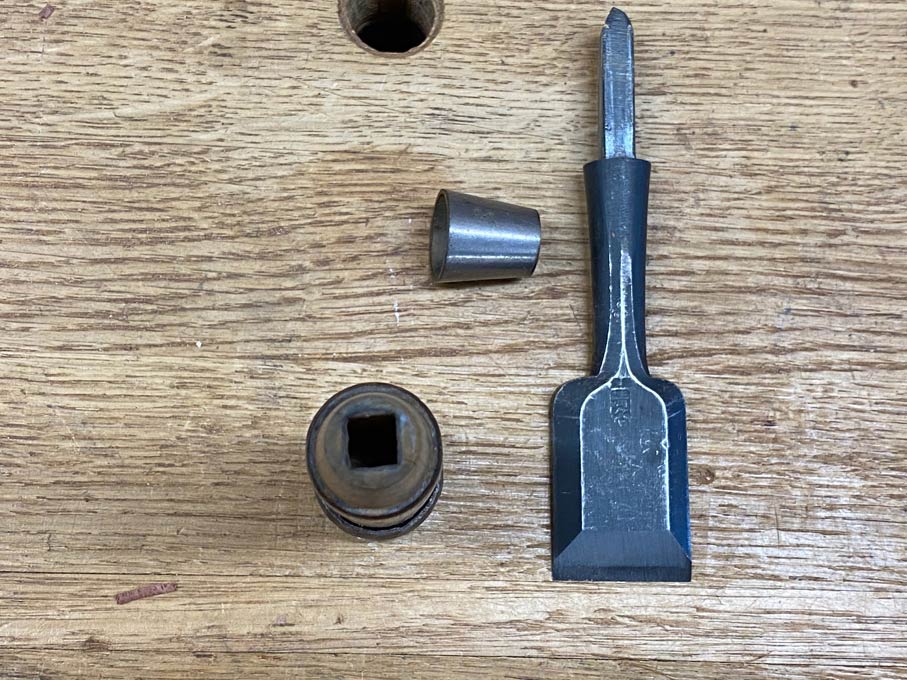
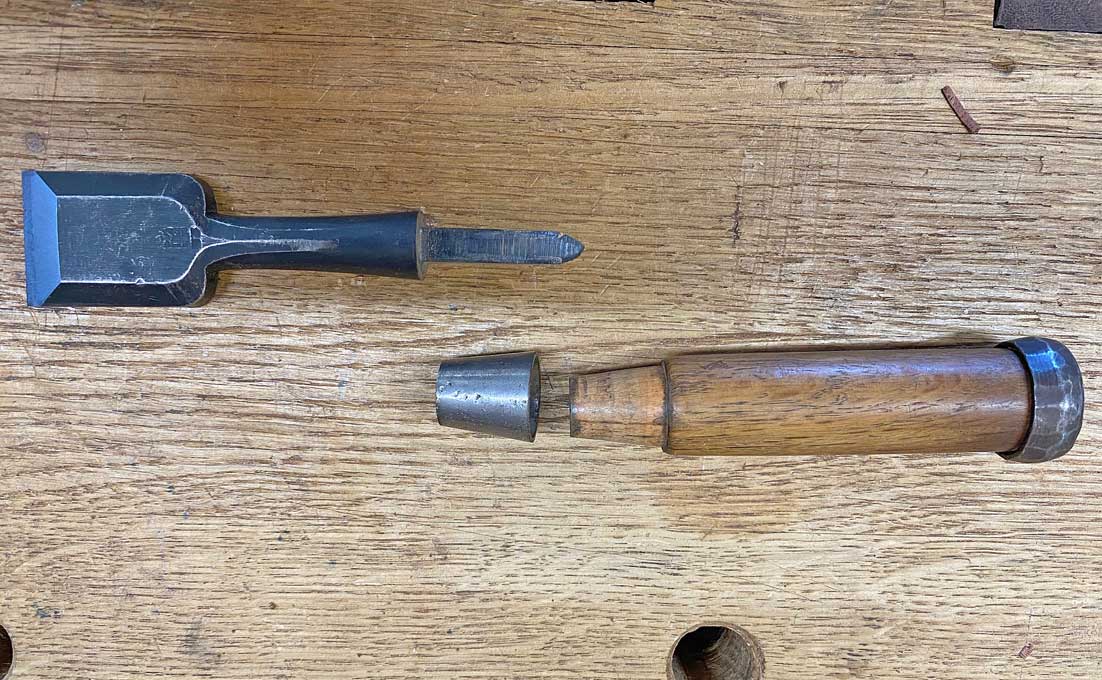
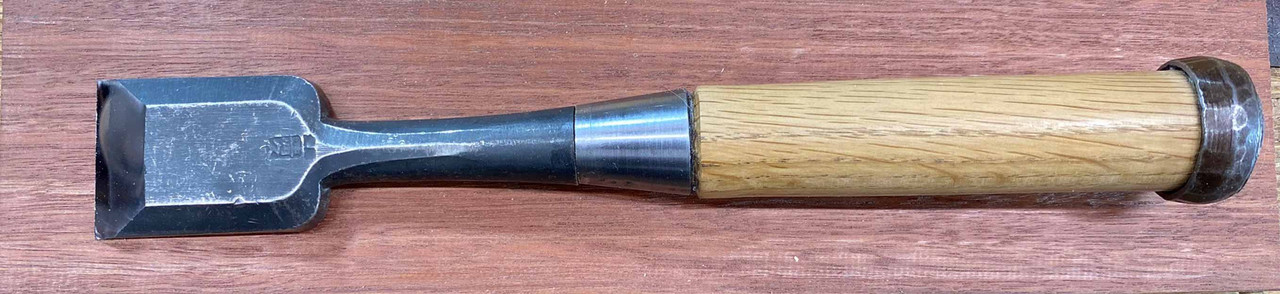
Duplicating this Kyohisa (I posted some of this about a month ago)...


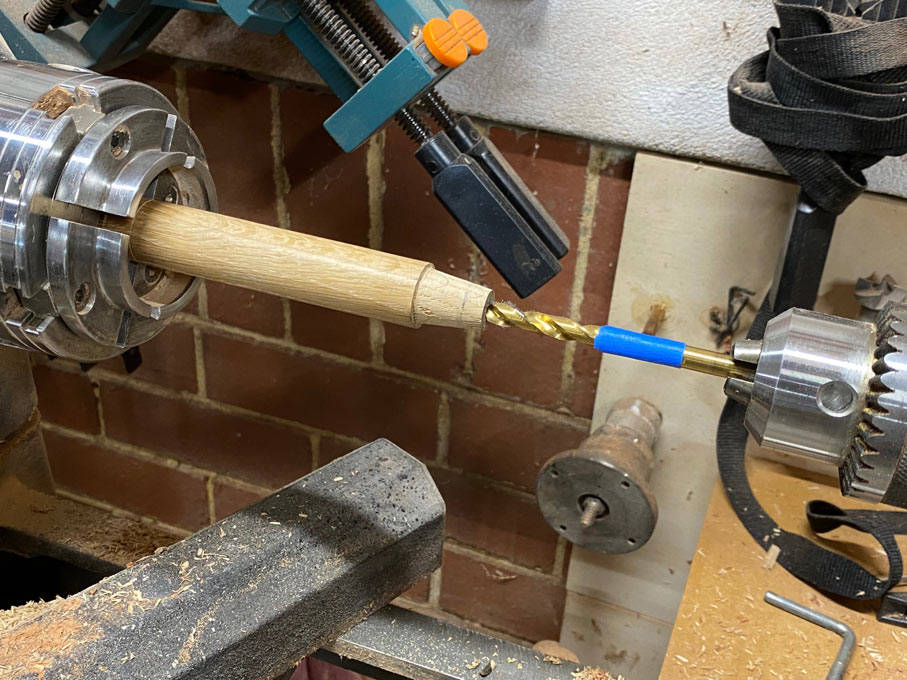
Turn and drill a new handle ....


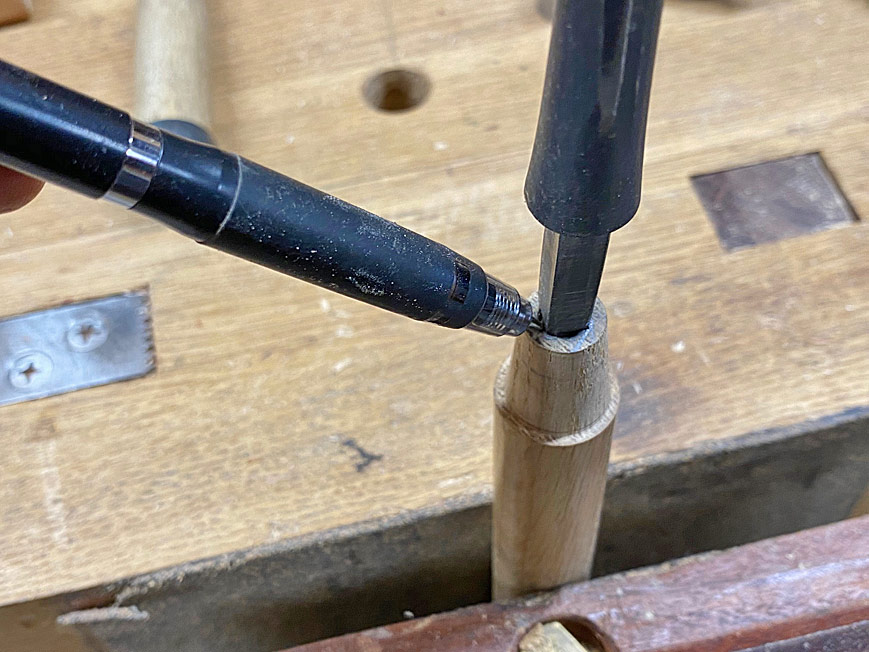
Mark around the hole ...


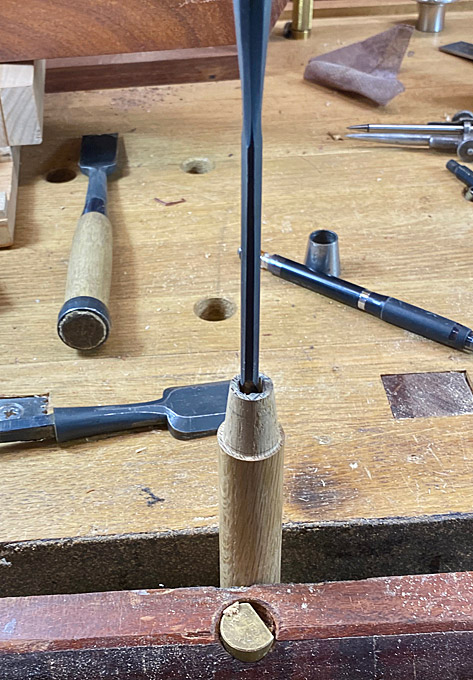
Pare the sides (long paring chisel helps here) ...


Regards from Perth

Derek

Re: Handsaws in the shop

#24

Re: I've only had one...

John Aniano in central NJ

David,

I very much like Richardson Bros. saws, in fact, I have about a dozen of them, both hand and backed saws. Four are sharpened and ready to use, the rest are just for looking at! They have some of the most interesting handle shapes and materials. They used birch, beech and apple wood and I have several examples of each. They also had a 2nd quality saw line branded "Noble" which even though the handles are pretty pedestrian, the saw blades themselves are still of nice quality. The demise of the firm was brought about when Disston bought them out, and I like the underdog. Lastly, the were made in Newark, NJ, not far from where I was born, so I feel a connection.

John

Re: Handsaws in the shop

#25

Re: Handsaws in the shop

Bruce Mack

The handles on your crosscut and miter box saws are beautiful and daring. The thin sections are more susceptible to trauma, I think. They remind me of those done by Two Lawyers Woodworks.

👍 This page answered my questions

Your vote helps other woodworkers quickly find the answers and techniques that actually work in the shop.