It is time to refine the fit and finish(remove glue smudges and the like) of the drawers. The sides are easy. Anything thrown to the bench that the drawer will hang over works to hold them while planing.
Because I don't have a good way to hold them I strive to not have to adjust height. But when it happens the height needs lowering, I have not figured out the best way to hold the drawer for planing the top. Suggestions?
The view of the desk when in service will be-
Drawers
Against sage advice I have yet to consider hardware. Maybe black knobs.
That’s what I do, too. Put a stop in a convenient vise or clamped against apron; hold the drawer against the stop with one hand and plane with the other.
Like a small plane for this job—easy for me to run a biggish plane into a ‘wall’ at the end of travel. Usually plane around the corner to avoid spelching (small chamfer can avoid this too).
It's been a while since i fitted a drawer, but two thoughts.
One, I will pile on to the advice about a stop. Have you got one? I could not live without the stop pictured below, but a less permanent solution like Wiley suggests would work as well.
Two, I keep seeing everyone talk about chamfering the rear corner to avoid blowout, but if your drawers are poplar like in the pic, or pine, or any other common drawer wood, I'd just plane in both directions. Poplar is not going to care.
When I mentioned chamferring, as an alternative to ‘planing around the corner’, I was talking about mitigating crossgrain planing of the adjacent side upon exiting. I just swing the plane around the corner.
BTW, woodies are good for this task, because it’s no fun dinging the back wall (at the end of the pass) using a metal plane—maybe no one but me has made this error. Woodies are good!
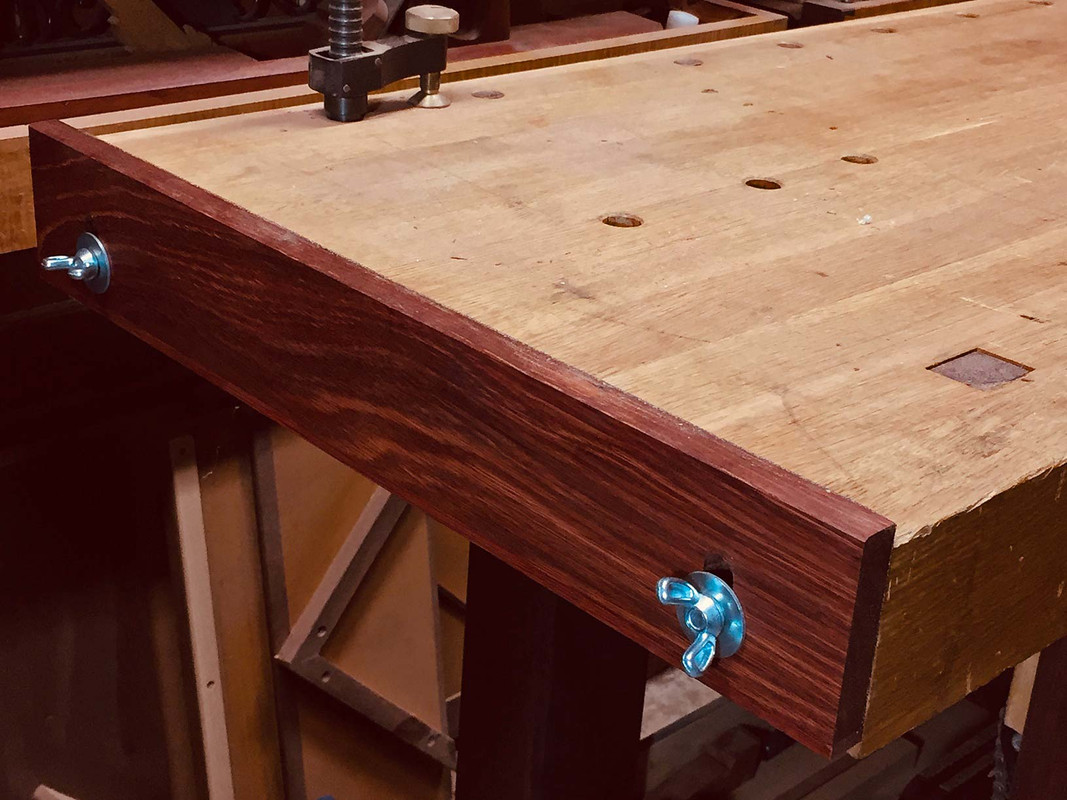
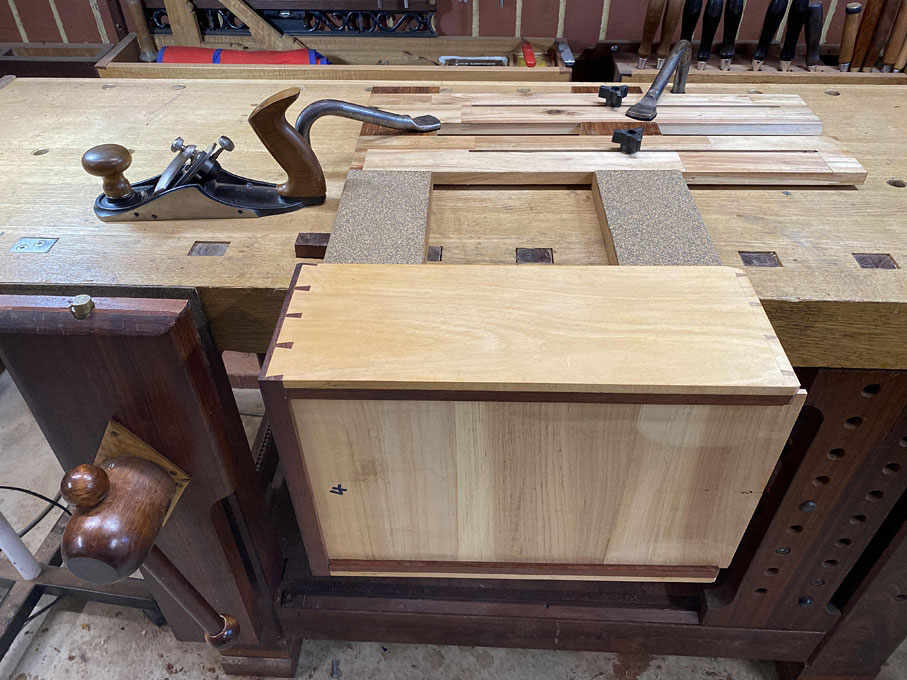
1. Planing tops of “flat” drawers, as Bill is using, the drawer is butted against a wide stop attached to the bench ...
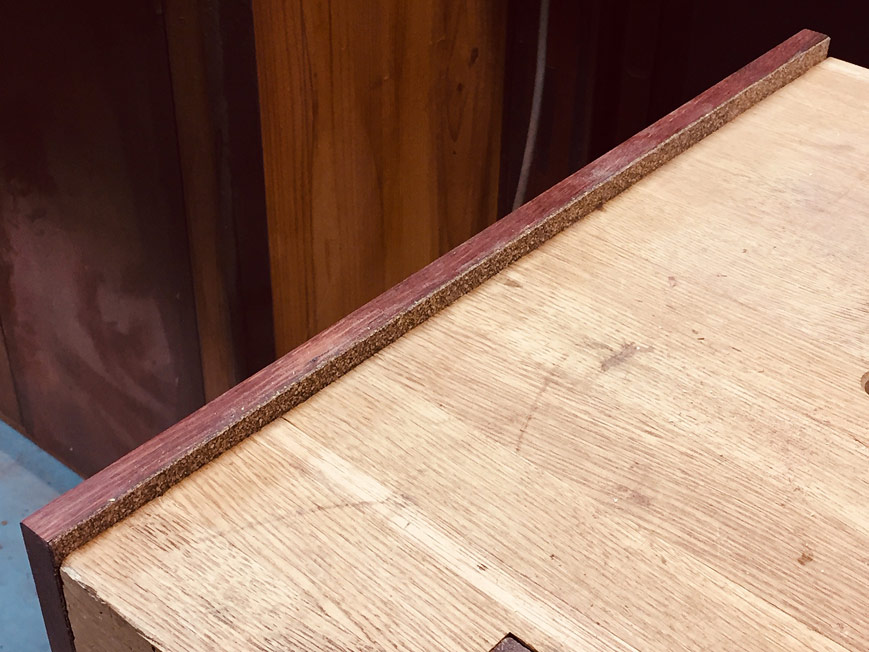
Note that the inside of the stop is covered in cork-rubber, which both cushions and acts as a non-slip.
2. If the drawer fronts are lipped, the lip can be held in a face vise. I use a leg vise.
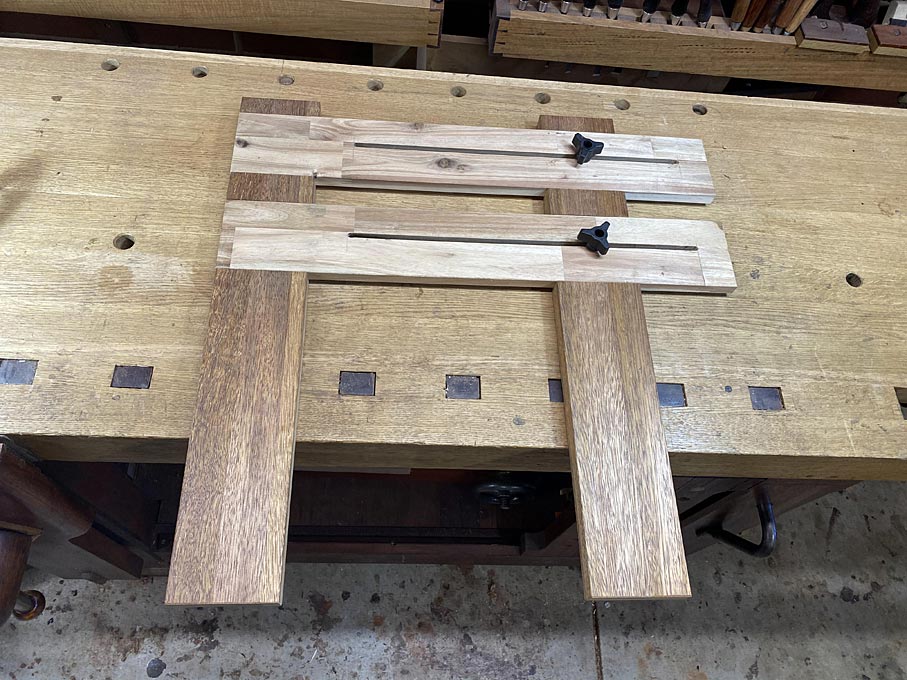
3. For the sides of drawers, I built an adjustable clamp - essentially what Bill is using in the first photo, but can slide open/closed to match a drawer size ...
Will try the stop. I must be taking heavier shavings that you all for my planing resistance is substantial so my holding power needs to be secure. I am thinking the stop plus that notched thingy Derek described to hold the drawer to the stop will do the trick. Or I could throw a bag of lead shot across the top.
Plane the top one handed with a block plane?....not this ash. Its a grunt to drive a #5 across it.
Bump the back with the plane nose. Nobody looks back there.
In the Headley shop one of them lowers the drawer back below the sides to avoid it scraping on the back blade. The other makes the back flush then spoke shaves a hollow in the back. Neither has convinced the other of the superior nature of what they do.
My drawer side ends with a half tail. This feature enables the back to be made less tall. The sides can be planed without concern of running into the back corner, not that it would be a concern with my pedestrian drawers. After all they have nail holes.
Everyone else used up my suggestions One thing I’ll add is clamping a board, stick, turning spindle blank will give you a stop without stopping your project to make a project in order to finish your project. You get the idea. Quick and easy also allows trying different options (placements) before making something more permanent.
Oh, and the ‘and’ ... Bill, the added rails at the panel bottom really dresses it up. Looks classy and complete to my eye. Very nice job!
If I knew proper names for these things it would make things clearer. By stop do you mean the thingy that goes in a row of holes? If so, I have that, with many heights and holes to choose from.
Mack's bench:
When I worked in the Headley shop I used Mack Headley's bench. It, of course, had a row of holes behind the vise and "stops" to go in the holes. At the time my home bench did not have holes. After working at a bench that did it was not long before my bench had holes. And over time it acquired more holes as needs arose.
But I don't find that a single stop provides sufficient support. However, some sort of stop that is a strip instead of a "peg" would. I will put my mind to coming up with something.
..if we're making up artificial names (which is what i usually have to resort to), the stop that's a long straight bar or strip is what i'm thinking of.
Not usually very tall for me on something like drawers. If what's being planed needs retention from behind to keep the drawer from coming off of the bench, then the amount being planed may be too much. You can hold the material down with the plane at the same time you're planing it unless the cut is too heavy.
May be a different story with the ash you're planing.
if the stop is a single point or dog, then more attention has to be paid to the drawer side being very close to the stop so that the drawer doesn't rotate while planing.
I call what goes into round or square holes “dogs” or “bench dogs” to be more accurate. Dog holes are usually aligned to a vice(s). What Steve and Derek showed in the photos are what I call “stops”. Both are great and (varying degrees of) permanent mods to your bench. A clamped board is a similar stop to Derek’s but repositionable. All the above stop’ the stuff from moving when working on it.
I want to end up with a permanent one but I’m still trying to determine my preference and location before making holes. If I did more WW’ing I’d know by now.
and the attachment possibilities on your bench. One could throw a clamp across the bench and a t-shirt over that, and that’s a stop. Endless possibilities....
Here’s a stop I butt things into, or plane edges into the birds’ mouths:
It’s sawed out of a piece of 1x12 poplar, with a cleat glued underneath to grab in the vise. The cleat could be glued at different angles (or even made rotatable) to get different presentations.
Think limiting degrees of freedom. Each additional degree of limitation requires one more feature. And ultimately you arrive at a fixture, like Derek’s nice one, that eliminates all degrees of freedom.
Re: Stop question - holding things on the bench... *LINK*
John Aniano in central NJ
Hello All,
I can't imagine that those in this forum haven't seen this book by Christopher Schwarz, but if you haven't, it's worth a look. It's an excellent read, especially if you like esoteric history. Shows many of the ideas described here...
My vise has a part that can be raised which can be used to capture something between this part and a dog/stop in the bench. I don't see the equivalent in this vise. Are the dogs/stops there just to be pushed against, and not for clamping against the vise?
Unclear what the difference is between "dogs" and "stop". Surely the stop is not permanently fixed into the bench?
What is the curved (cyma?) part the extends to the right of the vise handle closest in the picture?
1.For trimming like you are doing, we usually don't fix the drawer to the bench which would waste time. We work it loose against the stop, which is always there. The vertical dog on a face vise is an old 20th century device.
2. f is a keeper or garter. It slides into a slot in the vise check and engages a groove in the bench screw. It makes the check stay with the screw head.
3. Dogs are usually iron, at least in 19th century benches. They are for pinching stock to secure it to the bench. They are usually quite a bit narrower than bench stops.
4. Curved part on end vise is attached to a small batten that goes into the bench to help keep the end vise from racking. You can see the very end of the batten in the picture. I don't know how well it works.
Unclear what the difference is between "dogs" and "stop". Surely the stop is not permanently fixed into the bench?
Bill, did you look at the pic in my previous post? The stop is a 3 x 3 x 12 post mortised into the benchtop. It is raised/lowered with mallet blows. Warren mentioned his is 2 x 2 but otherwise it's the same thing. Lots of people put iron toothed devices into them, but mine (and Warren's) is just wood.
It is not used with the tail vise; you just butt the work up against this. I do most of my planing this way. I have a tail vise and dogs but rarely use them. If you need additional support you can use a doe's foot (google it).


 One thing I’ll add is clamping a board, stick, turning spindle blank will give you a stop without stopping your project to make a project in order to finish your project. You get the idea. Quick and easy also allows trying different options (placements) before making something more permanent.


