Re: Washita stone
Bryan in Broad Ripple, IN
It's been many years since I posted here, but I thought I'd go ahead and chime in with my 2 cents. I posted a SG measurement formula here many years ago for helping ID stones.
I agree with most of David Weavers observations on the topic.
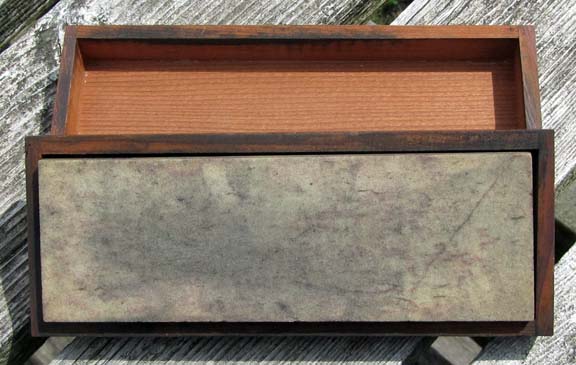
First, I've owned dozens (maybe 50 or so) of various Arkansas and Washitas bench stones. These are stones in the 2"x 6" to 2"x 8" range. Except for 4 of them, they were all found out in the wild from auctions, garage sales, estate sales, etc, so I know that they were all original, and were very old stones. Since I bought them in the wild, my views probably reflect a region bias as I live in the Midwest. Some were in old carved boxes, some were in original paper-board boxes, and some were just flopping around on benches or on shelves. Most were jet black and glazed over when I bought them, but a few were NOS and in pristine condition. Most were never recognizable as Arks, but looked more like a fouled and caked up Crystolon or India Stones.
I've looked extensively at old catalogs, geological reports, advertising, catalogs, etc. to try and figure out the history of these stones and I believe that I figured out a bit about them.
Originally, Pike and then Norton sold a wide variety of Novaculite stones...the Washita's and Arkansas stones that we are talking about now. Washita stone was plentiful and relatively easy to mine, and the Arkansas stone was more rare and more difficult and costly to mine. With Washita stone, they could mine huge boulder sized pieces (a ton or so) for processing. With the Arks, it was more like 50 pound pieces.
With Washita's, there was relatively little waste (50%) to get finish stones, but with Arkansas stones there was huge waste (75% to 90%) to get to the finished products. In the late 1800's, it was estimated that there was close to 800,000 lbs/year of Washita mined compared to 60,000 lbs/yr or Arkansas stone mined. This translated to 400,000 lbs or finished Washita's to 15,000 lbs of Arkansas stone per year. So, historically, Washita's were much cheaper than Arkansas stone (hard or soft) to produce and sell. Washita's were sold in quantities that were 10 to 20 times higher than Arks.
Pike/Norton sold the Washitas in many different ranges. The best range was Lily white and which was actually divided up onto a few grades...basically: Coarse/Soft, Fine/Medium Hard, and Fine/Hard. So the benefit of the early Lily Whites was that they were pre-graded and guaranteed. The other ranges of Washita were not guaranteed...you got what you got.
It's important to note that several sources discuss the variability of Washita stone and how some unscrupulous sellers would sell poor quality stone disguised as genuine Washita stone. This began to diminish the Washita stones reputation, and is probably what caused Pike to grade their stone so careful, and to guarantee the best of their line.
In terms of pricing, if you go back to the late 1800's up to the late 1930's, the Hard Arkansas stones sold for about 5x time what a top of the line Lily White sold for. A Soft Ark sold to 2 to 3 times what Lily White Sold for. I really don't think there was much demand for Soft Arks, and it doesn't even look like they were sold much before the very end of the 1890's. So historically, The Washita stones were much cheaper that the Arkansas Stones.
In 1891 an Arkansas stone (hard) was priced at $3.00 per lb and a Lily White was priced at $.0.60 per lb.
In 1899 a Hard was $3.50, a Soft was $1.70, and a Lily White was $0.60 (all per pound).
In 1913, a Hard was $5.00. a Soft was $2.50, and a Lily White was $0.75 each.
By 1934, a Hard was $8.00, a Soft was $3.20, and a Lily White was $1.60 each. Interestingly, India stones were about $1.50 to $1.75 at this time.
After WWII, information gets more spotty as the catalogs generally stopped listing prices. So it's hard to tell what happened, but By the 1950's Norton topped selling the Lily Whites but continued to sell other Washitas.
By the late 1950's Norton pretty much phased out the Washita's in favor of the (Synthetic) India and Crystolon stones.
That's what I know from documented sources. What follows is speculation:
As I said above, originally, Washita were very well respected and desirable stones. This caused to market to get hit with cheap, poor quality knock-offs that seriously hurt their reputation. I think originally there were several sources to genuine Washita stone, but as Pike grew, they consolidated the market and bought the Washita quarries until only THEY had access to genuine Washita Stone. Pike/Norton did sell their stone to other retailers that labeled them under their own brand names, though.
Generally, though, most of what's labeled today (and in the last few decades) as Washita by Bucks, Smiths, or Case, etc. is NOT the same thing as the Pike/Norton Washita stone. As David has said, it's just lower quality stone that they are calling Washita.
What happened to the Washita's and why did Norton discontinue them? It's hard to say what the actual market conditions were that cause Norton to discontinue them, but generally it seems like Norton just replaced them with their synthetic stones. They spent years developing and marketing the synthetics espousing their virtues and consistency in grit. Early on, the synthetics were more expensive than the Washita's. As time went on, they became cheaper than the Washitas. The bottom line is that the synthetic stones were easier to make, cheaper to make, and they could make whatever grit the market demanded, and were not at the mercy of nature to dictate which stones they sold. They were good stones, and you could get the grit range you were looking for pretty easily and cheaply.
Overall, It's my experience that with the older stones, the Washita far outnumber Arkansas stones. However, this may be a regional thing. Out of the 50 or so larger OLD (think 75 to 100 years or so) Novaculite bench stones I've found and restored, most were Washita's, maybe 10 were hard Arkansas (black and translucent), and only 2 were soft Arkansas. One of those softs was a labeled Norton Soft from the 1970's that actually looks and behaves more like a Washita, though.
I've own easily 2 to 3 times that number in smaller stones and slips, but most of those are Hard/Trans stones that were acquired from machinists and other higher end sources that demanded fine finishing stones. A few are labeled Soft Arkansas stones.
What I've also found is that the SG range of the Washita's range from the low 2.0's to into the 2.4 range, so there is a ton of variability. The Soft Arks are in the 2.3 range. The Hard/Trans all are in the 2.62 to 2.67 range. Most of my really old Washita's (estimated at 100+ years old) are white or light gray/tan and generally pretty uniform in color and texture. In the more recent Norton Washita stones, I started seeing much more color and variability. I have a very striking purple/red stone from the 1950's that is a very good stone to use.
Generally, the Soft Arkansas stones are exactly as David describes them: slow cutting, gnerally do not impart a fine edge, and they look like finely fused sand grains under magnification. It's also been my experience that in the OLD stone from 75 to 100+ ago, (at least in this area of the county) that Washitas are far more common than Soft Arks.
As for Arkansas stones of the last few decades and of today...I think the same thing has happened to their quality and reputation that happened to the Washita's 100+ year ago. You have a few good reputable sources like Dan's that makes an excellent product, and you have cheap knock-off's that diminish the reputation of the stone. The new Arkansas Stone that you can buy $20 are pretty poor for woodworking.
-Bryan
 it was for trend "lapping fluid".


