Home Articles Forums Gallery Marketplace Videos

WoodCentral Forums

Knowledge You Can Build On — Est. 1998

Hold downs and augers

Posts

Hold downs and augers

#1

Hold downs and augers

Derek Cohen (in Perth, Australia)

There is a technique to using augers in hard wood that I would like to pass on.

What has this to do with hold downs? Well, I have two Gramercy hold downs, and they are great. I also have a single Veritas hold down, and have wanted another as I think that they are the best. But I kept putting off buying one as the Australian Dollar has gone to Hell and they are now really expensive. But, about a week ago I came across two being sold extremely cheaply - the seller was really offering them as a gift - and I was the first to respond. Now I have three!

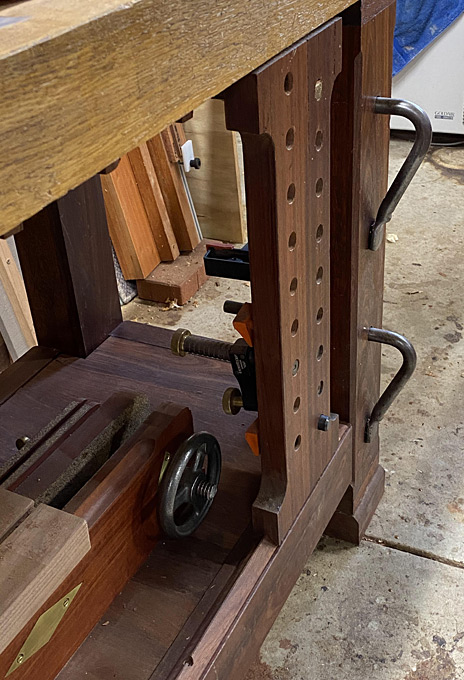
Storing the Gramercy hold downs has been easy enough. They simply slot into holes in the bench leg ...

The Veritas hold down is more of a problem. They cannot go into a leg like this as they project too far. As a result, the one I have lived in a dog hole on the bench ...
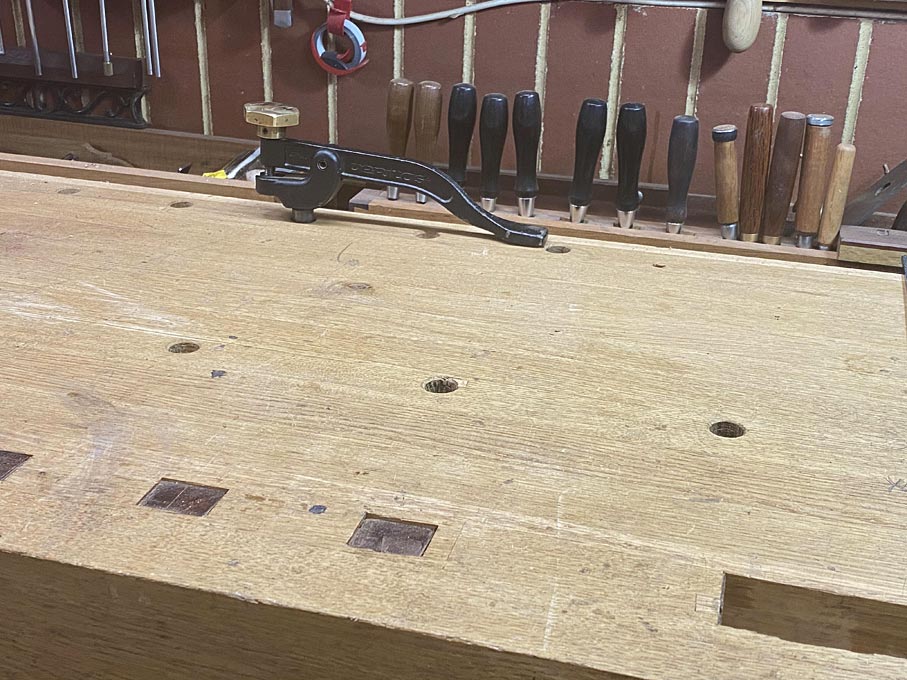

This is not ideal as it takes up wanted real estate. The bench is just 80" long.

I came up with a solution to drill holes in the bench leg, but on the outside, so they face inwards ..
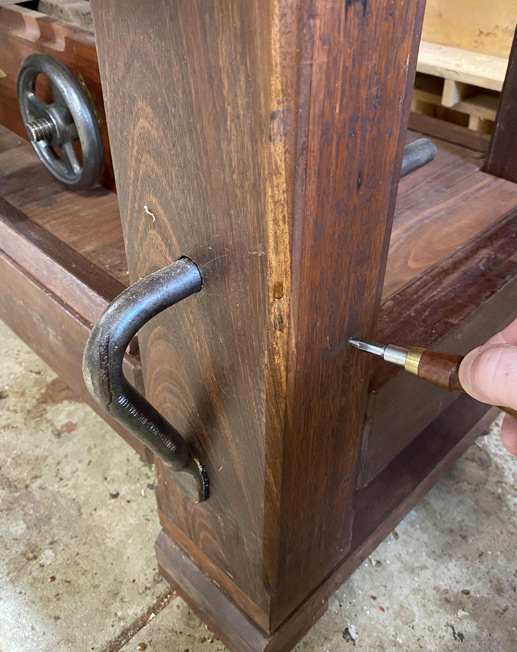

Two issues here: the first is that there is a sliding deadman to consider. This is about 1 1/4" thick Jarrah, as seen in the first photo, and the 3/4" holes must not interfere with it. The second is that, while the holes for the Gramercy hold downs went through 3" of leg, the Veritas holes will need to clear 5" solid Jarrah.

The method here is used by all augers. I have Russell Jennings, Irwin and, as used here, Wood Owl, a Japanese make. The Wood Owl are the best I have used. They have 3 cutting faces verses the 2 on other augers.
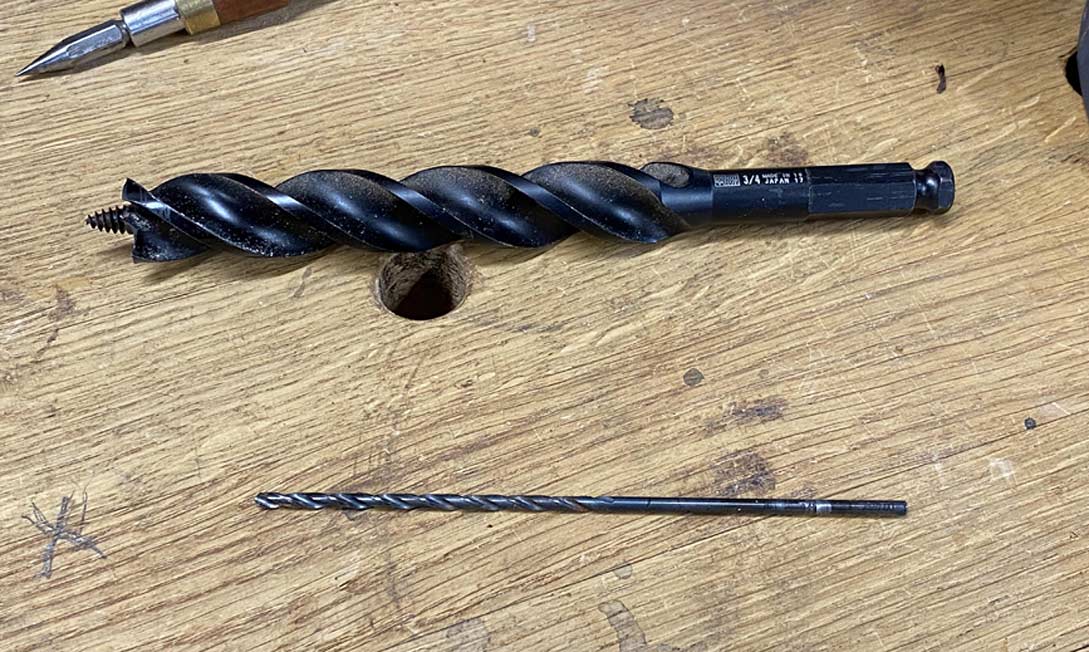

The hex shank is, I believe, 7/16" across. This fits the 10" Stanley 2101 Bell brace I am using here.
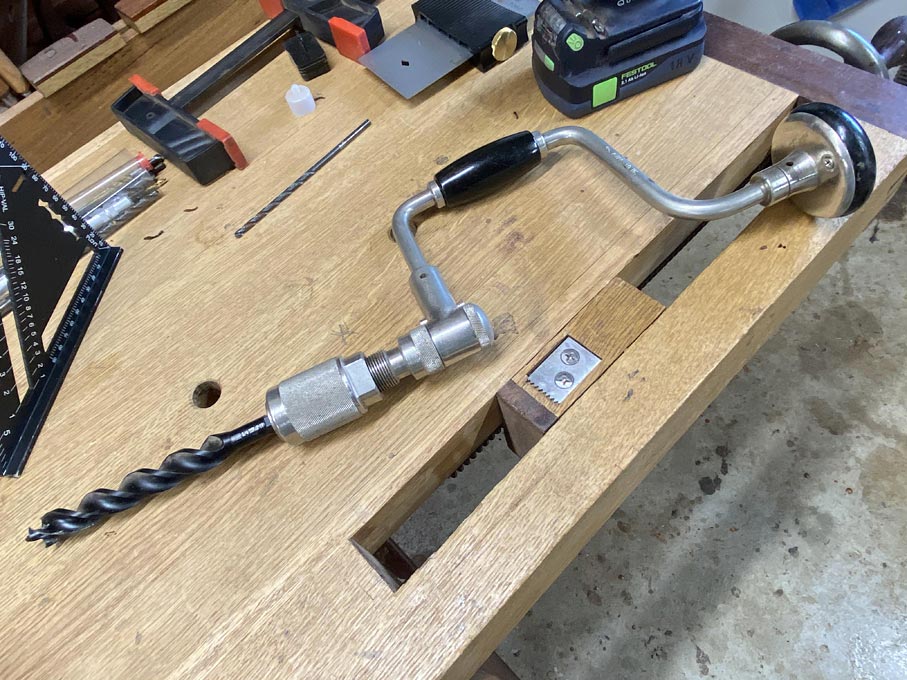
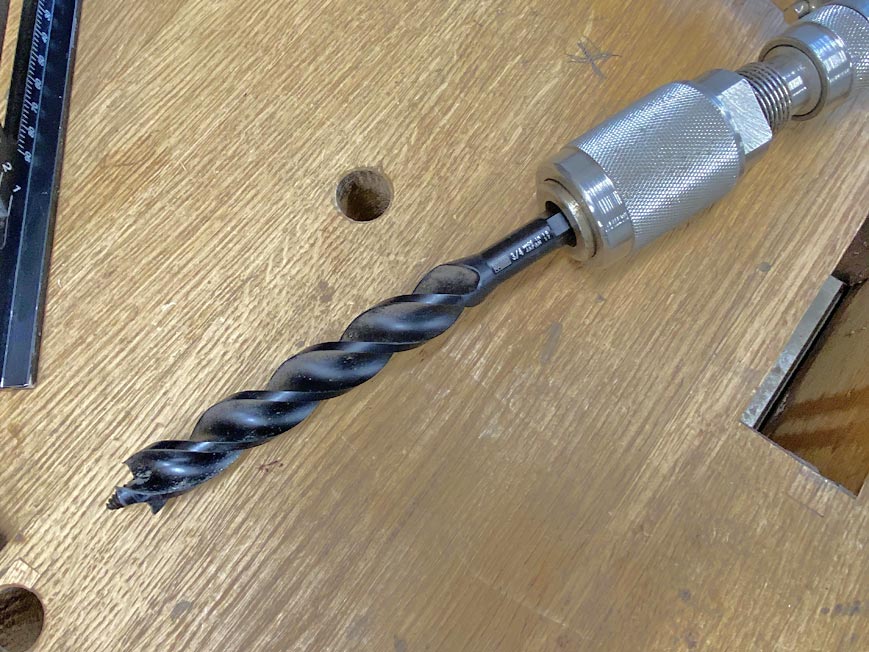

If you have ever tried to use a brace and auger in hard wood, you will hear recommendations to get augers with fine lead screws (and that coarse lead screws are for soft wood). In my experience, it really makes no difference what you use in really hard woods. For interest, the Jarrah here came from roof trusses rescued when we completed a renovation 15 or so years ago. They had been baking in the West Australian sun for 15 years prior to that (yes, 30 years ago, West Australian home builders were still using Jarrah to build roofs!). Trying to drill through this wood requires a huge amount of down force and forearms like Popeye.

Enter the pilot hole.

The idea is to drill a hole slightly smaller than the lead screw ...
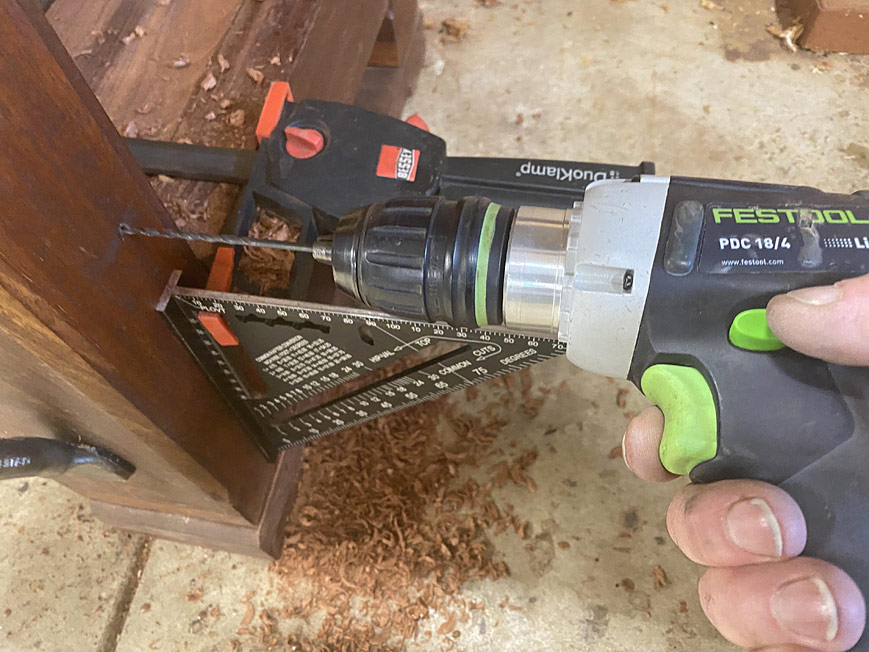

Once this is done - noting that my drill bit was 1" too short to clear the leg - you can begin using the bit and brace ...
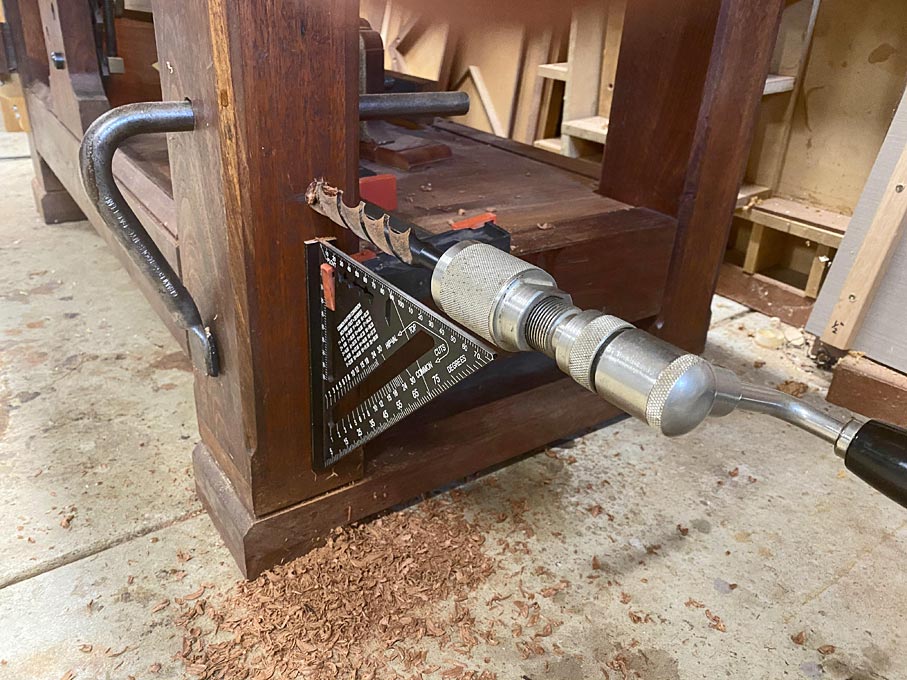

The pilot hole provides the lead screw with enough side wall to grip, without also making it create a hole to enter. The force now needed to drill is a tiny percentage of that otherwise need. Below I am just balancing the brace and turning the arm. It feeds itself through the leg ...
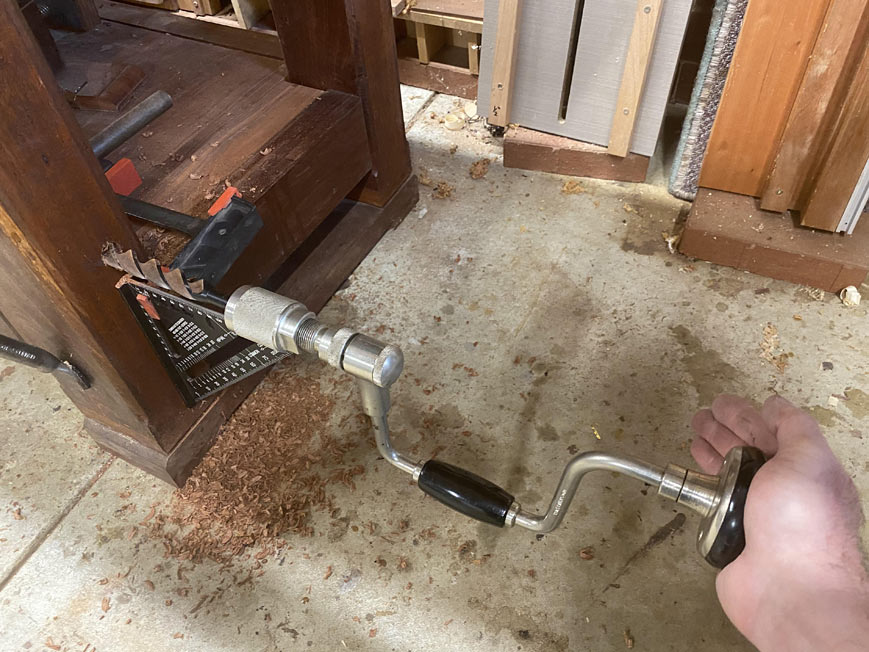
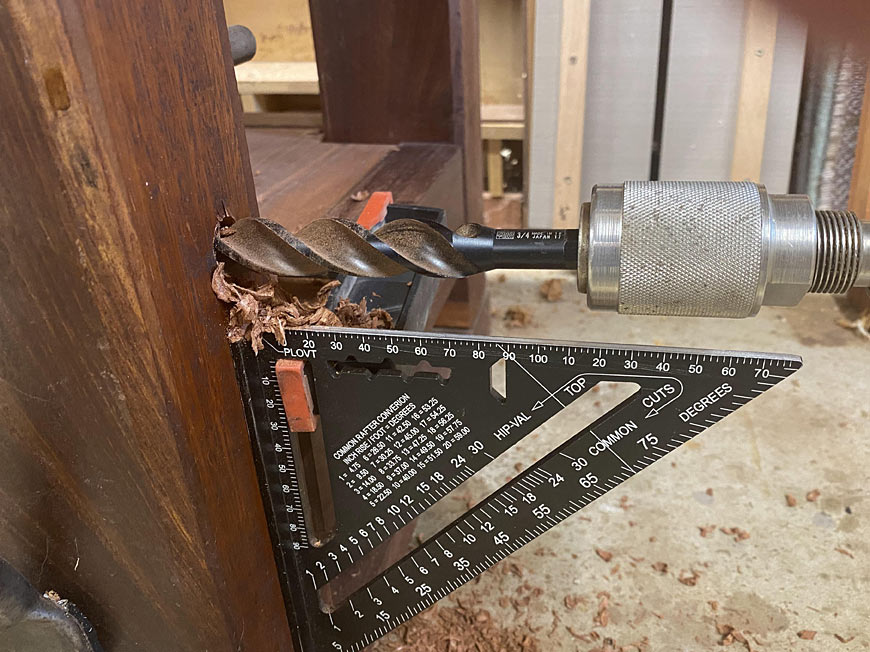

Keep drilling until the tip of the lead screw just peeps out the other side ...
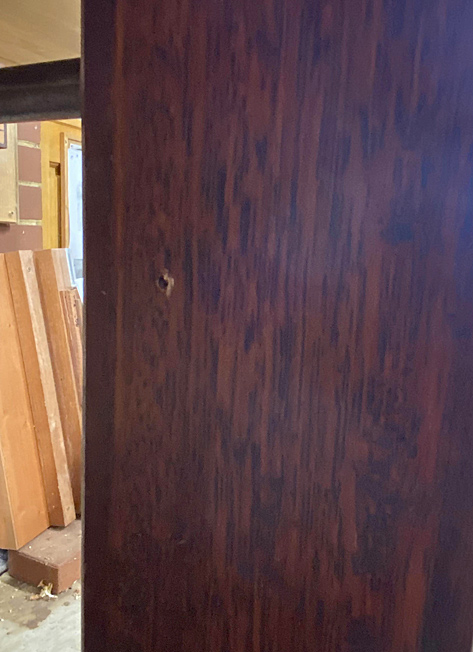

Then drill back from this side ...
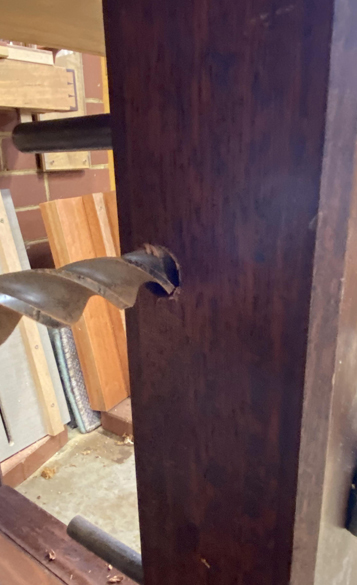

This prevents spelching (blow out).

The holes are actually very clean. This is the worst - any damage here was actually caused by pulling out the auger bit ...
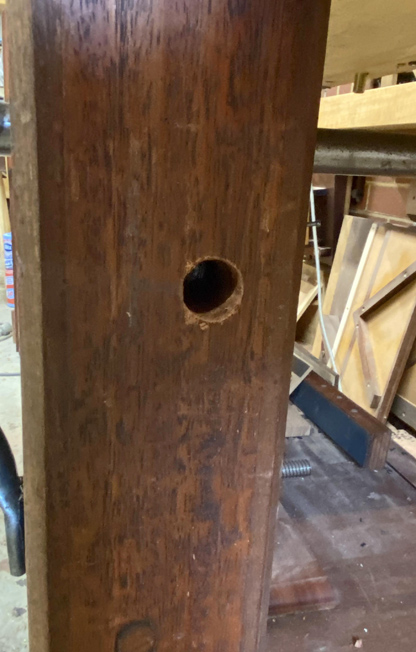

The edges were chamfered ..
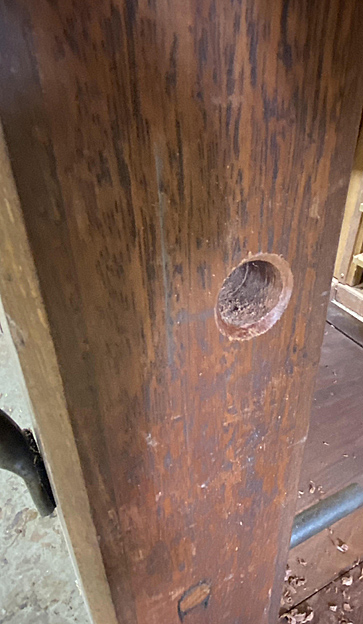

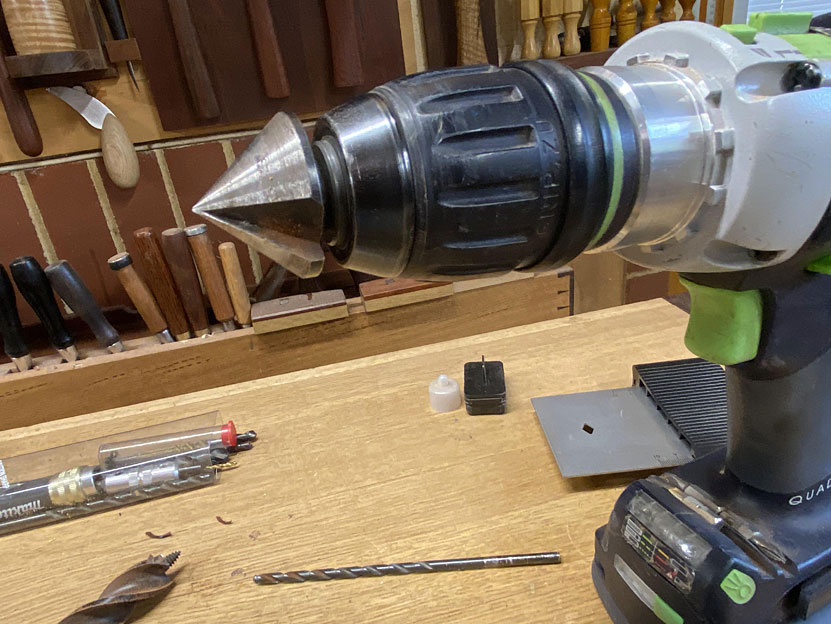
For interest, I used this large chamfer bit from Lee Valley, which was also used 7 years ago when I added some round dog holes to the bench ...

Final result ...
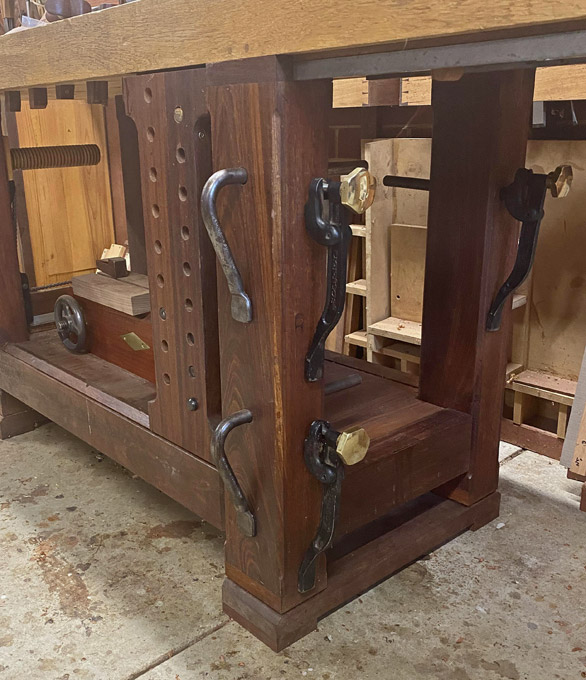

Regards from Perth

Derek

Re: Hold downs and augers

#2

Re: Hold downs and augers

David Weaver

The result is neat and clean. I've always had the hardest (especially the woods that smash together well and aren't stringy) woods clog my jennings auger lead screws and that's that.

For deep holes, I've started the top of the hole with something that cuts nicely and then drilled the remainder of the hole with a cheap spade bit. That will horrify some, but all of the dog holes in my bench are done that, even the counter hole in the bottom that's a larger diameter.

You get man points today for drilling through jarrah with an auger bit!!!

Re: Hold downs and augers

#3

Re: Hold downs and augers

Wiley Horne

Derek,

Very useful post! Particularly for the pilot hole idea, but also for the Wood Owl augers, which I see are carried by LV. Will try it first with the Russell Jennings already owned.

The Veritas clamps are expensive, but it’s some of the best money I‘ve spent. No knock on traditional ones.

Wiley

Re: Hold downs and augers

#4

Re: Hold downs and augers

William Duffield

For the pilot hole through thick material, you need to find an aircraft bit. While they may be hard to find new, I picked up a lifetime supply in two diameters at a machine shop auction.

Re: Hold downs and augers

#5

Re: Hold downs and augers

William Duffield

Thank you for the ideas, Derek. I'm going through the exercise of organizing my six holdfasts, two Veritas planing stops, some bench dogs and my Veritas Wonder Dog, all of which I continue to find parked in whichever dog hole I need now, or strewn all over the bench top. Since I haven't drilled any holes in bench legs yet, your post was perfectly timed. My dog holes are also in demand for two articulated work lights and assorted hand tools, but I can't do anything about them, because it is impractical to store them horizontally.

When I chamfer the top of dog holes, I've been using a chamfer router bit in my DeWalt DWP611. I think your tool choice would be easier and quicker.

Re: Hold downs and augers

#6

Re: Hold downs and augers

John Jardin

Derek,

I agree with you and Wiley...the Veratas Hold Downs are great.

John Jardin

Re: Hold downs and augers

#7

Re: Something Doesn't Add Up

William Duffield

You stated that you have one Veritas Hold Down, but in you last photo I count three. Another one of your photos was also confusing, until I blew it up and studied Lee-Valleys "RELATED PRODUCTS" on the hold down page and figured out that (in addition to various bench pups) you had at least Veritas Surface Clamp stowed in the back side of your board jack. You can never have too many clamps.

I have tried gluing wooden and leather pads to the tongues of my Gramercy holdfasts, but eventually they peel off when I hit the back of the holdfast with a mallet to release it. It looks like the Veritas products would not have that problem. Can you verify?

For reference:

https://www.leevalley.com/en-us/shop/tools/workshop/workbenches/benchtop-accessories/31149-veritas-hold-down

https://www.leevalley.com/en-us/shop/tools/workshop/workbenches/benchtop-accessories/57059-veritas-surface-clamp

https://toolsforworkingwood.com/store/item/MS-HOLDFAST.XX

Re: Hold downs and augers

#8

Re: Hold downs and augers

ken ca

I have two Gramercy hold downs also, and am wondering how anything could function any better? They work perfectly, are easy to set and to release. What makes those rather "Rube Goldberg" (or "Heath Robinson" if you prefer?) Lee Valley hold downs better?

Cheers!

Re: Hold downs and augers

#9

Re: Hold downs and augers

William Duffield

You can operate the Veritas quietly, and without a mallet. It is much easier to adjust the pressure without marring the work you are trying to hold down. They don't rust (though a little rust is an advantage if the Gramercy holdfast are not holding fast enough in your dog hole ;) ). A lot of people really like the Gizmosity Factor of the Veritas products. The Gramercy holdfasts look neither fancy high tech nor traditional forged in fire.

Re: Hold downs and augers

#10

Gramercy *LINK*

Warren in Lancaster, PA

The Gramercy holdfasts are notorious for poor holding. Here is a video of Frank Klaus trying to use one. It came loose half a dozen times in three minutes.

Some have suggested work-around solutions, but the truth is that a well designed holdfast does not have these problems.


Gramercy holdfasts

Re: Hold downs and augers

#11

80 grit

David Weaver

10 seconds of turning those holdfasts around and making spirals of 80 grit spirals on the surfaces will make them hold in a 4 1/8 hole with no counterbore.

They don't hold well without being scuffed. They probably don't hold well if someone babies scuffing them - they're bent pieces of spring steel, no reason to baby them.

For the money, they're fantastic. Even without regard to the money, they're fantastic. It's up to the person who buys them to decide what finish they need. Nothing special, just hold coarse paper in hand on the shaft of the holdfast, squeeze and turn.

Re: Hold downs and augers

#12

Re: 80 grit

John Pappas

I struck mine a thousand times with a sharp cold chisel that left a fairly course surface on the shaft. Got the idea from something on YouTube, I think.

Re: Hold downs and augers

#13

Re: Gramercy

David Weaver

something didn't sound right here (klausz struggling with a holdfast - nobody would tolerate that in their shop if they did any amount of work) - it appears that in the first video, he as using someone else's stuff at a contest.

In this video, no such problem. I can see that he sanded the shaft of the holdfast.

A *pair* of these holdfasts is $39. They're pretty much unbreakable and not absurdly long or heavy. If one can't stand the look of what appears to be bent drill, I guess that's something they'll have to deal with, but a minute of shaft sanding will get you a decade of service. I can't see that as being a problem.

I just looked at the tops of mine - I often hit them with a steel hammer. They have barely shown any damage (a century of my use would leave them hardly much worse). They're one of the rare treats in modern manufactured tools. Something that's really excellent and cheap at the same time.

Re: Hold downs and augers

#14

They work for me

Bill Tindall, E.Tn.

I have never had one slip in my bench. In fact I often seat them with a thump from my hand and always have to unseat with a mallet.

Re: Hold downs and augers

#15

Re: Something Doesn't Add Up

Derek Cohen (in Perth, Australia)

You stated that you have one Veritas Hold Down, but in you last photo I count three. Another one of your photos was also confusing, until I blew it up and studied Lee-Valleys "RELATED PRODUCTS" on the hold down page and figured out that (in addition to various bench pups) you had at least Veritas Surface Clamp stowed in the back side of your board jack. You can never have too many clamps.

I have tried gluing wooden and leather pads to the tongues of my Gramercy holdfasts, but eventually they peel off when I hit the back of the holdfast with a mallet to release it. It looks like the Veritas products would not have that problem. Can you verify?

William, eagle eyes for the Surface Clamp!

The story again. I will say it s-l-o-w-l-y :) : I had a single Veritas clamp, and this lived in a dog hole. I was looking to get another, and then lucked into two, which were sold together. That is how I ended with three.

My Moxon is held down by a Gramercy hold down at each end. Since making the new one, the position of the dog holes is about 1” further back than optimum. The vise can be seen rocking slightly in the videos I made. A Veritas hold down can now replace these as they are longer.

The Surface Clamp rarely gets any use. I bought it to use in the sliding jack, but find it fiddly. One day I will master it as it is otherwise the ideal clamp for this purpose. It is not much use on a bench as it does not have any reach. It live on the inside of the jack as it projects quite far, and I kept bumping into it if placed on the outside.

All my hold downs have leather pads attached (with 3M contact glue). I last replaced them about three years ago.

Regards from Perth

Derek

Re: Hold downs and augers

#16

We saw the same video...

Jim Matthews

I think MacGuire did this, too.

I had no choice, as they require oil in my damp shop, lest they rust.

5 minute with a points punch diddit.

Re: Hold downs and augers

#17

Re: Hold downs and augers

Derek Cohen (in Perth, Australia)

I have two Gramercy hold downs also, and am wondering how anything could function any better? They work perfectly, are easy to set and to release. What makes those rather "Rube Goldberg" (or "Heath Robinson" if you prefer?) Lee Valley hold downs better?


Ken, I have a video demonstrating how easy it is to use the Gramercy. I have never experienced any difficulty with their slipping, and the video was to demonstrate that ia get them to hold with hand pressure.

The Veritas have a longer reach, and are not restricted for placement. Traditional hold downs, like the Gramercy, require space behind them to release with a swing of a hammer. There are times when this is not easy. The Veritas simply require a twist of the nob. They also permit a viable downforce.

Two products, both very usable and similar, with a difference that makes them desirable as a team.

Regards from Perth

Derek

Re: Hold downs and augers

#18

Agreed

Joe shelton

Mine are terrific. My hands are too feeble to set them, but a mallet works works perfectly.

I also use them in the larger holes of my Sjobergbench, by cutting short sections of hose to make them fit and grab.

Re: Hold downs and augers

#19

also agreed

ken ca

I'v never had one slip, and I didn't bother to sand mine, even tho' it's recommended. Mine don't rust - well, it is CA - and I never get damage on the workpiece because if it's a surface I care about I put a small piece of scrap wood under it. I love them, and for the price they are a bargain. OK, I admit they're a piece of bent steel but who cares?

Re: Hold downs and augers

#20

Re: Hold downs and augers

ken ca

Makes sense Derek,

Yes, I thought I ahd seen a video of yours using the Gramercys.

Re: Hold downs and augers

#21

Re: Gramercy

Derek Cohen (in Perth, Australia)

The Gramercy holdfasts are notorious for poor holding. Here is a video of Frank Klaus trying to use one. It came loose half a dozen times in three minutes.

Some have suggested work-around solutions, but the truth is that a well designed holdfast does not have these problems.

Warren, I also note that Frank is using a Wood is Good mallet, which is wrapped in Sorbothane. This makes it spongy and I wonder if Frank miss-read how hard to strike the hold down? If you look at his second use of it, for the tails, he strikes it a little harder, and does not repeat this at all.

The experiences I have are very positive. I made a video which demonstrates that mine hold with a rap of my hand or a small 7 oz hammer, never mind a hulking 20oz mallet.

Some benches are not suited to these 3/4" shaft hold downs, and that is simply because they are too thick (and this reduces the angle of the shaft inside the hole). The Gramercy are not recommended for 4" and above. My bench is 3 1/2" thick.

Here is my video. I am not sure why I sound breathless or doing an impersonation of Winston Churchill. I am not usually this dramatic :) ...

https://www.youtube.com/watch?v=OaI_E2Yv1O0

Regards from Perth

Derek

Re: Hold downs and augers

#22

Re: Hold downs and augers

William Duffield

Sometimes, if you can't hit them from behind on top, you can find room to hit them from the front or even on the bottom, underneath the bench. You don't have to hit them as hard, and they release quickly.

I never try to hit them with my hand. That can cause carpel tunnel or other RSI, and we don't pay medical insurance on my mallets. My hands are wearing out too fast already, without subjecting them to further abuse.

If the Gramercy's don't hold, there are four fixes, at least:

- Take of the factory applied rust proof coating with some mineral spirits. Gramercy Toolworks and my shop are both at sea level on the humid U.S. East Coast, so things rust quickly, and people don't like to buy rusty tools even if they work better.

- Let them rust a little to give them a little tooth.

- Use the old 80 grit gouge (that's what the turners call abrasive paper) to give them a little tooth. People don't like to buy things with a scratched surface, so you'll have to do that yourself. A file, a handful of coarse beach sand, a wire brush, or even sharkskin would work instead. After all, they're not made from hardened tool steel. They wouldn't work if they were.

- If your bench top or whatever you pound them into is more than 3" thick, reduce the effective thickness to no more than 3" by drilling a larger relief hole from the underside of the bench. I find that mine hold sufficiently in oak that is only 1-1/4" thick.

Re: Hold downs and augers

#23

No hands

Derek Cohen (in Perth, Australia)

I never try to hit them with my hand. That can cause carpel tunnel or other RSI, and we don't pay medical insurance on my mallets. My hands are wearing out too fast already, without subjecting them to further abuse.

Agreed William - don't use a hand. My video was just for demonstration.

I use my head, you know :)

Regards from Perth

Derek

Re: Hold downs and augers

#24

Re: 80 grit

Warren in Lancaster, PA

Fantastic? Maybe you have never used a holdfast enough to show wear on the hole in the bench. Maybe some who read this will be on to their next bench before any great amount of use. We have had this discussion before; here is a solution that Paul (NJ) posted on this forum years ago:


Paul could have thinned down the arm even more. Roubo says the whole arm should be tapered for more elasticity and that it should taper to two lines at most (deux lignes d épaisseur au plus ). Two lines is .167 inches, which is less than 3/16.

Re: Hold downs and augers

#25

Re: No hands

John Jardin

My sister and brother-in-law are still stuck using flip phones.

As William has stated so clearly, the advantages of using the Veritas, in addition to its ease of use, is the fact that the amount of force applied limits the damage to the work being held...this tool is a pleasure to use.