Ah ..ha
Derek Cohen (in Perth, Australia)
So you can't. 
Regards from Cape Town
Derek
Knowledge You Can Build On — Est. 1998
Ah ..ha
Derek Cohen (in Perth, Australia)
So you can't.
Regards from Cape Town
Derek
Re: Besides grinding...
david weaver
For something that small, you don't actually need a forge or an anvil. A piece of railroad track would be fine, or a piece of plate steel, or a decent machinist vise.
A hand-held torch is enough to heat the end of a chisel or a piece of stock to hammer on it.
I heated my moulding plane irons with just a torch (MAPP and TS4000 torch that you can get at H-D) and later added some lightweight refractory bricks. The bigger irons with a weed burner. I'm still on the fence about getting a proper forge in the future, but for right now, I can make a 4" knife blade, and the higher output hand held torches will get a 2 1/4" wide iron critical in a paint can forge.
Anyway, just an option - sometimes grinding is fun, sometimes hammering is fun. Sometimes buying a nice tool that someone else made is fun.
Re: Seaton tool chest book
Brian Holcombe
Those are really wonderful! I concluded for my own self that there is a difference in quality between quick work and top work of the 18th century. I'm continually amazed that work of the 18th century gets lumped into one category. It's not true today and does not appear true then that all unseen work is slap-dash.
I recall a documentary closely detailing some of the work of Chippendale's cabinetmakers. The work shown was excellent, highly detailed work that was still functioning perfectly. The drawers shown in the documentary were 'piston' fit (Bill has argued that this term is nonsense, but I still prefer it) with interior boxes, equally detailed in their construction, that nicely floated their way back into the bottom of the drawer after they were shown.
It certainly helps that the work is in England in place without HVAC to my knowledge.
Re: Ah ..ha
Sgian Dubh
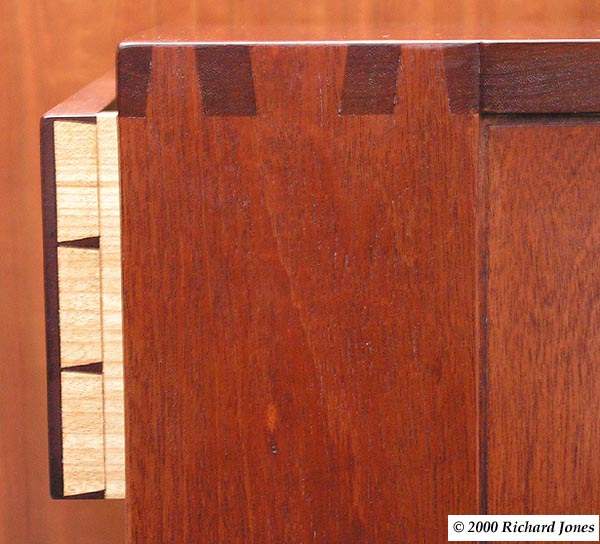
Hey Derek, what do you mean "you can't"? I know you were having a wee joke, but the end result of my technique is good enough to hold together. I can't recall anyone so far saying my dovetails are too shabby to be acceptable in their piece of furniture. Slainte.
Re: A lands question for Rob Lee.....
North of the Border
Piece of cake.
Rest the 1/8" chisel on its side as you approach the corner.
Re: A lands question for Rob Lee.....
Derek Cohen (in Perth, Australia)
Used this way, the chisel will make a release cut - but it will not clear the waste that is attached to the floor of the socket.
If the socket dividing wall (the tail) was thicker, digging into the corner would not be a problem. However, the walls with skinny dovetails are fragile in this area, and it is not advisable. Best to use a (fishtail) chisel that will scoop out the waste and not endanger the socket walls by overshooting.
Regards from Cape Town
Derek
Those are VERY nice dovetails, Richard
Re: A lands question for Rob Lee.....
North of the Border
The use of the chisel on its side in tight corners is just a matter of control and care. I have had no issues with such control and use. Probably another practice makes perfect thing.
Re: Seaton tool chest book
Darren Brewster
Carved with Love: The Genius of British Woodwork has an episode all about Thomas Chippendale with lots of close ups of the work. It is a great little series.
Re: A lands question for Rob Lee.....
TomD
I think my early sets of chisels had a side grind for dovetails on them. Mahogany masterpieces got all their chisels made to whatever that angle needs to be: 81 degrees comes to mind, but this is like '79, maybe, so hard to recall. So my set of Ouchiis has that on them, it isn't a really visible thing, the narrow ones look almost like mortising chisels, but the sides aren't square.
That said, I always feel this question is a little overwraught. The kerf detunes this need becaus the saw has already taken the corner out, and you can tip the chisel very slightly so that the side doesn't fully fit into the corner, and you will get by that way also. Just doesn't seem to come up a lot in my work. Though obviously getting the chisels as you want them is job one.
Japanese carpentry doesn't seem as obsessed with dovetails as ours, but western chisels are also squared away, and have been for ever, though the square portion can be narrow, I just wonder how something this obvious could have been overlooked so long, if it was such a big deal. They were grinding the edges and backs of the chisels anyway.
Re: A lands question for Rob Lee.....
david weaver
I don't know where you can see a lot of japanese woodworkers cutting dovetails, because a lot of their cabinet work tastefully hides them.
A relatively well known series that Kotaro Tanaka showed on youtube had a guy (a "san"?) making a small case that, I'm sure, has a traditional japanese name. Dado and miter dovetail, and he cut the pins with the edge "in the direction of the straws" if that makes sense.
I don't think they have any of this 1:7 or whatever stuff that is obsessed about over here as shinogi are the only chisels I've seen that originally had the very delicate edges. the chisels they call dovetail chisels were probably made to have very short sides by western demand.
I'd guess that more than half of their high end production goes out of country, just like Kamisori. I saw someone in tokyo asked about kamisori on a shaving forum, and he said "they'll be hard to find on the ground here...they mostly sell overseas". That's not a compliment there.


