Home Articles Forums Gallery Marketplace Videos

WoodCentral Forums

Knowledge You Can Build On — Est. 1998

Criteria for deciding when to sharpen

Posts

Re: Criteria for deciding when to sharpen

#26

Re: I find it curious.....

AlanWS

I think the real question you are asking is what benefit would you get from sharpening sooner, given that you are planing to your satisfaction now. Here's how you might answer that. Next time you use the plane, rather than sharpening before a work session, sharpen in the middle. That way you will feel how the plane behaves initially, and you will be able to feel whatever difference may result from touching up the edge.

If you can't feel a difference, can't see a difference in the planed stock, and are not risking tearout, then there does not seem to be much point in your more frequent sharpening. If you start smooth planing more, your needs may change. I suspect most people here find it more pleasant to smooth with a plane than a sander.

Re: Criteria for deciding when to sharpen

#27

Re: I find it curious.....

steve voigt

Bill, you wrote:

I find it curious....that all the responses from experienced planers have been that the need to sharpen has been revealed by some tactile signal, if I understood correctly. So far nobody has said that they look at the edge and if it looks too worn they sharpen.

At the risk of sound like some new age guru, I think that you are not paying attention to the sensory information that is at your fingertips. Or perhaps you are not at present attuned to that information. Possibly you are so focused on the end result--getting the project done--that you are blocking out the wealth of signals bombarding you.

The reason none of your responders look at the iron is that it's unnecessary, time-wasting, and reveals less information. The feedback you get through your hands, listening to the sound of the cut, and looking at the surface, all give far more relevant information. Try tuning in to this information. For example, as the iron begins to dull, you should be able to see and feel that the shavings are getting just a bit thinner, even though you have not touched the iron. You will notice that, unconsciously, you have begun to apply more downforce to the plane in order to stay in the cut. You will notice the sound change, that it becomes duller, has less "zip" to it. Hopefully you will notice this before you hear the tell-tale ripping sound that indicates tearout.

Possibly one issue is that, according to your own description, you plane 30 seconds here, a minute there. That probably isn't sufficient to develop the necessary sensitivity to the planing process. To borrow an analogy from Warren, if you practiced a violin piece 30 seconds at a time, you would never get good at it. But if you regularly practiced playing scales, you'd get better faster.

In my analogy, playing scales is like dimensioning by hand. If you spend some time flattening and thicknessing boards, you'll become far more attuned to the sensory feedback that's right in front of you. Once you have it, you're not likely to lose it.

My suggestion is that for some small project--perhaps making a box with the son in law--you try dimensioning all the pieces by hand. Don't set a time limit, and pay more attention to the process than the result. Yes, that means this particular project will take much longer. But I bet it would pay that time back eventually.

Re: Criteria for deciding when to sharpen

#28

Some provocative thoughts there

Bill Tindall, E.Tn.

I am finishing a display cabinet, two chests of drawers have been requested after that, I would like to build a table for our breakfast nook and granddaughter needs a bed and a desk. So it comes down to investment vs pay back. You have shown the way.

Unlike the violin analogy, not planing at a high proficiency is not preventing me from building anything to the standards I aspire to. Nor am I trying to emulate some style of woodworking that necessitates skilled hand planing. I could muster up the patience to practice to become a more proficient planer, maybe. I would not find the process enjoyable.

Learning to set the cap iron close did pay off for now I used a plane in situations where before I would not risk it. What I need to decide is whether there are productivity gains to be had by learning more.

Typically, I'll only learn what I have to to get something made- string inlay, French Feet, turned spindles and feet, etc. I have decided carving will take too long to learn so I hire it done. So far an air driven ROS is sufficient for panel surfacing.

Re: Criteria for deciding when to sharpen

#29

Re: Some provocative thoughts there

Steve Voigt

Unlike the violin analogy, not planing at a high proficiency is not preventing me from building anything to the standards I aspire to.

I couldn't agree more. If you are happy with the result you get, that's all that matters. I only brought it up because of the interest you expressed earlier in the thread. Anyway yeah, something like a tabletop sounds like a great first project for flattening/thicknessing by hand.

Re: Criteria for deciding when to sharpen

#30

an experiment

Bill Tindall, E.Tn.

I have a chest of drawers coming up with 6 drawers to be fitted by planing the sides. If I wait and fit all at once that will be a marathon of planing (for me). Now to plan the experiment. I'm thinking - plane one drawer with the plane in whatever state I last left it, then sharpen and see if I can detect a benefit. Continue fitting until I detect a change. Sharpen and see what gets better that would be meaningful in fitting drawers.

Re: Criteria for deciding when to sharpen

#31

Re: an experiment

Warren in Lancaster, PA

The problem with the experiment is that a plane does not suddenly get dull, it dulls gradually over time. When I have had beginners working in my shop, they have to be told when it is time to sharpen because they can't notice the gradual deterioration of the edge.

It is like buying a loaf of bread on Monday and making a sandwich every day. By Friday the bread is a little stale, but you don't notice it because it is not that different from Thursday's sandwich. When you buy another loaf the next Monday you do notice that it is fresh because of the contrast to the week old loaf.

A better experiment is to sharpen after every other drawer and see of you can notice the fresh sharpening.

Re: Criteria for deciding when to sharpen

#32

Re: disassemble?

TomD

"The part of the edge wear that necessitates sharpening is readily seen by turning the plane over (bevel down)."

That would be a fairly advanced stage of dullness. It should have a different sound planing at that point, or be easily diagnosed as working differently.

The point at which planes need to be sharpened depends on a lot of factors. Such as species, the type of planing, and how difficult it may be at the time to sharpen them, and how difficult it is to cycle the plane through a sharpening. So I don't have any one rule. At the most refined end of things, I sharpen when I first think I need to. You are picking up on something almost invisible. But once you are aware of it, you start sharpening. I don't think that kind of inference is any different than say noticing when a fish picks up a fly when you can't identify anything, you just know. Or knowing when you are getting tired, without having to actually nod off behind the wheel of a car. Little signals spread throughout life. Not maters of any particular mastery, just paying attention as we all do. Though if you overshoot plane resharpening time, it doesn't even amount to a fish lost.

Re: Criteria for deciding when to sharpen

#33

Re: I find it curious.....

North of the Border

I think Paul Sellers preaches about listening to the sound of planing or skipping, among other things, as feedback. I, for one, never ever rely on sound because the minute I step in the shop, the music is on. What works for others definitely may not work for me.

Whether I am using a chisel, saw or plane, I can easily tell if the edge needs a honing: ie if the tool becomes much harder to cut. If so, I will check the edge by feeling it with my finger and then I can decide if I need to do a quick hone -- which will take a couple of minutes in most cases as I don't usually wait till an edge dulls a lot.

I will look at the edge and feel it or slice a piece of paper to confirm it is super sharp only after I give the edge a total sharpening.

Re: Criteria for deciding when to sharpen

#34

Re: I find it curious.....

TomD

I don't actually feel edges, partly because when I see people do it it creeps me out. These days tons of people sharpen, but back when I started it wasn't so common. My dad would take one of my tools, and press his thumb down on it's edge until it bulged around the edge. I found it insulting since he couldn't sharpen worth a lick, and I don't know what he thought he was doing. I should say he was pretty supportive, it wasn't that kind of thing. But you see someone do that, and you wonder what they heck they think they are doing, and whether you need the ambulance on speed dial.

The other thing is I know a few ways of feeling the edge that are highly effective, and non-destructive, no clods of hair. But they don't tell you much as far as a working tool is concerned. The one for final honing, the answer would always be negative as the edge is only there for a short period of time. The other methods is for the move to start honing. The tool is always going to be between the two, when doing normal work.

So I guess we all have our methods.

Re: Criteria for deciding when to sharpen

#35

Re: Some provocative thoughts there

TomD

"Typically, I'll only learn what I have to to get something made- string inlay, French Feet, turned spindles and feet, etc. I have decided carving will take too long to learn so I hire it done. So far an air driven ROS is sufficient for panel surfacing."

1) as a scientist you know that you don't start by investigating those things you already know the answer to. You poke into the unknown. You march to a different drummer in a good sense, so no mater what, your tune is probably going to be specific to you, and asking other people probably won't be the end of it;

2) I don't really get the whole learning curve thing. I would think any small amount of planing, given the amount of work you do, would give you the feedback you need;

3) There are utilities to the feedback. For instance planes are adjustable measurement tools. When you pick them up, no incense required, right off the bat they are mostly flat. You are holding a rule. Your blade adjustment sets the curvature the plane planes to, in thou per inch terms. When the edge stops cutting and you bottom out, you are at a particular setting. After a while of doing that, you find it no long takes the shaving you need. The plane is dull. It's not some vodoo, you want a flat surface. You proceed with hollowing cuts, they stop taking a shaving, you have a dull blade. It's abc, and it's useful.

Or you are simply reducing a surface, taking a given shaving, say a thou, roughly, not measured, though you could, when making tapered laminations I do. When it stops taking the proper shaving, it's dull.

Re: Criteria for deciding when to sharpen

#36

Testing the edge

Brian Holcombe

A couple of my fellow Japanese tool nuts think I'm quite full of it for this but I don't test edges. I guess so many find it hard to resist cutting a piece of paper or shaving their arm or whatnot. I've tried the hanging hair a few times to see if I could do it (sometimes if the edge is shallow enough) but beyond that I don't find the exercises very insightful.

I simply put the iron back in the plane and the shaving/surface finish tells me everything I need to know about the edge.

I do, however, look at the edge prior to reinstalling and feel for a burr. If the edge is not clean or the burr not removed then I did my job poorly and should start over.

I look for the right reflection of light to show me a clean edge, perfectly straight and without undulations.

If lines, even very faint lines, show in your finish then you didn't do a good job or your edge has worn away quickly (likely because you didn't do a good job). A plane should leave a completely clean, bright finish that exceeds that of sander, if it does not, then your iron is not to its full potential.

Re: Criteria for deciding when to sharpen

#37

Agree. I look instead of test

Bill Tindall, E.Tn.

I don't test but I do look with a 10X lens which I keep at hand for all sorts of observations. It reveals that pesky wire edge you speak of. Actually it reveals a lot about the state of the edge before and after sharpening.

The lens gets employed when trying to figure out what direction was used that resulted in tear-out when the defect is too small to reliably judge by feel or naked eye examination. Also use it for repairs to see that they are good and for examining stringing intersections...etc. Indispensable.

Re: Criteria for deciding when to sharpen

#38

Re: Agree. I look instead of test

Brian Holcombe

They're handy, for the annual Kezurou-Kai I have been debating a 100x that is geared toward tool inspection. It's more to satisfy my curiosity than anything else.

Along the same lines a squeeze type micrometer for measuring the shavings.

Re: Criteria for deciding when to sharpen

#39

microscope examination

Bill Tindall, E.Tn.

I have considerable experience photographing edges. It is not easy even though I have had access to a well equipped industrial microscope lab. Lighting is everything and there are a lot of ways to do it.

The lab acquired a scope for imaging metal specimens and that was a great leap forward.

Other than being able to measure features I don't gain a lot with the microscope over a high quality 10X lens for routine edge assessment. There is a substantial difference between a quality 10X lens and one that is cheap.


The image is of an A2 TiN coated blade after a planing test in maple. The silver is where the TiN has worn off the edge. This picture is an example of what can be done with a microscope set up for metal examination. Even a $30K Nikon scope without these features produced images greatly inferior.

Re: Criteria for deciding when to sharpen

#40

Re: microscope examination

Brian Holcombe

What are you using for a 10x lense, I assume we're not talking the average jeweler's loupe.

My lighting is pretty good, especially around the sharpening bench. Still I expect that a light should also be right near the lense.

Re: Criteria for deciding when to sharpen

#41

Not to the level of Bill's picture..

david weaver

..but several years ago, I bought a dissection scope as well as a regular microscope and a cheap digital scope (cheap like $12).

The $12 scope is the one that I've gotten the most use out of. The dissection scope works well, but at 25x, it's just not strong enough to really see much - especially when you compare something like an edge done with natural stones and one done with shaptons or something - the harsh cutting oxide stones still look like a shiny mirror.

What really matters with the pictures is the shape of the edge and its condition, and not necessarily how small the scratches look on the bevel (I guess that's obvious), but the bevel is easier to look at and I mistakenly thought that I could use the scratches on it to judge the actual quality of the edges.

I found that stray scratches from natural stones were larger and more prominent, but they must've been shallower because the edges I got with them were more uniform along their length.

At any rate - not directed at bill or Brian - I think the inexpensive digital scopes with built in lighting are the easiest to use, because you can create some sort of mount for them (at that price, the base that comes with them sucks) and then view the adjustment of the picture in real time on your computer screen and just capture the screen image when it's what you want. Lighting is difficult because of the reflectivity, of course.

Alex Gilmore has a much more expensive scope set up, but it wasn't worth it to me to find out what I was looking at for the price a scope like his would cost.

https://www.youtube.com/watch?v=BW1HSBQyrzE

Cheap imported dissection scopes are about $50 (hard to get a picture from them, though - even if you could ramp up the magnification with a replacement eye piece).

This is similar to the scope I got. It is *very* limited, but it will get you a picture of an edge that is perhaps half as clear as Bill's - maybe more if you fiddle with it. It's clear enough to tell what's going on (I think they are more like 100x than whatever number they claim).

http://www.ebay.com/itm/USB-New-8-LED-Digital-500X-Microscope-2MP-Zoom-Endoscope-PC-Camera-Magnifier/382037723375?_trksid=p2045573.c100505.m3226&_trkparms=aid%3D555014%26algo%3DPL.DEFAULT%26ao%3D1%26asc%3D41375%26meid%3Dd97371d972e74c4ab3f4275ad9a3dc05%26pid%3D100505%26rk%3D1%26rkt%3D1%26

Re: Criteria for deciding when to sharpen

#42

Re: Not to the level of Bill's picture..

Brian Holcombe

Thanks David!

I do always see stray scratches with natural stones, but unlike synthetics they never seem to result in fractures beginning where they end.

This one continues to linger in my mind;

http://www2.odn.ne.jp/mandaraya/pkuwaido-maikurosuko-pu.html

At the bottom of the page there is a 10x that might be the best of both worlds, I'm sure its pretty high quality and not as expensive as the 150x.

Re: Criteria for deciding when to sharpen

#43

Re: it might be a case...

david weaver

where something inexpensive and Chinese will fit the bill better. I think you'll instantly want to see more than you can see with 10x. That's what happened to me with 25. I liked the scope because I could see things better, but I couldn't see things as well as I wanted to when it came to what's going on at the edge.

I can't access the pictures I took of blade edges with a $12 microscope - google image sees them where I posted them years ago, but I get an error when I try to download them. they were surprisingly good. I'd probably put the cutoff at 100x - you'll be able to see everything that's important and visible, and if you decide you want to examine other things, it'll work well for that. The cheapies have LEDs around the lens, so you can literally just sit them on top of something like a fine washita stone and get a picture like the one attached here (this is just the thumbnail that I could get from this picture - I'm sure I could dig up edge pictures tonight).


Money on a good micrometer would probably be well spent.

Of course, that's just my opinion, I may not have a proper idea of what you're looking to do, or you may decide otherwise because I have bad judgement!

Re: Criteria for deciding when to sharpen

#44

Re: it might be a case...

Brian Holcombe

We're both guilty of that when it comes to tools. I always feel that if I will use it then it's well spent, occasionally that's true, lol.

100x is probably right, also likely why it is sold out at the moment. The mic is overkill, I have a really good mic but did not realize that the squeeze type was ideal for this (and probably has many more uses).

Re: Criteria for deciding when to sharpen

#45

Pictures from the $12 scope

david weaver

This scope supposedly has variable power, but it really only focuses at two powers. I don't know what they are, so I'll refer to them as high and low. adjusting the magnification between these two powers just results in blurry pictures.

The scope does much better at low power, but it's not quite enough to see what's going on with a razor edge. A better scope would probably take clear pictures of everything. This one seems to get confused when there are shiny bits in a picture, and it loses focus of everything else.

The first picture is a tool edge at "low" power. I don't remember what the tool was. You can see how cheap I am with effort on the edge - only the very edge is really polished. This is also why I like a slow finish stone - the geometry of the edge is almost unaffected and removing that polished part and raising the next wire edge is easy.

https://s11.postimg.org/k5zyn95xv/Cap8.jpg

Just for giggles, this was the surface of the tsushima, I don't remember if it's at high power or low power.

https://s11.postimg.org/3weuhh1lf/Cap2.jpg

And the bevel of a very thinly ground razor on "high" power - honed on a translucent arkansas. It looks fairly coarse, but the bevel is tiny and it just a bit hazy but mostly shiny to the naked eye. I was shocked when I saw this as other things show up uniformly - it could be a software effect due to light just being picked up on those little scratches. The important thing is though, there is really no damage at the edge. After linen and leather, this edge shaved well whereas some that show almost no scratches at the bevel showed edge damage and weren't as good:

https://s11.postimg.org/qxqdq3uxf/Cap7.jpg

I can't say what level of spending it takes to get better pictures than this, because I don't know, and though the close pictures aren't that great, I saw what I wanted to see.

Here is a clearer bevel (possibly due to lighting), but a fair amount of foil is still at the edge. Acceptable for shaving, but not as good as the much scratchier ark bevel.

https://s16.postimg.org/idcb1dnlx/Cap10.jpg

Re: Criteria for deciding when to sharpen

#46

Re: Pictures from the $12 scope

Brian Holcombe

Thanks David! Wow, those are especially impressive considering that the thing cost $12, lol.

The high power photos seem pretty useful, you can see that little bit of foil and contrast and compare different finish stones. Always interesting of course that the best finish is not necessarily the best shave.

Sounds similar to what I heard from Stan WRT Kez, in that basically he saw competitors getting fine shavings off bevels finished to 1k....that shocked me. The backs, apparently were very finely finished. I've not heard that anywhere else, to that same extreme, but I have heard of people only working to 6k~ on the bevel side. I assume the edge wears out fairly quickly.

Re: Criteria for deciding when to sharpen

#47

Re: Pictures from the $12 scope

Kees

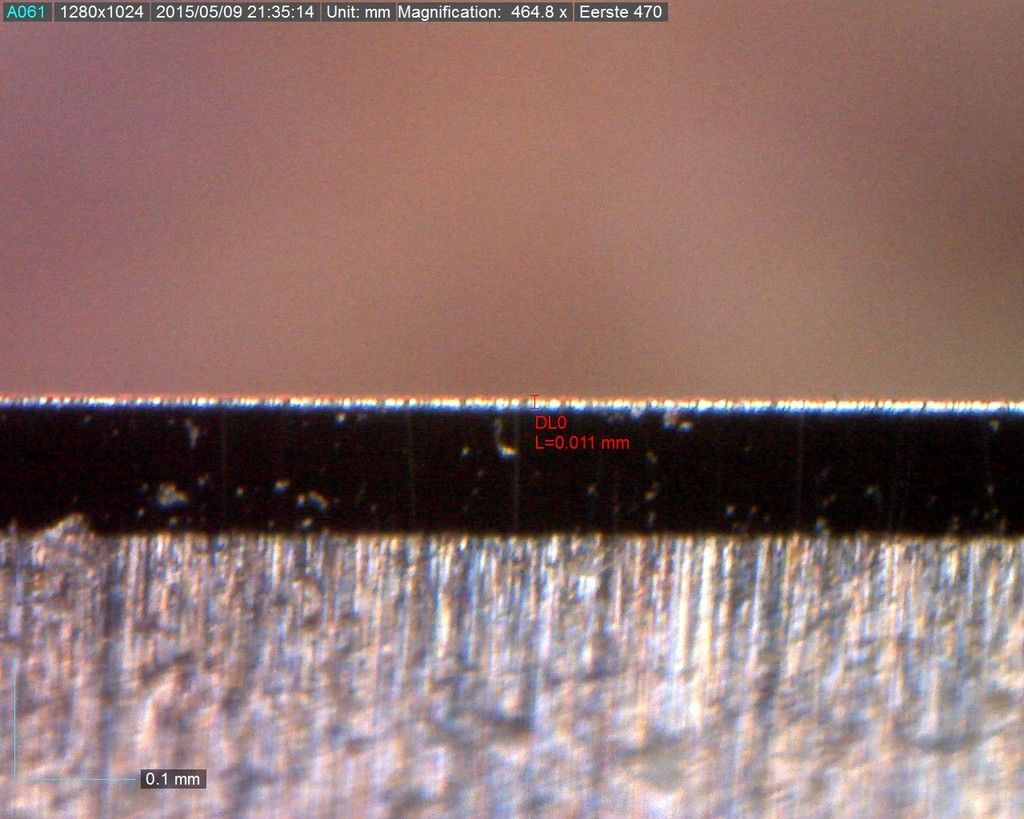
I find it extremely difficult to make good pictures with a microscope. Mine does about 400x and it has a polaroid filter which helps to avoid glare on steel surfaces. Lightning is very important. But at 400x you are starting to get close to the wavelength of light, so it is not unusual to see weird things happening around the edge.

Here is an example, O1 tool steel after 150 meters planing in beech. The wear on the bevel side of the iron is very visible. There is some redish light scattering over the edge. The black area is sharpened on a 8000 Naniwa SS, below that are the 1000 grit scratches from a Sigma stone. I tilted the iron so that the 8000 grit area was very dark, because I wasn't interested in that. I was interested in the wear area. You can see how some stray scratches are still visible, and they don't seem to be starting points for edge damage.

I think the lighter spots on the black area is just dirt in this case.


img

Re: Criteria for deciding when to sharpen

#48

lighting is everything

Bill Tindall, E.Tn.

On the Nikon we used before the lab got the metallurgy scope we had all sorts of lighting options and none were good for lighting metal. Variables in lighting will enable one to see anything they want to imagine at the edge because of reflections and refraction. The features that could be reliably seen were detected with a good 10X lens. But the scope enabled measurement to be made and images recorded.


For example, this picture shows a typical used edge from a Sorby chisel taken with the old scope in best we could do mode (this image is done on a $35K Nikon). One can see the deformation but reflections prevent the resolution seen in my earlier picture. You can see that the edge is deformed with a good 10X lens.

As an aside this is the kind of "wear" typical of a chisel that has not been hardened optimally.

Re: Criteria for deciding when to sharpen

#49

Robt. Sorby..

David weaver

Robert Sorby has a reputation for that. Even their turning chisels are soft. A shame, because some ofriends their chisel patterns are legit, like their parers and some of the cabinet making chisels.

Re: Criteria for deciding when to sharpen

#50

Re: Pictures from the $12 scope

david weaver

I think single iron, that refinement is important due to edge life. With the double iron, I think it becomes a lot less important - uniformity and clearance are important. If you have one side of a bevel polished and 1k finish on the other but remove all of the foil, the edge will be very good.

I didn't take any pictures of the infills that I bought working wood, but I had five vintage irons to condition the other night, including their caps, and about an hour to do it. Fortunately, none were in basket case shape.

I also have an 80 grit 3 1/2 foot lap, so I worked the back of the irons flat with it, and shaped the caps quickly. I used only the washita stone to refine the back for about 30 seconds to a minute and worked the bevel. You'd be surprised how well they cut. The difference with them, of course, is that the very thin shavings aren't as "perfect" as they are with a very refined edge. In the cut, though, they feel like any other edge. I did the opposite of what you describe - working the bevel more completely than the back because 30 seconds to a minute on each results in a completed bevel. Over time, the washita will work the scratches out completely, because it's good at that. It's less good at cutting into an already polished large area (or, I should say, it's terrible at that).

Someone who wasn't finishing off of a plane would never need to refine one of the faces beyond 1K - 1k on both faces, though, makes for a weak edge.